What you'll learn
- How sociologists define media, mass media and new media.
- How media links to socialisation, culture and identity.
- How sociologists analyse ownership, representations, audiences and effects.
- How to build AO1, AO2 and AO3 points using contemporary UK examples.
Starting point: what do sociologists mean by “media”?
If you are studying Media as your Section C option, you are studying much more than “TV and newspapers”. Sociologists are interested in how media content is produced, who controls it, how audiences interpret it, and how it shapes ideas about society.
Media
Media are the organisations, technologies and forms of communication used to create and share messages, images, stories and information with audiences.
Mass media and new media
Mass media means communication aimed at large audiences, often from one producer to many consumers. Traditional examples include television, radio, newspapers and magazines.
New media refers to digital, interactive and networked forms of media, such as social media, streaming platforms, podcasts, online news and video-sharing apps. New media often allows users to comment, share, remix and create content themselves.
Digital convergence means different media forms coming together through digital technology. For example, a smartphone can be a television, camera, newspaper, radio, gaming device and social network all at once.
Media as a social institution
The media is a major agent of secondary socialisation: it helps teach people norms, values, lifestyles, identities and ideas about who has power in society.
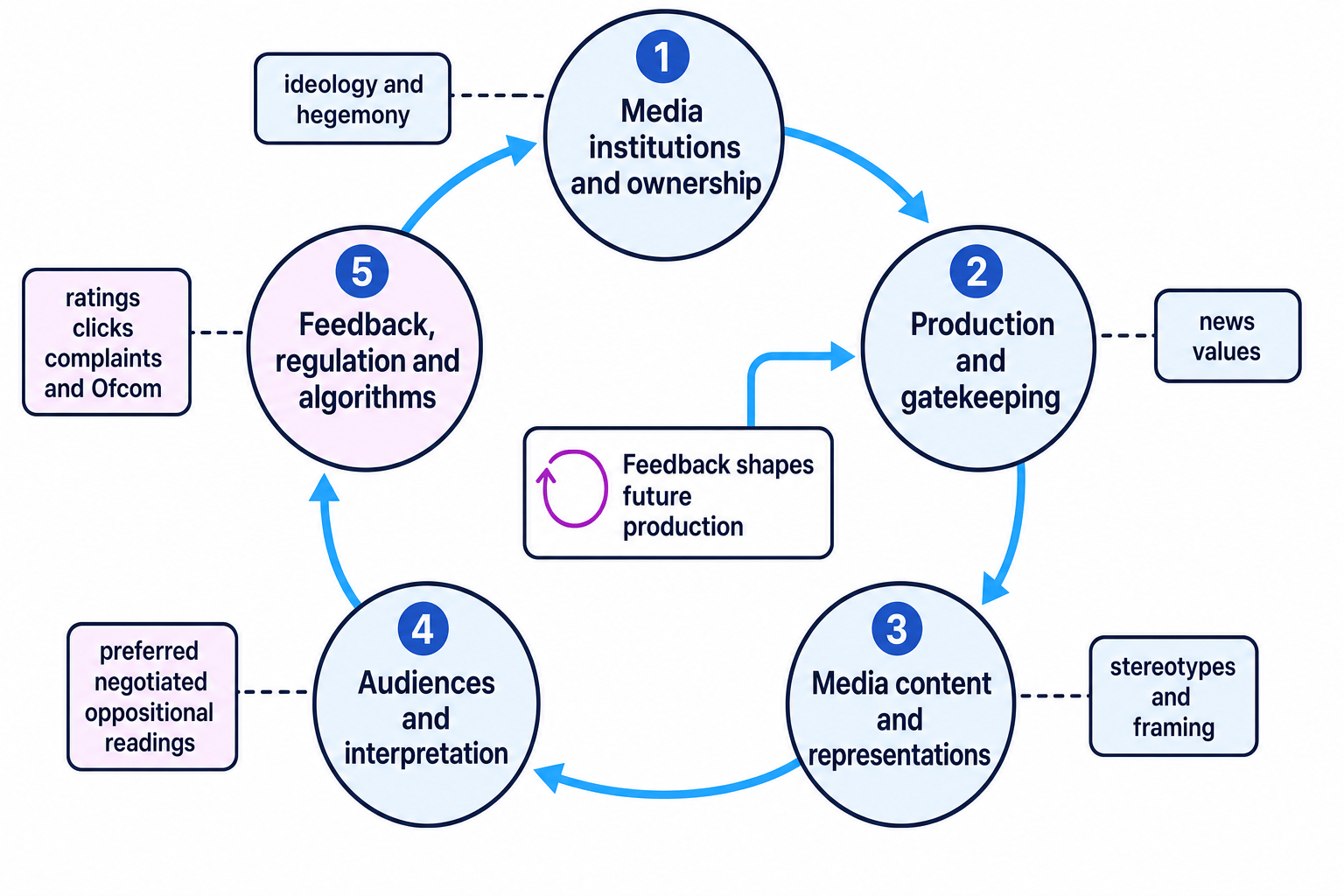
The topic is easiest if you imagine media as a loop: institutions produce content, audiences interpret it, and feedback such as ratings, clicks, complaints and regulation then shapes future content.
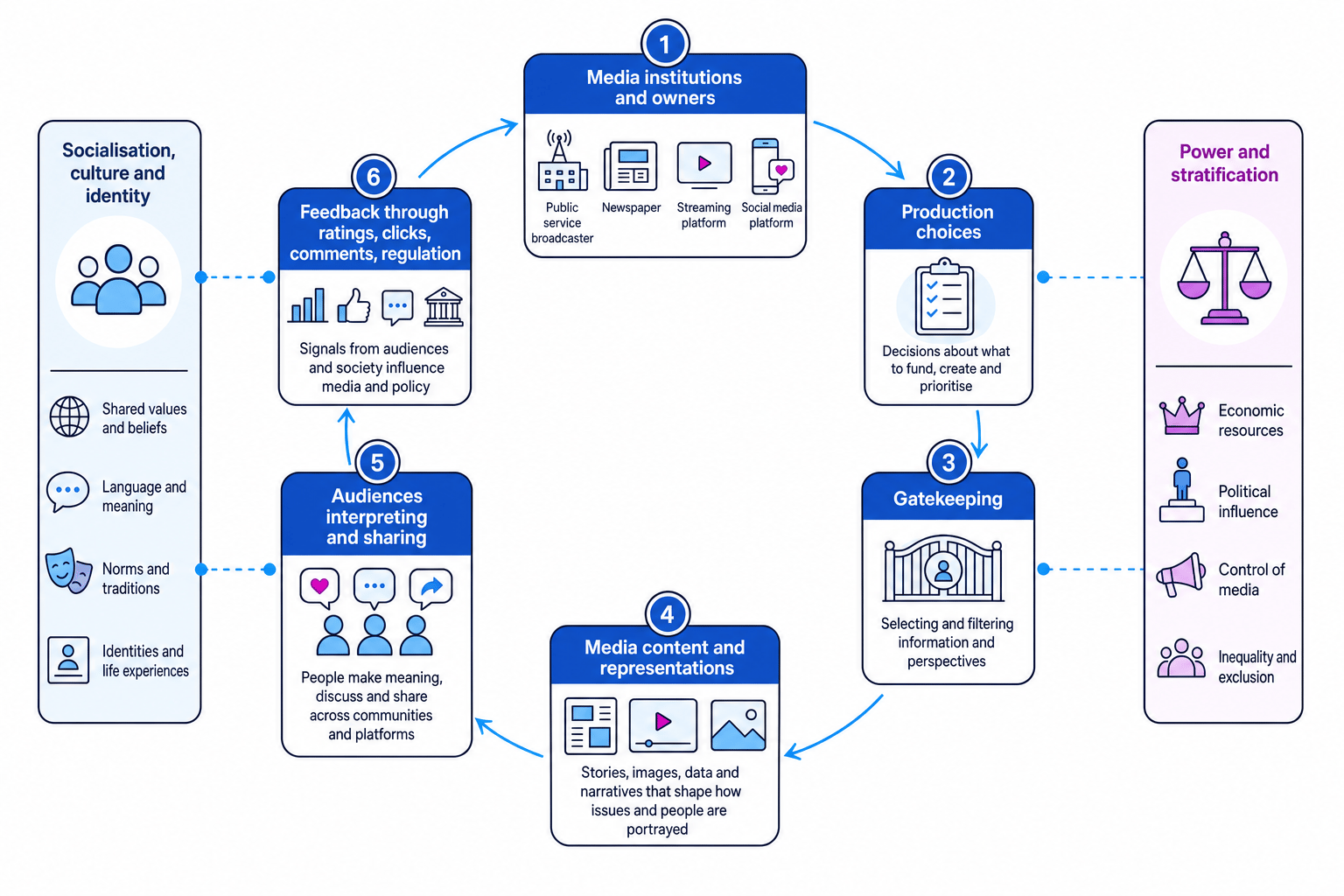
A simple way to analyse any media item
When you see a news article, advert, documentary, TikTok clip or TV drama, ask four sociological questions.
- Who produced it? Consider ownership, funding, platform and institutional aims.
- What message is being constructed? Look at language, images, storylines and omissions.
- Who is represented, and how? Think about gender, ethnicity, class, age, disability, sexuality and nationality.
- How might audiences respond? Audiences may accept, negotiate or reject the message.
Analysing a social media news clip
-
Identify the institution or platform: a clip shared by a commercial news brand may be shaped by the need for attention, advertising revenue and fast engagement.
-
Analyse the representation: if the clip shows young people mainly through images of disorder, it may construct youth as threatening rather than diverse.
-
Apply an audience theory: some viewers may accept the preferred meaning, while others may challenge it using their own experiences or alternative sources.
-
Evaluate the power issue: the clip may reflect unequal power if young people are spoken about but not given a voice in the story.
Ownership, control and ideology
A key question in Media is: who has the power to shape what we see and hear?
Media ownership refers to who owns and controls media organisations. Sociologists often discuss media concentration, where a small number of large companies own a large share of media outlets. This matters because owners, advertisers and editors may influence which issues receive attention.
Ideology and hegemony
An ideology is a set of ideas and beliefs about how society is or should be. Hegemony, associated with Gramsci, means dominance through consent, where powerful groups make their worldview seem natural or common sense.
Marxist views
Marxist sociologists argue that media often supports the interests of the powerful. It may promote capitalism, consumerism and acceptance of inequality. For example, news may focus on individual “success” and “failure” while paying less attention to structural causes of poverty.
Neo-Marxists are more flexible. They often argue that media workers have some independence, but the overall system still tends to favour dominant groups. The Glasgow Media Group studied news reporting and argued that media coverage can present industrial disputes, poverty or foreign policy in ways that favour powerful institutions.
Pluralist views
Pluralists argue that media power is more spread out. Audiences have choice, media organisations compete, and regulation can limit bias. In the UK, public service broadcasting and Ofcom regulation are often used as examples of attempts to maintain standards, impartiality and public accountability.
AO3 evaluation
Marxist arguments are useful for analysing ownership and inequality, but they can underplay audience choice and the diversity of online media. Pluralists rightly note that audiences can switch, complain and create content, but they may exaggerate how equal that choice really is, especially when algorithms and large platforms shape what people see.
Assuming all control is direct
Avoid saying owners simply “tell journalists what to write” in every case. Control can be indirect: through funding, news values, deadlines, advertising pressures, platform algorithms and assumptions about what audiences want.
Representations: whose reality is shown?
A representation is the way a person, group, place or issue is portrayed in media. Representations are not neutral mirrors of reality. They involve selection, framing and interpretation.
Stereotypes are simplified and repeated images of a group. They can be positive or negative, but they often reduce complex people to a narrow set of traits.
Gender
Feminist sociologists argue that media has often reinforced patriarchy, meaning male dominance in society. Women may be represented through beauty, domesticity, sexual availability or emotional labour. Mulvey’s idea of the male gaze suggests that visual media can present women as objects to be looked at from a heterosexual male viewpoint.
However, representations have changed. UK media now includes more female presenters, political leaders, athletes and complex female characters. AO3 evaluation should ask whether these changes are deep or mainly symbolic.
Ethnicity, class and age
Media representations of ethnic minorities can involve under-representation, tokenism or association with social problems. Stuart Hall argued that media representations are linked to wider power relations and can help construct racialised meanings.
Social class can also be represented unequally. Working-class people may be shown as “chavs”, irresponsible benefit claimants or comic figures, while middle-class lifestyles are often treated as normal.
Youth is frequently linked to risk, crime and disorder. Cohen’s study of the Mods and Rockers in 1972 showed how media can create a moral panic, where a group is exaggerated as a threat to social order. Such groups become folk devils, meaning symbolic villains blamed for wider social anxieties.
Use intersectionality
Strong answers avoid treating identity as one-dimensional. Intersectionality means people’s experiences are shaped by overlapping factors such as gender, ethnicity, class, age, disability and sexuality.
Audiences: passive or active?
Sociologists also ask whether media audiences are strongly influenced by media messages or whether they actively interpret them.
Passive audience models
The hypodermic syringe model suggests media messages are injected into passive audiences, directly influencing beliefs and behaviour. This model is simple and is often criticised, but it appears in debates about advertising, propaganda, misinformation and violence.
Active audience models
The uses and gratifications model, linked to Blumler and Katz, argues that audiences use media to satisfy needs such as information, entertainment, personal identity and social interaction.
The two-step flow model, associated with Katz and Lazarsfeld, suggests media influence often works through opinion leaders: people who interpret media messages and pass them on to others.
Hall’s encoding/decoding model argues that producers encode preferred meanings, but audiences may decode them in different ways:
- Preferred reading: the audience accepts the intended message.
- Negotiated reading: the audience partly accepts it but adapts it.
- Oppositional reading: the audience rejects the intended meaning.
Evaluating a claim about media effects
-
Start with the claim: “violent media causes violent behaviour” uses a largely passive audience assumption, because it treats media content as having a direct effect.
-
Apply an active audience criticism: different viewers interpret the same content differently depending on age, social background, peer group, family socialisation and previous experiences.
-
Add methodological evaluation: it is difficult to isolate media as the cause because real behaviour is also shaped by poverty, education, masculinity, mental health, policing and peer influence.
-
Reach a balanced judgement: media may contribute to attitudes or desensitisation in some contexts, but a simple one-cause explanation is too deterministic.
News values, gatekeeping and agenda-setting
News values are the criteria journalists and editors use to decide what counts as newsworthy. Galtung and Ruge identified values such as negativity, drama, proximity, elite people, unexpectedness and personalisation.
Gatekeeping means selecting and filtering information before it reaches audiences. Agenda-setting means influencing which issues people think are important, even if media does not directly tell them what opinion to hold.
In contemporary UK society, stories about migration, the NHS, knife crime, climate protest or welfare can be framed in very different ways depending on the outlet. AO2 is strongest when you link a theory to a real media example rather than describing the theory in isolation.
Media shapes visibility
Media power is not only about telling people what to think. It is also about deciding what is visible, what is ignored, whose voices are heard, and which explanations seem legitimate.
Researching the media
Sociologists use different methods to study media.
Content analysis involves systematically counting features of media content, such as how often women appear as experts in news programmes. It can be reliable because categories can be repeated, but it may miss deeper meanings.
Semiotic analysis studies signs and symbols, such as clothing, camera angles, headlines and music. It can be high in validity because it explores meaning, but it may be harder to replicate.
Interviews and focus groups can explore how audiences interpret media. These methods are useful for validity but may involve small, less representative samples.
Surveys can study audience habits on a larger scale, but they rely on people accurately reporting their media use.
Choosing a method to study gender in adverts
-
Choose content analysis if the aim is to measure patterns, such as how often men and women are shown in domestic, professional or sexualised roles.
-
Add semiotic analysis if the aim is to understand meaning, such as how lighting, body language or camera angle constructs masculinity and femininity.
-
Evaluate the choice: content analysis may be more reliable, but semiotic analysis may be more valid because it captures subtle messages.
Pulling it together for Eduqas answers
For AO1, use accurate concepts and named sociologists: Marx, Gramsci, Hall, Cohen, Blumler and Katz, Katz and Lazarsfeld, Galtung and Ruge.
For AO2, apply ideas to contemporary examples: UK news coverage, social media algorithms, public service broadcasting, streaming, advertising, moral panics, online activism or representations in drama and reality TV.
For AO3, compare perspectives and evaluate evidence. Ask: does the theory overstate media power? Does it ignore audience agency? Is the evidence outdated? Does digital media strengthen or weaken the argument?
In the exam
-
Build each paragraph around a clear concept, such as representation, agenda-setting, moral panic, ideology or active audiences.
-
Add a precise example from UK media or the item/source material, then explain how it proves or complicates the theory.
-
Evaluate as you go: compare perspectives, question methods, and consider whether digital media has changed the debate.
Check yourself
- What is the difference between a passive audience model and an active audience model?
- How can media representations link to power and stratification?
- Why might content analysis be reliable but not always valid?