What you'll learn
- How sociologists define health, illness, impairment and disability.
- Why health outcomes are patterned by class, gender, ethnicity, age and disability.
- How the medical model, social model, sick role and medicalisation explain power in health.
- How to evaluate health evidence using official statistics and research-methods language.
1. Starting point: health is not just biology
In everyday life, people often talk about health as if it is simply about bodies working properly. Sociologists agree biology matters, but they also ask: who gets ill, how illness is defined, who receives care, and who has power to label someone as “healthy” or “ill”?
Health, illness and disease
Health means a person’s physical, mental and social well-being. Illness is the lived experience of feeling unwell. Disease is a condition usually identified through medical diagnosis, such as cancer, diabetes or asthma.
This distinction matters because someone may have a diagnosed disease but not feel very ill day-to-day, while another person may feel serious distress but struggle to get a diagnosis. Sociology therefore links health to culture and identity: different societies, generations and communities define “normal” bodies and minds differently.
Core sociological point
Health is socially patterned: it is shaped by social class, income, work, housing, ethnicity, gender, age, culture and access to services — not just by individual choices.
2. Social determinants of health
Social determinants of health
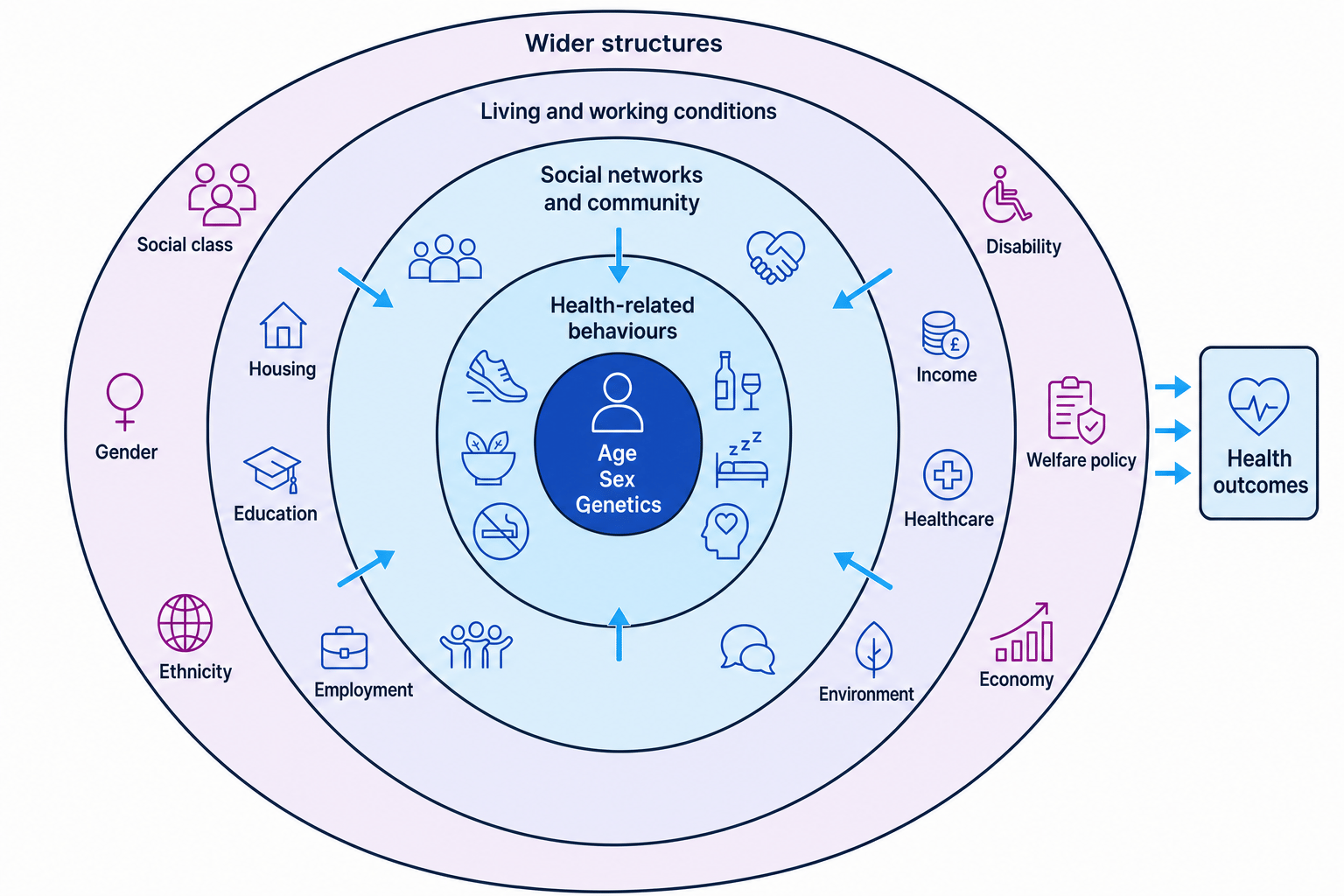
Social determinants of health are the social conditions that influence people’s chances of being healthy or unhealthy, such as income, education, housing, employment, environment and access to healthcare.
The diagram below shows how wider structures shape health outcomes. For example, “choosing” healthy food is easier if someone has enough income, local shops, cooking facilities, time, transport and stable housing.
Social class and health
Social class refers to a person’s position in the economic and occupational hierarchy. In the UK, class affects health through income, working conditions, education, housing and neighbourhood environment.
For instance, people in more deprived areas are more likely to experience lower life expectancy, long-term illness and poorer mental health. The Office for National Statistics frequently reports gaps in health outcomes between the most and least deprived areas of England and Wales.
Applying social determinants to class inequality
A student writes: “Poorer people are less healthy because they make worse lifestyle choices.” Improve this sociologically.
- Identify the individual explanation: the claim focuses on personal behaviour, such as diet, smoking or exercise.
- Add structural factors: income, insecure work, damp housing, pollution, stress and reduced access to leisure spaces can limit healthy options.
- Apply a UK example: a family in temporary accommodation may find it harder to store fresh food, sleep well or register consistently with a GP.
- Evaluate: lifestyle matters, but it is shaped by unequal resources, so a stronger answer links agency with structure.
Blaming individuals only
Do not reduce health inequalities to “bad choices”. In sociology, you need to ask how power, poverty and social conditions make some choices easier than others.
3. Disability: impairment and social barriers
Sociology separates impairment from disability, especially in the social model.
Impairment and disability
An impairment is a physical, sensory, cognitive or mental difference in the body or mind. Disability, in the social model, is the restriction created when society fails to include people with impairments.
This is a crucial power-and-stratification issue. Disabled people may face unequal access to education, work, transport, housing, benefits and public spaces. The Equality Act 2010 gives legal protection against disability discrimination, but sociologists ask whether rights are fully realised in practice.
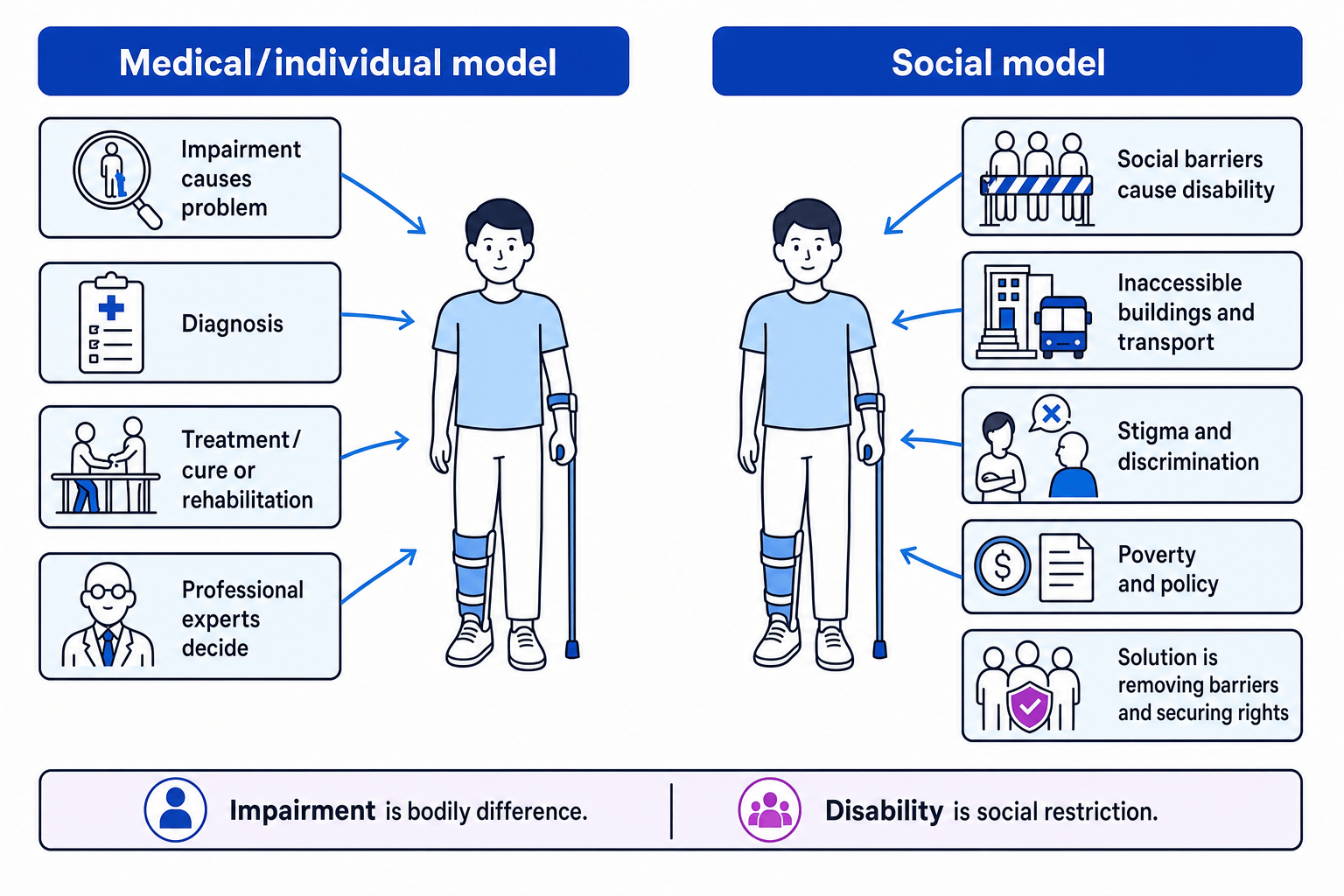
The two main models of disability are shown here.
Medical model
Medical model
The medical model sees disability mainly as a problem located in the individual body or mind, to be treated, cured, managed or rehabilitated by professionals.
This model can be useful because medical treatment, pain relief, therapy and support can improve quality of life. However, it can also be criticised for making disabled people appear “deficient” and giving professionals too much power over their identity.
Social model
Social model
The social model argues that people are disabled by barriers in society, such as inaccessible buildings, discriminatory attitudes, inflexible workplaces and exclusionary policies.
The social model shifts attention from “What is wrong with this person?” to “What is wrong with the organisation of society?”
Applying the social model to transport
A wheelchair user cannot access a railway station because there is no working lift.
- The medical model might focus on the person’s mobility impairment as the main problem.
- The social model identifies the barrier: the station design and maintenance exclude wheelchair users.
- The solution changes: rather than “fixing” the person, society should provide reliable lifts, ramps, staff assistance and accessible information.
- The evaluation is balanced: medical support may still matter, but equal participation requires changing the social environment.
Easy comparison phrase
Use this contrast: the medical model locates the problem in the person; the social model locates the problem in society.
4. The sick role: Parsons and functionalism
Sick role
Parsons argued that the sick role is a socially approved role that allows a genuinely ill person to be excused from normal duties, as long as they seek help and try to get better.
This is a functionalist view because it asks how society maintains order. Illness can disrupt work, school and family life, so the sick role regulates illness by giving rights and responsibilities.
Parsons’ two rights and two duties
A sick person is usually allowed to be exempt from normal responsibilities and not blamed for being ill. In return, they are expected to see illness as undesirable and seek professional help.
AO2 application: in the NHS, a GP note can officially confirm someone’s sickness absence from work. This shows how medical professionals help decide whether someone is legitimately “sick”.
Evaluation
Parsons has been criticised because the sick role fits short-term physical illness better than chronic illness, disability or mental health conditions. It also assumes people can access doctors easily and that doctors’ decisions are neutral.
5. Medicalisation and professional power
Medicalisation
Medicalisation is the process where more areas of everyday life become defined and treated as medical problems.
Examples might include childbirth, menopause, childhood behaviour, sadness, addiction, ageing or body weight. Medicalisation does not mean a condition is “fake”. It means sociology examines how something comes to be understood through medical language and controlled by medical experts.
Illich criticised the expansion of medical control, arguing that medicine can sometimes create dependency or harm. Foucault focused on how expert knowledge creates power: medical categories can monitor, classify and discipline bodies.
Analysing medicalisation of mental health
A school introduces more mental health screening for students.
- Positive interpretation: earlier identification may help students access counselling, support plans or NHS referrals.
- Medicalisation critique: ordinary stress caused by exams, poverty or family pressure may be reframed mainly as an individual disorder.
- Power analysis: professionals gain authority to define what counts as normal behaviour, risk or need.
- Balanced judgement: the strongest answer avoids saying medicalisation is simply good or bad; it asks who benefits, who is labelled, and what social causes may be ignored.
Saying medicalisation means invention
Medicalisation does not mean doctors “make up” illnesses. It means medical explanations become more powerful than moral, social, spiritual or political explanations.
6. Stigma, identity and lived experience
Stigma
Goffman used stigma to describe a socially discrediting label that can reduce a person from a whole individual to a spoiled or devalued identity.
Health and disability can affect identity. For example, someone with a visible impairment, mental health diagnosis or long-term condition may experience stereotyping, pity, fear or exclusion. Bury described serious chronic illness as biographical disruption, meaning it can interrupt a person’s expected life story, relationships and plans.
However, this should not lead to a purely negative view. Disabled people and people with long-term conditions also build identities through community, activism, online networks and resistance to stigma.
7. Inequalities: gender, ethnicity and age
Gender
Gender shapes health through work, caring roles, income, violence, body expectations and help-seeking patterns. Women may be more likely to consult health services, but they may also have pain dismissed or conditions under-researched. Men may face cultural pressure to appear tough, which can reduce help-seeking for mental health problems.
Ethnicity
Ethnicity affects health through racism, migration experiences, language barriers, poverty, housing and unequal treatment in services. Sociologists avoid biological explanations unless there is strong evidence, because ethnic health inequalities are often linked to social conditions and institutional racism.
Age
Age influences health because older people are more likely to experience chronic illness, but age is also socially constructed. Ageism means stereotyping or discriminating against people because of age, such as assuming older people are dependent or younger people are irresponsible.
Intersectionality
Intersectionality means inequalities overlap. For example, a disabled older woman from a minority ethnic background may experience health services differently from a non-disabled middle-class man.
8. Researching health and disability
Sociologists use both quantitative and qualitative evidence.
Official statistics
Official statistics are numerical data collected by the state or public bodies, such as Census data, NHS data, mortality rates, life expectancy figures and ONS deprivation indices.
Official statistics are useful because they cover large populations and show patterns over time. This supports a more positivist approach, which values measurable, reliable data.
But they also have limitations. Categories may change, some conditions are underdiagnosed, and statistics may not capture lived experience. An interpretivist approach may prefer interviews or ethnography to understand meanings, stigma and identity.
Evaluating official health statistics
You see a claim that one region has worse health than another.
- Check what is being measured: mortality, life expectancy, diagnosed illness, self-reported health and hospital admissions can show different things.
- Consider representativeness: large official datasets may be broad, but some groups can still be undercounted or less likely to seek diagnosis.
- Add validity: the figures may show a pattern, but they may not explain the lived reasons behind it, such as fear, stigma or poor access.
- Link to theory: a positivist may value the reliability of the data, while an interpretivist may ask for qualitative evidence too.
In the exam
- Define key terms early, especially health, illness, impairment, disability, medical model, social model and medicalisation.
- Apply ideas to UK examples such as the NHS, Equality Act 2010, GP access, mental health services, housing, poverty and ONS health inequalities.
- Evaluate every major point by comparing perspectives: functionalism, social constructionism, feminism, Marxism, interactionism and research-methods issues.
Check yourself
- How would the medical model and social model explain the same disabled person’s experience differently?
- Why might official health statistics be reliable but not fully valid?
- How can class, gender and ethnicity combine to shape someone’s experience of illness or healthcare?