What you'll learn
- How sociologists see education as a social institution, not just “going to school”.
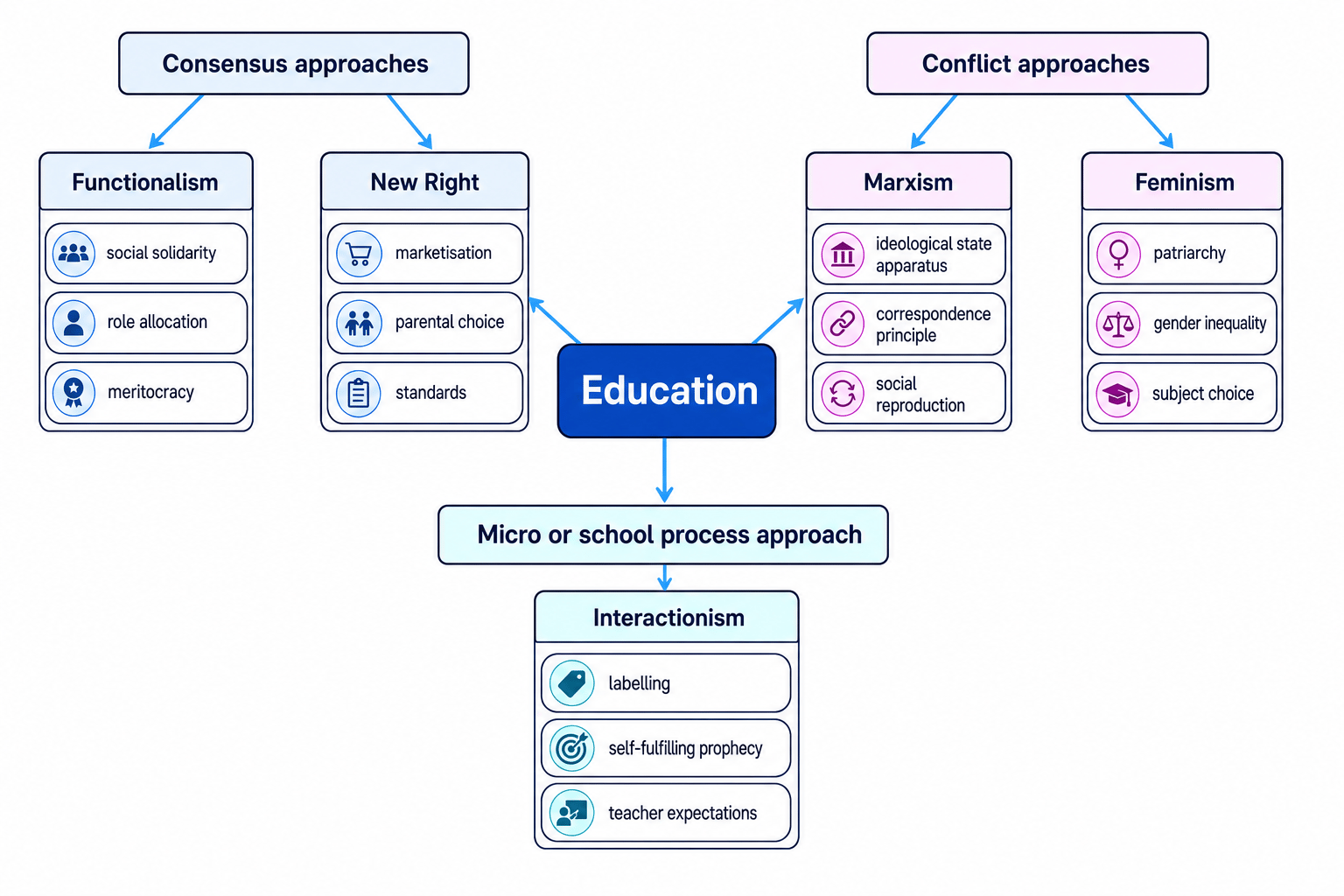
- How functionalists, Marxists, feminists, New Right thinkers and interactionists explain schooling.
- Why achievement patterns differ by class, gender and ethnicity.
- How to apply evidence, policies and studies using AO1, AO2 and AO3.
Education as a social institution
Education is one of the key areas you may study in Section C. Sociologists are interested in schools, colleges and universities because they do more than teach subjects: they transmit culture, sort people into future roles, shape identities and reproduce or challenge inequalities.
Education and social institutions
Education is the organised process through which people learn knowledge, skills, values and norms. A social institution is a major organised part of society, such as the family, education, religion or the media, which helps shape behaviour and identity.
Two cross-cutting themes run through the whole topic:
- Socialisation, culture and identity: how schools teach values, norms and ideas about “who you are”.
- Power and stratification: how education may create, justify or challenge inequalities between groups.
Curriculum and hidden curriculum
Curriculum and hidden curriculum
The formal curriculum is the official content taught in schools, such as English, maths, science and sociology. The hidden curriculum refers to the unofficial lessons pupils learn through school routines, rules and expectations, such as punctuality, obedience, competition, gender roles or respect for authority.
For example, a school timetable may teach organisation and punctuality even when no teacher says, “Today’s lesson is about timekeeping.” Sociologists ask whether these lessons help society function smoothly or prepare young people to accept unequal power relations.
The main theoretical map
The main perspectives disagree about whether education mainly benefits society as a whole or benefits powerful groups. They also differ in whether they focus on large-scale structures or everyday interactions.
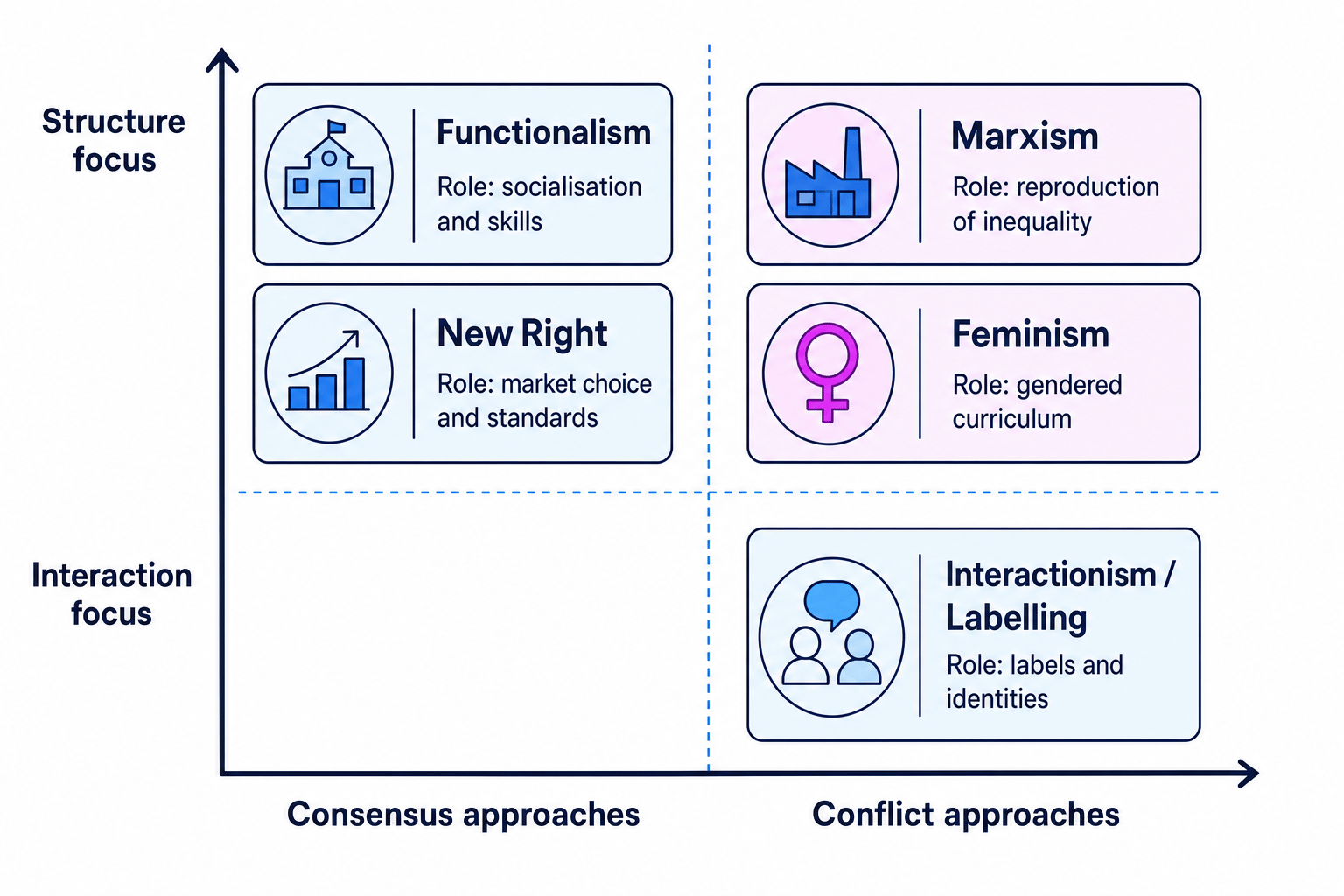
A consensus approach sees society as based mainly on shared values. A conflict approach sees society as shaped by inequality, competition and power struggles.
Functionalist views: education helps society work
Functionalists take a consensus view. They argue that education performs useful functions for society.
Durkheim argued that schools create social solidarity, meaning a sense of belonging to a wider community. Parsons saw school as a bridge between the family and wider society because pupils move from particularistic standards at home — being treated as a unique child — to universalistic standards at school, where everyone is judged by the same rules. Davis and Moore argued that education supports role allocation, sorting people into jobs according to ability.
Meritocracy
A meritocracy is a system where individuals gain rewards, such as qualifications, jobs and income, based on talent and effort rather than inherited privilege.
AO2 application: the National Curriculum, public exams and qualifications can be used as examples of education creating common standards and preparing young people for work.
AO3 evaluation: functionalists may overstate equality of opportunity. If pupils arrive at school with very different levels of money, support, confidence and cultural capital, then the competition may not be fair.
Treating meritocracy as proven
Do not write as if education definitely is meritocratic. Functionalists often present meritocracy as an ideal or function of education, while Marxists, feminists and many interactionists question whether it exists in practice.
Marxist views: education reproduces inequality
Marxists take a conflict view. They argue that education serves capitalism by preparing pupils for unequal work roles and making inequality seem natural.
Althusser described education as an ideological state apparatus: an institution that spreads ruling-class ideas. Bowles and Gintis argued there is a correspondence principle, meaning school mirrors the workplace. For example, pupils learn obedience to authority, external rewards, hierarchy and acceptance of routine.
Social reproduction
Social reproduction is the process by which inequality is passed from one generation to the next, so that class advantages and disadvantages continue over time.
Bourdieu added the idea of cultural capital: the knowledge, language, tastes and confidence valued by powerful institutions. Middle-class pupils may be more familiar with the language and expectations of school, giving them an advantage that can look like “natural ability”.
AO3 evaluation: Marxism is powerful for explaining class inequality, but it can be too deterministic. Willis’s study of working-class “lads” showed pupils are not passive; they can resist school. However, their resistance may still lead them into working-class jobs, so resistance does not always create freedom.
Applying perspectives to school league tables
-
Identify what league tables do: they compare schools using exam results, encouraging parents to choose and schools to compete.
-
Apply a functionalist or New Right view: league tables may raise standards by making schools accountable and helping pupils gain qualifications for future roles.
-
Apply a Marxist view: middle-class parents may be better placed to interpret data, move house, arrange transport or appeal admissions decisions, so “choice” may reproduce class advantage.
-
Evaluate both views: league tables may provide useful information, but the benefits are uneven if some families have more economic and cultural capital than others.
Feminist views: education and gender power
Feminists focus on how education reflects and challenges patriarchy, which means male power in society. They examine subject choices, teacher expectations, sexual harassment, school leadership and representations in textbooks.
Liberal feminists often emphasise progress, such as girls’ improved exam performance and equal opportunities policies. Radical feminists are more likely to argue that schools still reproduce gender inequality through the hidden curriculum and everyday sexism.
AO2 application: girls now often outperform boys in many headline attainment measures, but gender patterns remain in subject choice, such as the under-representation of girls in some STEM subjects and boys in some care-related subjects.
AO3 evaluation: gender cannot be analysed alone. Class and ethnicity shape gender experiences. For example, “boys’ underachievement” is too broad because middle-class boys and working-class boys may have very different educational experiences.
Interactionism: labels, identities and school processes
Interactionists focus on everyday interactions inside schools. They ask how teachers, pupils and peer groups create meanings.
Labelling and self-fulfilling prophecy
Labelling happens when a person is defined in a particular way, such as “bright”, “troublemaker” or “lazy”. A self-fulfilling prophecy occurs when a label influences behaviour so that the label appears to come true.
Becker found that teachers may judge pupils against an “ideal pupil” image. Rosenthal and Jacobson argued that teacher expectations can affect pupil performance. Gillborn and Youdell linked labelling to educational triage, where schools focus resources on pupils seen as likely to help league table results.
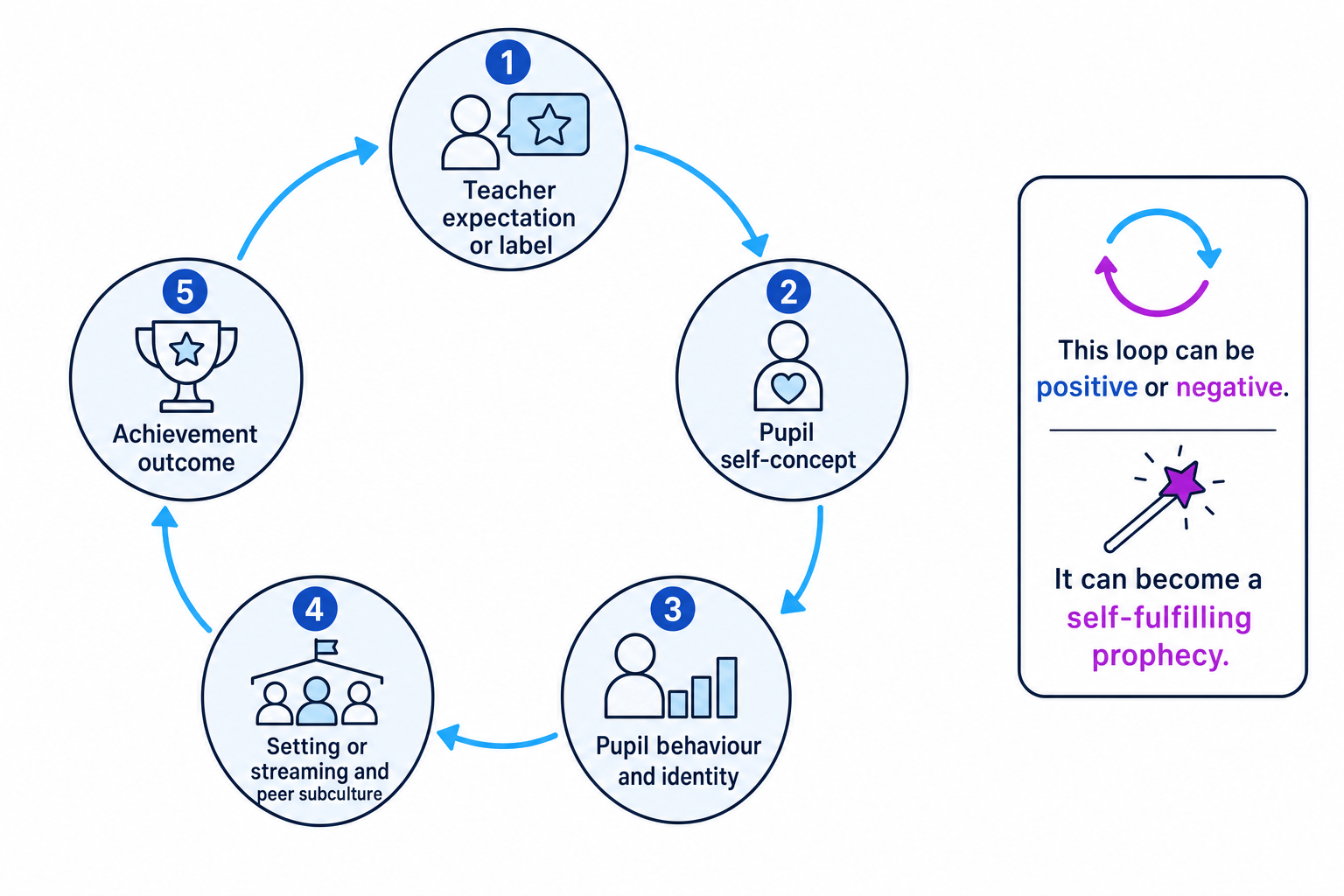
Tracing a self-fulfilling prophecy
-
Start with the label: a teacher expects a pupil in a lower set to struggle and gives them less demanding work.
-
Link the label to identity: the pupil may begin to see themselves as “not academic” and reduce effort, or join an anti-school peer group.
-
Show the outcome: lower attainment then appears to confirm the original judgement, even though the school process helped create that outcome.
-
Add evaluation: pupils do not always accept labels. Fuller’s study of Black girls showed that pupils can reject negative stereotypes and still work towards success.
Patterns of educational achievement
Sociologists examine patterns in achievement by class, gender and ethnicity. The strongest answers avoid single-cause explanations.
Social class
Working-class pupils are more likely to face material deprivation, such as overcrowded housing, fewer study resources, food insecurity or limited access to private tutoring. They may also be disadvantaged by cultural capital if school expectations are closer to middle-class language, confidence and knowledge.
AO2 application: the Pupil Premium in England is designed to reduce the attainment gap linked to disadvantage. Official statistics on pupils eligible for free school meals are often used to explore class inequalities, although they are an imperfect measure.
Gender
Girls’ achievement has improved significantly over time. Explanations include changing female aspirations, feminism, equal opportunities policies and changes in the labour market. Some sociologists also examine boys’ “laddish” subcultures, where academic effort may be seen as uncool or unmasculine.
AO3 evaluation: avoid saying “girls succeed, boys fail”. Gender patterns vary by subject, class, ethnicity and school context.
Ethnicity
Ethnic achievement patterns are complex. Some minority ethnic groups achieve above national averages, while others face persistent disadvantages. Sociologists examine racism, teacher expectations, poverty, language, school exclusions, community support and institutional processes.
Gillborn argues that education policy and school practices can reproduce racial inequality. However, researchers also warn against treating ethnic groups as fixed or identical.
Overgeneralising ethnicity
Do not write “ethnic minorities underachieve” as a blanket statement. Different groups have different outcomes, and ethnicity intersects with class, gender, religion, migration history and racism.
Analysing a class gap in achievement
-
Begin with the pattern: pupils from disadvantaged backgrounds, such as those eligible for free school meals, often have lower average attainment than more advantaged pupils.
-
Apply an outside-school factor: material deprivation may reduce access to quiet study space, technology, enrichment activities and stable routines.
-
Apply an inside-school factor: setting, streaming and teacher expectations may place some pupils into lower-status groups, affecting confidence and opportunities.
-
Evaluate the explanation: class matters strongly, but it interacts with gender, ethnicity and school policy, so a strong answer combines structural factors with pupil agency.
Education policy: what should schools do?
Education policy is a major AO2 area because it lets you apply theory to real UK changes.
Key policy moments include:
- The 1944 Education Act and the tripartite system, which aimed to match pupils to school types but was criticised as class-biased.
- Comprehensive education, intended to reduce selection and class division.
- The 1988 Education Reform Act, which introduced stronger marketisation through parental choice, testing, league tables and a National Curriculum.
- Academies, free schools and Pupil Premium funding, which are often debated in terms of standards, choice and inequality.
The New Right supports marketisation because competition is seen as a way to raise standards. Critics such as Ball, Bowe and Gewirtz argue that “parental choice” can become a myth of parentocracy: it appears that all parents are equally free to choose, but middle-class parents often have more resources to make effective choices.
The big debate
Education can be seen as a route to opportunity and social mobility, but also as a system that may reproduce class, gender and ethnic inequalities. The strongest sociology answers hold both possibilities in tension.
Researching education
Education is also a useful topic for methods. Sociologists may use:
- Official statistics, such as Department for Education data, to identify achievement patterns. These are often reliable and large-scale, but may hide differences within categories.
- Questionnaires, useful for gathering comparable data from many pupils, though they may lack depth.
- Interviews and ethnography, useful for understanding pupil identity, teacher expectations and school culture, though access can be difficult.
When researching schools, ethical issues are especially important because many participants are children. Researchers need informed consent, confidentiality and care to avoid harm. Access may also be controlled by headteachers, parents and safeguarding rules.
Methods link
For AO3, connect method to theory: positivists often prefer large-scale statistics because they reveal patterns, while interpretivists often prefer interviews or observation because they reveal meanings and experiences.
In the exam
-
Build paragraphs using AO1 → AO2 → AO3: define the concept or theory, apply it to education, then evaluate it.
-
Compare perspectives directly: functionalists and New Right thinkers often stress order, standards and opportunity, while Marxists and feminists stress power and inequality.
-
For achievement questions, avoid one-cause answers: combine outside-school factors, inside-school processes and intersections of class, gender and ethnicity.
Check yourself
- What is the difference between the formal curriculum and the hidden curriculum?
- How would a functionalist and a Marxist explain school league tables differently?
- Why is it risky to explain achievement using only class, only gender or only ethnicity?