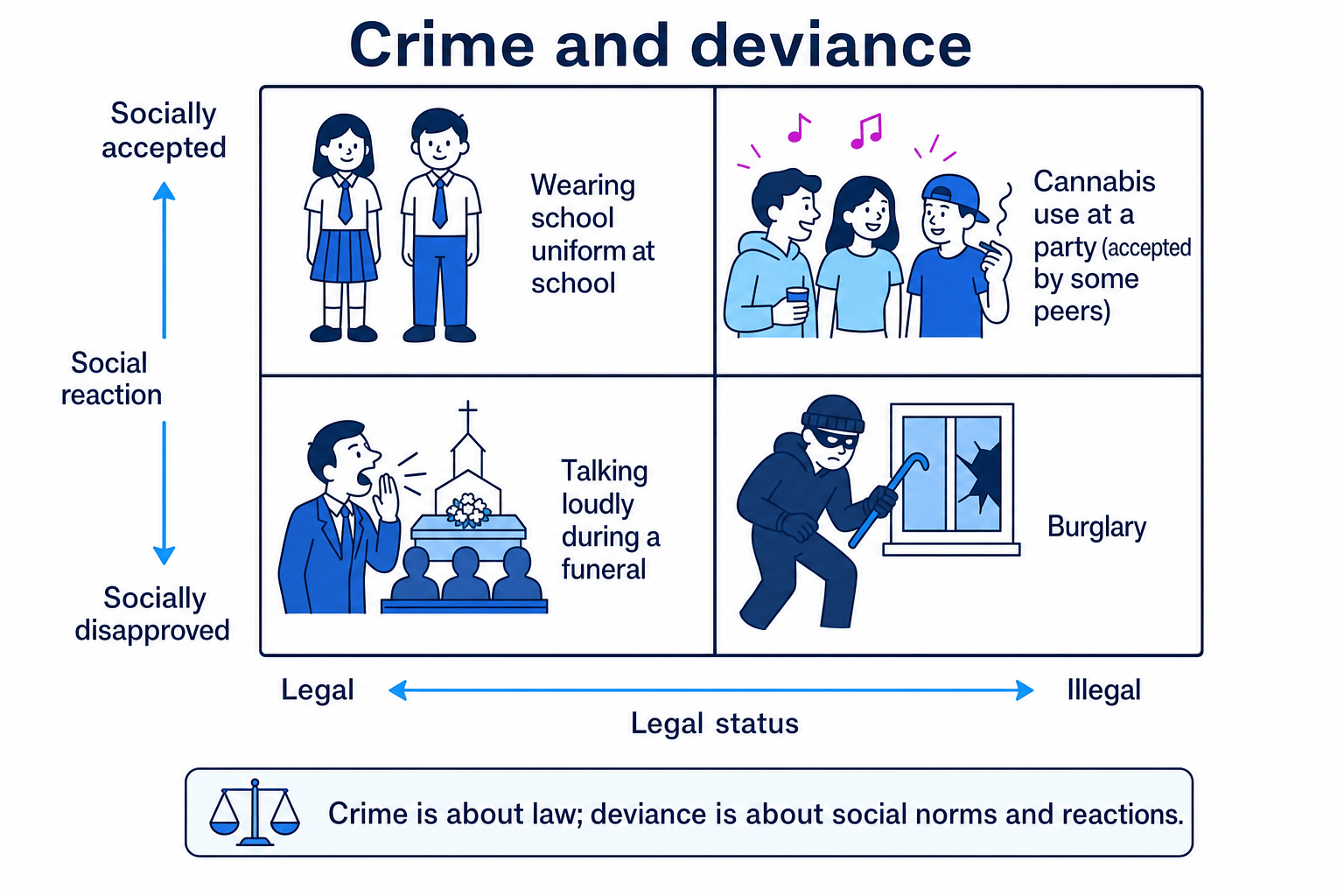
What you'll learn
- How sociologists distinguish crime, deviance, norms, values and social control.
- Why crime and deviance are often described as socially constructed.
- How crime is measured through police statistics, the Crime Survey for England and Wales and other methods.
- How major perspectives — functionalism, Marxism, interactionism, feminism and realism — begin to explain crime.
Starting point: society, rules and reactions
Before you study theories of crime, you need the basic sociological idea that societies are held together by shared expectations. These expectations are learned through socialisation: the process by which people learn the norms, values and identities of their society or social group.
Norms and values
Values are general beliefs about what is important, such as fairness, respect or success. Norms are more specific rules of behaviour based on values, such as not pushing into a queue or not stealing someone’s property.
Sociologists are interested not just in rule-breaking, but in who makes the rules, who is likely to be punished, and whose behaviour is treated as a problem. This links the topic closely to power and stratification: class, gender, ethnicity, age and other inequalities can shape both offending and the social response to offending.
Crime and deviance: related, but not the same
Crime
A crime is behaviour that breaks the criminal law and can be punished by the state, for example through a fine, community sentence or imprisonment.
Deviance
Deviance is behaviour that goes against the norms or expectations of a particular social group and leads to disapproval or sanction.
The key difference is that crime is about law, while deviance is about social reaction. Some acts are both criminal and deviant, such as burglary or assault. Some acts may be deviant but not criminal, such as speaking loudly through a solemn ceremony. Some acts are illegal but may not be strongly disapproved of in some peer groups, such as minor speeding.
This grid helps you separate the two ideas.
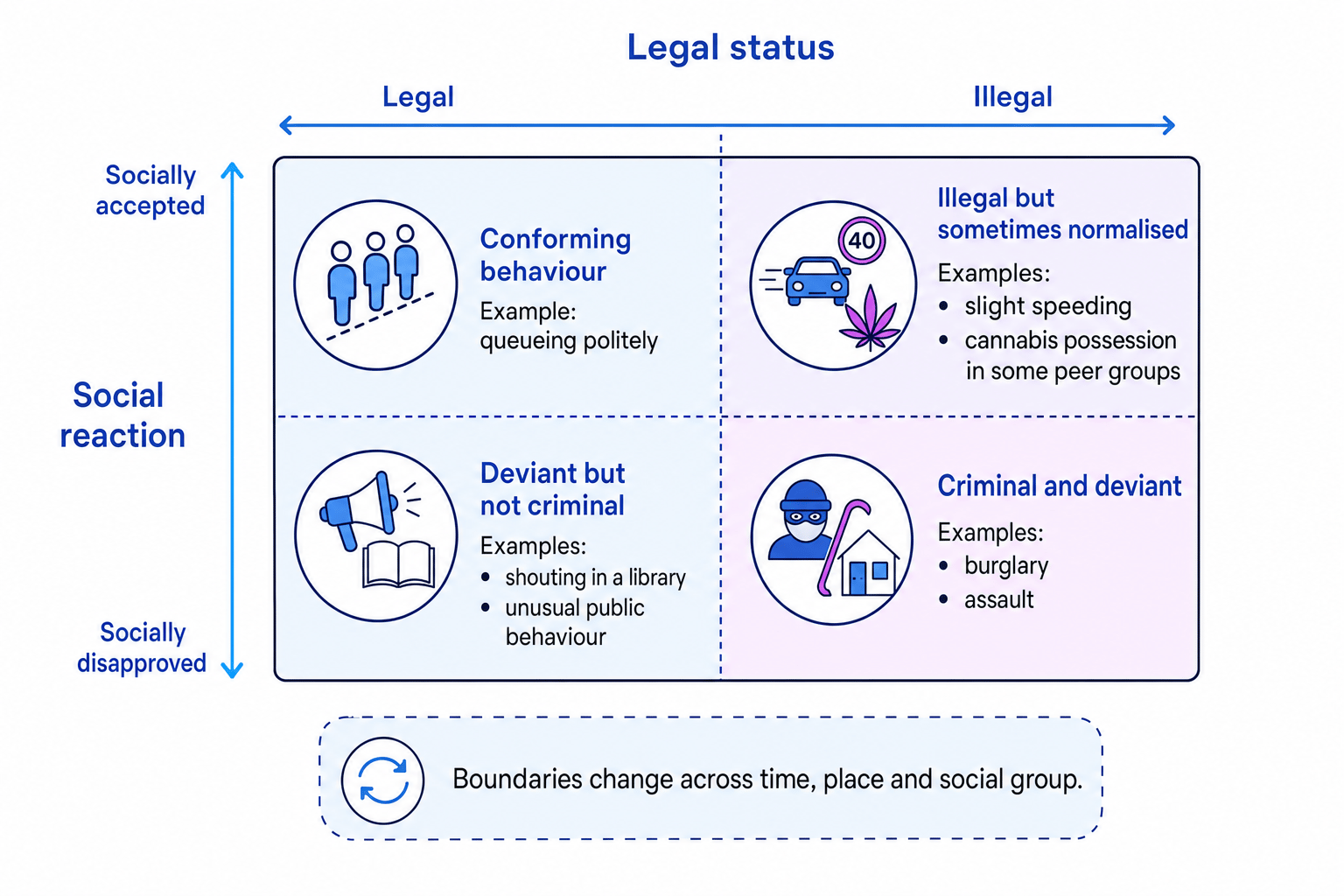
Classifying crime and deviance
Imagine a student writes: “A teenager uses cannabis at a party, and their friendship group sees this as normal.”
- Check the legal status: cannabis possession is illegal in the UK, so this behaviour can be classed as crime.
- Check the social reaction: within this friendship group it is normalised, so it may not be seen as deviant by that group.
- Add sociological precision: the same act may still be seen as deviant by parents, teachers, police or other community members, showing that deviance depends on audience and context.
Treating crime and deviance as identical
Do not write as if all deviance is criminal or all crime is strongly deviant. The strongest answers keep asking: illegal according to law, or disapproved according to social norms?
Crime and deviance are relative
Sociologists say crime and deviance are relative, meaning they vary across time, place and social group.
Across time
What counts as criminal can change. For example, male homosexual acts were partially decriminalised in England and Wales in 1967, while coercive and controlling behaviour in intimate relationships became a criminal offence under the Serious Crime Act 2015. This shows that law reflects changing social values and political struggles.
Across place
Behaviour may be legal in one country and illegal in another. Drug laws, alcohol laws and abortion laws vary internationally. This reminds you that crime is not simply “natural”; it is defined by legal systems.
Across social group
The same behaviour may be judged differently depending on age, class, gender, ethnicity or setting. For instance, loud behaviour might be tolerated at a football match but condemned in a library. A young person wearing a hoodie may be interpreted differently depending on stereotypes about youth, class and ethnicity.
Relativity
Crime and deviance are not fixed labels attached permanently to actions. They depend on laws, norms, power and social reaction.
The social construction of crime and deviance
A social construction is an idea or category created and maintained through social processes rather than existing in a simple, natural way. This does not mean crime is “imaginary”. It means the meaning of behaviour is shaped by institutions, culture and power.
Interactionist sociologist Becker (1963) argued that “deviance is not a quality of the act” but a consequence of others applying rules and labels. In other words, a person becomes “deviant” when others successfully define them that way.
This raises important questions:
- Who has the power to define an act as criminal?
- Who is most likely to be stopped, searched, arrested or convicted?
- Which harms are taken seriously, and which are ignored?
For example, street robbery may receive intense public and media attention, while corporate harms such as unsafe working conditions, pollution or financial fraud may be less visible, even when their effects are widespread.
Applying social construction
Suppose an item says: “New laws have been introduced to punish online abuse more severely.”
- Identify the change: behaviour that may once have been treated as unpleasant communication is now being more strongly defined as a legal problem.
- Connect to social context: increased use of social media has changed where harm happens and how visible it becomes.
- Apply power and culture: pressure from victims, campaigners, media and politicians can influence which online behaviours are criminalised and how seriously they are policed.
Social control: how societies encourage conformity
Social control
Social control refers to the ways societies try to make people conform to norms and laws.
There are two main types.
Formal social control
Formal social control is carried out by official agencies, such as the police, courts, prisons, probation services and government. It uses written rules and official sanctions.
Examples include:
- arrest by police
- court trials
- fines
- prison sentences
- community orders
Informal social control
Informal social control happens through everyday social pressure from family, friends, schools, workplaces, religion and the media.
Examples include:
- being told off by parents
- losing respect from friends
- gossip or embarrassment
- praise for “good” behaviour
Sanctions
Sanctions are rewards or punishments that encourage conformity. They can be positive, such as praise, or negative, such as a fine, prison sentence or social exclusion.
Useful sentence starter
“Crime and deviance are linked to social control because societies do not simply have rules; they also have agencies and sanctions that enforce those rules.”
Measuring crime: how do we know how much crime there is?
Sociologists use crime data carefully because no source gives a perfect picture. Crime is often hidden, under-reported or differently recorded.
Dark figure of crime
The dark figure of crime refers to crime that happens but does not appear in official statistics, usually because it is not reported to or recorded by the police.
Police recorded crime
Police recorded crime includes offences reported to and recorded by the police. It is useful for showing patterns in offences that are likely to be reported, such as burglary or vehicle theft.
However, it is affected by:
- victims’ willingness to report
- police recording practices
- policing priorities
- changes in law
- public trust in the police
For example, a rise in recorded domestic abuse may mean more incidents are happening, but it may also mean victims are more willing to report or police are recording incidents more consistently.
Crime Survey for England and Wales
The Crime Survey for England and Wales, often linked to the ONS, is a large victim survey asking people about crimes they have experienced. It can reveal offences not reported to police, so it is useful for estimating the dark figure.
Its limitations include:
- it relies on memory
- people may not disclose sensitive experiences
- it is mainly based on households, so some groups are harder to include
- it cannot measure all crimes equally well, such as homicide or some corporate crimes
Self-report studies
Self-report studies ask people to admit offences they have committed. These can be useful for researching youth crime or hidden deviance, but respondents may exaggerate, forget or conceal behaviour.
Reading crime statistics carefully
A headline says: “Police recorded shoplifting has increased.”
- Avoid assuming one cause: the rise could reflect more shoplifting, but it could also reflect more reporting by shops or changes in police recording.
- Compare sources: if victim surveys, retail reports and police figures all show increases, the claim becomes stronger.
- Evaluate validity: police data may be reliable in counting recorded incidents, but it may not fully measure the true level of shoplifting if many incidents remain unreported.
First theory map: why do sociologists explain crime differently?
You will study detailed theories later, but it helps to know the main debate from the start.
Functionalism: crime can have functions
Functionalists see society as based mainly on shared values. Durkheim argued that some crime is inevitable and can even have functions. It can reinforce boundaries by reminding people what is unacceptable, and it can help social change when rule-breaking challenges outdated norms.
Merton developed strain theory, arguing that crime can occur when people are encouraged to pursue cultural goals, such as wealth, but lack legitimate means to achieve them.
AO3 point: functionalism is useful for linking crime to social order, but it can underplay power and inequality. It may also sound as if crime is “good” for society, while victims experience real harm.
Marxism: law and crime reflect capitalism
Marxists argue that law often reflects the interests of the powerful. They focus on class inequality, selective law enforcement and crimes of the powerful, such as corporate crime.
For example, working-class street crime may be heavily policed, while harmful business practices can be harder to detect and punish.
AO3 point: Marxism is strong on power and stratification, but it may overstate class and underplay gender, ethnicity, age and individual choice.
Interactionism: labels can create deviance
Interactionists focus on meanings and reactions. Becker’s labelling theory suggests that being labelled “deviant” can affect identity and future behaviour. Cohen (1972) studied moral panics around Mods and Rockers, showing how media reaction can amplify deviance.
AO3 point: interactionism is strong on social reaction, media and identity, but it may say less about the original causes of offending.
Feminism: gender matters
Feminist approaches argue that crime and control are shaped by patriarchy: male power over women. They highlight hidden crimes such as domestic abuse, sexual violence and harassment, and ask whether the criminal justice system treats victims fairly.
AO3 point: feminism makes gender visible, but different feminist approaches disagree about whether the focus should be patriarchy, capitalism, ethnicity, sexuality or intersectionality.
Realism: take crime seriously
Right realists often emphasise individual responsibility, deterrence and opportunities for crime. Left realists focus more on relative deprivation, marginalisation and subcultures, while also taking victims’ experiences seriously.
AO3 point: realist theories are useful for policy debates, but they can sometimes rely heavily on official categories of crime and may underplay the social construction of deviance.
AO3 comparison
A strong evaluation often contrasts consensus theories that stress shared values with conflict theories that stress inequality and power.
Linking to identity, culture and power
Crime and deviance are not just about individual behaviour. They connect to identity and culture because people learn what is “normal” through family, peers, school, media and community. They connect to power because some groups have more ability to define, police and punish deviance than others.
For example, youth subcultures may be labelled threatening by adults and the media. Ethnic minority communities may experience disproportionate stop and search. Women may experience forms of harm that have historically been minimised or treated as private matters. These examples help you apply theory to contemporary UK society.
In the exam
- Define precisely first: separate crime, deviance, norms, values, sanctions and social control before moving into theory.
- Apply with UK examples: use examples such as stop and search, domestic abuse, cybercrime, corporate crime, cannabis, shoplifting or the Crime Survey for England and Wales.
- Evaluate throughout: compare perspectives, question data sources, and ask who has the power to define and enforce rules.
Check yourself
- What is the difference between crime and deviance?
- Why do sociologists describe crime and deviance as relative?
- How might police recorded crime and the Crime Survey for England and Wales give different pictures of crime?