What you'll learn
- How the family is linked to wider social structure and social change.
- How changes in the economy affect family life, gender roles and household patterns.
- How state policies can shape, support, regulate or disadvantage families.
- How to compare functionalist, Marxist, feminist, New Right and postmodern views for AO3 evaluation.
The big idea: families do not exist in a bubble
Sociologists study the family as part of wider society. This means family life is shaped by work, class, gender, ethnicity, law, welfare, housing and cultural expectations. At the same time, families help reproduce society by socialising children, caring for dependants and providing workers for the economy.
Core terms
- Family means a social group connected by kinship, marriage, civil partnership, adoption or long-term care relationships.
- Household means people living together at the same address; they may or may not be a family.
- Social structure means the patterned institutions and inequalities that shape people’s opportunities, such as class, gender, ethnicity, age, education, work and law.
- Social change means large-scale change over time in social life, such as industrialisation, feminism, secularisation, migration, ageing and changing attitudes to sexuality.
- State policies are laws, welfare rules and government decisions that affect people’s lives, such as divorce law, benefits, childcare, education and housing policy.
- Economy means the system through which goods, services, paid work, wages and resources are produced and distributed.
The relationship is two-way
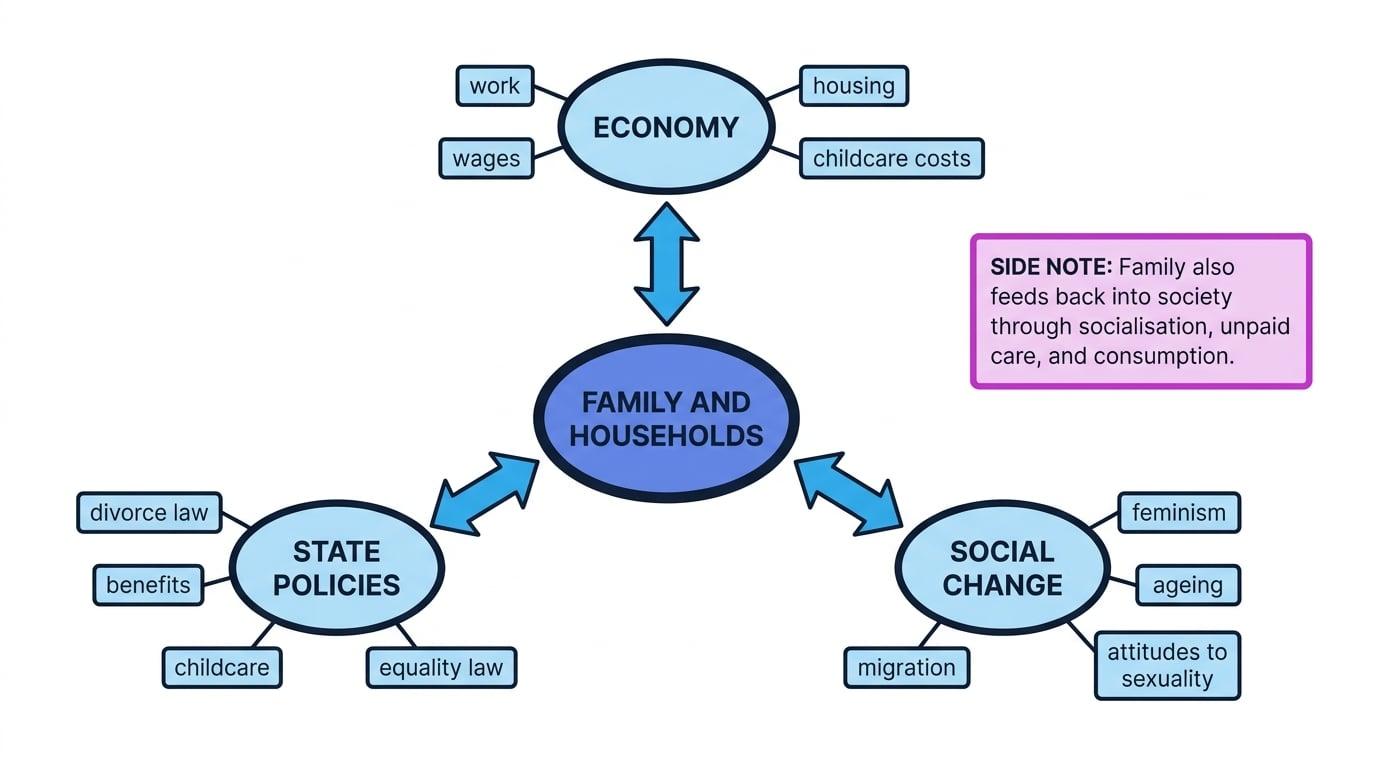
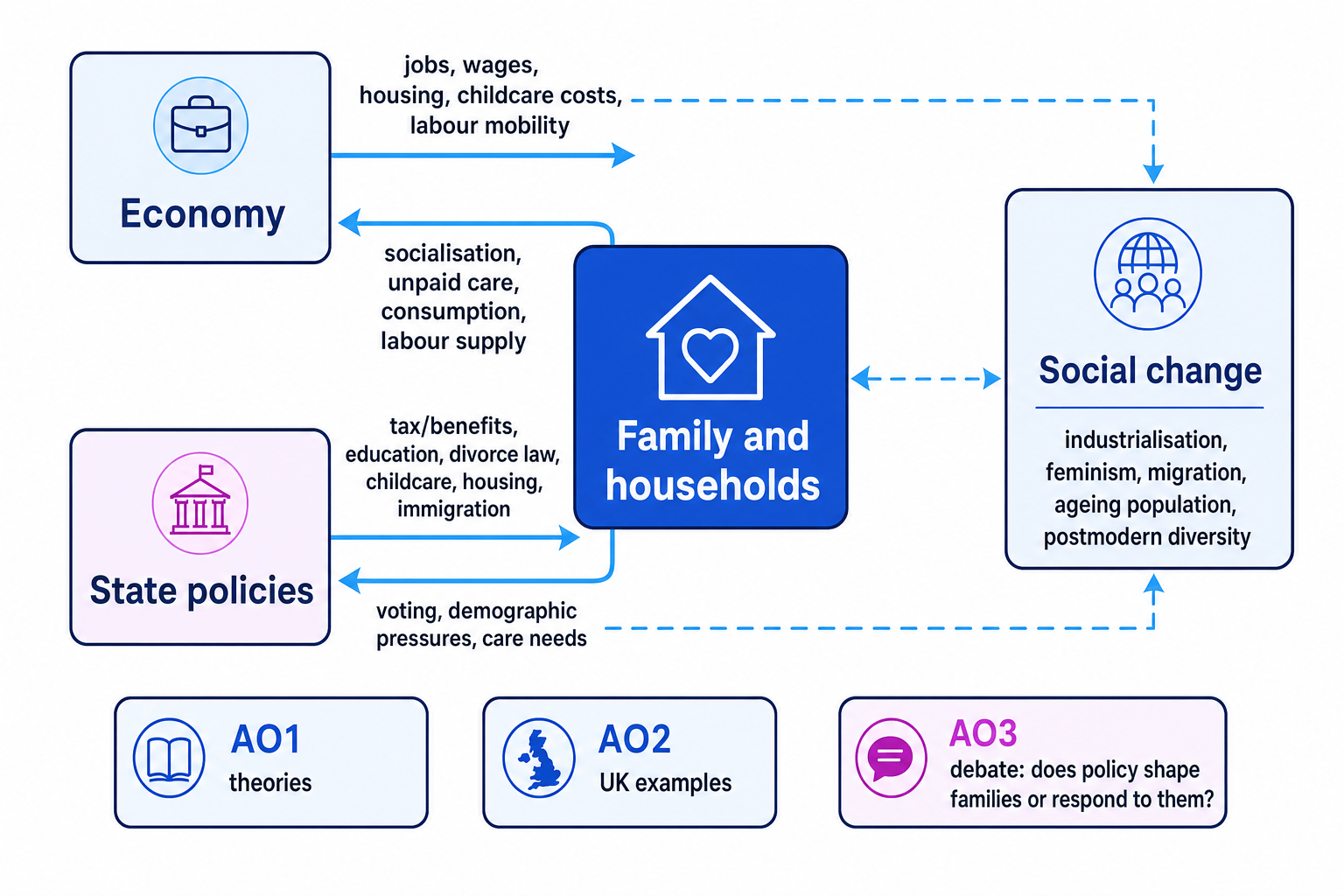
The family is shaped by the economy and state policies, but it also helps maintain and change society through socialisation, unpaid care, consumption, voting patterns and demographic pressures.
This diagram shows the main links you need to hold together in an essay: economy, policy, family and social change are connected rather than separate topics.
Family and the economy
Industrialisation and the nuclear family
Industrialisation means the shift from mainly agricultural work to factory-based and later office/service-based work. Functionalists such as Parsons (1955) argue that industrial society encouraged the nuclear family, meaning two adults and their dependent children.
Parsons claimed the nuclear family “fits” industrial society because it is:
- Geographically mobile: a small family can move for work more easily than a large extended family.
- Socially mobile: individuals can achieve status through education and jobs rather than inheriting it from kin.
- Focused on two “basic” functions: primary socialisation of children and stabilisation of adult personalities, meaning emotional support for adults.
Linking industrialisation to family change
- Identify the economic change: industrialisation moved work away from family farms and workshops into factories, offices and urban labour markets.
- Apply Parsons’ argument: a smaller nuclear family could move to where jobs were available, so it suited the needs of an industrial economy.
- Link to socialisation: the family prepared children with basic norms and values, while schools and workplaces taught more specialised skills.
- Evaluate the claim: historians such as Laslett suggest nuclear families were already common before industrialisation, while feminists argue Parsons naturalises unequal gender roles.
Women’s employment and changing gender roles
The growth of the service sector, higher female educational achievement and equal opportunities legislation have increased women’s participation in paid work. This has contributed to more dual-earner households, where both partners are employed.
However, feminists argue that economic change has not automatically created equality. Oakley (1974) showed how the “housewife” role was socially constructed, not natural. Many women still experience the dual burden, meaning paid work plus unpaid domestic labour, or the triple shift, meaning paid work, housework and emotional work.
This links to the core theme of socialisation, culture and identity: children may now grow up with more varied models of gender identity, but cultural expectations about “good mothers” and “main earners” still influence behaviour.
Class, housing and family life
The economy also shapes family through social stratification, meaning unequal ranking between groups. Low pay, insecure work, high rents and expensive childcare can affect when people leave home, whether they have children, and how stable relationships feel.
For AO2, you could apply this to the UK cost-of-living crisis, rising private rents, food bank use, and adult children living longer with parents. These are not just “personal choices”; they are linked to labour markets and housing markets.
Making family change sound purely personal
Avoid saying family patterns change only because people “choose” differently. Choices are shaped by class, gender, ethnicity, housing, childcare costs, wages and state support.
State policies and family life
State policies can affect families directly or indirectly. A direct policy explicitly targets family life, such as divorce law or child benefit. An indirect policy affects families even if that is not its main aim, such as education, immigration, housing or employment law.
Policies affecting relationships and family diversity
Important UK examples include:
- Divorce Reform Act 1969: made divorce easier by allowing “irretrievable breakdown” as grounds.
- No-fault divorce, introduced in England and Wales in 2022: reduced the need to prove blame.
- Civil Partnership Act 2004 and Marriage (Same Sex Couples) Act 2013: legally recognised same-sex partnerships and marriage.
- Equality Act 2010: protects against discrimination, including sex and sexual orientation.
- Domestic Abuse Act 2021: strengthened recognition of domestic abuse, including coercive control.
These policies show how the state can both reflect and accelerate social change. For example, same-sex marriage law did not create LGBTQ+ relationships, but it gave them legal recognition and cultural legitimacy.
Policies affecting income, childcare and parenting
Welfare and tax policies shape family resources. Examples include Child Benefit, Universal Credit, the benefit cap, the two-child limit, funded childcare hours, free school meals and parental leave rules.
Analysing the two-child limit
- State the policy accurately: since 2017, the two-child limit has usually restricted the child element of Universal Credit and Child Tax Credit to the first two children, with some exemptions.
- Apply it to family life: the policy can reduce household income for larger families, increasing pressure on parents and children rather than simply “causing” smaller families.
- Link to stratification: it is more likely to affect low-income families, some larger minority ethnic or religious families, and mothers who often manage everyday childcare and budgeting.
- Evaluate through perspectives: New Right thinkers may see it as discouraging welfare dependency, while feminists and social democrats argue it punishes children and ignores low pay, high rent and childcare costs.
A strong policy paragraph chain
Use this order: name the policy → explain what it does → link it to family life → connect to a theory → evaluate with inequality or evidence.
Theoretical perspectives
Different sociological perspectives interpret the same relationship in different ways. Use them to build AO3 comparison.
| Perspective | AO1: main argument | AO2: application | AO3: evaluation |
|---|---|---|---|
| Functionalism | The family performs useful functions for society. Parsons argues the nuclear family fits industrial society. Fletcher argues welfare policies can support families. | Education, healthcare and benefits help families care for children and adults. | Can be too positive about family life and ignore conflict, domestic abuse and gender inequality. |
| New Right | The traditional nuclear family is best for social order. Thinkers such as Murray argue generous welfare can create dependency and weaken responsibility. | Criticism of lone-parent families, absent fathers, high divorce and welfare reliance. | Often blames poorer families and ignores structural causes such as unemployment, low wages, housing costs and domestic abuse. |
| Marxism | The family supports capitalism, an economic system based on private ownership and profit. Engels linked the monogamous family to inheritance; Zaretsky argued the family reproduces labour power and encourages consumption. | Families buy goods, raise future workers and provide unpaid care that saves employers and the state money. | Can be economically deterministic and may underplay love, agency and diversity in family life. |
| Feminism | The family and many policies can reproduce patriarchy, meaning male dominance. Feminists examine unpaid care, domestic labour, violence and gendered welfare assumptions. | Childcare gaps, gender pay gap, maternity penalties and Universal Credit single payments can affect women’s power. | Feminism is strong on power and inequality, but different feminists disagree about class, ethnicity, sexuality and whether policy reforms are enough. |
| Donzelot / surveillance | Donzelot (1977) argued professionals such as social workers, doctors and teachers can “police” families through expert monitoring. | Safeguarding, parenting classes and school referrals can support children but also increase surveillance of working-class families. | Highlights power, but may understate that intervention can protect vulnerable people from harm. |
| Postmodernism / individualisation | Beck and Beck-Gernsheim argue tradition has weakened and relationships are increasingly negotiated. Giddens describes the “pure relationship”, based on satisfaction rather than duty. | Cohabitation, divorce, reconstituted families, same-sex families and living apart together show diversity. | Choice is real, but not equal: money, gender, religion, ethnicity and law still constrain people’s options. |
Treating ‘the family’ as one family type
In essays, avoid writing as if every family is a nuclear family. AQA expects awareness of family diversity: lone-parent, reconstituted, same-sex, extended, beanpole, transnational and single-person households may all be relevant.
Families, identity and power
This topic links directly to the two AQA core themes.
Socialisation, culture and identity: families teach norms, values, gender roles, language, religion and cultural belonging. But these identities change as policies and economic conditions change. For example, same-sex marriage and greater female employment can alter what children see as “normal” family life.
Social differentiation, power and stratification: policies do not affect all families equally. Intersectionality means inequalities overlap, such as class, gender, ethnicity, disability and immigration status. A childcare policy may benefit middle-class dual-earner families more than parents in insecure shift work. Immigration rules may separate transnational families. Pension and social care policies affect older people and their adult children.
Using evidence carefully
A lot of evidence in this topic comes from official statistics, such as ONS Census data, marriage and divorce statistics, birth rates, labour market data and poverty measures. These are useful because they are large-scale, often reliable and allow trends over time.
For AO3, remember their limits. Official statistics show patterns, but they do not always explain meanings. For example, divorce statistics show legal endings, not the quality of relationships before divorce. Domestic abuse statistics may underestimate the issue because not all abuse is reported. Categories also change over time, making long-term comparison tricky.
In the exam
- Start with a clear concept or theory: for example, Parsons on industrialisation, Zaretsky on capitalism, or feminism on patriarchy.
- Apply it to a concrete UK example: divorce law, same-sex marriage, Universal Credit, childcare, housing costs, women’s employment or ageing.
- Evaluate by comparing perspectives: ask whether the family is being supported, controlled, exploited, diversified, or made unequal by social structure and policy.
Check yourself
- How would a functionalist and a feminist explain the impact of women’s paid work on family life differently?
- Choose one UK state policy: how might it affect families differently by class, gender or ethnicity?
- Why is it too simple to say that state policies either “cause” family change or merely “respond” to it?