What you'll learn
- How sociologists define family, household, kinship and family diversity.
- The main family and household forms you need for Eduqas A-Level Sociology.
- How key perspectives — functionalist, Marxist, feminist, New Right and postmodernist — explain families.
- How to apply UK evidence and evaluate it using sociological methods.
Why families are sociological
Families can feel “personal”, but sociologists study them because they connect private life to wider society. Families shape socialisation, which means the process of learning society’s expected behaviour. They also shape identity, meaning your sense of who you are, and stratification, meaning the unequal layering of society by class, gender, ethnicity, age and other social divisions.
In Component 1, if you study this Section B option, you are not just learning “types of family”. You are learning how family life links to culture, power, inequality and social change.
Family
A family is a group of people connected through kinship — ties of blood, marriage, civil partnership, adoption, cohabitation or long-term caring relationships.
Household
A household is one person living alone, or a group of people living together at the same address and sharing living arrangements.
A family and a household can overlap, but they are not identical. For example, a single-person household is a household but not usually a family unit. A non-resident parent may be part of a child’s family but not part of the child’s household.
This diagram helps you separate family forms from household forms.
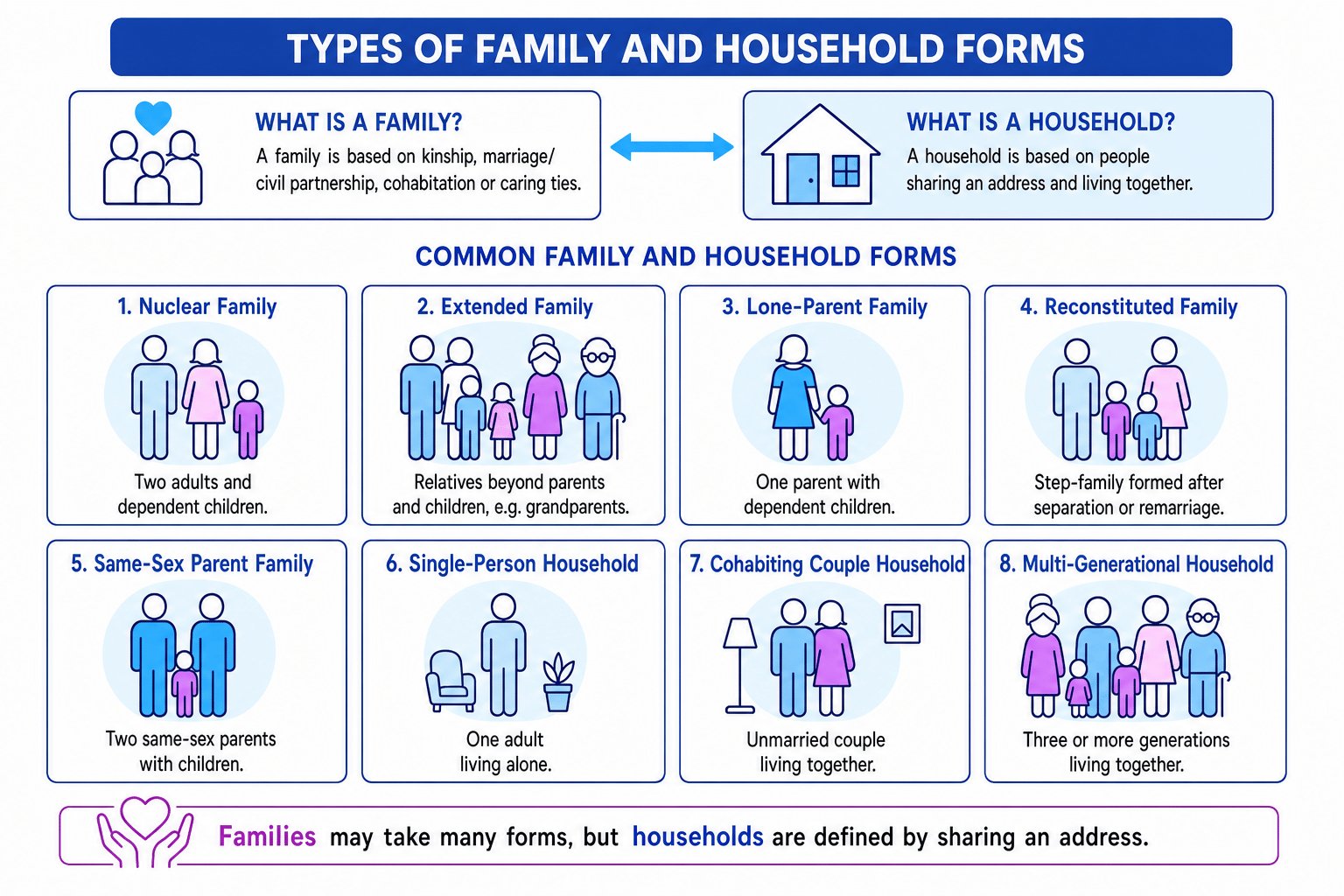
Main family and household forms
A nuclear family means two adults living with their dependent children. Dependent children are children who rely on adults for care, money and decision-making.
An extended family includes relatives beyond parents and children, such as grandparents, aunts, uncles or cousins. A lone-parent family has one parent living with dependent children. A reconstituted family, sometimes called a step-family, forms when adults create a new family after separation, divorce or remarriage.
A cohabiting couple lives together in an intimate relationship without being married or in a civil partnership. A same-sex parent family has two same-sex parents raising children. A single-person household is one person living alone.
Family diversity
Family diversity means that family life takes many forms, rather than one “normal” model. Rapoport and Rapoport (1982) argued that diversity appears in family structure, culture, social class, life stage and historical generation.
Family diversity has increased partly because of changing laws and values. For example, the Divorce Reform Act 1969 made divorce more accessible, the Civil Partnership Act 2004 recognised same-sex partnerships, and the Marriage (Same Sex Couples) Act 2013 allowed same-sex marriage in England and Wales from 2014.
Classifying a household
A source describes: “Amira lives with her mother, her mother’s new partner, her half-brother and her grandmother.”
- Apply the household test: they share one address, so they are one household.
- Apply the family test: they are linked by kinship and caring relationships, so they are also a family.
- Identify the reconstituted element: the mother’s new partner and half-brother suggest a step-family or reconstituted family.
- Identify the extended element: the grandmother means the family is also extended or multi-generational.
Assuming diversity means decline
Do not automatically treat divorce, cohabitation or lone parenthood as “family breakdown”. Sociologists disagree: some see decline, while others see adaptation, choice and changing social norms.
Socialisation, culture and identity
Primary socialisation is the early socialisation that usually happens in the family. Children learn values, which are broad beliefs about what matters, and norms, which are expected patterns of behaviour.
For example, families may teach ideas about gender, religion, language, food, manners, education and respect. These everyday routines help create identity. They also reproduce inequalities: Bourdieu argued that middle-class families often pass on cultural capital, meaning knowledge, habits and tastes that schools and employers tend to reward.
Theoretical perspectives: the big map
A theoretical perspective is a broad way of explaining society. In this topic, you often compare theories using two contrasts:
- Consensus theories stress shared values and social order.
- Conflict theories stress inequality, power and competing interests.
- Structure means large social forces, such as class, capitalism, patriarchy or law.
- Agency means people’s capacity to make choices and create meaning.
Use this map to remember where the main theories tend to sit.
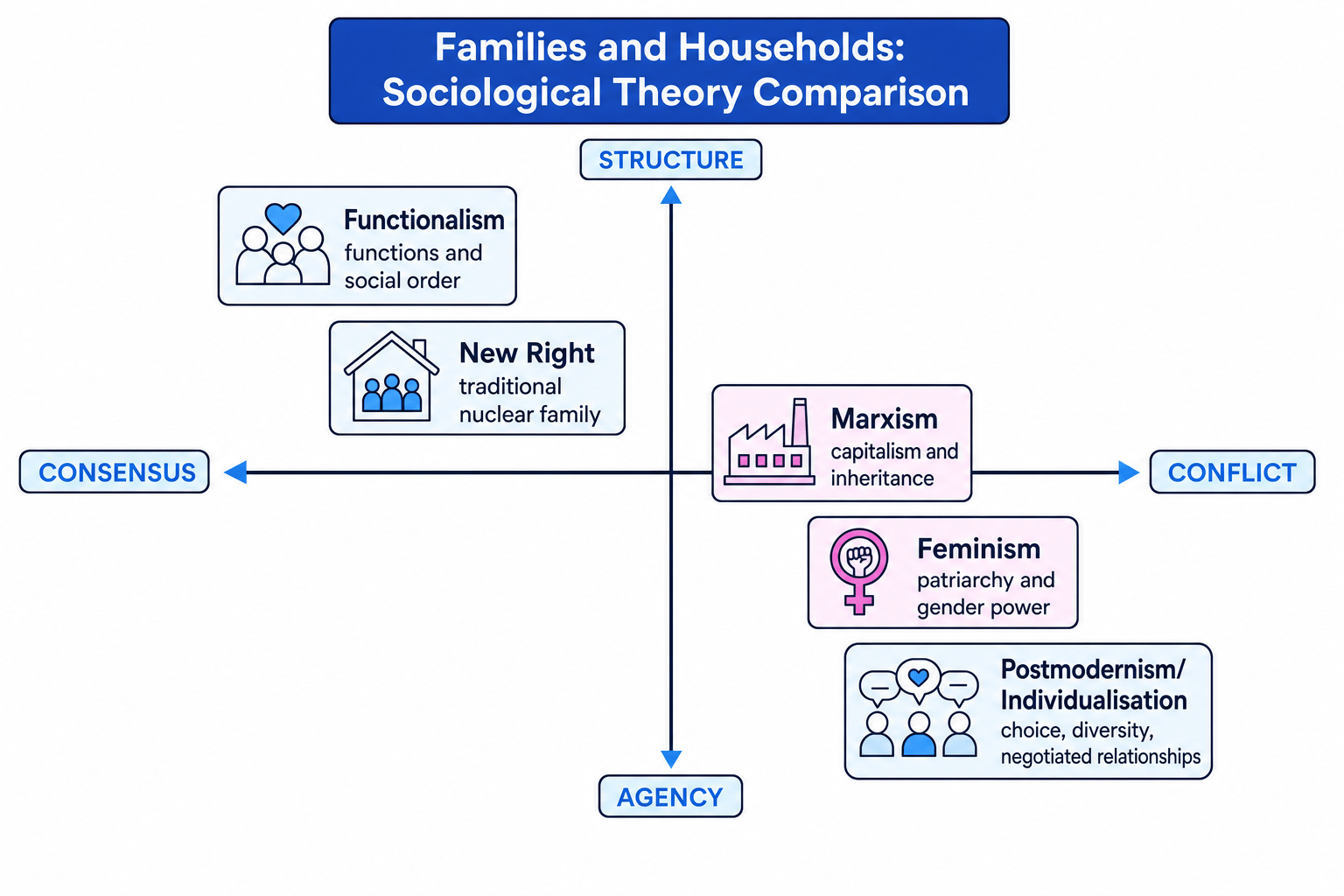
Functionalism: family as social order
Functionalism is a consensus and structural theory. It sees society as a system with parts that work together.
Murdock (1949) argued that the nuclear family is universal because it performs essential functions: sexual regulation, reproduction, economic cooperation and socialisation. Parsons (1955) argued that in industrial society the nuclear family became especially useful because it is mobile and focused on two “irreducible” functions: primary socialisation of children and stabilisation of adult personalities.
AO3 evaluation: functionalism can explain why families matter for social order, but it often assumes harmony. It can ignore domestic abuse, gender inequality, child conflict and the experiences of families that do not fit the nuclear model.
The New Right: the traditional family
The New Right is a conservative perspective that favours the traditional nuclear family. Thinkers such as Charles Murray argued that welfare dependency and lone parenthood can weaken responsibility and create an “underclass”.
AO2 application: New Right arguments often appear in debates about marriage promotion, benefit policy and concerns about absent fathers.
AO3 evaluation: critics argue that this view blames individuals for problems caused by poverty, insecure work, high housing costs and inequality. It may also ignore the stability and care found in cohabiting, lone-parent, same-sex and extended families.
Marxism: family and capitalism
Marxism is a conflict and structural theory based on class inequality. Marxists argue that society is shaped by capitalism, an economic system where a wealthy owning class profits from workers’ labour.
Engels linked the family to private property and inheritance. Zaretsky (1976) argued that the family supports capitalism by offering workers a private “haven”, while also encouraging consumption. Families buy houses, toys, technology, cars and holidays, so they become units of consumption.
AO3 evaluation: Marxism is useful for linking families to class, wealth and inheritance. However, it can be economically deterministic, meaning it explains too much through capitalism and too little through love, identity, gender, ethnicity or personal choice.
Feminism: family and patriarchy
Feminism focuses on gender inequality. Patriarchy means male power over women in society and social institutions.
Oakley (1974) challenged the idea that housework is naturally women’s work. Delphy and Leonard (1992) argued that men benefit from women’s unpaid domestic labour. Duncombe and Marsden described the triple shift, where women may do paid work, housework and emotional work.
AO2 application: UK debates about childcare costs, maternity and paternity leave, the gender pay gap and domestic abuse all connect family life to gender power.
AO3 evaluation: feminism is strong on power and inequality, but feminists disagree. Liberal feminists stress legal progress and equal opportunities; radical feminists stress continuing male domination; intersectional feminists add that class, ethnicity, sexuality and disability shape women’s family experiences differently.
Postmodernism and individualisation: choice and diversity
Postmodernism argues that society is more fragmented and diverse than in the past. Cheal (1991) suggested that family life has become less predictable. Individualisation, associated with Beck and Beck-Gernsheim (1995), means people are less controlled by tradition and must make their own life choices.
Giddens (1992) argued that modern relationships may become pure relationships, based more on emotional satisfaction than duty. Morgan (1996) preferred the term family practices, meaning the everyday actions through which people “do” family.
AO3 evaluation: these theories capture diversity, cohabitation, divorce, same-sex families and chosen families. However, “choice” is not equal for everyone. Class, gender, religion, ethnicity, migration status and housing costs can limit people’s options.
Applying theories to cohabitation
A source says: “More couples are living together before marriage, and some choose not to marry at all.”
- Functionalist/New Right application: ask whether cohabitation is seen as weakening or replacing the traditional nuclear family’s role in stability and socialisation.
- Feminist application: consider whether cohabitation gives women more independence from traditional marriage roles, or whether unpaid labour remains unequal.
- Marxist application: link cohabitation to economic conditions, such as insecure work, rent costs or delayed home ownership.
- Postmodern application: interpret cohabitation as evidence of individual choice, negotiated relationships and increasing family diversity.
- Evaluation: compare the perspectives rather than choosing one instantly; cohabitation may involve both choice and economic constraint.
Evidence and methods in this topic
The Office for National Statistics (ONS) and the Census provide official statistics, meaning government-collected quantitative data. Quantitative data is numerical data, such as rates of marriage, divorce, lone-parent households or people living alone. The Census is especially useful because it aims to cover the whole population every 10 years.
Reliability means research is consistent and repeatable. Official statistics are often reliable because categories and procedures are standardised. Representativeness means the data reflects the wider population; large-scale statistics are usually strong here.
But validity means whether evidence captures the truth or meaning of social life. Statistics may not show how happy, equal or supportive a family is. For that, sociologists may use qualitative data, such as interviews or observations, which explore meanings in depth.
Method evaluation shortcut
For any evidence on families, ask: How was it collected? Who might be missing? Does it measure structure only, or does it also capture meanings, power and lived experience?
Practical issues include time, cost, access and whether there is a clear sampling frame. Ethical issues include informed consent, confidentiality and avoiding harm, especially when researching sensitive topics such as divorce, domestic abuse or child-parent conflict.
Theoretically, positivists prefer reliable, representative data that reveals social patterns. Interpretivists prefer valid, detailed data about meanings and experiences. Strong exam answers often combine both.
Pulling the assessment objectives together
For Eduqas, keep all three assessment objectives in mind. Assessment Objective 1 (AO1) is knowledge: concepts, theories, studies and evidence. Assessment Objective 2 (AO2) is application: linking ideas to a source, example or contemporary UK context. Assessment Objective 3 (AO3) is analysis and evaluation: comparing perspectives, judging evidence and showing limitations.
In the exam
- Define key terms early: family, household, nuclear family, diversity, socialisation and patriarchy.
- Use named theorists for AO1, such as Murdock, Parsons, Engels, Zaretsky, Oakley, Delphy and Leonard, Beck, Giddens or Morgan.
- Add AO2 with a UK example, such as Census data, same-sex marriage law, cohabitation, childcare costs or housing pressures.
- Build AO3 by comparing perspectives: for example, functionalism stresses order, while feminism stresses gender power.
- Evaluate methods when using evidence: reliability, validity, representativeness, ethics and whether the data captures lived experience.
Check yourself
- How is a family different from a household?
- Why might the nuclear family be seen differently by functionalists, feminists and the New Right?
- Why can official statistics on families be reliable but still limited in validity?