What you'll learn
- How to identify major ethical issues in psychological research.
- How to apply ethical ideas to practical investigations and study scenarios.
- How researchers manage ethical risk using guidelines, debriefs and ethics committees.
- How to evaluate ethics in AO3 without just saying “it was unethical”.
Why ethics matters in psychology
Psychology studies people’s thoughts, feelings and behaviour. That means research can affect participants’ privacy, emotions, relationships, status and wellbeing. Ethics is about making sure research is conducted responsibly, not just efficiently.
In Eduqas Component 2, you may be asked to identify ethical issues in a novel scenario, explain how to deal with them, or evaluate a named study or your own practical investigation.
Ethics
Ethics refers to moral principles that guide how research should be planned, carried out and reported so that participants, researchers and wider society are protected.
The British Psychological Society, usually shortened to BPS, provides ethical guidance for psychologists. Its Code of Ethics and Conduct is built around principles such as respect, competence, responsibility and integrity.
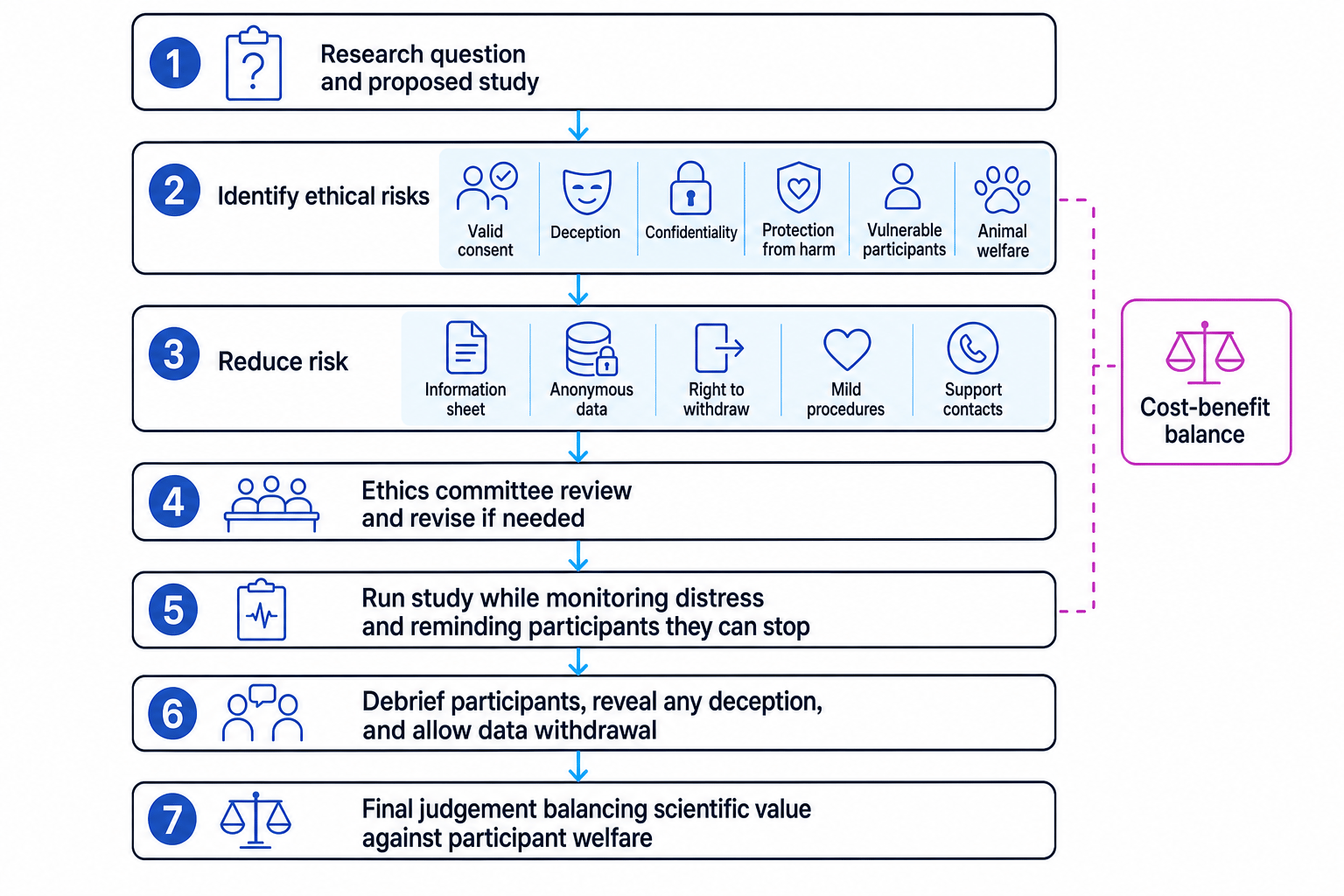
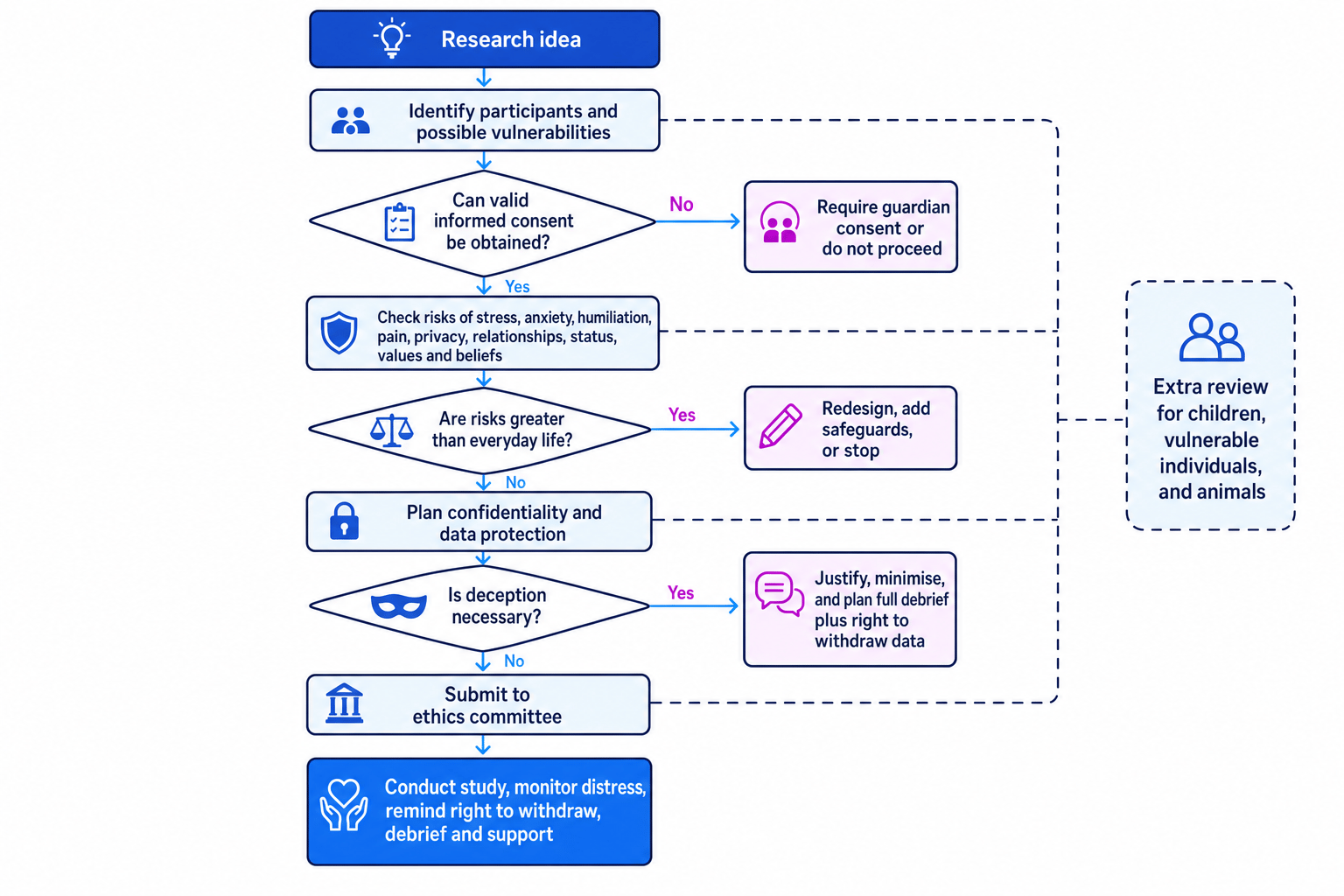
Ethics is easiest to think of as a decision process: identify the risk, reduce it, justify what remains, and monitor participants throughout the study.
The big ethical balance
Psychologists must balance the value of the research against the possible cost to participants or animals. A study is not automatically acceptable just because it produces useful findings.
Valid consent
Consent means agreement to take part. For consent to be valid, participants need enough information to make a free and informed choice.
Valid consent
Valid consent is consent that is informed, voluntary and given by someone competent to make the decision. Participants should know what they will do, any likely risks, their right to withdraw, and how their data will be used.
In practice, researchers usually provide an information sheet and consent form. These should explain the aim of the study, the task, approximate duration, any recording, confidentiality, the right to withdraw, and contact details for questions.
For children, consent is more complex. Researchers normally need parental or guardian consent, plus the child’s own assent, meaning the child shows they are willing to take part.
Checking whether consent is valid
A researcher asks Year 12 students to complete a questionnaire about exam stress. The teacher says, “Everyone should do this now,” and the students write their names on the sheet.
-
Check whether the choice is voluntary. Because the teacher says “everyone should”, students may feel pressured. This weakens valid consent.
-
Check whether participants are properly informed. They need to know the purpose, what questions will involve, how long it takes, and that they can skip questions or stop.
-
Check whether privacy has been protected. Writing names on stress questionnaires creates a confidentiality risk, especially in a school setting.
-
Improve the procedure. The researcher should give an information sheet, make participation clearly optional, collect anonymous responses where possible, and explain withdrawal rights.
Consent is not just a signature
A signed form does not prove valid consent if the participant was pressured, misled about serious risks, or did not understand what they were agreeing to.
Confidentiality, anonymity and privacy
Confidentiality means personal information is not shared in a way that identifies the participant. Anonymity is stronger: it means the researcher does not know who gave which response.
Confidentiality
Confidentiality means participants’ personal data and responses are protected so they cannot be identified in reports, presentations or shared datasets.
Researchers can protect confidentiality by using participant numbers instead of names, storing consent forms separately from results, password-protecting files, limiting access to data, and reporting group results rather than individual details.
Privacy is slightly different. Privacy is the participant’s right to control access to personal information and personal spaces. A public observation may still raise privacy issues if people reasonably believe they are not being studied.
Ethics also includes possible risks to participants’ values, beliefs, relationships, status or privacy. For example, a study on prejudice, addiction, criminal behaviour or mental health could affect how others see the participant if data were leaked.
Confidentiality versus anonymity
If you can match a response to a participant, it is confidential, not fully anonymous. If nobody can link the response to the person, it is anonymous.
Deception
Deception occurs when researchers mislead participants or withhold important information. It may involve a false aim, staged situation, confederate, or misleading feedback.
Deception
Deception is deliberately misleading participants or not telling them full information about the study when that information could affect their decision to take part.
Deception is sometimes used to reduce demand characteristics, where participants change their behaviour because they guess the aim of the study. However, deception threatens valid consent because participants cannot fully agree to something they do not properly understand.
Famous examples include Milgram’s obedience study in 1963, where participants were misled into believing they were giving electric shocks, and Watson and Rayner’s Little Albert study in 1920, where a child was conditioned to fear a white rat.
Judging whether deception is justified
A researcher tells participants they are doing a “memory task”, but the real aim is to see whether background noise increases irritability.
-
Decide whether deception affects consent. The false aim means participants cannot give fully informed consent about the real purpose.
-
Assess the level of risk. If the noise is mild and temporary, the deception may be low risk. If the task is designed to seriously upset participants, it becomes harder to justify.
-
Ask whether there is a non-deceptive alternative. If telling the real aim would not ruin the study, deception should be avoided.
-
Plan safeguards. The researcher should gain ethics approval, allow withdrawal, monitor distress, and give a full debrief explaining the true aim afterwards.
A debrief is a post-study explanation. It should explain the real aim, reveal any deception, check wellbeing, answer questions, remind participants of withdrawal rights, and provide support contacts if needed.
Debriefing does not erase all ethical problems
A debrief can reduce harm, but it does not automatically make serious deception or distress acceptable.
Risk of stress, anxiety, humiliation or pain
Researchers must protect participants from physical and psychological harm. This includes stress, anxiety, humiliation, embarrassment, pain, lowered self-esteem, or distressing memories.
The usual standard is that risk should be no greater than what participants might experience in everyday life. If risk is higher, researchers need a strong justification and extra safeguards.
Milgram’s 1963 study is a useful AO3 example. Many participants showed signs of extreme tension, such as sweating, trembling and nervous laughter. The study produced important evidence about obedience, but it raised serious concerns about deception, distress and the right to withdraw.
Zimbardo’s Stanford Prison Experiment in 1973 is another example often discussed in relation to humiliation, distress and role pressure. It also shows why researchers must be prepared to stop a study if harm emerges.
Protection from harm
Participants should leave the study in at least as good a psychological and physical state as when they entered it.
Researchers can reduce harm by screening participants, avoiding unnecessarily sensitive tasks, using mild procedures, allowing breaks, reminding participants they can withdraw, stopping if distress appears, and providing debriefing and support.
Values, beliefs, relationships, status and privacy
Some harm is social rather than physical. Research may challenge participants’ religious beliefs, political views, cultural values, personal identity or relationships.
For example, a questionnaire about family conflict could create tension if answers are seen by relatives. A study about cheating, prejudice or drug use could damage someone’s status if their responses are identifiable.
This is especially important in socially sensitive research. Socially sensitive research investigates topics that may have consequences for the participant or the group they belong to, such as mental illness, criminality, gender, culture or intelligence.
Spotting social risk in a scenario
A researcher interviews employees about bullying at work and plans to quote individual responses in a report for the company manager.
-
Identify who could be harmed. Employees could suffer damaged relationships, reduced status or workplace consequences if they are recognised.
-
Identify the risky design feature. Direct quotes may reveal identity through wording, job role or specific incidents, even if names are removed.
-
Reduce the risk. The researcher should anonymise details, avoid identifiable quotes, report themes across the group, and make clear that the employer cannot access raw data.
Working with vulnerable individuals
A vulnerable individual is someone who may have reduced ability to give free informed consent or who may be at greater risk of harm. This can include children, people with learning disabilities, people experiencing mental health difficulties, patients, prisoners, or people dependent on an authority figure.
Vulnerable individuals
Vulnerable individuals are participants who may need additional protection because of age, capacity, dependency, distress, illness, disability or power imbalance.
When working with children, researchers should use age-appropriate language, gain guardian consent, seek the child’s assent, avoid pressure from teachers or parents, and stop if the child seems uncomfortable.
Bandura, Ross and Ross’s 1961 Bobo doll study involved children watching aggressive adult models. In evaluation, you could discuss whether exposing children to aggression was justified, whether parents gave consent, and whether the children were protected from long-term effects.
For adults in vulnerable situations, researchers should consider capacity to consent, support needs, safeguarding duties and the possibility that people may feel unable to refuse.
Power imbalance
Consent may not be fully voluntary if participants think saying no could affect their grades, treatment, job, care or relationship with an authority figure.
Working with animals
Some psychological research uses non-human animals, often because researchers want high control, biological evidence, or procedures that would be unethical with humans. However, animals cannot give consent, so researchers have a special duty to protect welfare.
Animal research in the UK is controlled by legal and ethical rules, including the Animals (Scientific Procedures) Act 1986 and BPS guidance. Researchers must justify the use of animals and minimise suffering.
A key framework is the 3Rs:
- Replacement: use non-animal alternatives where possible.
- Reduction: use the fewest animals needed for valid results.
- Refinement: improve procedures to reduce pain, distress or lasting harm.
Harlow’s research with rhesus monkeys in the 1950s is often used in ethical debate. It contributed to understanding attachment and the importance of comfort, but it involved separation and distress, so it would require very strong scrutiny today.
Applying the 3Rs to animal research
A psychologist wants to test whether a new enrichment toy reduces stress behaviours in lab rats.
-
Apply replacement. The researcher should ask whether existing video data, computer modelling or human volunteer research could answer the question instead.
-
Apply reduction. If animals are necessary, the sample should be large enough for meaningful results but not larger than needed.
-
Apply refinement. The study should use non-invasive observation, suitable housing, enrichment, careful monitoring, and humane endpoints if animals show distress.
-
Judge the cost-benefit balance. The likely scientific or welfare benefit must be strong enough to justify any remaining risk.
Managing ethical issues
Ethical issues are not just spotted after a study has happened. They should be managed before, during and after the research.
Ethics committee
An ethics committee is a group that reviews research proposals before data collection to check whether the design follows ethical guidelines and whether risks have been properly managed.
An ethics committee may ask researchers to change the consent form, reduce deception, add safeguarding procedures, improve confidentiality, provide support contacts, or stop the study from going ahead.
Researchers also use ethical guidelines. These are formal rules or recommendations that help psychologists make consistent decisions. Guidelines do not remove judgement, but they give a clear standard for planning and evaluation.
For your own practical investigation in Component 2, you should be able to explain practical safeguards such as using anonymous response sheets, avoiding sensitive questions, gaining consent, allowing withdrawal, storing data securely, and debriefing participants.
AO3 ethics structure
For evaluation, use the pattern issue → why it matters → how it was managed → judgement. This avoids simply listing “consent, deception, harm” without analysis.
Writing about ethics in essays
For AO1, accurately describe the ethical issue. For AO2, apply it to the study or scenario. For AO3, make a balanced judgement.
For example, “deception occurred” is weak on its own. A stronger point would explain that deception undermined valid consent, apply this to what participants were misled about, then evaluate whether debriefing, right to withdraw and scientific value reduced the ethical concern.
In the exam
-
Name the exact ethical issue rather than writing “it was unethical”. Use terms such as valid consent, confidentiality, deception, protection from harm or vulnerable participants.
-
Apply the issue to the scenario or study. Say precisely who is at risk and how they could be affected.
-
Explain management strategies. Mention ethics committees, guidelines, consent forms, debriefing, withdrawal rights, anonymity, support and extra safeguards for children, vulnerable individuals or animals.
Check yourself
- What makes consent valid rather than just “given”?
- How are confidentiality and anonymity different?
- Why do children, vulnerable individuals and animals require extra ethical protection?