What you'll learn
- How prejudice, stereotypes and discrimination are different but connected.
- How individual differences, especially personality, can affect prejudice.
- How situations such as competition, group norms and contact can increase or reduce prejudice.
- How culture teaches attitudes through social learning, media, history and social norms.
Starting point: what are we explaining?
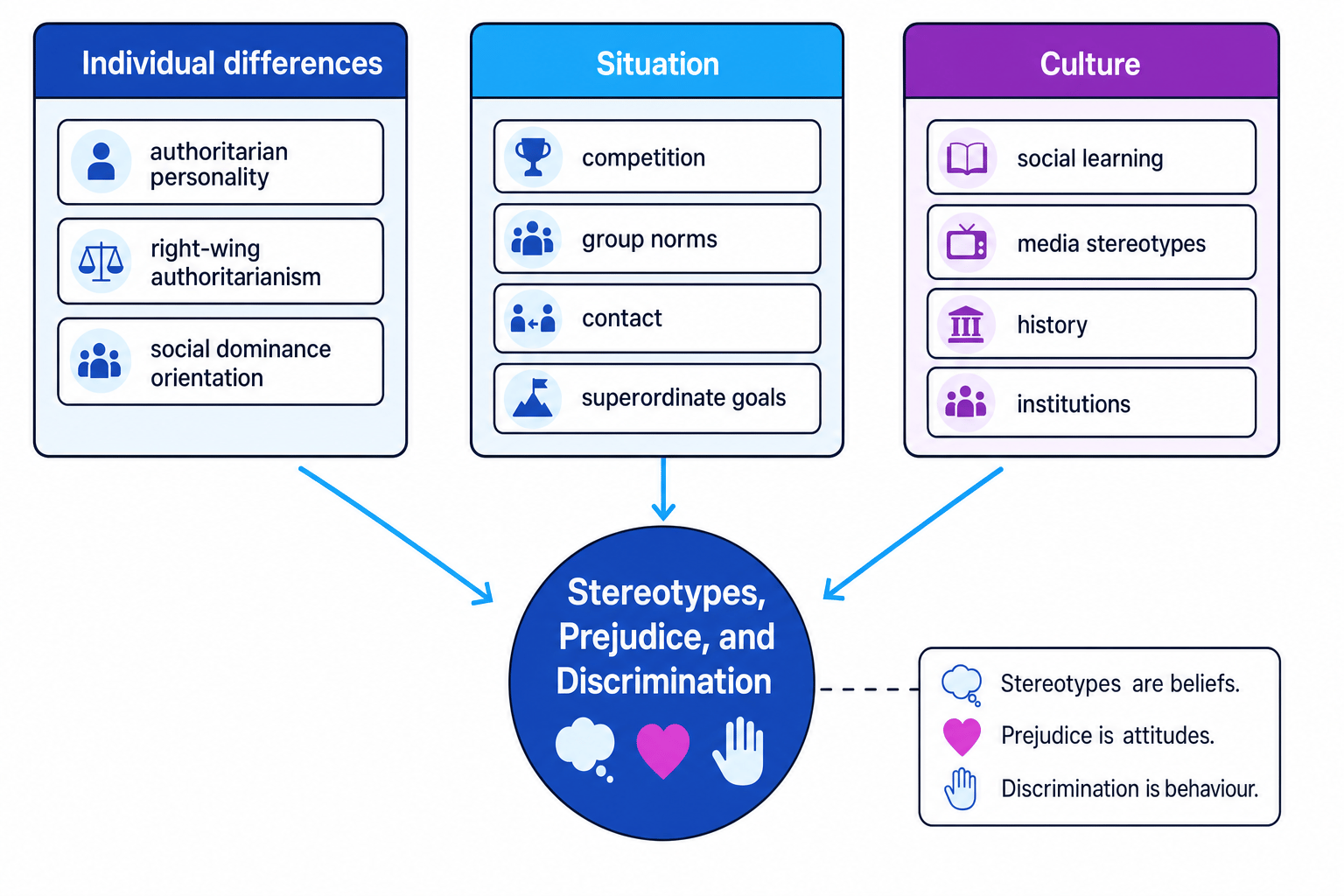
Before you can explain factors affecting prejudice, you need to separate three related ideas: what people believe, what they feel, and what they do.
Prejudice, stereotypes and discrimination
- Prejudice is a negative attitude or feeling towards a person because they belong to a particular social group.
- A stereotype is an oversimplified belief about the characteristics of a group.
- Discrimination is behaviour that treats people unfairly because of their group membership.
For example, someone might believe “older people are bad with technology” — that is a stereotype. If they feel irritated or suspicious around older people because of that belief, that is prejudice. If they refuse to hire an older applicant because of it, that is discrimination.
Separating belief, attitude and behaviour
A student says, “People from that area are trouble,” feels nervous sitting near them, and chooses not to invite them to a group project.
- The statement “People from that area are trouble” is a stereotype because it generalises about a whole group.
- The nervous feeling is prejudice because it is an attitude or emotional response towards members of that group.
- Excluding them from the group project is discrimination because it is an unfair action based on group membership.
The three-level view
For Edexcel 9PS0, you should be able to explain factors affecting prejudice and discrimination at three broad levels:
- Individual differences — what the person is like, especially personality.
- Situation — what is happening around the person.
- Culture — what wider society teaches, normalises or rewards.
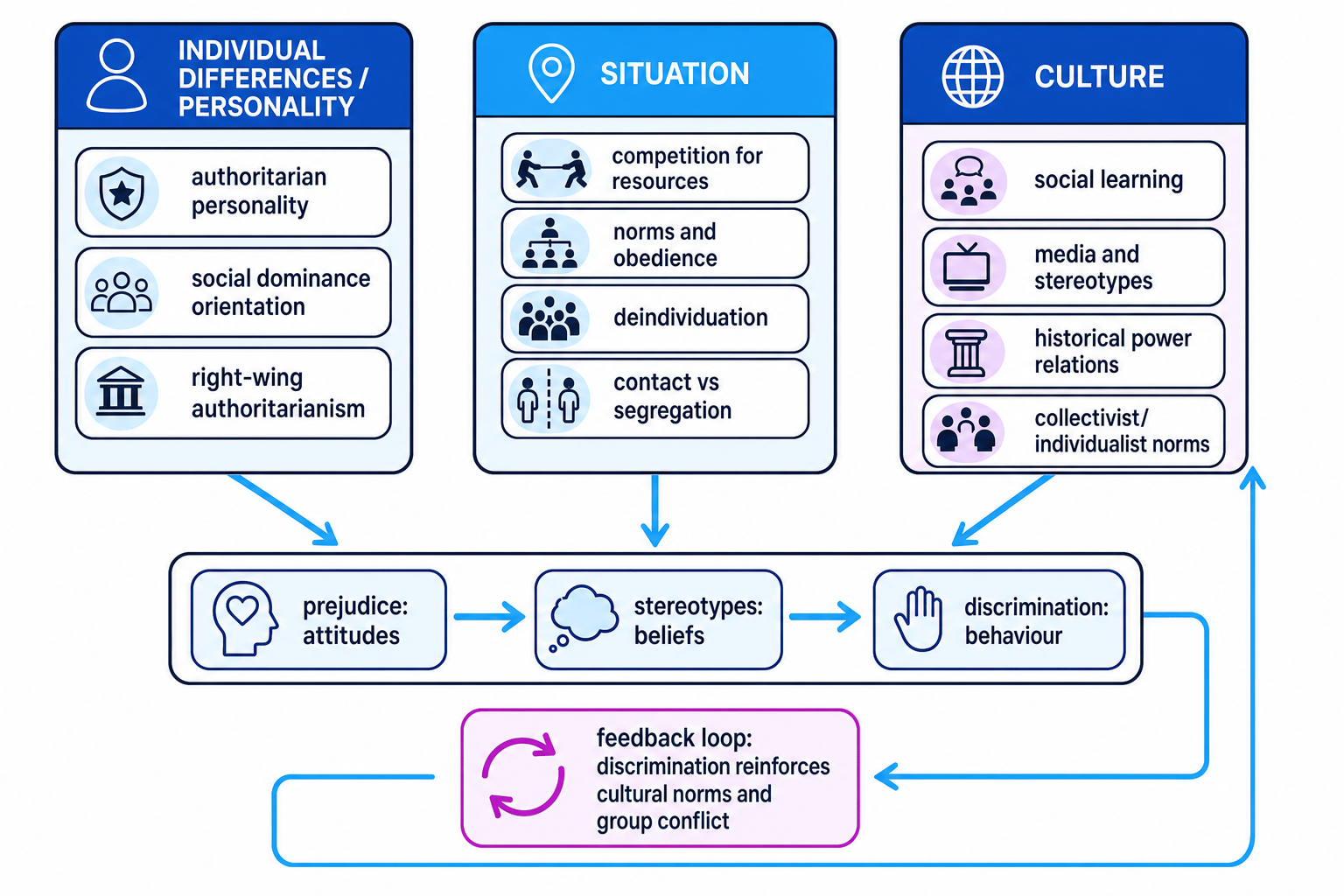
These factors usually work together rather than separately.
Main takeaway
Prejudice is not caused by one simple thing. A strong answer usually explains how personality, immediate social situations and wider cultural norms interact.
Individual differences: personality
Individual differences
Individual differences are characteristics that vary from one person to another, such as personality traits, beliefs, values or levels of authoritarianism.
One explanation is that some people are more likely to develop prejudice because of their personality.
Authoritarian personality
The classic version is the authoritarian personality, proposed by Adorno et al. (1950) in The Authoritarian Personality. Adorno argued that people raised with very strict, punitive parenting may develop:
- strong respect for authority
- hostility towards people seen as “different” or lower status
- rigid thinking
- conventional values
- a tendency to displace anger onto weaker out-groups
Adorno measured this using the F-scale, where “F” stood for fascism. Higher scores were linked to more prejudiced attitudes.
Later work refined this idea. Altemeyer (1981) developed right-wing authoritarianism, often shortened to RWA, involving submission to authority, aggression towards norm-breakers, and strong conventionalism. Pratto et al. (1994) developed social dominance orientation, or SDO, which is the extent to which someone prefers hierarchy between social groups.
AO3 evaluation of personality explanations
A strength is that personality explanations help explain why not everyone in the same situation or culture shows the same level of prejudice. For example, two people may see the same media coverage, but the person higher in RWA or SDO may respond with stronger prejudice.
However, personality explanations are often correlational. If high RWA is associated with prejudice, that does not prove RWA directly causes prejudice. It could be that family background, education, peer groups or culture influence both.
There is also a measurement issue. People may hide prejudiced attitudes because they know they are socially unacceptable. This is called social desirability bias.
Correlation is not causation
Do not write that Adorno “proved” authoritarian personality causes prejudice. A safer phrase is: authoritarian traits are associated with higher levels of prejudice.
Using personality as an explanation
A person strongly believes society needs strict authority, dislikes people who break traditional norms, and supports harsh treatment of minority groups.
- The strong support for authority suggests right-wing authoritarianism, because the person values obedience and social order.
- The dislike of norm-breakers can explain prejudice because out-groups may be seen as threatening traditional values.
- The support for harsh treatment links prejudice to potential discrimination, because the attitude may translate into unequal treatment.
- A balanced answer should add that personality may not be the only factor; cultural messages or current threats could strengthen the response.
Situation: what the context makes likely
Situation
A situation is the immediate social context a person is in, including group membership, competition, authority, peer norms and opportunities for contact.
Situational explanations argue that prejudice can increase or decrease depending on what is happening around the person.
Competition and realistic conflict
Realistic conflict theory argues that prejudice increases when groups compete for limited resources, such as jobs, territory, money or status.
A key study is Sherif et al.’s Robbers Cave study (1954/1961). Boys at a summer camp were split into two groups. When the groups competed, hostility and prejudice increased. When they had to work together on superordinate goals — goals that required cooperation — hostility reduced.
Superordinate goal
A superordinate goal is a shared goal that can only be achieved if groups cooperate.
Social identity and minimal groups
Situations do not always need real competition. Tajfel et al. (1971) showed that simply categorising people into groups can create in-group favouritism. In minimal group experiments, participants favoured their own group even when the groups were meaningless.
In-group and out-group
An in-group is the group someone sees themselves as belonging to. An out-group is a group they see as separate from their own.
This suggests prejudice can come from the desire to maintain a positive social identity: “my group is better than their group.”
Contact and prejudice reduction
Allport’s contact hypothesis (1954) argues that contact between groups can reduce prejudice, but especially when certain conditions are present:
- equal status between groups
- cooperation rather than competition
- common goals
- support from authorities or social institutions
A major meta-analysis by Pettigrew and Tropp (2006) found that intergroup contact generally reduces prejudice, especially when Allport’s conditions are met.
AO3 evaluation of situational explanations
A strength is real-world application. Schools, workplaces and communities can reduce prejudice by creating cooperative, equal-status contact.
A weakness is that contact does not always work. If contact happens in unequal, hostile or competitive conditions, it may reinforce prejudice instead of reducing it.
Sherif’s Robbers Cave study also raises ethical issues by modern standards. The boys were exposed to conflict and deception, and the study took place before today’s BPS expectations around informed consent, protection from harm, right to withdraw and debriefing.
Explaining prejudice after competition
Two groups of students get along at first, but hostility increases after they are told only one group can win a prize.
- The prize creates competition for a limited resource, so realistic conflict theory is relevant.
- The students begin to see the other group as an out-group, which can increase negative stereotypes and in-group loyalty.
- If the teacher later gives them a shared task where both groups must cooperate to succeed, this introduces a superordinate goal.
- Prejudice should reduce if cooperation is meaningful and both groups have equal status.
Situation is useful for explaining change
If prejudice appears quickly, increases in a crowd, or changes when group rules change, a situational explanation is often stronger than a purely personality-based one.
Culture: what society teaches
Culture
Culture refers to the shared norms, values, beliefs, practices and expectations of a society or social group.
Cultural explanations argue that prejudice is learned from the social world. This includes families, schools, religion, media, political language, laws and historical power relationships.
Social learning
According to social learning theory, associated with Bandura (1977), people learn behaviours and attitudes by observing others and noticing rewards or punishments.
A child might hear adults make prejudiced comments, see those comments go unchallenged, and learn that this attitude is acceptable. If peers laugh at discriminatory jokes, prejudice may be socially rewarded.
Media and stereotypes
Culture can also affect prejudice through repeated stereotypes in films, news, advertising or social media. If a group is repeatedly shown as dangerous, dependent, unintelligent or comic, those associations can become familiar and feel “normal”.
Classic stereotype research by Katz and Braly (1933) found that Princeton students showed shared stereotypes about national and ethnic groups. Later replications found that stereotypes changed over time, suggesting that prejudice reflects cultural norms rather than fixed truths.
Historical power relations
Some prejudices are linked to long histories of inequality, colonialism, class hierarchy, sexism, racism or religious conflict. In these cases, discrimination may be built into institutions as well as individual attitudes. This is why prejudice is not only about “bad individuals”; it can be reinforced by policies, traditions and unequal access to power.
AO3 evaluation of cultural explanations
A strength is that cultural explanations account for why prejudice varies across societies and historical periods. If stereotypes change over time, this suggests they are learned rather than biologically fixed.
A limitation is the risk of overgeneralising. Saying “that culture is prejudiced” can itself become a stereotype. A better answer explains specific cultural messages, norms or institutions, while recognising individual differences within any culture.
Applying culture without stereotyping
A TV drama repeatedly shows one ethnic group as criminals, while another group is shown as professionals and leaders.
- The repeated portrayals act as cultural messages, because they are part of the media environment people observe.
- Social learning theory suggests viewers may learn associations between the first group and criminality, especially if the stereotype is not challenged.
- This could increase prejudice by shaping negative attitudes, and may lead to discrimination if viewers treat real people according to the stereotype.
- A careful answer avoids saying all viewers will become prejudiced, because personality, prior beliefs and contact with the group will affect responses.
Overgeneralising culture
Avoid phrases like “people from this culture are prejudiced.” Instead, write about specific norms, media messages, laws or historical inequalities that may encourage prejudice.
How the factors interact
In strong essay answers, do not treat individual differences, situation and culture as completely separate boxes.
For example, Duckitt and Sibley’s dual-process model (2007) suggests that different worldviews predict different forms of prejudice. People who see the world as dangerous may be more drawn to authoritarianism and prejudice towards groups seen as threatening. People who see the world as competitive may be more likely to show social dominance orientation and prejudice towards low-status groups.
So, the same situation can affect people differently. A period of economic uncertainty might increase prejudice most strongly among people already high in authoritarianism or social dominance orientation, especially if the culture also contains hostile media stereotypes.
Researching prejudice ethically
Research into prejudice can be sensitive because participants may reveal socially unacceptable attitudes or be exposed to upsetting material. Under the BPS Code of Ethics and Conduct (2009), researchers should consider:
- consent — participants should know enough to make an informed choice
- deception — only used when justified and followed by a full debrief
- right to withdraw — participants should be able to leave without penalty
- protection from harm — avoid distress, humiliation or conflict
- confidentiality — responses about prejudice must be handled carefully
- debrief — participants should understand the study’s purpose afterwards
This is especially important when evaluating older studies such as Sherif’s Robbers Cave study, which would face stricter ethical scrutiny today.
In the exam
- Define the key terms first: prejudice is an attitude, stereotypes are beliefs, and discrimination is behaviour.
- Use the three-factor structure: individual differences, situation and culture. This gives your answer clear AO1 organisation.
- Evaluate with balance: personality explains individual variation, situation explains rapid change, and culture explains shared norms over time.
- Apply to scenarios carefully: look for evidence of traits, competition/contact, or learned cultural messages.
- Add ethics when studies are used: especially consent, deception, protection from harm, confidentiality, right to withdraw and debrief.
Check yourself
- How is prejudice different from discrimination?
- Why might competition between groups increase prejudice?
- How can culture influence prejudice without every individual in that culture being prejudiced?