What you'll learn
- How environmental effects can shape obedience and prejudice over development.
- Why gender and culture are treated as learned social influences, not fixed biological causes.
- How to apply evidence from studies such as Milgram (1963), Burger (2009), Sherif (1954/1961) and Tajfel et al. (1970/1971).
- How to evaluate this explanation using AO3 points about methods, ethics and real-world usefulness.
Big picture: why is this developmental psychology?
Developmental psychology looks at how behaviour changes as people grow and gain experience. In this part of Social Psychology, the focus is not on babies or childhood stages directly. It is on how social behaviour — especially obedience and prejudice — may be learned through the environment over time.
That means you should think about the influences around a person: family, school, peers, media, religion, laws, history and wider cultural expectations.
Environmental effects
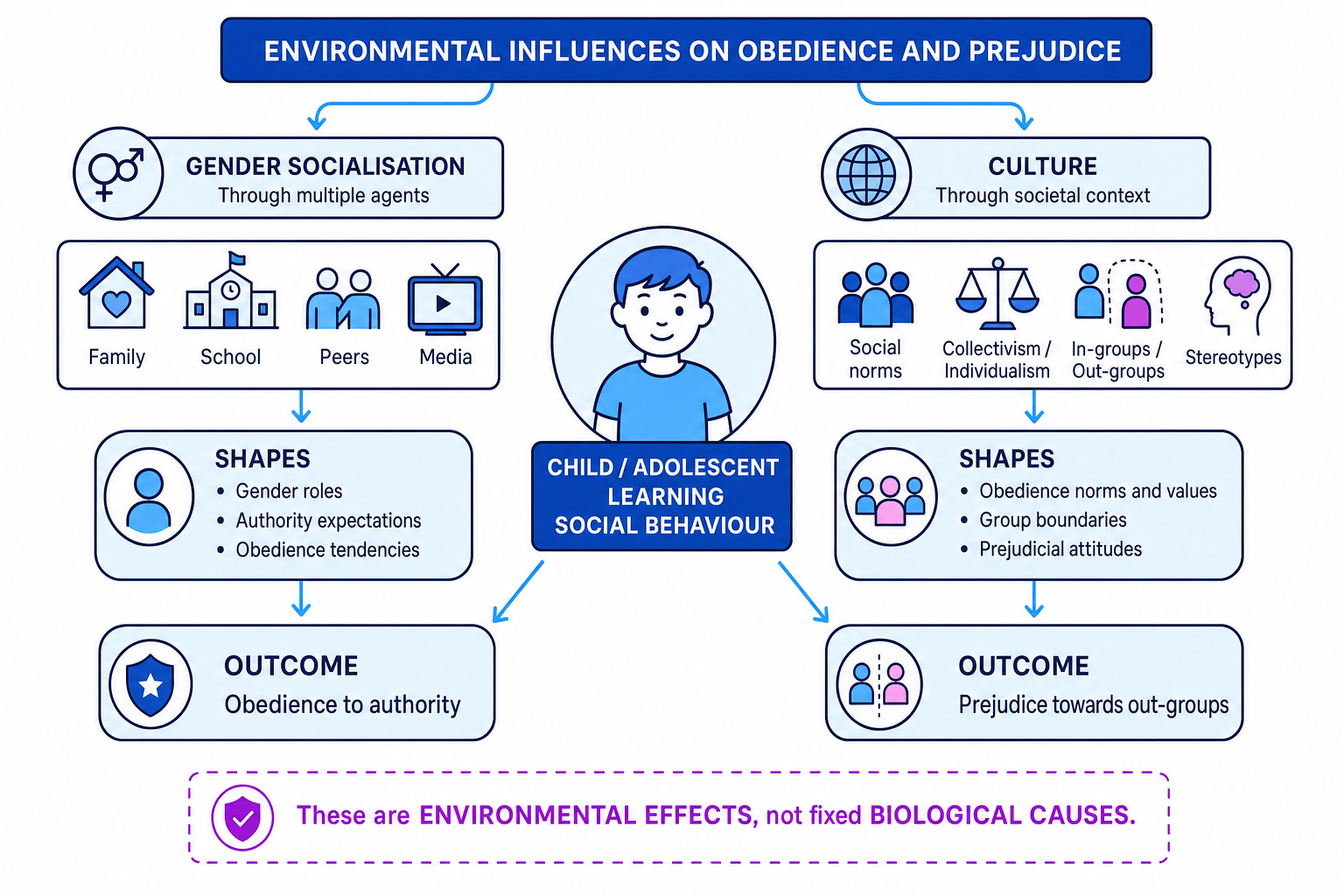
An environmental effect is an influence on behaviour that comes from a person’s surroundings and experiences, rather than from inherited biology. In this topic, gender roles and cultural norms are treated as environmental because people learn them through socialisation.
This diagram shows the basic route: people develop within social environments, and those environments can shape how they respond to authority and to out-groups.
Key terms: obedience, prejudice, gender and culture
Obedience and prejudice
Obedience is following a direct order from an authority figure. Prejudice is a usually negative attitude towards a person or group, often based on stereotypes rather than individual evidence.
A stereotype is a fixed, oversimplified belief about a group. Discrimination is behaviour that treats people differently because of group membership. So prejudice is the attitude; discrimination is the action.
Gender means the socially learned roles, expectations and identities linked to being male, female or another gender identity. It is not the same as biological sex. Culture means the shared values, customs, norms and beliefs of a group or society.
Sex is not the same as gender
Do not write that “males obey because of biology” if the question asks about gender as an environmental effect. A stronger answer says gender roles are learned through socialisation, such as being rewarded for being compliant, assertive, respectful or independent.
The learning route: socialisation and social learning
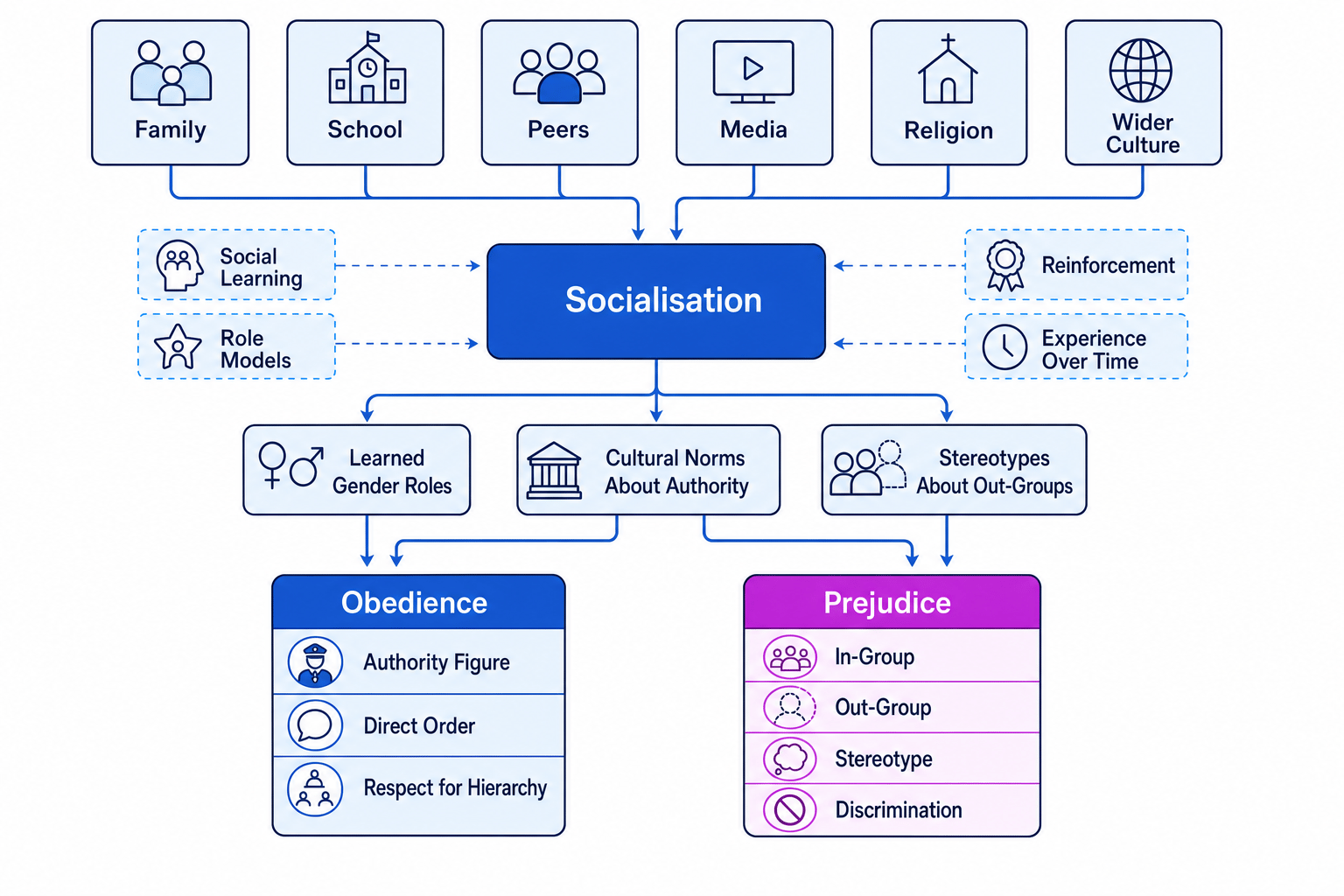
Socialisation is the process of learning the norms and expectations of society. A norm is an unwritten rule about what behaviour is seen as acceptable.
One important learning process is social learning theory, linked to Bandura (1977). People can learn by watching others, copying role models and seeing whether behaviour is rewarded or punished. This is especially useful for explaining how children may learn respect for authority or attitudes towards out-groups.
Tracing an environmental influence
A child sees older siblings being praised for doing exactly what a teacher says, even when they complain privately.
- Identify the environmental source: The influence comes from family and school, not from the child’s genes.
- Apply the learning process: The child observes a role model being rewarded for obedience, so obedience becomes more likely through vicarious reinforcement.
- Link it to the behaviour: When the child later receives an order from a teacher, they may obey because they have learned that authority figures should be followed.
- Avoid determinism: This does not mean the child must always obey; the situation, personality and competing norms can still affect behaviour.
Gender and obedience
The specification says obedience can be affected by gender, and gender comes from environmental effects. This means the focus is on learned expectations about how different genders “should” behave.
In some social environments, girls may be encouraged to be polite, caring and compliant, while boys may be encouraged to be independent or assertive. In other environments, boys may be socialised to respect hierarchy and authority strongly. Either pattern could affect obedience depending on what the culture teaches about gender roles.
However, the evidence does not show a simple “one gender obeys more” rule. Milgram’s original obedience study (1963) used only male participants, which limits what it can tell us about gender. In a later female sample reported by Milgram, obedience was similar to the male sample. Burger (2009), in a partial replication with stronger ethical safeguards, also found no clear gender difference.
Gender is a possible influence, not a fixed rule
For AO1, explain how gender socialisation could shape obedience. For AO3, evaluate by saying research often finds situation and authority pressure to be more powerful than gender alone.
Evaluating gender as an explanation
A strength is that gender socialisation helps explain why people may behave differently in different social contexts. It is flexible and can account for changes over time, as gender roles shift across generations.
A weakness is that many obedience studies were not designed mainly to test gender. If gender is treated only as “male versus female”, the research may ignore gender identity, upbringing, culture and personality. This makes the explanation too simplistic.
Culture and obedience
Culture can also affect obedience because societies differ in how they teach people to view authority. Some cultures place strong emphasis on respect for elders, hierarchy, community and duty. Others place more emphasis on personal autonomy, questioning authority and individual choice.
A useful distinction is between collectivist cultures, which tend to emphasise group harmony and social duties, and individualist cultures, which tend to emphasise personal independence. This is a broad pattern, not a perfect rule.
Evidence comes from cross-cultural research on social influence. Bond and Smith (1996) carried out a meta-analysis of Asch-style conformity studies and found that conformity tended to be higher in collectivist cultures. This is not direct evidence about obedience, but it supports the idea that cultural norms can influence responses to social pressure.
Milgram-style obedience studies have also found different obedience rates across countries, such as high obedience in Mantell’s (1971) German replication and lower obedience in Kilham and Mann’s (1974) Australian study. However, these studies also differed in procedure, time period and sample, so culture is not the only possible explanation.
Culture and prejudice
Culture can affect prejudice by teaching people which groups are seen as “us” and “them”. Children may learn stereotypes from jokes, media portrayals, family comments, peer approval, school experiences or wider social conflict.
This links well to social identity theory, proposed by Tajfel and Turner (1979). The theory argues that people categorise themselves into in-groups and out-groups, then seek a positive social identity by favouring their own group. Tajfel et al. (1970/1971) showed that even minimal group labels could lead boys to favour their in-group when allocating points.
Culture can also shape prejudice through competition. Realistic conflict theory, illustrated by Sherif’s Robbers Cave study (1954/1961), suggests that prejudice can arise when groups compete over limited resources. In the study, boys at a summer camp developed hostility after being placed into competing groups, but hostility reduced when they had to cooperate on shared goals.
Applying culture to prejudice
A teenager grows up in a community where a minority group is often described as “dangerous” in local media and family conversations.
- Identify the attitude: The teenager’s negative expectation is prejudice because it is based on group membership rather than individual evidence.
- Locate the cultural source: The belief is learned from repeated messages in the social environment, such as family and media.
- Apply a theory: Social identity theory explains how the teenager may see their own group as the in-group and the minority group as an out-group.
- Suggest a developmental change: Prejudice could reduce if the teenager has equal-status contact or cooperative experiences with members of the out-group.
AO3: strengths, weaknesses and ethics
A major strength of environmental explanations is that they explain variation. If obedience and prejudice were purely biological, we would not expect them to change so much across cultures, historical periods and social settings. Environmental explanations also have practical value: they suggest prejudice can be reduced through education, intergroup contact and cooperative goals.
A weakness is that “culture” is a very broad concept. Researchers may oversimplify cultures as collectivist or individualist, even though every culture contains variation. Gender and culture also interact with age, social class, ethnicity, religion and personality, so it can be difficult to isolate one cause.
Ethics are important because many classic studies used deception or created distress. Milgram’s obedience research involved deception, pressure to continue and potential psychological harm. Burger (2009) improved this by stopping at 150 volts, screening participants and debriefing them, but deception was still involved. Sherif’s Robbers Cave study also raises issues because the boys did not fully know they were in a study.
Under the BPS Code of Ethics and Conduct (2009), psychologists should consider consent, deception, right to withdraw, protection from harm, confidentiality and debriefing.
Methods link
If you investigated this topic yourself, choose the test from the design and data: Mann-Whitney U for a difference between two independent groups, Wilcoxon signed-ranks for a difference using related scores, Spearman’s rho for a correlation, and chi-square for an association between categories. The usual significance level is p≤.05p \le .05p≤.05, with p≤.10p \le .10p≤.10 being more lenient and p≤.01p \le .01p≤.01 more strict. For Mann-Whitney U and Wilcoxon, the observed value must usually be equal to or smaller than the critical value; for Spearman’s rho and chi-square, it must usually be equal to or larger.
How this becomes an essay answer
For AO1, describe the environmental route clearly: gender roles and cultural norms are learned through socialisation, and these may affect obedience or prejudice.
For AO2, apply the idea to the scenario. If the scenario mentions parents, school, media, peers, religion or national values, link those cues to environmental learning.
For AO3, avoid claiming that gender or culture always causes obedience or prejudice. The best evaluation says these influences matter, but they interact with situational pressure, individual differences and research methodology.
In the exam
- Define the behaviour first: Make it clear whether you are explaining obedience, prejudice, or both.
- Use environmental language: Write about socialisation, norms, role models, reinforcement and cultural values.
- Evaluate with balance: Support the idea using named evidence, then add limits such as cultural oversimplification, gender confounds and ethical issues.
Check yourself
- How is gender different from biological sex in this part of the specification?
- Why might culture affect obedience to authority?
- How can social identity theory explain culturally learned prejudice?