What you'll learn
- What Steyvers and Hemmer (2012) investigated about reconstructive memory in everyday settings.
- How schemas, noisy memory traces, and Bayesian reasoning help explain memory errors.
- The study’s key procedures, findings, and conclusions for AO1.
- How to evaluate the study for AO3, including methodology, ethics, and real-world application.
The big idea: memory is reconstructed, not replayed
When you remember something, your mind does not simply “play back” a perfect recording. Instead, it often reconstructs the memory using two sources of information:
- details you actually encoded at the time
- your existing knowledge about what usually happens in that kind of situation
This links strongly to Bartlett’s classic study of reconstructive memory, War of the Ghosts (1932). Bartlett showed that people changed unfamiliar story details so they fitted their cultural expectations. Steyvers and Hemmer (2012) developed this idea using more naturalistic, everyday visual materials.
Reconstructive memory
Reconstructive memory is the idea that recall is an active rebuilding process, where remembered information is influenced by previous knowledge, expectations, and schemas.
Schema
A schema is a mental framework of knowledge about a person, object, event, or situation. For example, your “kitchen schema” includes expectations about sinks, cupboards, plates, and food preparation.
Why “naturalistic environments” matter
Many memory studies use artificial tasks, such as recalling lists of unrelated words. These are useful because they allow tight control, but they may not reflect everyday memory very well.
Steyvers and Hemmer were interested in memory in naturalistic environments.
Naturalistic environment
A naturalistic environment is a setting or stimulus that resembles real-life experience more closely than an artificial laboratory task. In this study area, that means meaningful scenes and objects rather than random word lists.
This matters because everyday memory usually involves meaningful surroundings. If you try to remember where a mug was in a room, you may use your general knowledge that mugs are often on tables, desks, or kitchen counters.
Main takeaway
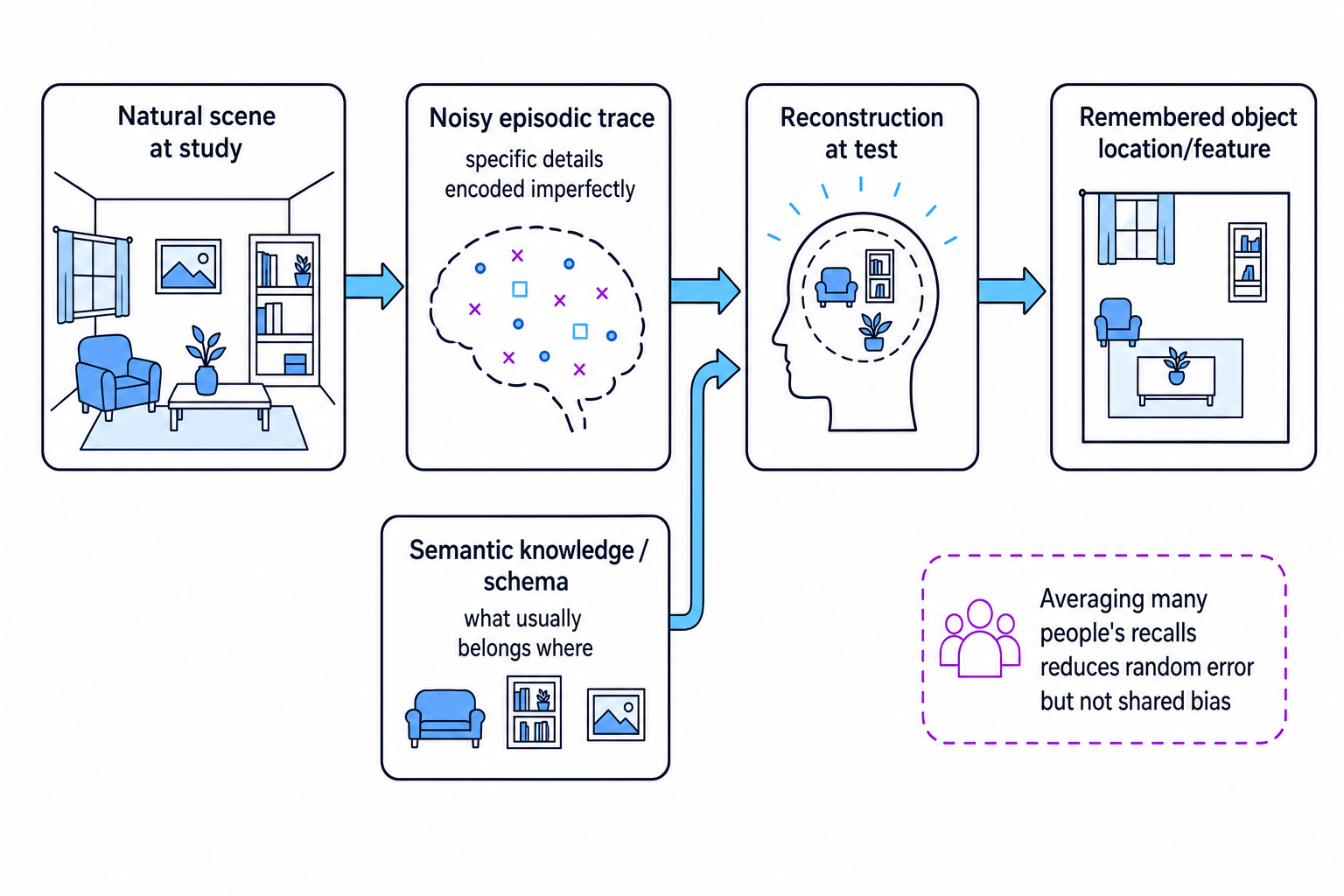
Steyvers and Hemmer argued that memory is often a sensible reconstruction: people combine imperfect memory traces with general knowledge about the world.
The study: Steyvers and Hemmer (2012)
Aim
The aim was to investigate how people reconstruct memories from naturalistic scenes, especially how their recall is influenced by:
- the original information they saw
- their prior knowledge about what is typical in that kind of environment
- the shared patterns that appear when many people’s memories are combined
General procedure
The paper reports research using computer-based memory tasks rather than one simple single experiment. The key approach was:
- Participants viewed meaningful visual material, such as objects in realistic scenes.
- After a delay or test phase, they reconstructed what they had seen.
- Their responses were compared with the original scene.
- The researchers analysed the pattern of errors, including whether errors shifted towards what would usually be expected in that environment.
For example, if an object was shown in an unusual place, participants might remember it as being closer to a more typical position.
What was measured?
The researchers could measure recall accuracy in a more objective way than in Bartlett’s story-recall study. For visual reconstruction tasks, errors can be measured by comparing the remembered response with the original stimulus.
Memory error
A memory error is the difference between what was originally experienced and what is later recalled or recognised.
For a location task, this could mean measuring how far the recalled object position was from its true position. For a feature task, it could mean how much the recalled feature differed from the original.
The Bayesian explanation
Steyvers and Hemmer used a Bayesian account of memory.
Bayesian reasoning
Bayesian reasoning is a way of making the best estimate by combining current evidence with prior knowledge. In memory, the “evidence” is the memory trace, and the “prior knowledge” is what you already know about the world.
You do not need to calculate Bayesian models for the Edexcel exam, but you should understand the logic.
Imagine trying to remember where a plant was in a room. Your exact memory trace may be fuzzy. Your schema tells you that plants are often near windows. So your final memory may be pulled slightly towards the window, even if the plant was not originally there.
A simplified version is:
estimate=wx+(1−w)μ\text{estimate} = w x + (1 - w)\muestimate=wx+(1−w)μwhere xxx is the remembered detail from the event, μ\muμ is the typical value suggested by your schema, and www is the weight given to the memory trace.
Predicting a schema-based reconstruction
Suppose a participant saw an object at position 80 on a screen, but their schema suggests that this object is usually around position 60. Their memory trace is fairly uncertain, so the trace is given a weight of w=0.4w = 0.4w=0.4.
-
Identify the two sources of information: the remembered event detail is x=80x = 80x=80, and the schema-based typical value is μ=60\mu = 60μ=60.
-
Substitute into the simplified reconstruction formula:
estimate=0.4(80)+(1−0.4)(60)\text{estimate} = 0.4(80) + (1 - 0.4)(60)estimate=0.4(80)+(1−0.4)(60) -
Calculate each part: 0.4(80)=320.4(80) = 320.4(80)=32, and 0.6(60)=360.6(60) = 360.6(60)=36.
-
Add the two weighted values: 32+36=6832 + 36 = 6832+36=68.
-
Interpret the result: the reconstructed memory is position 68, so recall has shifted away from the original position 80 and towards the schema-based position 60.
Key findings
The main findings were that people’s memories were not random. Their errors often showed systematic patterns.
1. Recall was influenced by prior knowledge
Participants tended to reconstruct scenes in ways that fitted their expectations. This supports the idea that schemas guide memory.
For example, if an object belongs in a certain kind of place, people may remember it as being nearer to that typical place than it really was.
2. Memory traces were noisy
A noisy memory trace is an imperfect or uncertain memory of the original event. It does not mean the participant remembers nothing; it means the memory contains some useful information but also error.
When the memory trace is weak or uncertain, people rely more heavily on prior knowledge.
3. Group averages could improve accuracy
Steyvers and Hemmer also explored the idea that combining responses from many people can reduce random error. This is related to the wisdom of crowds effect.
Wisdom of crowds
The wisdom of crowds is the finding that averaging many independent estimates can produce a more accurate answer than relying on a single person’s estimate.
However, this only reduces random individual error. If many people share the same schema-based bias, the group average can still be biased.
Thinking schemas always make memory worse
Schemas can create distortions, but they can also make memory more efficient. In everyday life, using prior knowledge often helps you make a sensible reconstruction when your exact memory is incomplete.
Conclusions
Steyvers and Hemmer concluded that memory reconstruction is adaptive. Human memory is not designed to store every detail perfectly. Instead, it uses meaningful knowledge to make likely reconstructions of the past.
This supports reconstructive memory theory and gives it a more modern, quantitative basis than Bartlett’s original work.
Conclusion in one sentence
Steyvers and Hemmer showed that remembering natural scenes involves combining imperfect episodic details with semantic knowledge about what is usually true in the world.
AO2: applying the study
In an exam scenario, you might be asked to apply Steyvers and Hemmer to everyday memory.
Suppose someone briefly sees an office and later reports that a stapler was on the desk. If the stapler was actually on a shelf, this could be explained by schema-based reconstruction. Their “office schema” makes a stapler-on-desk memory seem likely.
Applying the study to a scenario
A witness sees a bag briefly in a classroom. Later, they remember it as being beside a desk, although it was actually near the door.
-
Identify the naturalistic setting: the classroom is meaningful, so the witness can use existing knowledge about what usually appears where.
-
Identify the schema: a classroom schema may include bags being placed beside desks or chairs.
-
Apply reconstructive memory: because the witness’s memory trace is imperfect, their recall may shift the bag towards the schema-consistent location.
-
Link to Steyvers and Hemmer: this fits their finding that memory for naturalistic scenes is reconstructed using both actual encoded information and prior knowledge.
AO3: evaluating Steyvers and Hemmer
Strength: higher ecological validity than artificial memory tasks
A major strength is that the study used meaningful, naturalistic material. This is more realistic than memorising random syllables or unrelated word lists.
This increases ecological validity, which means the findings may be more relevant to everyday memory.
Ecological validity
Ecological validity is the extent to which research findings can be generalised to real-life settings and behaviours.
Strength: objective measurement
The study used measurable reconstruction errors, such as differences between original and recalled visual details. This is more objective than relying only on qualitative interpretation.
This improves reliability because researchers can compare responses in a consistent way.
Strength: real-world applications
The findings are useful for understanding eyewitness memory. Witnesses may confidently reconstruct details based on schemas, especially when the original event was brief, stressful, or unclear.
This does not mean eyewitnesses are “lying”. It means their memory may be a sincere reconstruction.
Useful application point
For AO3 application, link the study to eyewitness testimony: independent witnesses may reduce random error, but shared expectations can still create similar false memories.
Weakness: still not fully real life
Although the materials were more naturalistic than word lists, the task was still controlled and computer-based. Real memories often involve emotion, movement, conversation, stress, and personal consequences.
So, the study improves ecological validity, but it does not completely recreate real-world remembering.
Weakness: schemas vary between people and cultures
People do not all have identical schemas. Prior knowledge may depend on culture, age, occupation, and personal experience.
For example, a chef, a child, and an office worker may have different expectations about where objects are usually found. This can limit generalisability.
Weakness: alternative explanations
Memory errors might not only be caused by schema-based reconstruction. They could also be affected by attention, visual perception, guessing, or interference from other stimuli.
A strong evaluation answer should acknowledge that reconstructive memory is a good explanation, but not the only possible one.
Ethics
This type of study is generally low risk, but ethical issues still matter under the British Psychological Society Code of Ethics and Conduct (2009).
Researchers should ensure:
- informed consent
- the right to withdraw
- protection from psychological harm
- confidentiality of participant data
- debriefing after the task
If the full aim was not explained beforehand to reduce demand characteristics, this would involve mild deception. That can be acceptable if participants are fully debriefed and no harm is caused.
Comparison with Bartlett (1932)
Bartlett’s classic study showed reconstructive memory using a story from another culture. Participants changed details to make the story more familiar and logical.
Steyvers and Hemmer supported the same general theory, but with more modern methods:
- more naturalistic visual materials
- quantitative measurement of errors
- computational modelling
- focus on how prior knowledge and memory traces are combined
Forgetting the contemporary angle
Do not describe Steyvers and Hemmer as just “another Bartlett study”. The key contemporary feature is that they used naturalistic reconstruction tasks and a more mathematical, model-based account of memory.
In the exam
-
For AO1, cover the aim, naturalistic reconstruction task, schema influence, noisy memory traces, and the conclusion that memory combines event details with prior knowledge.
-
For AO2, apply the study to a concrete example: show how a person’s recall shifts towards what is typical in that setting.
-
For AO3, balance the evaluation: praise ecological validity and objective measurement, but criticise the remaining artificiality, individual differences in schemas, and possible alternative explanations.
Check yourself
- What is the difference between a noisy memory trace and a schema?
- How does Steyvers and Hemmer’s study support reconstructive memory theory?
- Why might averaging several witnesses’ memories reduce some errors but not remove shared bias?
