If you have ever wondered why some people are more prone to prejudice than others, you are not alone. Psychologists have long debated whether prejudice is primarily caused by situational factors (like competition for resources) or by individual differences—aspects of our unique personality and ideological makeup.
In this contemporary study, Cohrs et al. (2012) investigated how personality traits and ideological attitudes work together to predict prejudice. Critically, they introduced a clever methodological twist: they did not just ask people to rate themselves; they also asked their friends and family to rate them.
What you'll learn
- The definitions of Right-Wing Authoritarianism (RWA) and Social Dominance Orientation (SDO) as predictors of prejudice.
- How Cohrs et al. (2012) designed a correlational study using both self-reports and peer-reports.
- Why common-method variance threatens the validity of questionnaire studies, and how this study addressed it.
- How to evaluate the strengths, limitations, and applications of this contemporary social psychology study.
1. Core Concepts: The Predictors of Prejudice
To understand this study, we first need to define the two major ideological attitudes that psychologists believe lead to prejudice.
Right-Wing Authoritarianism (RWA)
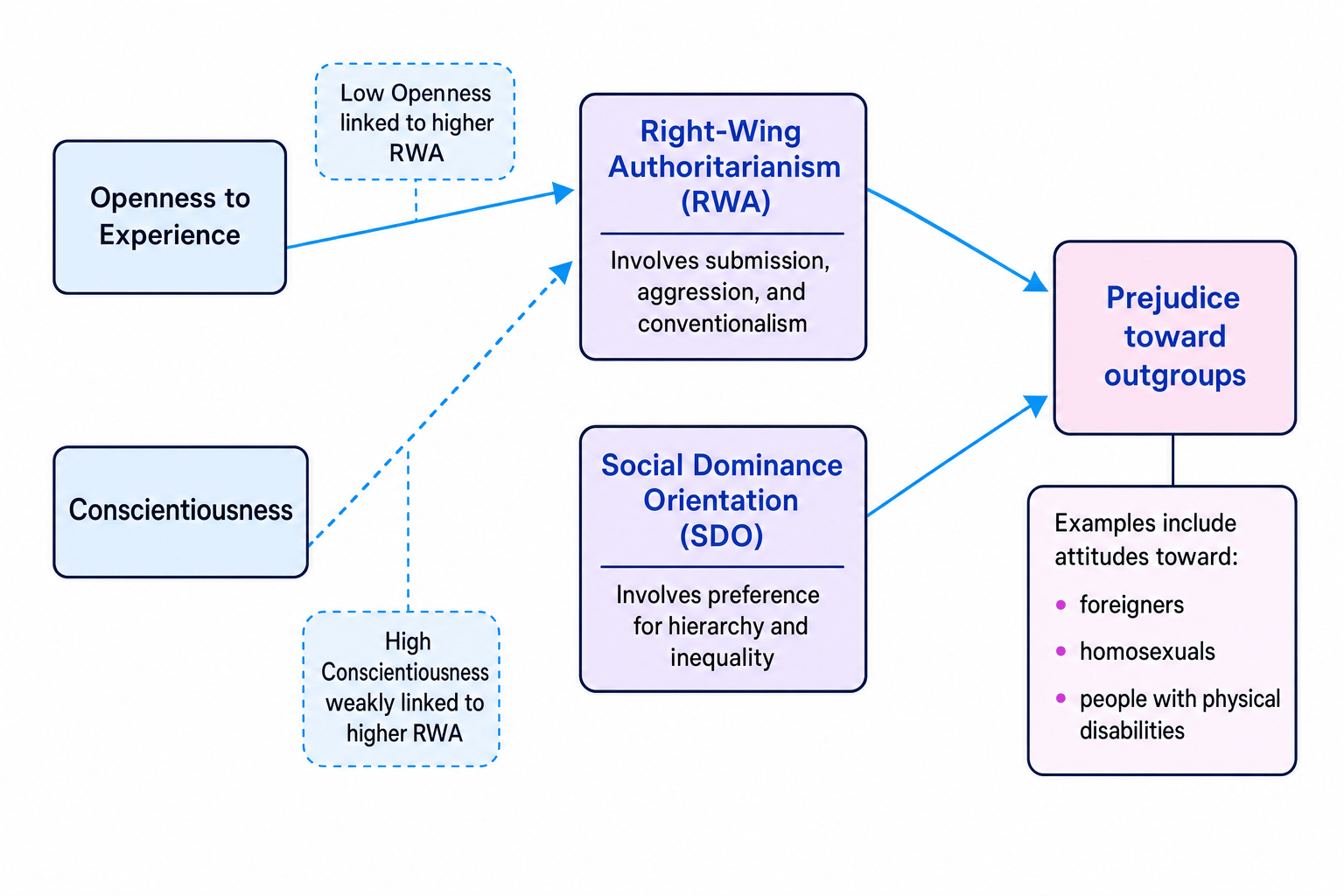
Right-Wing Authoritarianism (RWA) is an ideological attitude characterized by three main tendencies:
- Submission: A high degree of obedience to established, legitimate authorities.
- Aggression: Aggression directed toward outgroups or individuals who deviate from traditional social norms.
- Conventionalism: A strict adherence to traditional social rules and values.
People high in RWA tend to perceive the world as a dangerous, threatening place. They cope with this fear by clinging to established authority structures and rejecting anyone who threatens social order.
Social Dominance Orientation (SDO)
Social Dominance Orientation (SDO) is an ideological attitude characterized by a preference for hierarchy and inequality among social groups. Individuals high in SDO believe that some groups are inherently superior to others and that it is acceptable (and even desirable) for dominant groups to maintain power over subordinate groups.
People high in SDO tend to view the world as a competitive "jungle" where resources are scarce and only the strong survive. They display prejudice toward low-status groups (e.g., immigrants, minority groups) to maintain their dominant status.
The Personality Link
According to psychologists, these ideological attitudes do not just appear out of nowhere; they are influenced by basic personality traits, specifically from the Five-Factor Model ("The Big Five"):
- Openness to Experience: How curious, imaginative, and willing to try new things a person is. People low in Openness are more likely to adopt RWA.
- Conscientiousness: How organized, dutiful, and self-disciplined a person is. People high in Conscientiousness tend to prefer order and predictability, which can sometimes align with high RWA.
2. The Methodological Challenge: Common-Method Variance
Before looking at the study design, we need to understand a major flaw in most psychological survey research: common-method variance (CMV).
The Self-Report Problem
If you ask someone to rate their own personality ("I am open-minded"), their ideological attitudes ("I value authority"), and their levels of prejudice ("I dislike foreigners"), all of these answers come from the same source using the same method.
This can lead to artificial relationships due to acquiescence bias (the tendency to agree with statements) or social desirability bias (trying to look good). This artificial inflation of correlations is called common-method variance.
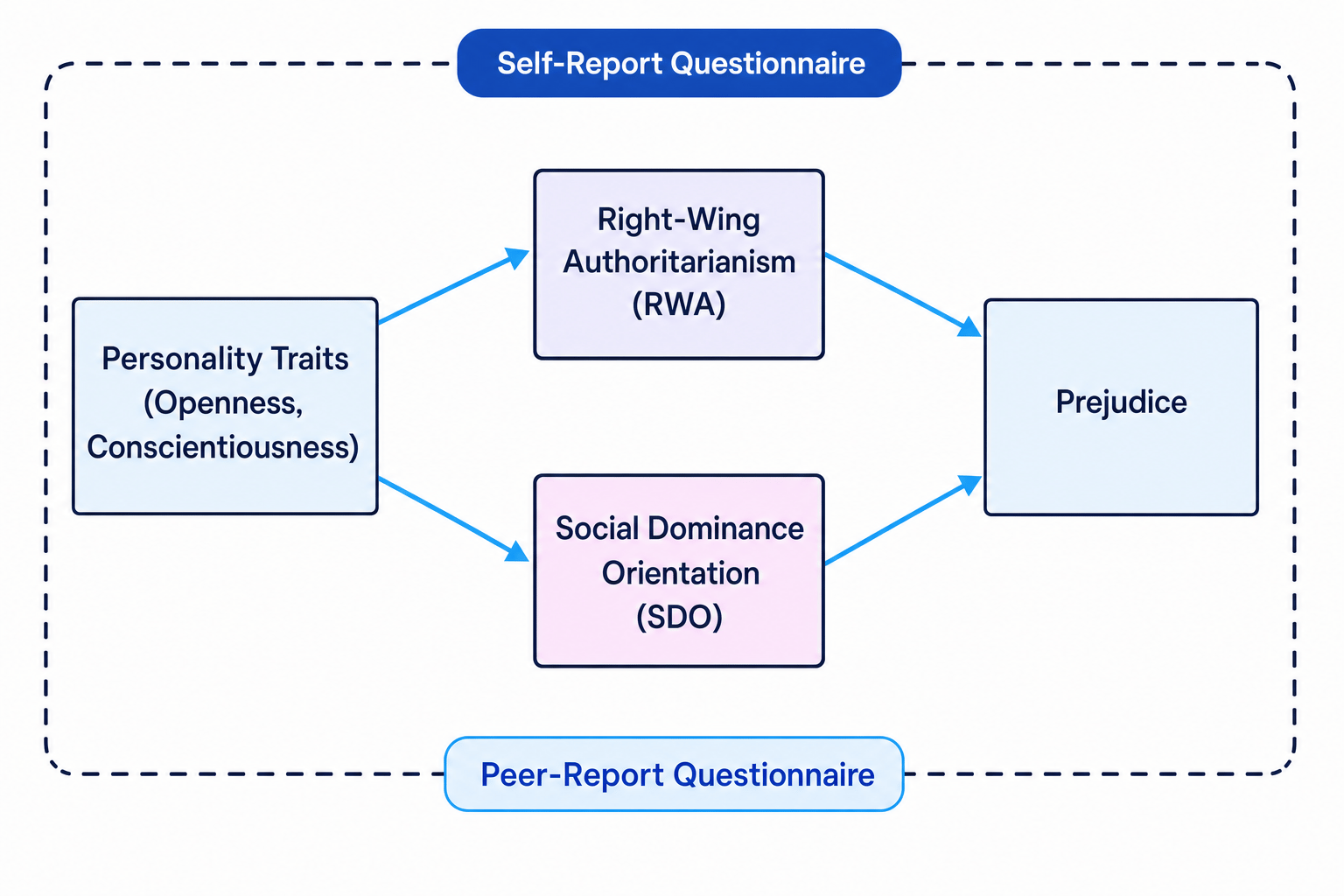
To solve this, Cohrs et al. decided to use peer reports (informant data). They asked a close friend or family member of each participant to fill out the exact same questionnaires about them. This allowed the researchers to cross-reference the data and see if the relationships still held true when measured by another person.
3. Study Details (AO1)
Aims
- To examine the relationships between personality traits (Openness and Conscientiousness), ideological attitudes (RWA and SDO), and prejudice.
- To test whether these relationships are robust when using peer-report data instead of just self-reports, thereby controlling for common-method variance.
Sample
- Self-reports: 193 German adults (reception sample, diverse in age and occupation, though recruited through students at a German university).
- Peer-reports: 193 "peers" (friends, partners, or family members who knew the self-report participants well).
Procedure
The study used a correlational design. Both the primary participants and their peers completed a pack of questionnaires:
- Personality: Measured using the NEO Five-Factor Inventory (specifically focusing on Openness to Experience and Conscientiousness).
- RWA: Measured using a German version of Altemeyer's RWA scale.
- SDO: Measured using a German translation of Pratto's SDO scale.
- Prejudice: Measured using multiple scales assessing attitudes toward foreigners, homosexuals, and people with physical disabilities.
Triangulation of Data
By comparing the self-reports with peer-reports (e.g., correlating the participant's self-reported RWA with their peer's rating of their prejudice), the researchers could prove that prejudice was a real, observable behavior, not just a questionnaire quirk.
4. Key Findings and Results (AO1)
The researchers analyzed the correlations between the variables. The key findings were remarkably consistent across both self-reports and peer-reports:
- Personality and Ideology:
- Openness to Experience had a moderate negative correlation with RWA (self-report: r=−0.36r = -0.36r=−0.36). People who were highly open to new experiences were much less likely to hold authoritarian views.
- Conscientiousness had a weak positive correlation with RWA (self-report: r=0.15r = 0.15r=0.15). Organized, conventional individuals were slightly more likely to value authority.
- Ideology and Prejudice:
- Both RWA and SDO were strongly positively correlated with prejudice.
- RWA and prejudice: r=0.57r = 0.57r=0.57 (self-report) and r=0.49r = 0.49r=0.49 (peer-report).
- SDO and prejudice: r=0.48r = 0.48r=0.48 (self-report) and r=0.44r = 0.44r=0.44 (peer-report).
- The Power of Peer Reports: Even when correlating self-reported ideology (e.g., SDO) with peer-reported prejudice, the correlations remained highly significant. This proved that the relationship was not an artifact of self-report bias.
The Path to Prejudice
Ultimately, the study showed that personality traits (such as low Openness) make people vulnerable to developing ideological attitudes (like RWA or SDO), which in turn directly predict prejudiced attitudes toward outgroups.
5. Worked Example: Interpreting Correlation Coefficients
Because Cohrs et al. is a correlational study, you will often be asked to interpret correlation coefficients (rrr) in your research methods questions or as part of an AO2 application task.
Interpreting statistical relationships in individual differences
A researcher replicates part of Cohrs et al.'s study and finds a correlation between Openness to Experience and Right-Wing Authoritarianism of r=−0.36r = -0.36r=−0.36 (p<.01p < .01p<.01). Explain what this correlation coefficient indicates about the relationship between these two variables.
- Analyze the direction of the correlation: First, look at the sign of the coefficient. The negative sign (−-−) indicates a negative correlation. This means that as scores on one variable (Openness to Experience) increase, scores on the other variable (Right-Wing Authoritarianism) tend to decrease.
- Determine the strength of the correlation: Next, assess the magnitude. A value of 0.360.360.36 (ignoring the negative sign) represents a moderate relationship. It is not weak (typically <0.10< 0.10<0.10), but it is not strong (typically >0.50> 0.50>0.50). It suggests that personality is a notable factor but does not fully dictate ideological attitudes on its own.
- Interpret the statistical significance: Look at the ppp-value (p<.01p < .01p<.01). This means there is less than a 1%1\%1% probability that this moderate negative relationship occurred by random chance. Therefore, we can reject the null hypothesis and conclude that there is a statistically significant, genuine relationship between low Openness to Experience and high RWA in the target population.
Correlations do not prove causation!
When discussing Cohrs et al., never say that "low Openness causes high RWA." Because this study used a correlational design, we can only state that these variables are associated or related. It is possible that a third variable (such as upbringing or education level) influences both.
6. Evaluation of Cohrs et al. (AO3)
When evaluating this contemporary study for an essay, structure your points into strengths and weaknesses, covering methodology, ethics, and applications.
Strengths
- Methodological Validity (Control of CMV): By collecting peer-report data alongside self-report data, Cohrs et al. successfully controlled for common-method variance. Finding that friends and family observed the same personality traits and prejudiced beliefs in the participants strongly supports the construct validity of the RWA, SDO, and prejudice scales.
- Reliability of Measures: The study used highly established, standardized psychometric scales (such as Altemeyer's RWA scale and the NEO Five-Factor Inventory). These scales have high internal consistency, meaning other researchers can easily replicate the study to test for consistency.
- Real-world Application: Understanding that prejudice is driven by specific ideological attitudes (RWA and SDO) helps society target interventions. For example, to reduce prejudice in individuals high in SDO, interventions should focus on showing how equality benefits everyone, rather than just appeal to empathy (which SDO individuals typically score low on).
Weaknesses
- Sampling Bias (Generalizability): The sample consisted entirely of German adults, and participants were recruited using a convenience sampling method via university students. This means the sample may be younger and more liberal or highly educated than the general population, making it difficult to generalize the findings to other cultures or older generations.
- Correlational Nature (No Causation): Although the study suggests a developmental path from personality →\rightarrow→ ideology →\rightarrow→ prejudice, it is strictly correlational. We cannot establish direct cause-and-effect relationships.
- Social Desirability in Peer Reports: While peer reports reduce self-report bias, they are not completely objective. Peers (such as close friends or spouses) might also display social desirability bias, either by rating their loved ones too favorably (underreporting their prejudice) or by sharing similar ideological biases because friends tend to hold similar worldview attitudes (homophily).
Ethical Considerations
- Protection from Harm: Assessing political views (RWA, SDO) and levels of prejudice can cause mild psychological discomfort or social awkwardness if participants feel judged. However, Cohrs et al. ensured complete confidentiality and anonymity of data, meaning no individual's prejudiced views could be identified publicly.
In the exam
If you face a question on Cohrs et al. (2012), use these strategies to maximize your marks:
- Explicitly contrast self and peer reports: High-scoring answers always explain why peer reports were used (to combat common-method variance) rather than just stating that they were used.
- Distinguish clearly between RWA and SDO: Do not treat them as the same thing. RWA is about authority, traditionalism, and fear of a dangerous world; SDO is about competitive power, dominance, and social hierarchy.
- Link AO1 directly to AO3: When evaluating, reference specific findings (e.g., "The strong correlation of r=0.57r = 0.57r=0.57 between self-reported RWA and prejudice was validated by a high peer-reported correlation of r=0.49r = 0.49r=0.49, showing...") to make your evaluation points concrete.
Check yourself
- Why did Cohrs et al. include peer-report questionnaires in their methodology?
- What are the distinct psychological profiles of someone high in Right-Wing Authoritarianism (RWA) versus someone high in Social Dominance Orientation (SDO)?
- What does a correlation of r=−0.36r = -0.36r=−0.36 between Openness to Experience and RWA tell us about the relationship between personality and political ideologies?