What you'll learn
- How leading questions can influence eyewitness memory.
- The aim, procedure, results and conclusions of Loftus and Palmer’s two experiments.
- The difference between response bias and actual memory alteration.
- How to evaluate the study using AO1, AO2 and AO3 for Edexcel 9PS0 essays.
Why this study matters
Loftus and Palmer’s study is a classic in criminological psychology because it shows that eyewitness memory is not a perfect recording of events. The words used after an event can influence what a witness later reports.
The full title is Reconstruction of automobile destruction: An example of the interaction between language and memory. That title is useful: the study is about how language affects memory reconstruction.
The key memory ideas first
Eyewitness testimony
Eyewitness testimony
Eyewitness testimony is evidence given by someone who has seen an event, such as a crime or accident, and later describes what they saw.
In court, eyewitness testimony can be very persuasive. However, psychologists are interested in whether eyewitnesses remember events accurately, especially after being questioned.
Reconstructive memory
Reconstructive memory
Reconstructive memory means memory is actively rebuilt when we recall it, rather than being played back like a video recording.
This idea links back to Bartlett (1932), who argued that recall is shaped by schemas.
Schema
A schema is a mental framework of expectations and knowledge built from past experience, such as what usually happens in a car crash.
If you hear the word “smashed”, your schema for a serious accident may become active. That can affect how you interpret what you saw.
Memory is reconstructed
Loftus and Palmer (1974) supports the idea that memory can be changed by information given after an event, especially by the wording of questions.
Leading questions
Leading question
A leading question is a question that suggests a particular answer or influences how a person interprets an event.
For example, “How fast was the car going when it smashed into the wall?” suggests a more violent event than “How fast was the car going when it hit the wall?”
Explaining the effect of a leading verb
- Compare the two verbs: smashed implies a severe, high-impact collision, while hit is more neutral.
- Apply the schema idea: “smashed” may activate expectations of broken glass, high speed and more damage.
- Predict the effect on recall: the witness may estimate a higher speed or later report details that were not actually present.
Aim of Loftus and Palmer (1974)
The study aimed to investigate whether the wording of a question could affect eyewitnesses’ memory of a car accident.
More specifically, Loftus and Palmer wanted to see whether changing one verb in a question would affect:
- estimated speed of cars
- later recall of details, such as broken glass
The study had two experiments.
Experiment 1: speed estimates
Participants and procedure
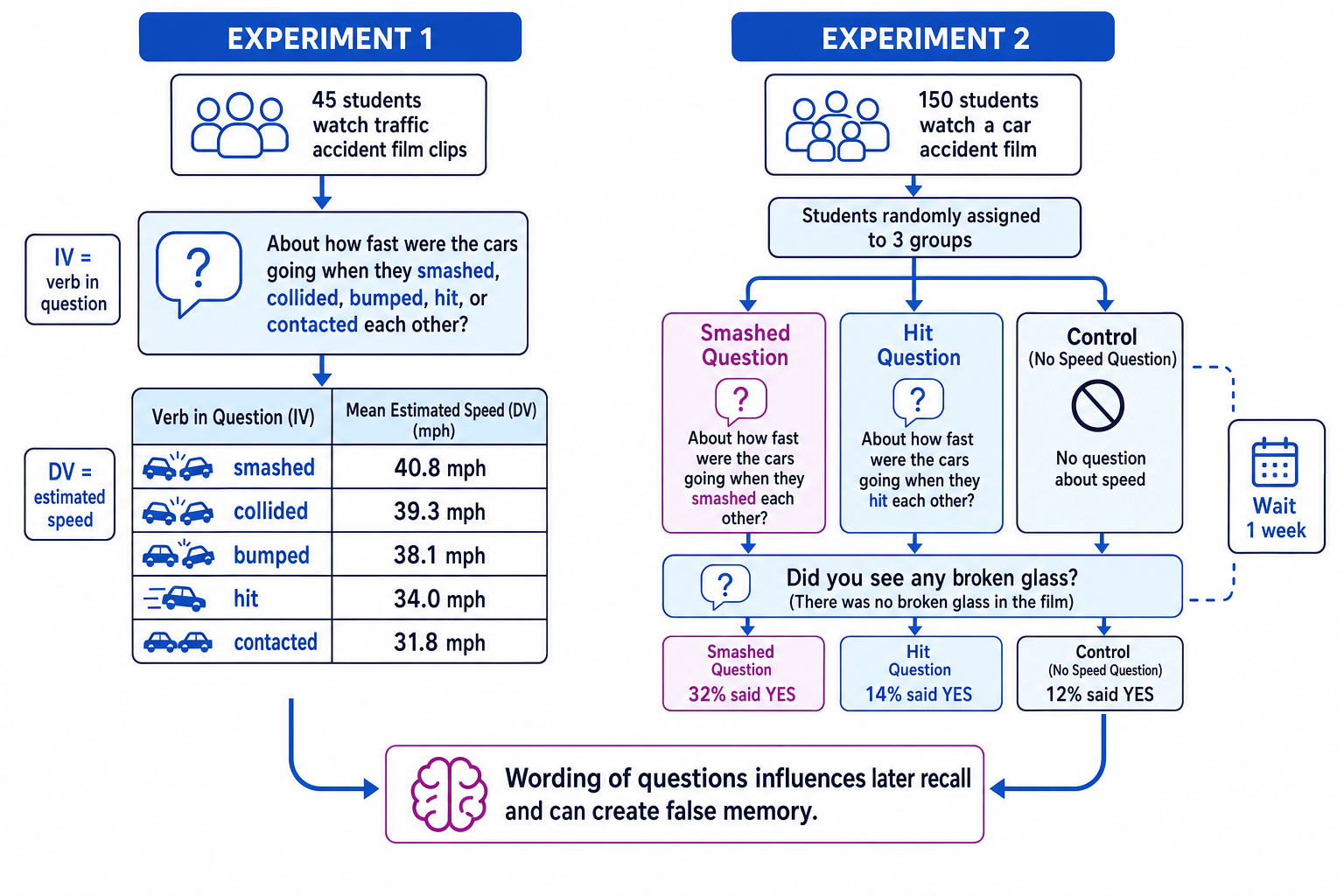
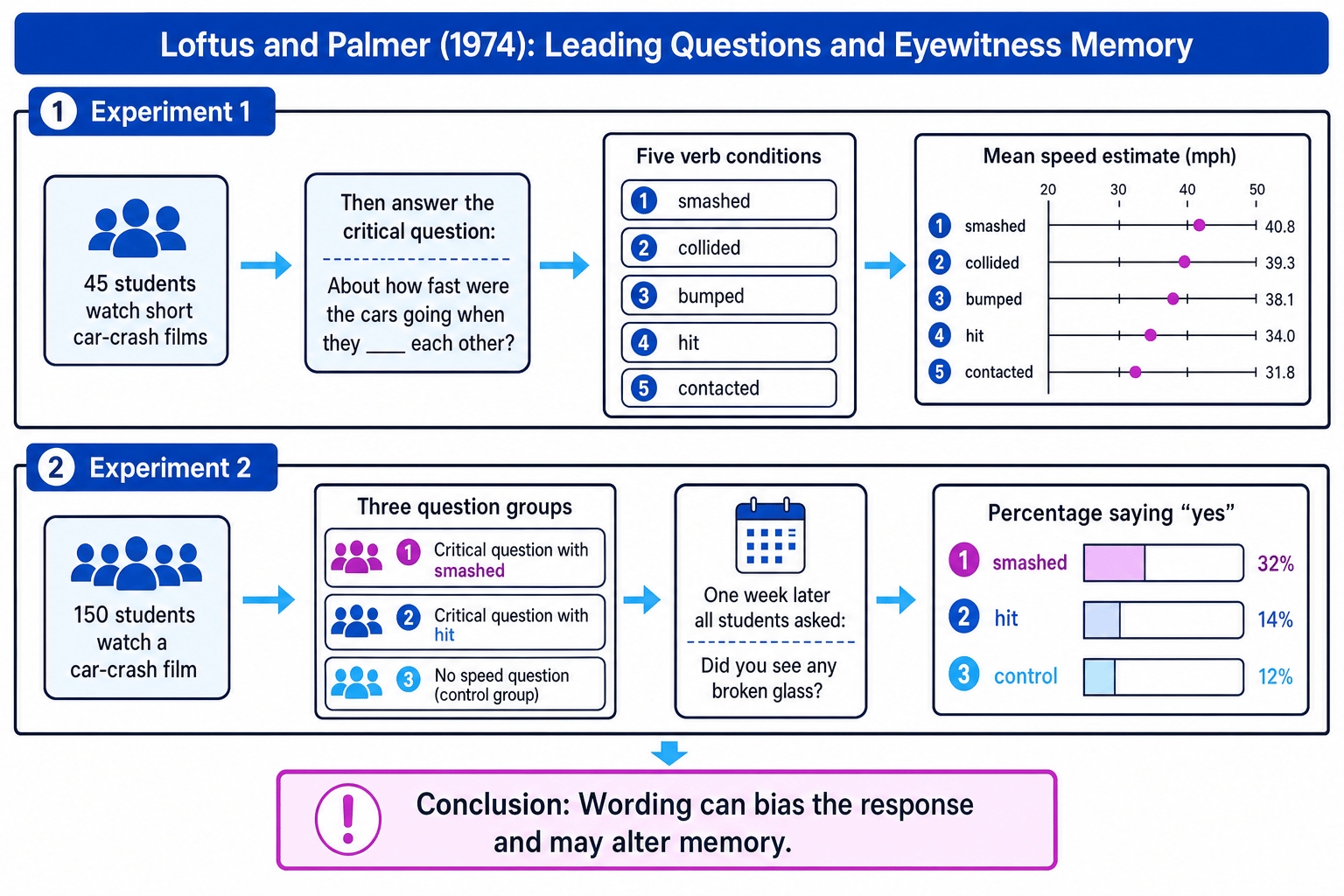
Loftus and Palmer used 45 student participants. They watched short film clips of traffic accidents.
After each film, participants answered questions. The critical question was:
“About how fast were the cars going when they _____ each other?”
The blank was filled with one of five verbs:
- smashed
- collided
- bumped
- hit
- contacted
The independent variable was the verb used in the question. The dependent variable was the speed estimate given by the participant.
Independent and dependent variables
The independent variable is what the researcher changes. The dependent variable is what the researcher measures to see if the change had an effect.
Results
The mean speed estimates were:
- smashed: 40.8 mph
- collided: 39.3 mph
- bumped: 38.1 mph
- hit: 34.0 mph
- contacted: 31.8 mph
The more dramatic the verb, the higher the estimated speed.
Conclusion from Experiment 1
Loftus and Palmer concluded that the wording of the question influenced participants’ answers. “Smashed” led to higher speed estimates than “contacted”.
Identifying the variables in Experiment 1
- Compare the question versions: the accident films stayed the same, but the verb changed, so the verb was the independent variable.
- Identify the measured outcome: participants gave a numerical speed estimate, so estimated speed was the dependent variable.
- Link the result to the aim: because stronger verbs produced higher mean estimates, the study suggests question wording can influence eyewitness reports.
Experiment 2: broken glass
Why a second experiment was needed
Experiment 1 showed that wording affected speed estimates. However, Loftus and Palmer wanted to know whether this was just a response bias, or whether the wording could actually alter memory.
Response bias
Response bias is when a participant gives an answer influenced by the wording or situation, without their actual memory necessarily changing.
For example, someone might say a higher speed because “smashed” hints that the researcher expects a high number.
Participants and procedure
Loftus and Palmer used 150 student participants.
They watched a film of a car accident and were split into three groups:
- one group was asked a question using smashed
- one group was asked a question using hit
- one control group was not asked a speed question
One week later, all participants were asked:
“Did you see any broken glass?”
There was no broken glass in the film.
Results
The percentage of participants who said they had seen broken glass was:
- smashed group: 32%
- hit group: 14%
- control group: 12%
Conclusion from Experiment 2
The “smashed” group were more likely to falsely remember broken glass. This suggests that the wording of the original question may have altered their memory of the accident.
The strongest conclusion
Experiment 1 shows that wording can bias an immediate answer. Experiment 2 goes further by suggesting that wording can also distort later memory.
Assuming witnesses are lying
Loftus and Palmer were not saying eyewitnesses deliberately lie. The point is that memory can be unintentionally distorted by post-event information.
Response bias or memory alteration?
Loftus and Palmer’s findings can be explained in two ways.
Explanation 1: response bias
Participants may have adjusted their answers to fit the verb. “Smashed” sounds fast, so they gave a higher number.
This explanation fits Experiment 1 well because participants gave speed estimates immediately after hearing the question.
Explanation 2: memory alteration
The verb may have changed the participant’s memory representation of the event. “Smashed” may have made the accident seem more violent, leading some participants to later “remember” broken glass.
This explanation fits Experiment 2 better because the false memory appeared one week later.
Choosing the better explanation
- Start with Experiment 1: higher estimates after “smashed” could be due to response bias because participants may have been guided by the wording.
- Add Experiment 2: participants later reported broken glass that was not present, especially after “smashed”.
- Make the judgement: Experiment 2 provides stronger evidence for memory alteration because the wording affected later recall of a non-existent detail.
Research methods link
Loftus and Palmer used a laboratory experiment, meaning the study was conducted in a controlled setting where variables could be carefully managed.
This improves control because the researchers could standardise the films and questions. It also improves replicability, because the procedure is clear enough for other researchers to repeat.
For Edexcel research-methods links:
- Experiment 1 used mean speed estimates as a measure of central tendency.
- Experiment 2 produced categorical data: “yes” or “no” to broken glass.
- A bar chart would be suitable for displaying the broken-glass results.
- If testing association between question condition and broken-glass response, chi-square would fit because both variables are categorical.
- The default significance level in psychology is usually p≤.05p \leq .05p≤.05, with stricter or more lenient alternatives such as p≤.01p \leq .01p≤.01 and p≤.10p \leq .10p≤.10.
Do not force the wrong test
Spearman’s rho is for correlations, so it would not be suitable for Loftus and Palmer’s experimental question about different wording conditions.
AO3 evaluation
Strength: high control
A major strength is the high level of control. Participants watched the same accident clips and answered standardised questions. This means differences in answers are more likely to be due to the verb used rather than random differences in the situation.
This gives the study good internal validity, meaning it is more likely to measure the effect it intended to measure.
Strength: useful real-world application
The study has clear applications to police interviews and courtroom questioning. It suggests that interviewers should avoid leading questions because they may contaminate eyewitness memory.
A better approach would be to use neutral prompts, such as:
- “Describe what happened.”
- “What did you see next?”
- “Tell me anything else you remember.”
This links to the broader legal concern that eyewitness testimony can be unreliable if questioning is poorly handled.
Weakness: low ecological validity
The study used film clips rather than real accidents. Watching a video in a laboratory is very different from witnessing a real crash or crime, where there may be fear, surprise, injury or personal involvement.
Ecological validity
Ecological validity is the extent to which findings can be applied to real-life settings and behaviour.
This means the findings may not fully represent how real eyewitnesses behave.
Weakness: sample issues
The participants were students, so the sample may not represent the wider population. Students may differ from real eyewitnesses in age, driving experience, attention, or motivation.
This limits population validity, which is the extent to which findings can be generalised to other groups of people.
Weakness: demand characteristics
Participants may have guessed that the verb was important and changed their answers to match what they thought the researcher expected.
Demand characteristics
Demand characteristics are cues in a study that lead participants to guess the aim and change their behaviour.
This is especially relevant to Experiment 1, where the speed estimate might have been influenced by the wording without memory actually changing.
Ethical considerations
Under the BPS Code of Ethics and Conduct (2009), researchers should consider consent, deception, right to withdraw, protection from harm, confidentiality and debriefing.
Loftus and Palmer’s study was relatively low risk, but there are still ethical points:
- Participants may not have been fully aware of the true aim, so there was some deception.
- They should have been debriefed afterwards.
- Film clips of accidents could cause mild distress, so protection from harm matters.
- Their data should be kept confidential.
Balanced evaluation
A strong AO3 paragraph often says: “This is a weakness, but…” For example, the study is artificial, but the control helped isolate the effect of question wording.
How to use this study in essays
For AO1, describe the aim, procedure, results and conclusion accurately. Include both experiments if the question asks for the study as a whole.
For AO2, apply the idea to a scenario. If a police officer asks, “How fast was the car going when it smashed into the victim’s car?”, you can explain that “smashed” is a leading verb and may distort recall.
For AO3, evaluate methodology, ethics and usefulness. The best answers are balanced: high control and real-world usefulness, but low ecological validity and possible demand characteristics.
In the exam
- Use the study title to stay focused: Loftus and Palmer is about the interaction between language and memory.
- Separate the two experiments clearly: Experiment 1 is speed estimates; Experiment 2 is false memory for broken glass.
- In evaluation, avoid one-sided answers: balance strong control and application with artificial tasks, student sample and ethical issues.
Check yourself
- What were the independent and dependent variables in Experiment 1?
- Why does Experiment 2 give stronger evidence for memory alteration than Experiment 1?
- How could Loftus and Palmer’s findings improve police interviewing?