What you'll learn
- How Ainsworth’s Strange Situation assesses infant attachment.
- The behavioural differences between secure, insecure-avoidant, and insecure-resistant attachment.
- What van IJzendoorn and Kroonenberg (1988) found about cultural variations in attachment.
- How to evaluate this research for AO3, including methodology, ethics, and culture bias.
Before the Strange Situation: what is attachment?
Attachment
An attachment is a close, two-way emotional bond between an infant and a caregiver, where each person seeks closeness and feels more secure when they are together.
In the Attachment topic, you have already met the idea that infants form bonds with caregivers. The Strange Situation is important because it gave psychologists a standardised way to observe how infants behave when that bond is mildly tested.
The key assumption is that attachment is revealed most clearly when the infant experiences mild stress, such as being in an unfamiliar room, meeting a stranger, or being briefly separated from the caregiver.
Secure base
A secure base is the role of a caregiver as a source of safety from which an infant can explore the environment and return for comfort.
A securely attached infant is not expected to cling constantly. In fact, one sign of security is being confident enough to explore, because the caregiver is available if needed.
Ainsworth’s Strange Situation: AO1
Ainsworth et al. (1978) developed the Strange Situation, a controlled observation used to assess the quality of attachment between an infant and caregiver. It was mainly used with infants aged around 9 to 18 months.
Controlled observation
A controlled observation is a research method where behaviour is watched and recorded in a structured setting, with the same procedure used for each participant.
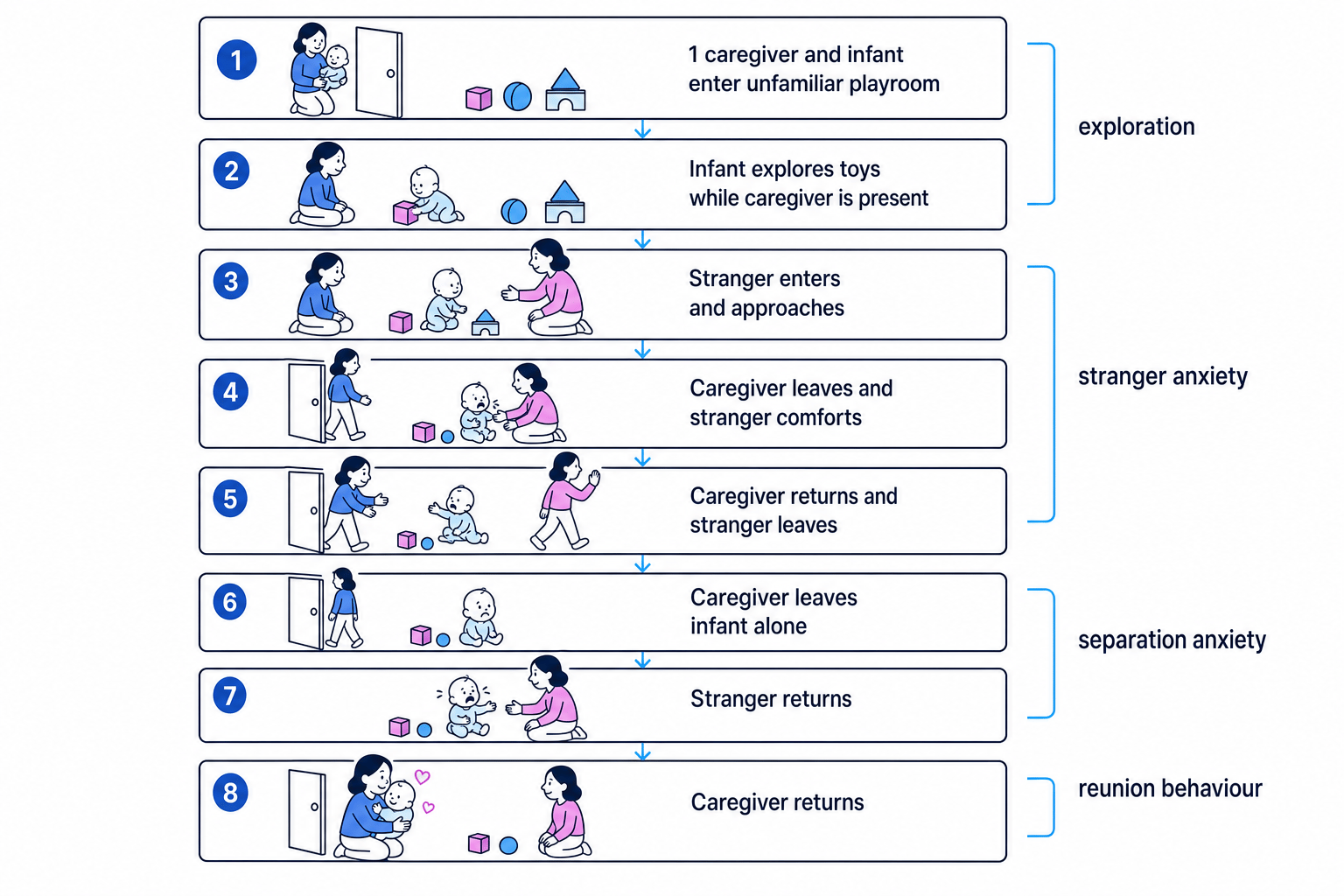
The Strange Situation takes place in an unfamiliar playroom. The infant experiences a sequence of events involving the caregiver, a stranger, separations, and reunions.
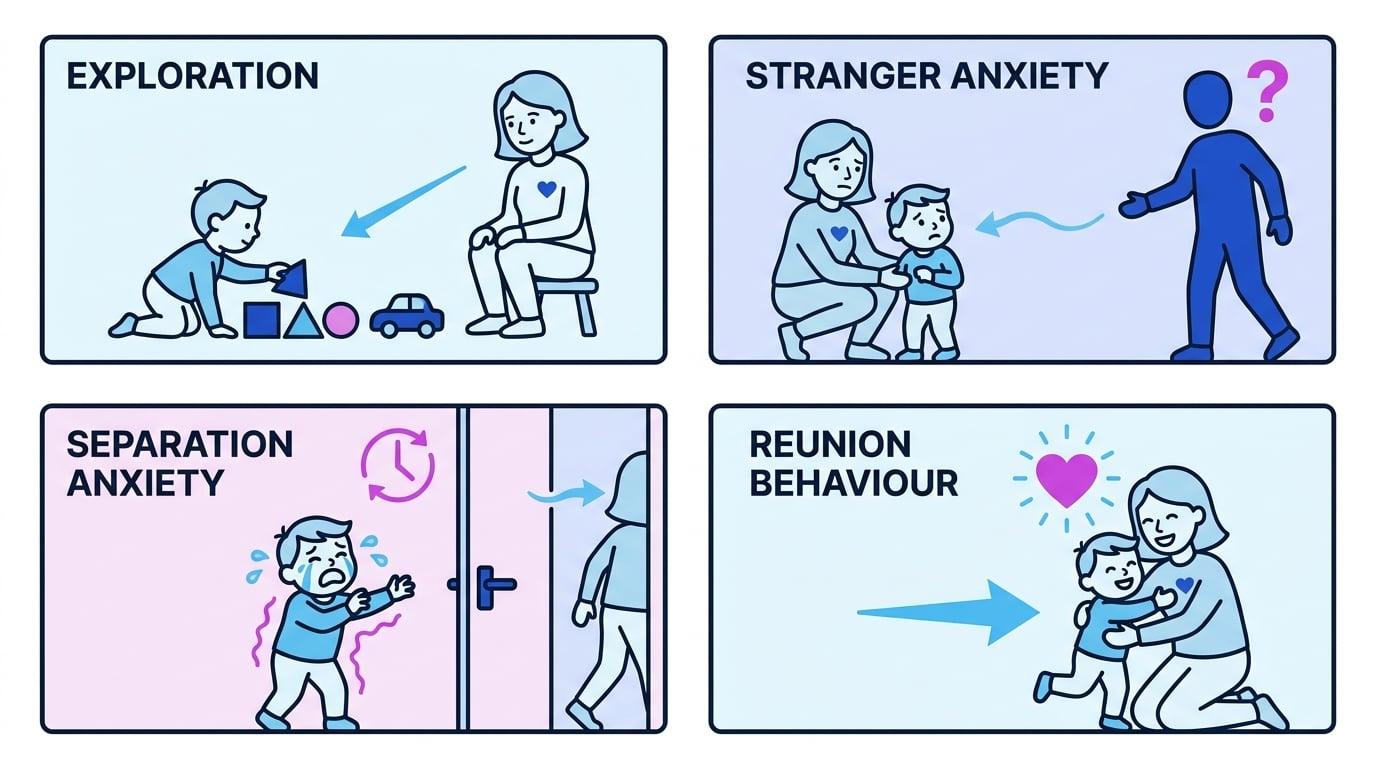
The aim is not simply to see whether the baby cries. The observer records several behaviours:
- Exploration — whether the infant plays with toys and investigates the room.
- Stranger anxiety — distress or wariness when approached by an unfamiliar adult.
- Separation anxiety — distress when the caregiver leaves.
- Reunion behaviour — how the infant responds when the caregiver returns.
The eight episodes
The procedure has eight short episodes, each lasting around three minutes, although episodes can be cut short if the infant becomes too distressed.
- Caregiver and infant enter the unfamiliar room.
- Infant explores while the caregiver is present.
- A stranger enters, talks to the caregiver, then approaches the infant.
- Caregiver leaves; the infant is alone with the stranger.
- Caregiver returns; the stranger leaves.
- Caregiver leaves again; the infant is briefly alone.
- Stranger returns and tries to comfort the infant.
- Caregiver returns; stranger leaves.
What the Strange Situation measures
The Strange Situation classifies attachment by comparing how the infant balances exploration, anxiety, and comfort-seeking, especially during reunion with the caregiver.
Types of attachment
Ainsworth identified three main attachment types: secure, insecure-avoidant, and insecure-resistant. You may also see letters used: secure is Type B, avoidant is Type A, and resistant is Type C.
Secure attachment: Type B
A securely attached infant uses the caregiver as a secure base. They usually explore the room when the caregiver is present, show moderate distress when the caregiver leaves, and are pleased when the caregiver returns.
They are usually easy to comfort at reunion and then may return to play.
Typical behaviours:
| Behaviour | Secure attachment |
|---|---|
| Exploration | Good exploration when caregiver is present |
| Stranger anxiety | Some wariness of stranger |
| Separation anxiety | Distressed when caregiver leaves |
| Reunion behaviour | Seeks comfort and is soothed fairly quickly |
In Ainsworth’s original American sample, around two-thirds of infants were classified as secure.
Insecure-avoidant attachment: Type A
An insecure-avoidant infant appears emotionally independent of the caregiver. They may explore freely, show little distress when the caregiver leaves, and avoid contact when the caregiver returns.
This does not necessarily mean the infant feels no stress. Some later research suggests avoidant infants may show physiological stress even if they do not show much visible distress.
Typical behaviours:
| Behaviour | Insecure-avoidant attachment |
|---|---|
| Exploration | High exploration, little reference to caregiver |
| Stranger anxiety | Little reaction to stranger |
| Separation anxiety | Little visible distress |
| Reunion behaviour | Avoids or ignores caregiver |
Insecure-resistant attachment: Type C
An insecure-resistant infant shows strong anxiety and is less confident exploring. They may become very distressed when separated from the caregiver, but when the caregiver returns they both seek and resist comfort.
For example, they may cling to the caregiver but also push away or continue crying.
Typical behaviours:
| Behaviour | Insecure-resistant attachment |
|---|---|
| Exploration | Low exploration |
| Stranger anxiety | Strong distress or fear |
| Separation anxiety | Very distressed |
| Reunion behaviour | Seeks contact but resists comfort |
Thinking crying automatically means insecure attachment
Crying during separation does not automatically mean insecure attachment. The most important evidence is often reunion behaviour: whether the infant is comforted by the caregiver and can return to exploration.
Classifying an attachment pattern
A 14-month-old explores the room while their mother is present. When the mother leaves, the infant cries. When she returns, the infant crawls to her, is picked up, quickly calms down, and then returns to the toys.
- Compare exploration first: the infant explores while the caregiver is present, which suggests the caregiver is being used as a secure base.
- Compare separation anxiety: the infant cries when the mother leaves, but this is not enough by itself to decide the attachment type.
- Focus on reunion behaviour: the infant seeks comfort, is soothed quickly, and returns to play.
- The best classification is secure attachment, because the infant shows distress but is comforted effectively by the caregiver.
Evaluating the Strange Situation: AO3
Strength: standardised and reliable
A strength of the Strange Situation is that it uses a standardised procedure. Each infant experiences the same sequence of separations, reunions, and stranger contact, so behaviour can be compared more fairly.
Ainsworth et al. (1978) reported high inter-rater reliability, meaning different observers tended to agree on which attachment type an infant showed.
Inter-rater reliability
Inter-rater reliability is the extent to which two or more observers agree when recording or classifying the same behaviour.
This supports the view that the attachment categories were not just subjective guesses.
Strength: useful real-world applications
The Strange Situation helped psychologists understand early caregiver-infant relationships. This has influenced childcare advice, adoption support, and interventions aimed at improving caregiver sensitivity.
It also encouraged later research into whether early attachment is linked to later relationships, emotional development, and social confidence.
Limitation: artificial setting
The Strange Situation takes place in an unfamiliar laboratory-style room. This gives control, but it may reduce ecological validity, because the infant may behave differently from how they would at home.
Ecological validity
Ecological validity is the extent to which research findings can be generalised to real-life settings.
However, the unfamiliar room is also part of the point: it creates mild stress so attachment behaviour becomes visible.
Limitation: temperament may affect behaviour
A limitation is that the Strange Situation may measure temperament as well as attachment.
Temperament
Temperament refers to a child’s biologically influenced emotional style, such as being naturally calm, fearful, sociable, or irritable.
For example, a naturally anxious infant may show strong distress in the Strange Situation even if their attachment relationship is not insecure-resistant. This makes classification less straightforward.
Ethical issues
The Strange Situation deliberately creates mild distress through separation and unfamiliarity. This raises protection-from-harm issues. However, the separations are brief, caregivers are nearby, and the procedure can be stopped if the infant becomes too upset.
Researchers also need informed consent from caregivers, the right to withdraw, confidentiality, and debriefing. The infant cannot give consent, so ethical responsibility lies especially with the researchers and caregiver.
Cultural variations in attachment
Cultural variations
Cultural variations are differences between cultural groups in behaviours, beliefs, norms, or research findings.
A culture’s child-rearing practices may influence how infants behave in the Strange Situation. For example, some cultures encourage early independence, while others emphasise constant closeness between mother and infant.
This matters because the Strange Situation was developed in the USA. If we apply it everywhere in exactly the same way, we may be using an imposed etic.
Imposed etic
An imposed etic occurs when researchers apply ideas or methods from one culture to another culture and assume they mean the same thing.
van IJzendoorn and Kroonenberg (1988): AO1
van IJzendoorn and Kroonenberg (1988) conducted a meta-analysis of Strange Situation studies from different countries.
Meta-analysis
A meta-analysis is a research method that combines findings from many studies to look for overall patterns.
They analysed 32 studies from 8 countries, involving nearly 2,000 mother-infant pairs.
Their main findings were:
- Secure attachment was the most common type in every culture studied.
- Insecure-avoidant attachment was relatively more common in some Western samples, especially Germany.
- Insecure-resistant attachment was relatively more common in some samples from Japan and Israel.
- Differences within cultures were greater than differences between cultures.
Main conclusion from van IJzendoorn
The basic pattern of secure attachment being most common may be universal, but the distribution of insecure types varies across cultures and subcultures.
Interpreting cultural variation
A study finds that a German sample has a higher proportion of avoidant attachment than Ainsworth’s original American sample.
- Link the behaviour to the classification: avoidant infants show less visible distress at separation and avoid contact at reunion.
- Consider the cultural context: German child-rearing has often been described as placing more value on independence.
- Avoid assuming the infants are “less attached”: the same behaviour may have a different meaning in that cultural context.
- A balanced interpretation is that the Strange Situation may partly reflect cultural norms about independence, not just attachment security.
Evaluating cultural variations research: AO3
Strength: large-scale evidence
van IJzendoorn and Kroonenberg’s meta-analysis is stronger than one isolated study because it combines evidence from many samples. This gives a broader view of attachment patterns and makes it possible to compare cultures.
It also found an important consistent pattern: secure attachment was most common across all countries studied.
Limitation: culture bias in the Strange Situation
The biggest issue is that the Strange Situation may not mean the same thing in every culture.
For example, Takahashi (1990) found that Japanese infants showed high levels of distress during separation. In Japan, infants were often rarely separated from their mothers, so the separation may have been unusually stressful. This could make infants appear insecure-resistant when they are actually responding to an unfamiliar experience.
Similarly, Grossmann and Grossmann (1991) found relatively high levels of avoidant attachment in Germany. This may reflect cultural encouragement of independence rather than emotional insecurity.
Treating cultures as simple stereotypes
Do not write as if “Germany means avoidant” or “Japan means resistant”. The evidence shows trends in particular samples, and variation within cultures is often larger than variation between cultures.
Limitation: samples were uneven
The meta-analysis included many more studies from some countries than others. For example, the USA was heavily represented compared with countries that had only one or two studies.
This means the “overall” pattern may be weighted towards certain cultures, especially Western, industrialised societies. It also means we should be cautious about generalising to whole countries.
Limitation: within-culture variation
A key finding was that intra-cultural variation was greater than inter-cultural variation. In other words, infants within the same country can differ a lot depending on family background, social class, childcare arrangements, urban or rural living, and parental beliefs.
This weakens any simple claim that attachment type is determined by national culture.
Real-world application
Cultural variations research reminds psychologists and childcare professionals to be careful when assessing families from different backgrounds. Behaviour that looks “avoidant” or “resistant” in one context may be normal or adaptive in another.
Essay shortcut
For cultural variations, a strong paragraph often follows this chain: finding → cultural explanation → imposed etic criticism → balanced conclusion.
In the exam
- For AO1, describe the Strange Situation using the four behaviours: exploration, stranger anxiety, separation anxiety, and reunion behaviour.
- For AO2, classify attachment from the whole pattern of behaviour, especially what happens at reunion.
- For AO3, evaluate both the method and the culture issue: mention standardisation and reliability, but also artificiality, temperament, ethics, and imposed etic.
Check yourself
- What behaviours would you expect from a securely attached infant during reunion?
- Why might the Strange Situation over-classify Japanese infants as insecure-resistant?
- What does it mean to say that within-culture variation is greater than between-culture variation?