What you'll learn
- What makes psychology “scientific”: empirical evidence, objectivity, falsifiability, and replication.
- How theories lead to hypotheses, data collection, and theory refinement.
- What paradigms and paradigm shifts mean in psychology.
- How scientific investigations are reported and evaluated in AQA Psychology.
Why psychology tries to be scientific
Psychology studies behaviour and mental processes. Because people are complex, psychologists need methods that are more reliable than guesswork, common sense, or personal opinion.
A scientific process is a systematic way of developing explanations, testing them with evidence, and changing them when the evidence does not fit.
Scientific method
The scientific method is the use of systematic observation, controlled procedures, and evidence-based reasoning to test explanations about the world.
In psychology, this might mean testing whether leading questions affect eyewitness memory, as in Loftus & Palmer (1974), or whether people obey authority figures, as in Milgram (1963). These studies were influential, but they also remind us that psychological science must consider ethics such as consent, deception, right to withdraw, protection from harm, confidentiality, and debriefing.
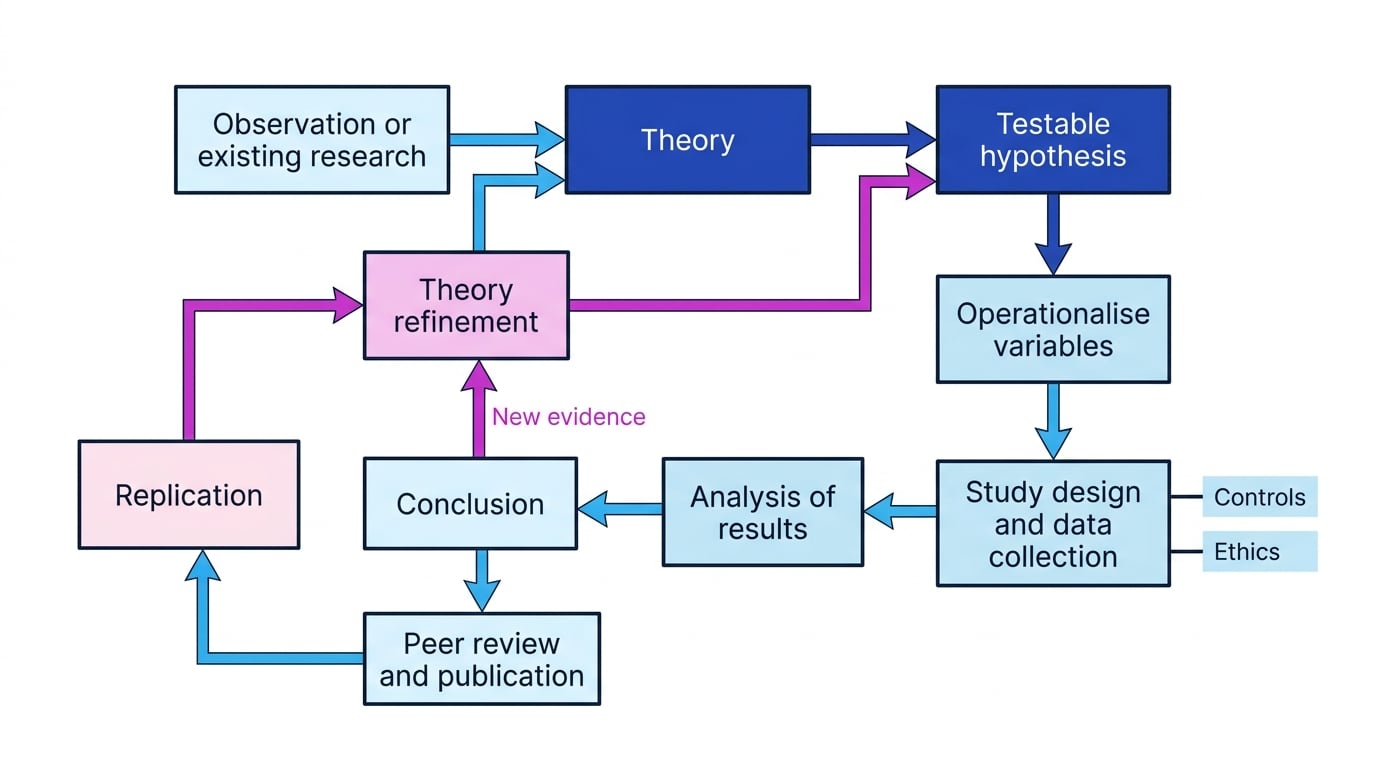
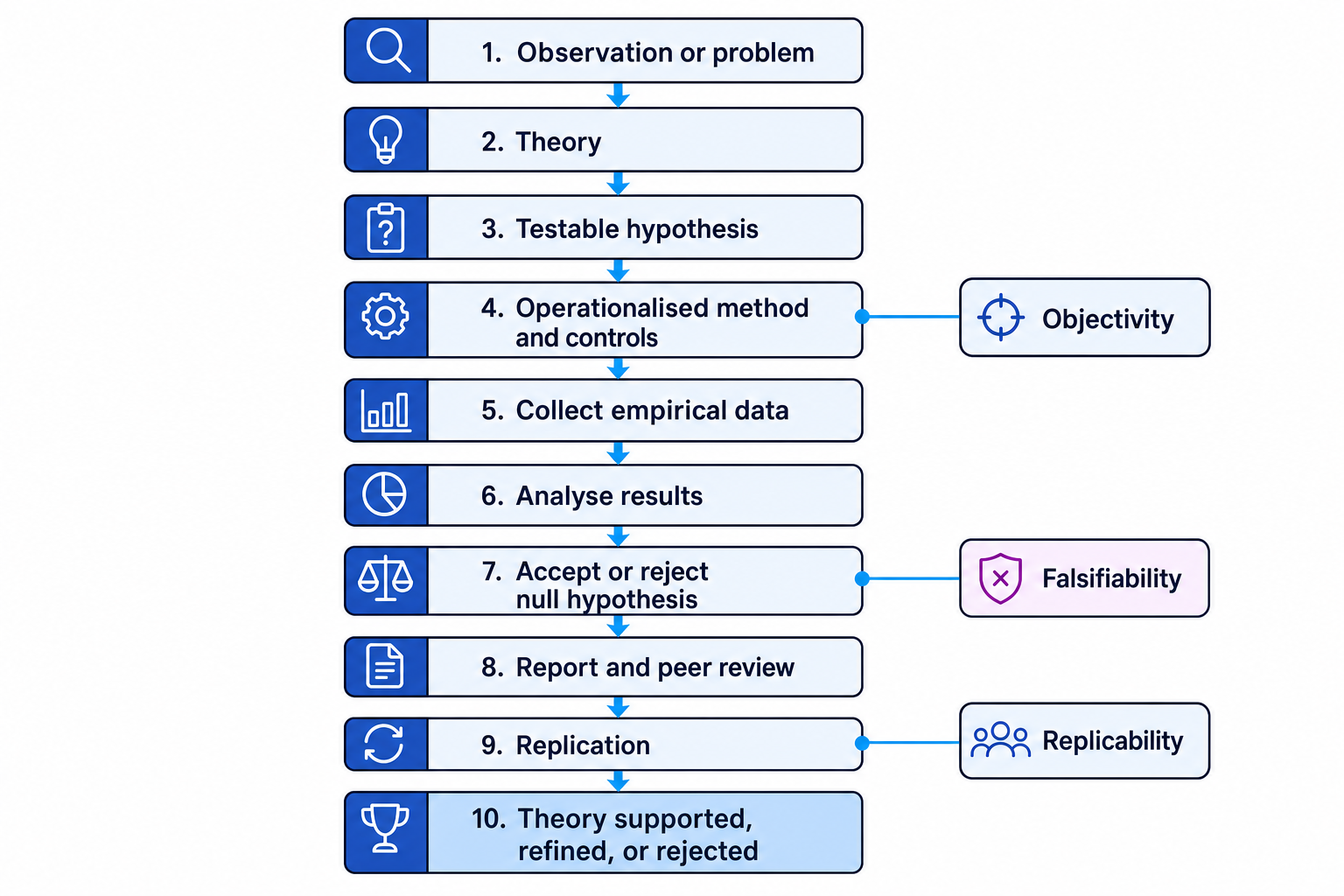
The scientific process is best understood as a cycle: theories generate hypotheses, hypotheses are tested, findings are reported, and other researchers try to replicate or challenge them.
Empirical method: evidence first
Empirical method
The empirical method means gaining knowledge through direct observation or measurement rather than through opinion, intuition, or tradition.
In psychology, empirical evidence could include reaction times, questionnaire scores, brain scans, behaviour counts, interview transcripts, or test scores.
For example, instead of simply saying “stress affects memory”, a psychologist might measure participants’ recall scores after exposing them to different stress conditions. The key point is that the claim is tested against evidence.
Evidence over opinion
A scientific psychological claim should be supported by observable or measurable evidence, not just by what seems believable.
Objectivity: reducing personal bias
Objectivity
Objectivity means keeping personal opinions, expectations, and biases from influencing the research process or interpretation of findings.
Psychologists try to increase objectivity by using:
- Standardised procedures: every participant experiences the same instructions and conditions.
- Operationalisation: variables are clearly defined so they can be measured.
- Controls: extraneous variables are managed so they do not distort the results.
- Peer review: other experts check the quality of the research before publication.
Operationalisation
Operationalisation means defining a variable in a precise, measurable way. For example, “memory” could be operationalised as the number of words correctly recalled from a list of 20.
Objectivity is especially important because researchers can unintentionally influence participants. In Zimbardo’s Stanford prison study (1973), for example, Zimbardo acted as both researcher and prison superintendent, which raises concerns about investigator effects and protection from harm. Modern ethical standards would require clearer safeguards, withdrawal rights, and monitoring of distress.
Objectivity does not mean emotionless
Objectivity does not mean the researcher “doesn’t care”. It means the researcher uses procedures that reduce bias and allow others to check the evidence.
Falsifiability: a claim must be testable
Falsifiability
Falsifiability means that a theory or hypothesis must be capable of being shown false by evidence.
This idea is strongly associated with philosopher Karl Popper. For Popper, science does not work by proving theories true forever. Instead, scientists make bold predictions and try to test whether those predictions fail.
A claim like “people behave aggressively because of invisible forces that can never be measured” is difficult to treat scientifically because no evidence could disprove it. A better scientific claim would be: “Participants exposed to violent media will show higher aggression scores on a standardised task than participants exposed to non-violent media.”
Turning a claim into a falsifiable hypothesis
A researcher is inspired by Loftus & Palmer (1974) and thinks the wording of a question affects eyewitness memory.
-
Identify the causal claim: the wording of the question is the factor being changed, and the memory estimate is the outcome being measured.
-
Operationalise the variables: the question wording could be “smashed” versus “hit”, and memory could be measured as the participant’s estimated speed of the cars.
-
Write a directional alternative hypothesis: participants asked the “smashed” question will give a higher mean speed estimate than participants asked the “hit” question.
-
Write the null hypothesis: there will be no difference in mean speed estimates between the “smashed” and “hit” groups; any difference will be due to chance.
-
Apply ethics: because participants may not be told the full aim at first, the researcher should gain consent for participation, protect them from distress, allow withdrawal, keep responses confidential, and debrief them afterwards.
Do not say a theory is proved
Psychological research usually supports or challenges a theory. It rarely proves a theory permanently true, because future evidence may contradict it.
Hypothesis testing and theory construction
Theory
A theory is an organised explanation of a set of observations. A good theory explains existing findings and makes predictions about future findings.
Hypothesis
A hypothesis is a clear, testable prediction about what will happen in a study.
Psychologists often use:
- An alternative hypothesis (H1H_1H1): predicts that there will be a relationship or difference.
- A null hypothesis (H0H_0H0): predicts that there will be no relationship or difference, and any pattern is due to chance.
If results are statistically significant, often using the default level of p<0.05p < 0.05p<0.05, researchers usually reject the null hypothesis. If not, they retain or fail to reject it.
Aim versus hypothesis
An aim is broad: “to investigate whether leading questions affect memory.” A hypothesis is specific and testable: “participants hearing ‘smashed’ will estimate a higher speed than participants hearing ‘hit’.”
Theory construction is not a one-off event. Evidence builds gradually. If many studies support a theory, confidence increases. If findings conflict with the theory, psychologists may revise it, limit its claims, or reject it.
For example, early memory theories were refined as new evidence emerged. The working memory model proposed by Baddeley and Hitch, later developed by Baddeley (1986), challenged the idea of short-term memory as one simple store by suggesting separate components for different types of information.
Replicability: can others get similar results?
Replication
Replication means repeating a study to see whether similar findings are obtained again.
Replication matters because one study can be affected by chance, sampling bias, poor controls, or researcher expectations. If a finding is replicated across different researchers, samples, and settings, it becomes more trustworthy.
There are two useful types:
- Direct replication: repeats the original method as closely as possible.
- Conceptual replication: tests the same underlying idea using a different method, task, or sample.
In psychology, replication can be difficult because human behaviour is influenced by culture, time, setting, and individual differences. For instance, obedience findings from Milgram (1963) may not generalise neatly across all cultures or historical periods. The original also involved major ethical issues, especially deception, stress, and questions about the right to withdraw.
Replication builds confidence
A result is more scientifically valuable when independent researchers can reproduce it under well-described conditions.
Paradigms and paradigm shifts
Paradigm
A paradigm is a shared set of assumptions, methods, concepts, and questions that guide research in a scientific field.
The idea is linked to Thomas Kuhn, who argued that sciences often work within a dominant paradigm until enough problems, or anomalies, build up. A major change in thinking is called a paradigm shift.
Paradigm shift
A paradigm shift is a major change in the accepted framework used to understand a topic.
In psychology, examples include:
- The move from behaviourism to the cognitive approach, as psychologists began to study internal mental processes scientifically.
- The growth of the biological approach, using methods such as brain scanning and genetic research.
- Challenges to psychiatric diagnosis, such as Rosenhan (1973), which questioned whether mental health professionals could reliably distinguish sanity from insanity. Rosenhan’s study also raised ethical issues because hospital staff were deceived and could not give informed consent.
Psychology is often described as multi-paradigmatic because different approaches exist side by side: biological, cognitive, behavioural, psychodynamic, and humanistic.
Reporting psychological investigations
Scientific findings need to be written up clearly so other researchers can evaluate and replicate the study.
Scientific report
A scientific report is a formal written account of a study, following a standard structure so the research can be checked, criticised, and repeated.
| Section | What it includes | Why it matters |
|---|---|---|
| Title | Clear summary of the topic | Helps readers identify the focus |
| Abstract | Brief summary of aims, method, results, and conclusion | Lets readers quickly judge relevance |
| Introduction | Background theory, previous research, aims, hypotheses | Shows why the study was done |
| Method | Design, participants, materials, procedure, controls, ethics | Allows replication and evaluation |
| Results | Descriptive statistics, graphs, inferential test outcome | Shows what was found |
| Discussion | Interpretation, limitations, applications, future research | Explains what the findings mean |
| References | Full details of sources used | Gives credit and allows checking |
| Appendices | Extra materials, such as questionnaires or consent forms | Keeps the main report concise |
Abstract is not the introduction
The abstract summarises the whole study briefly. The introduction explains the background research and builds the rationale for the study.
AO3: evaluating scientific processes in psychology
Strengths
Scientific processes make psychology more rigorous. Objectivity, operationalisation, and standardisation reduce bias and make findings easier to check. Replication helps separate reliable findings from one-off results. Empirical evidence also supports real-world applications, such as improving eyewitness interview techniques after research like Loftus & Palmer (1974).
Scientific reporting also increases transparency. If researchers describe their method clearly, others can identify flaws, repeat the study, or test the theory in new contexts.
Limitations
Human behaviour is complex, so scientific control can sometimes reduce realism. A laboratory study may be objective and replicable but lack ecological validity, meaning it may not reflect real-life behaviour.
Some psychological topics are also hard to falsify. For example, broad claims about unconscious motivation can be difficult to test directly. Ethical rules also limit what psychologists can do: researchers cannot deliberately cause serious harm just to test a theory.
Finally, science is carried out by humans. Researchers may be influenced by funding, cultural assumptions, publication bias, or dominant paradigms. Peer review helps, but it is not perfect.
In the exam
-
For AO1, define the feature clearly: empirical method, objectivity, falsifiability, replicability, theory construction, paradigm, or report section.
-
For AO2, apply the feature to the scenario: identify the theory, hypothesis, operationalised variables, controls, ethics, or replication issue.
-
For AO3, evaluate both sides: scientific processes increase rigour, but psychology can struggle with complexity, ethics, ecological validity, and researcher bias.
-
Avoid absolute language: say evidence “supports”, “challenges”, or “fails to support” a theory rather than saying it “proves” it.
Check yourself
- What is the difference between empirical evidence and objectivity?
- Why is falsifiability important for deciding whether a claim is scientific?
- What should be included in the method section of a scientific report?