What you'll learn
- What an experimental design is and why it matters in psychological research.
- How to describe repeated measures, independent groups, and matched pairs designs.
- How to apply designs to scenarios and spot strengths and weaknesses.
- How design choice links to validity, participant variables, order effects, ethics, and statistical tests.
The starting point: experiments have conditions
In an experiment, the researcher changes an independent variable and measures the effect on a dependent variable.
Independent variable and dependent variable
The independent variable (IV) is what the researcher deliberately changes. The dependent variable (DV) is what the researcher measures to see whether the IV had an effect.
For example, in a memory experiment, the IV might be background noise with two conditions: noise and silence. The DV might be the number of words recalled.
A key question is: who takes part in each condition? That is what experimental designs are about.
Experimental design
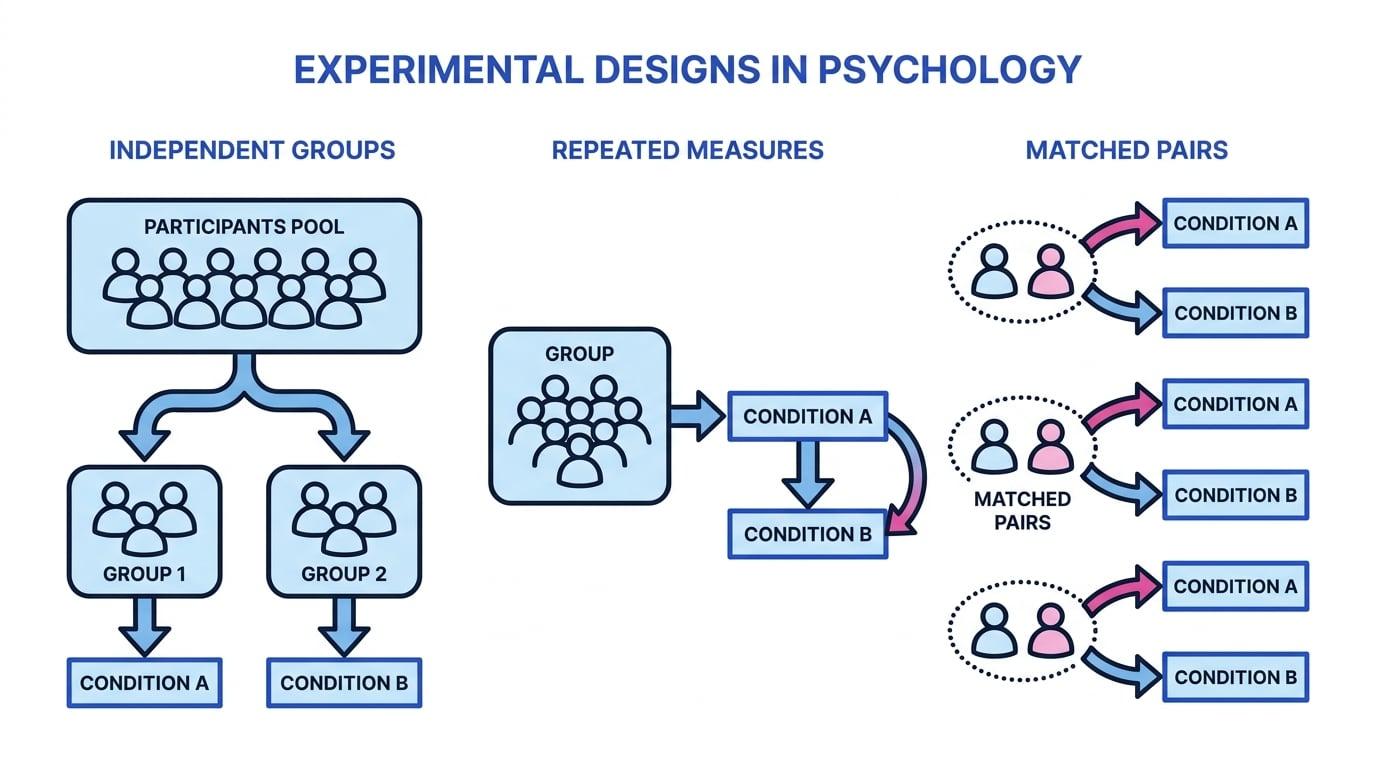
An experimental design is the way participants are allocated to the different conditions of the independent variable.
The big choice
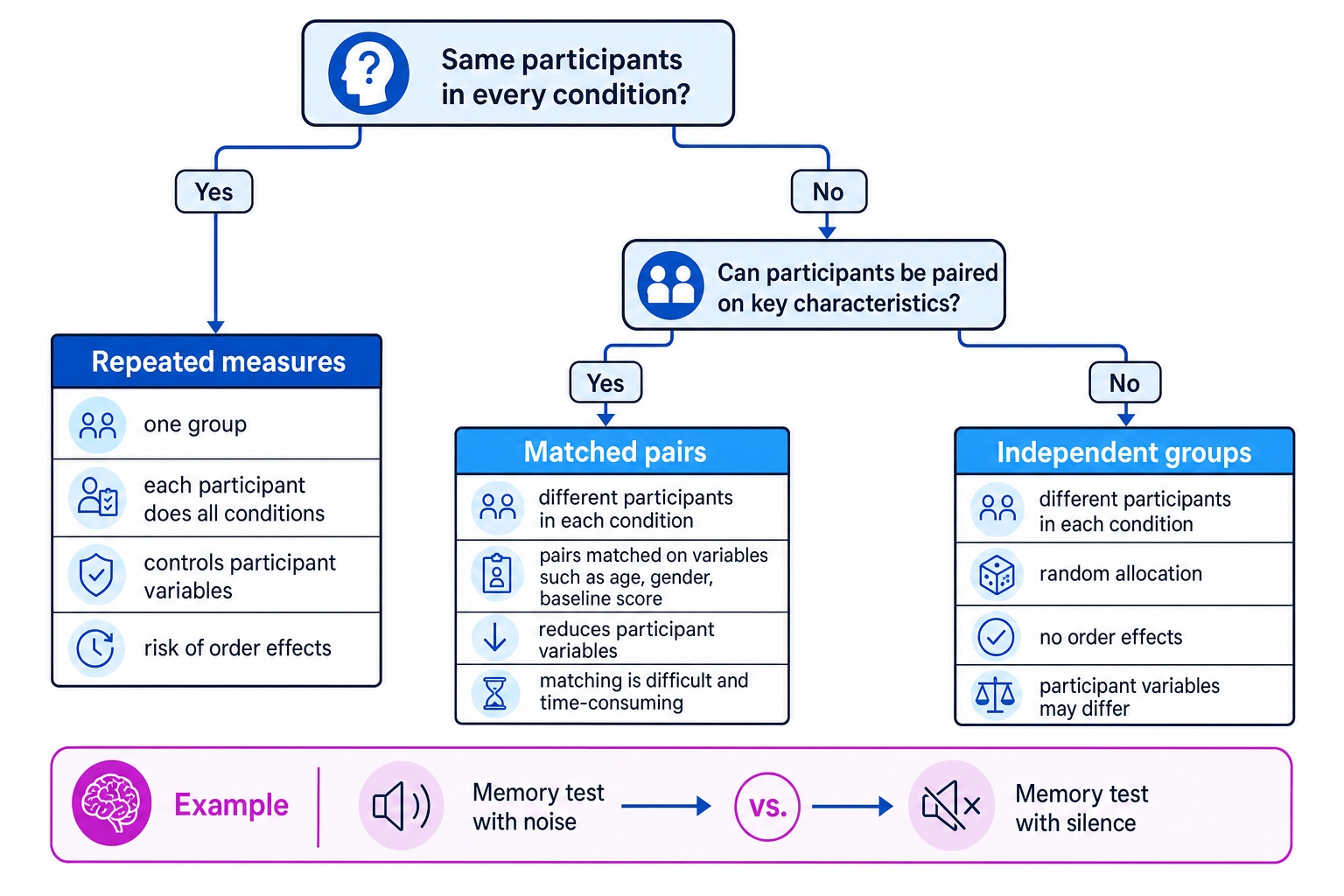
All three designs are trying to balance two problems: keeping groups comparable while avoiding unwanted effects caused by the design itself.
Participant variables
Participant variables
Participant variables are individual differences between participants that could affect the dependent variable, such as age, intelligence, personality, motivation, anxiety, memory ability, or prior experience.
Participant variables are important because they can act as confounding variables. A confounding variable is an uncontrolled factor that changes systematically with the IV and may be responsible for the result.
For example, if the “noise” group happens to contain stronger readers than the “silence” group, better recall in the noise condition might not be caused by noise at all.
Independent groups design
In an independent groups design, different participants are used in each condition of the IV.
Independent groups design
An independent groups design uses separate groups of participants in each experimental condition. Each participant takes part in only one condition.
Example: One group learns a list of words in silence. A different group learns the list with background noise.
Researchers often use random allocation, where participants are assigned to conditions by chance. This helps spread participant variables more evenly across groups.
Strengths of independent groups
A major strength is that there are no order effects because each participant only does one condition.
Order effects
Order effects occur when doing one condition affects performance in another condition, usually through practice, fatigue, boredom, or guessing the aim.
Independent groups are also useful when participants cannot realistically do more than one condition. For example, in Loftus and Palmer’s (1974) study of eyewitness testimony, participants were asked questions using different verbs such as “hit” or “smashed”. Using independent groups helps stop participants comparing the wording across conditions and working out the aim.
Weaknesses of independent groups
The main weakness is that participant variables may differ between groups. This can reduce internal validity, which is the extent to which the study truly measures the effect of the IV rather than other factors.
Another weakness is that independent groups often need more participants than repeated measures because each participant provides data for only one condition.
Assuming random allocation fixes everything
Random allocation reduces the risk of participant variables, but it does not guarantee perfectly equal groups, especially with small samples.
Choosing independent groups
A researcher wants to test whether a leading question affects eyewitness estimates of speed. Participants watch one car crash clip and are then asked either “How fast was the car going when it hit the other car?” or “How fast was the car going when it smashed into the other car?”
- The IV has two conditions: the verb hit or smashed in the question.
- If the same participants answered both questions, they might notice the wording manipulation and change their answers, creating demand characteristics.
- Different participants in each condition would reduce this risk, so an independent groups design is appropriate.
- The researcher should use random allocation to reduce the chance that one group is naturally better at estimating speed.
Repeated measures design
In a repeated measures design, the same participants take part in every condition of the IV.
Repeated measures design
A repeated measures design uses the same participants in all experimental conditions, so each participant is compared with themselves.
Example: Every participant completes a memory test in silence and also completes a memory test with background noise.
Strengths of repeated measures
The biggest strength is that it controls participant variables. Because the same people take part in both conditions, differences such as memory ability, motivation, or anxiety are held constant across conditions.
Repeated measures also usually require fewer participants than independent groups because each participant provides data in every condition.
Weaknesses of repeated measures
The main weakness is order effects. If participants do the silence condition first and the noise condition second, they might improve because they understand the task better. That is a practice effect. Alternatively, they might perform worse because they are tired or bored. That is a fatigue effect.
Repeated measures can also increase demand characteristics, where participants guess the aim of the study and alter their behaviour.
Counterbalancing
Counterbalancing is a control technique used in repeated measures designs where the order of conditions is varied between participants, such as half doing condition A then B, and half doing B then A.
Counterbalancing does not remove order effects completely, but it helps distribute them across conditions so they do not favour just one condition.
Using counterbalancing
A psychologist studies whether music affects concentration. Each participant completes a puzzle once in silence and once with music.
- If everyone completes silence first, any improvement in the music condition might be due to practice rather than music.
- The researcher splits participants into two order groups: Group 1 does silence then music, while Group 2 does music then silence.
- If practice effects occur, they should affect both conditions more evenly because each condition appears first for some participants and second for others.
- This improves internal validity because the effect of order is less likely to be confused with the effect of the IV.
Remember repeated measures
Repeated measures means repeated participation: the same people repeat the task across conditions.
Matched pairs design
A matched pairs design is a compromise between independent groups and repeated measures.
Matched pairs design
A matched pairs design uses different participants in each condition, but participants are paired on important characteristics before one member of each pair is placed in each condition.
Example: A researcher pairs participants with similar memory scores. One member of each pair learns words in silence, while the other learns words with background noise.
Participants might be matched on age, gender, IQ, baseline anxiety score, memory ability, or any variable likely to affect the DV. In some cases, researchers may use identical twins, but this is rare.
Strengths of matched pairs
Matched pairs reduces participant variables more than independent groups because the groups are made similar on key characteristics.
It also avoids order effects because each participant only takes part in one condition.
Weaknesses of matched pairs
The main weakness is that matching is difficult and time-consuming. It is rarely possible to match participants perfectly, especially on psychological characteristics like motivation, confidence, or previous experience.
Matched pairs may also require a larger initial sample because researchers may need to test people first to find suitable pairs.
Choosing matched pairs
A researcher wants to test whether a new revision app improves psychology test scores. Students’ prior psychology ability is likely to affect their final score.
- An independent groups design could be unfair if one group happens to contain stronger students before the app is introduced.
- A repeated measures design may not work well because taking the same test twice could create practice effects.
- The researcher could give all students a baseline psychology test, then pair students with similar scores.
- One student from each pair uses the revision app, and the other uses standard revision, making matched pairs the best option.
Comparing the three designs
| Design | Who is in each condition? | Main strength | Main weakness |
|---|---|---|---|
| Independent groups | Different participants in each condition | No order effects | Participant variables may differ |
| Repeated measures | Same participants in every condition | Controls participant variables | Order effects and demand characteristics |
| Matched pairs | Different but carefully paired participants | Reduces participant variables and avoids order effects | Matching is difficult and time-consuming |
Exam comparison shortcut
Independent groups avoids order effects. Repeated measures controls participant variables. Matched pairs tries to do both, but is harder to organise.
Links to statistical tests
Experimental design matters because it affects which inferential statistical test may be appropriate later.
For example, if the DV produces ordinal data and the design is repeated measures, a psychologist might use the Wilcoxon signed-ranks test. If the same ordinal DV came from independent groups, they might use the Mann-Whitney U test instead. For nominal data, a Chi-square test may be used, and for interval data, researchers might use related or unrelated t-tests depending on the design.
You do not need to choose a full statistical test every time you discuss experimental design, but it is useful to understand that the design affects analysis.
Related versus unrelated data
Repeated measures and matched pairs usually produce related data because scores are linked within the same person or within a matched pair. Independent groups usually produce unrelated data because the participants in one condition are not linked to participants in the other.
Ethical considerations
Experimental design itself is not usually the main ethical issue, but it can affect how ethical problems are managed.
In repeated measures designs, participants may spend longer in the study or complete more tasks, so researchers need to consider protection from harm, fatigue, and the right to withdraw. In independent groups designs, participants may receive different experiences, so researchers should ensure no group is disadvantaged. In matched pairs designs, collecting matching information such as age, test scores, or mental health data raises issues of confidentiality.
Researchers should also consider informed consent, deception, debriefing, and the right to withdraw, especially if participants are not told the full aim to reduce demand characteristics.
AO3 evaluation: what examiners like
When evaluating experimental designs, do not just state a strength or weakness. Explain the effect on the study.
For example, saying “repeated measures has no participant variables” is too brief. A stronger answer is: “Repeated measures controls participant variables because the same participants take part in every condition. This improves internal validity because differences in the DV are more likely to be due to the IV.”
Use the because chain
For AO3, aim for: feature → reason → consequence. For example: “Counterbalancing is used because order effects may occur, which improves internal validity by reducing the chance that practice or fatigue explains the result.”
In the exam
- Identify whether the same participants, different participants, or paired participants are used before naming the design.
- Link every strength or weakness to validity: explain how it affects confidence that the IV caused the change in the DV.
- Use precise terms such as participant variables, order effects, random allocation, counterbalancing, and demand characteristics.
- If given a scenario, apply your answer to the actual task rather than giving a generic definition.
- For comparison questions, make the contrast explicit: “Unlike repeated measures, independent groups avoids order effects because…”
Check yourself
- Why does repeated measures control participant variables better than independent groups?
- How does counterbalancing reduce the problem of order effects?
- In what kind of study might matched pairs be better than both repeated measures and independent groups?