Revision notes for Edexcel A Level Maths Conditional Probability. Open each subtopic for explanations, worked examples, and summaries of Set Notation, Conditional Probability, Conditional Probabilities in Venn Diagrams, Probability Formulae, and Tree Diagrams. Written against the Edexcel A Level Maths (9MA0) specification, so the content matches what's examinable rather than general Maths background.
Conditional Probability
What you'll learn
- How to read event notation such as A′A'A′, A∩BA \cap BA∩B and A∪BA \cup BA∪B.
- How to calculate probabilities when you are told something has already happened.
- How to test whether two events are independent.
- How to use tree diagrams and Venn diagrams for “given that” questions.
1. Events, complements, intersections and unions
In probability, letters such as AAA and BBB usually represent events. Probabilities are always between 0 and 1, and the total probability of all possible outcomes is 1.
Definition
Core event notation
- An event is a set of outcomes, such as “a selected person watches football”.
- The complement of AAA, written A′A'A′, means AAA does not happen.
- The intersection A∩BA \cap BA∩B means both AAA and BBB happen.
- The union A∪BA \cup BA∪B means at least one of AAA or BBB happens, including both.
For two events, the key “or” formula is:
P(A∪B)=P(A)+P(B)−P(A∩B)P(A \cup B)=P(A)+P(B)-P(A \cap B)P(A∪B)=P(A)+P(B)−P(A∩B)You subtract the overlap because it has been counted twice.
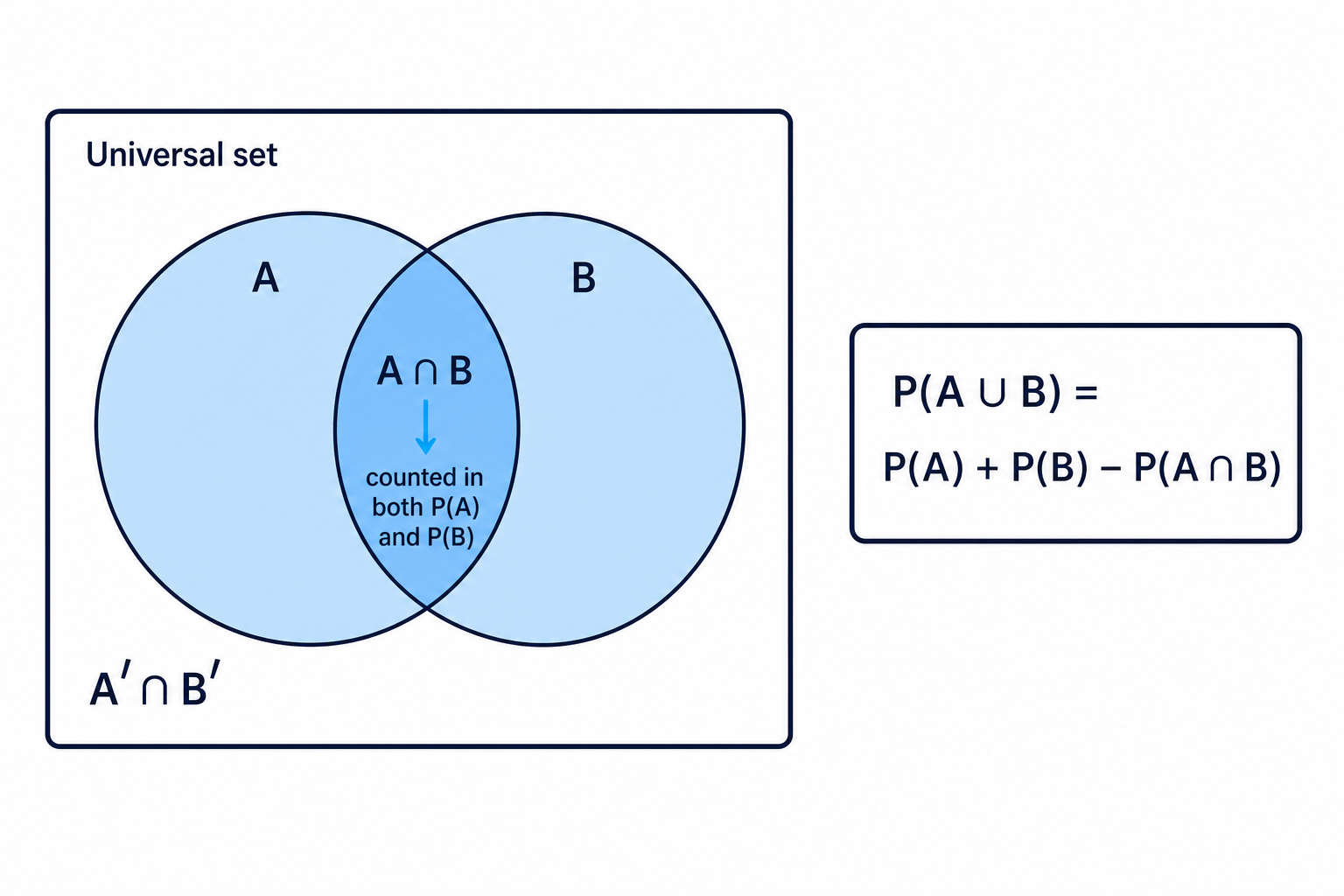
Example
Finding a union and the outside region
Events AAA and BBB have P(A)=0.45P(A)=0.45P(A)=0.45, P(B)=0.50P(B)=0.50P(B)=0.50 and P(A∩B)=0.18P(A \cap B)=0.18P(A∩B)=0.18. Find P(A∪B)P(A \cup B)P(A∪B) and P(A′∩B′)P(A' \cap B')P(A′∩B′).
-
Use the union formula.
P(A∪B)=0.45+0.50−0.18=0.77P(A \cup B)=0.45+0.50-0.18=0.77P(A∪B)=0.45+0.50−0.18=0.77 -
The event A′∩B′A' \cap B'A′∩B′ means neither AAA nor BBB, so it is outside the union.
P(A′∩B′)=1−P(A∪B)=1−0.77=0.23P(A' \cap B')=1-P(A \cup B)=1-0.77=0.23P(A′∩B′)=1−P(A∪B)=1−0.77=0.23
Common Mistake
Forgetting the overlap
If you calculate P(A)+P(B)P(A)+P(B)P(A)+P(B) for “AAA or BBB”, you count outcomes in both events twice. Always subtract P(A∩B)P(A \cap B)P(A∩B) once.
2. Conditional probability: “given that”
Conditional probability is about updating the probability when you know extra information.
Definition
Conditional probability
P(A∣B)P(A\mid B)P(A∣B) means “the probability of AAA, given that BBB has happened”. Provided P(B)>0P(B)>0P(B)>0,
P(A∣B)=P(A∩B)P(B)P(A\mid B)=\frac{P(A \cap B)}{P(B)}P(A∣B)=P(B)P(A∩B)Key Idea
Shrink the universe
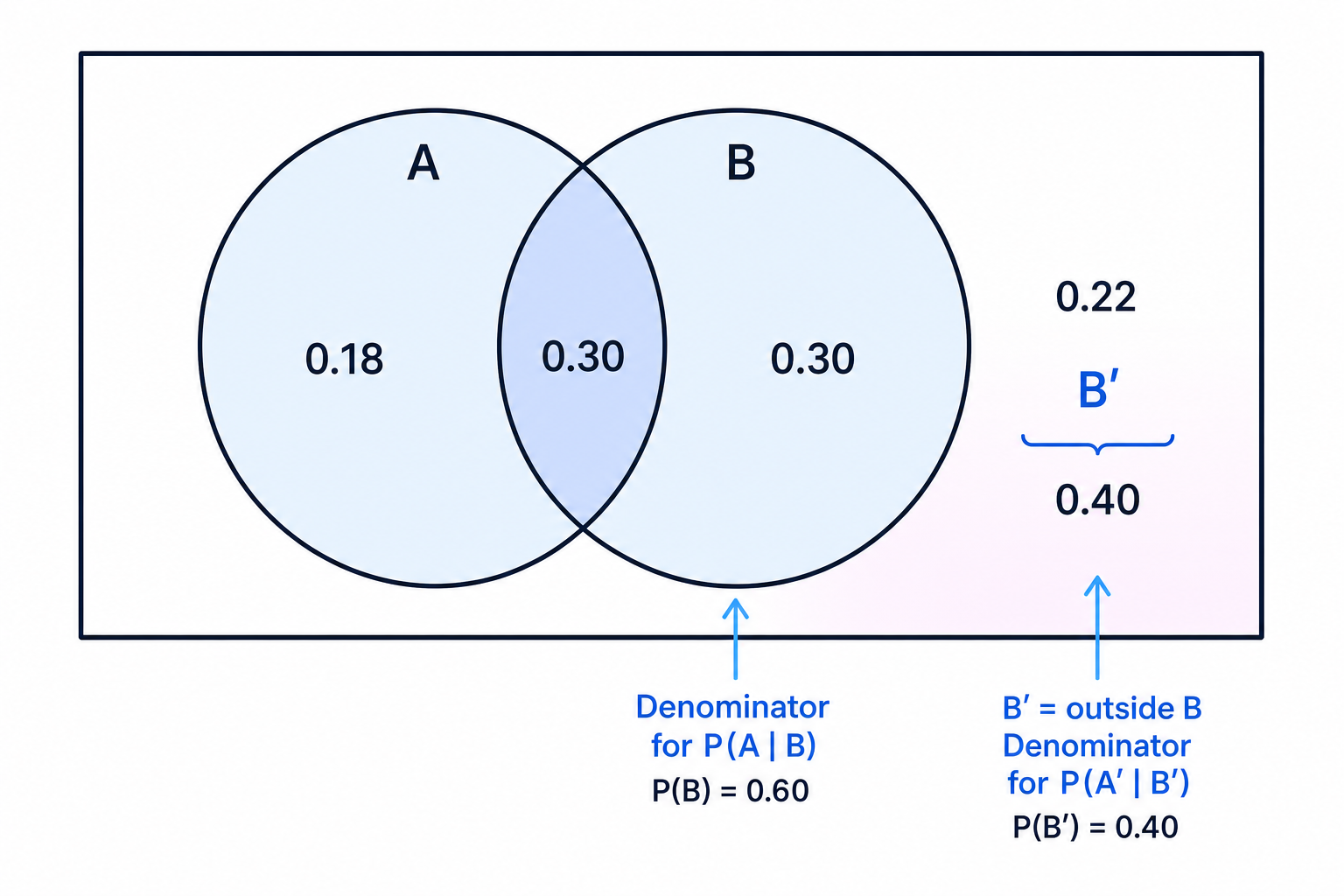
When you see “given BBB”, pretend BBB is the whole universe. The denominator is P(B)P(B)P(B).
Example
Using the conditional probability formula
Events AAA and BBB have P(A)=0.48P(A)=0.48P(A)=0.48, P(B)=0.60P(B)=0.60P(B)=0.60 and P(A∩B)=0.30P(A \cap B)=0.30P(A∩B)=0.30. Find P(A∣B)P(A\mid B)P(A∣B) and P(A′∣B′)P(A'\mid B')P(A′∣B′).
-
For P(A∣B)P(A\mid B)P(A∣B), divide the overlap by the probability of the condition.
P(A∣B)=0.300.60=0.5P(A\mid B)=\frac{0.30}{0.60}=0.5P(A∣B)=0.600.30=0.5 -
For P(A′∣B′)P(A'\mid B')P(A′∣B′), first find the union.
P(A∪B)=0.48+0.60−0.30=0.78P(A \cup B)=0.48+0.60-0.30=0.78P(A∪B)=0.48+0.60−0.30=0.78 -
The outside-both region is A′∩B′A' \cap B'A′∩B′.
P(A′∩B′)=1−0.78=0.22P(A' \cap B')=1-0.78=0.22P(A′∩B′)=1−0.78=0.22 -
Now condition on B′B'B′, where P(B′)=1−0.60=0.40P(B')=1-0.60=0.40P(B′)=1−0.60=0.40.
P(A′∣B′)=P(A′∩B′)P(B′)=0.220.40=0.55P(A'\mid B')=\frac{P(A' \cap B')}{P(B')}=\frac{0.22}{0.40}=0.55P(A′∣B′)=P(B′)P(A′∩B′)=0.400.22=0.55
Tip
Read the bar out loud
In P(A∣B)P(A\mid B)P(A∣B), say “AAA given BBB”. The event after the bar is what you divide by.
3. Rearranging the conditional probability formula
Sometimes you are given a conditional probability and need to work backwards to find an intersection.
From
P(A∣B)=P(A∩B)P(B)P(A\mid B)=\frac{P(A \cap B)}{P(B)}P(A∣B)=P(B)P(A∩B)we get:
P(A∩B)=P(A∣B)P(B)P(A \cap B)=P(A\mid B)P(B)P(A∩B)=P(A∣B)P(B)Example
Working backwards from a conditional probability
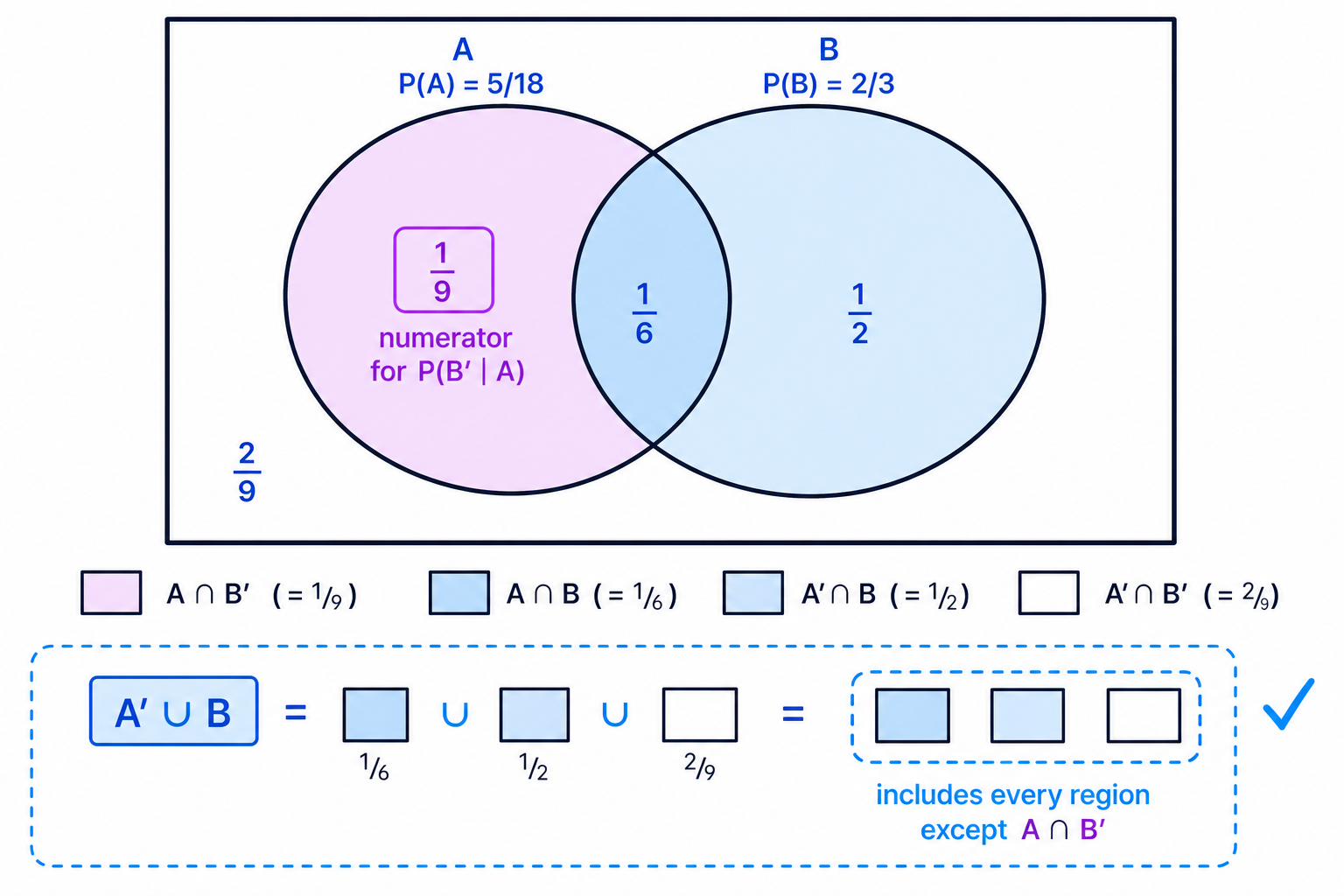
Events AAA and BBB have P(A)=518P(A)=\frac{5}{18}P(A)=185, P(B)=23P(B)=\frac{2}{3}P(B)=32 and P(A∣B)=14P(A\mid B)=\frac{1}{4}P(A∣B)=41. Find P(A∩B)P(A \cap B)P(A∩B), P(B′∣A)P(B'\mid A)P(B′∣A) and P(A′∪B)P(A' \cup B)P(A′∪B).
-
Multiply to find the intersection.
P(A∩B)=P(A∣B)P(B)=14×23=16P(A \cap B)=P(A\mid B)P(B)=\frac{1}{4}\times \frac{2}{3}=\frac{1}{6}P(A∩B)=P(A∣B)P(B)=41×32=61 -
To find P(B′∣A)P(B'\mid A)P(B′∣A), first find the part of AAA that is not in BBB.
P(A∩B′)=P(A)−P(A∩B)=518−16=19P(A \cap B')=P(A)-P(A \cap B)=\frac{5}{18}-\frac{1}{6}=\frac{1}{9}P(A∩B′)=P(A)−P(A∩B)=185−61=91 -
Now divide by the condition, P(A)P(A)P(A).
P(B′∣A)=P(A∩B′)P(A)=19518=25P(B'\mid A)=\frac{P(A \cap B')}{P(A)}=\frac{\frac{1}{9}}{\frac{5}{18}}=\frac{2}{5}P(B′∣A)=P(A)P(A∩B′)=18591=52 -
For P(A′∪B)P(A' \cup B)P(A′∪B), use the complement. The only excluded region is A∩B′A \cap B'A∩B′.
P(A′∪B)=1−P(A∩B′)=1−19=89P(A' \cup B)=1-P(A \cap B')=1-\frac{1}{9}=\frac{8}{9}P(A′∪B)=1−P(A∩B′)=1−91=98
Common Mistake
Using the wrong denominator
P(B′∣A)P(B'\mid A)P(B′∣A) is not divided by P(B′)P(B')P(B′). The phrase “given AAA” means divide by P(A)P(A)P(A).
4. Independence and mutually exclusive events
Two important phrases sound similar but mean very different things.
Definition
Independent and mutually exclusive
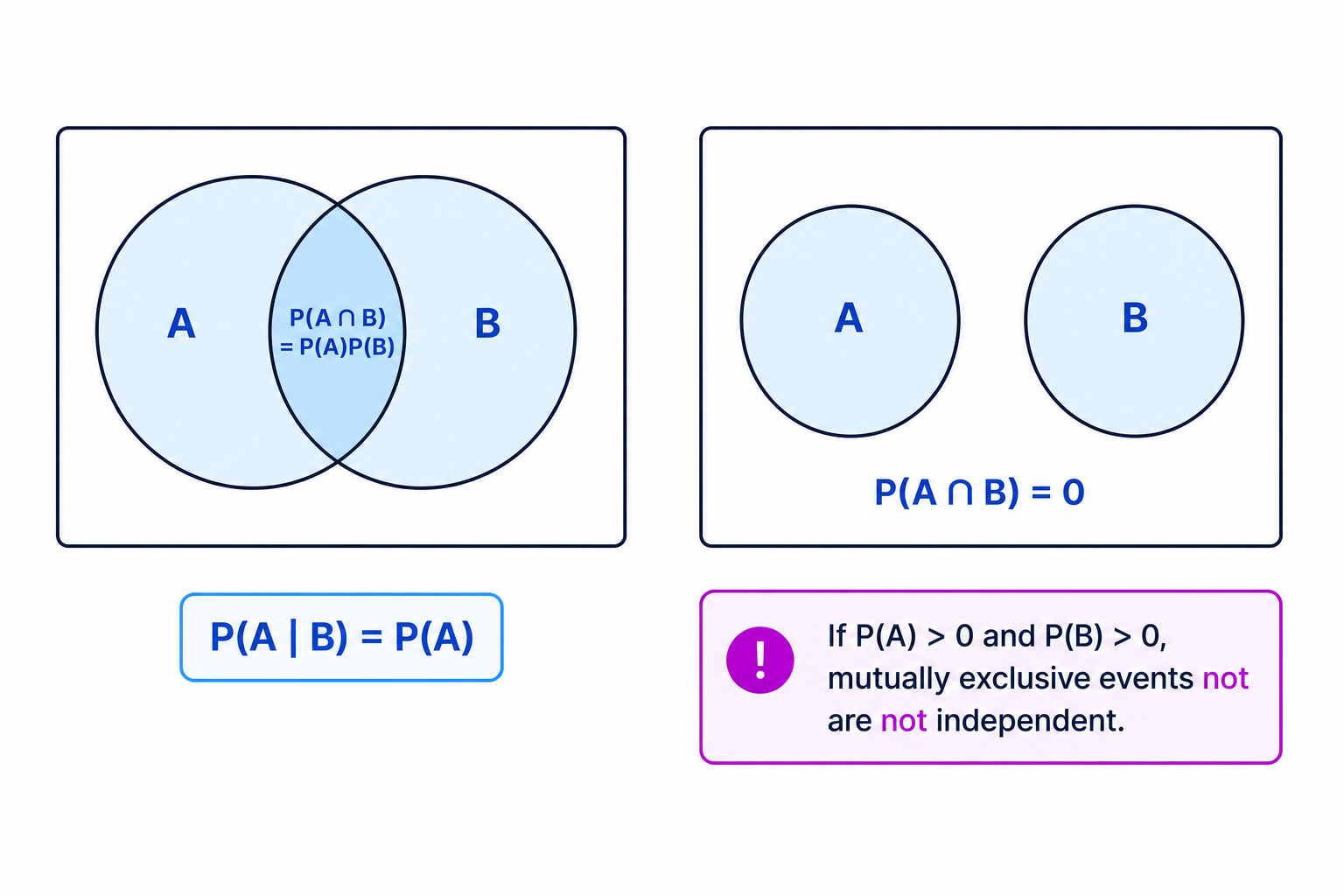
- Events AAA and BBB are independent if knowing one happened does not change the probability of the other. For independent events, P(A∩B)=P(A)P(B)P(A \cap B)=P(A)P(B)P(A∩B)=P(A)P(B).
- Events AAA and BBB are mutually exclusive if they cannot happen together. For mutually exclusive events, P(A∩B)=0P(A \cap B)=0P(A∩B)=0.
Common Mistake
Do not mix these up
If two events with non-zero probabilities are mutually exclusive, they are not independent: knowing one happened makes the other impossible.
Example
Using independence to find a missing probability
Suppose P(A)=0.30P(A)=0.30P(A)=0.30, P(A∪B)=0.72P(A \cup B)=0.72P(A∪B)=0.72, and AAA and BBB are independent. Find P(B)P(B)P(B) and P(A′∪B′)P(A' \cup B')P(A′∪B′).
-
Let P(B)=xP(B)=xP(B)=x. Since the events are independent, P(A∩B)=0.30xP(A \cap B)=0.30xP(A∩B)=0.30x.
-
Substitute into the union formula.
0.72=0.30+x−0.30x0.72=0.30+x-0.30x0.72=0.30+x−0.30x -
Solve for xxx.
0.72=0.30+0.70x⇒x=0.600.72=0.30+0.70x \Rightarrow x=0.600.72=0.30+0.70x⇒x=0.60 -
A′∪B′A' \cup B'A′∪B′ means “not both AAA and BBB”, so use the complement of A∩BA \cap BA∩B.
P(A′∪B′)=1−P(A∩B)=1−(0.30×0.60)=0.82P(A' \cup B')=1-P(A \cap B)=1-(0.30\times 0.60)=0.82P(A′∪B′)=1−P(A∩B)=1−(0.30×0.60)=0.82
5. Tree diagrams and reverse conditional probability
Tree diagrams are especially useful when there are stages, such as choosing a machine then checking whether an item is faulty, or removing counters one after another.
Definition
Tree diagram
A tree diagram shows probabilities on branches in stages. Multiply along a complete path; add probabilities of separate paths that lead to the same final outcome.
When you are told the final outcome and asked about an earlier branch, use the same conditional probability idea:
P(earlier event∣final event)=P(earlier event and final event)P(final event)P(\text{earlier event}\mid \text{final event})=\frac{P(\text{earlier event and final event})}{P(\text{final event})}P(earlier event∣final event)=P(final event)P(earlier event and final event)Example
Faulty components from different machines
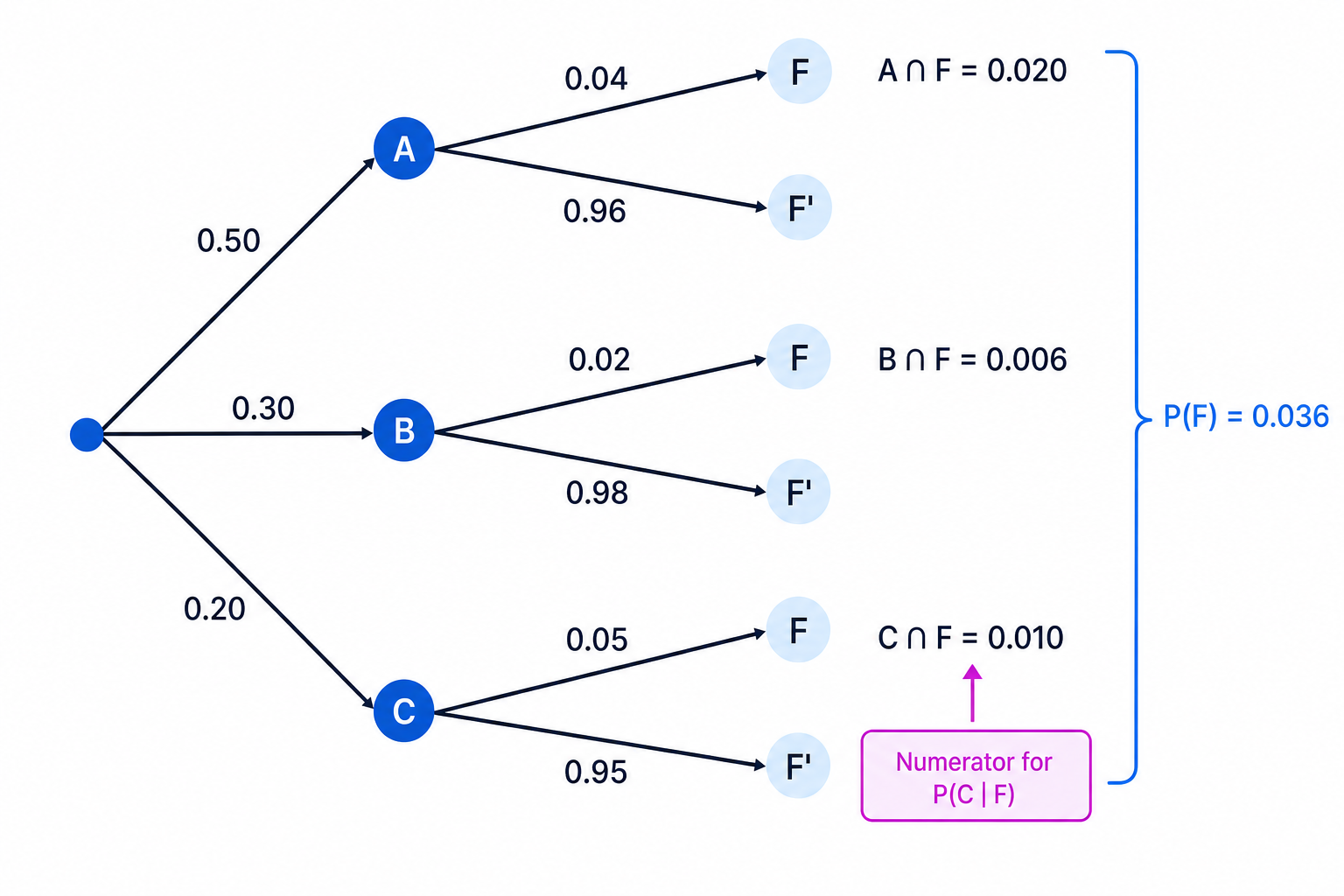
A factory uses three machines. Machine AAA makes 50% of the components, machine BBB makes 30%, and machine CCC makes 20%. Their faulty rates are 4%, 2% and 5% respectively. Find the probability a component is faulty, and then find the probability it came from machine CCC given that it is faulty.
-
Multiply along each “faulty” path.
P(A∩F)=0.50×0.04=0.020P(B∩F)=0.30×0.02=0.006P(C∩F)=0.20×0.05=0.010\begin{aligned} P(A \cap F)&=0.50\times 0.04=0.020\\ P(B \cap F)&=0.30\times 0.02=0.006\\ P(C \cap F)&=0.20\times 0.05=0.010 \end{aligned}P(A∩F)P(B∩F)P(C∩F)=0.50×0.04=0.020=0.30×0.02=0.006=0.20×0.05=0.010 -
Add the separate faulty paths.
P(F)=0.020+0.006+0.010=0.036P(F)=0.020+0.006+0.010=0.036P(F)=0.020+0.006+0.010=0.036 -
Given faulty, restrict to the faulty outcomes.
P(C∣F)=P(C∩F)P(F)=0.0100.036=518P(C\mid F)=\frac{P(C \cap F)}{P(F)}=\frac{0.010}{0.036}=\frac{5}{18}P(C∣F)=P(F)P(C∩F)=0.0360.010=185
Tip
Without replacement
If an item is not put back, update both the favourable count and the total count on the next branch. After taking one counter from 12 counters, there are 11 counters left.
6. Venn diagrams with three events
A Venn diagram is a picture showing how events overlap. With three events, fill the most specific regions first: usually the “all three” overlap, then the pairwise-only overlaps, then the single-event-only regions.
Example
A three-event Venn diagram with sports
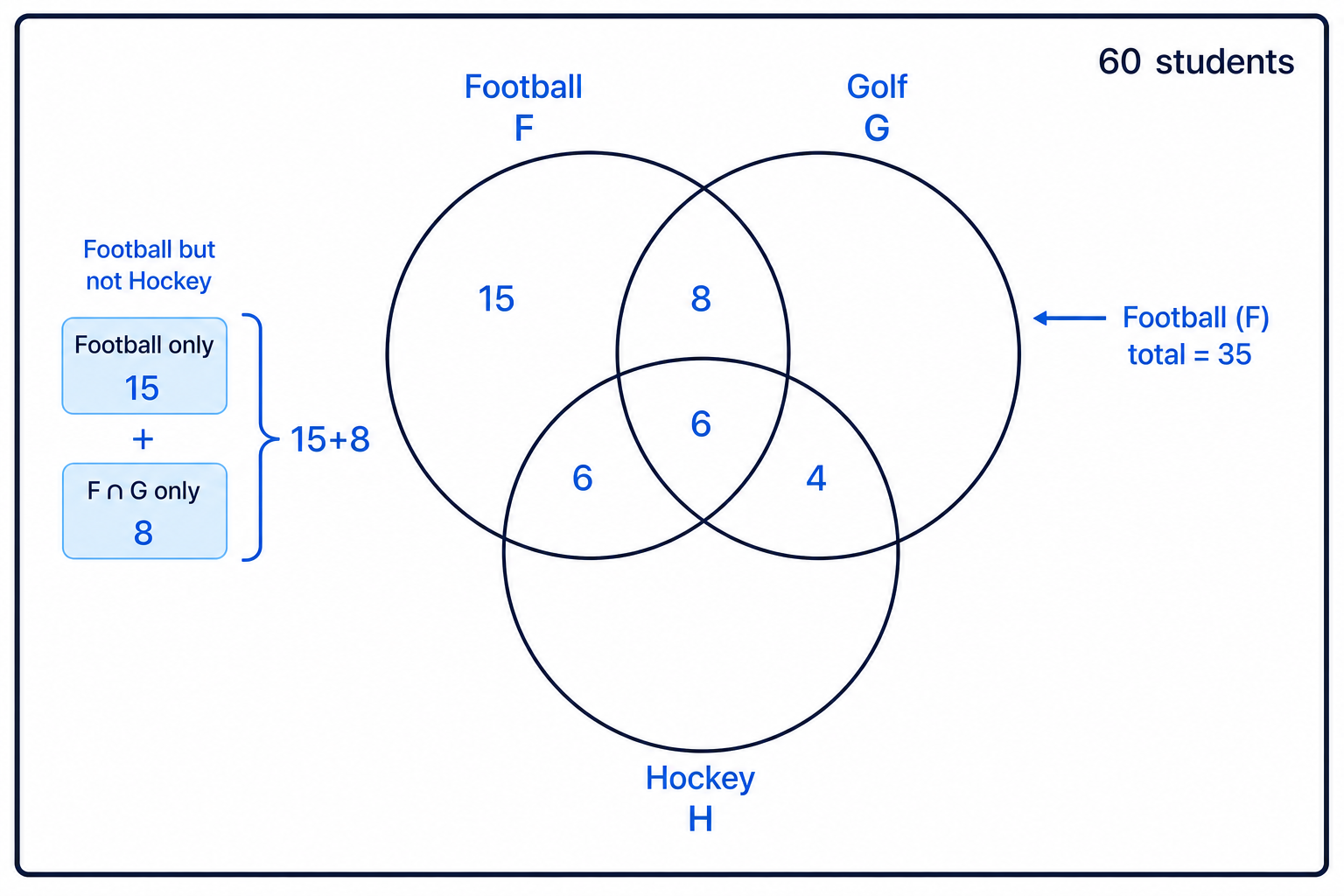
A group of 60 students are asked whether they watch football, golf and hockey. Six watch all three. The totals for football and golf, golf and hockey, and football and hockey are 14, 10 and 12 respectively. Overall, 35 watch football. Given a student watches football, find the probability they do not watch hockey.
-
Pair totals include the all-three region, so subtract 6 to get the pairwise-only regions.
football and golf only=14−6=8golf and hockey only=10−6=4football and hockey only=12−6=6\begin{aligned} \text{football and golf only} &= 14-6=8\\ \text{golf and hockey only} &= 10-6=4\\ \text{football and hockey only} &= 12-6=6 \end{aligned}football and golf onlygolf and hockey onlyfootball and hockey only=14−6=8=10−6=4=12−6=6 -
Find the football-only region.
football only=35−(8+6+6)=15\text{football only}=35-(8+6+6)=15football only=35−(8+6+6)=15 -
“Football but not hockey” includes football only and football-and-golf only.
P(not hockey∣F)=15+835=2335P(\text{not hockey}\mid F)=\frac{15+8}{35}=\frac{23}{35}P(not hockey∣F)=3515+8=3523
Tip
Pair totals include the middle
If a question says 14 watch football and golf, that usually includes students who also watch hockey. Subtract the all-three region to get the “football and golf only” region.
Exam technique
In the exam
- Underline the words “given that” and write the denominator first.
- For “or”, use P(A∪B)=P(A)+P(B)−P(A∩B)P(A \cup B)=P(A)+P(B)-P(A \cap B)P(A∪B)=P(A)+P(B)−P(A∩B) or add disjoint Venn regions.
- For tree diagrams, multiply along branches and add separate paths.
- For independence, check whether P(A∩B)=P(A)P(B)P(A \cap B)=P(A)P(B)P(A∩B)=P(A)P(B) or whether P(A∣B)=P(A)P(A\mid B)=P(A)P(A∣B)=P(A).
- For “at least one”, consider using the complement “none”.
Self review
Check yourself
- In P(A′∣B)P(A'\mid B)P(A′∣B), which probability goes in the denominator?
- How can you find P(A′∩B′)P(A' \cap B')P(A′∩B′) if you know P(A∪B)P(A \cup B)P(A∪B)?
- What calculation would show that two events are independent?

Recap questions
Test yourself with 5 quick questions on this guide. Answer them all correctly to complete it.
You've reached the end
Test yourself on this topic, or move on to the next guide.
How was this guide?