Revision notes for Edexcel A Level Maths Parametric Equations. Open each subtopic for explanations, worked examples, and summaries of 8.1 Parametric Equations, 8.2 Using Trigonometric Identities, 8.3 Curve Sketching, 8.4 Points of Intersection, and 8.5 Modelling with Parametric Equations. Written against the Edexcel A Level Maths (9MA0) specification, so the content matches what's examinable rather than general Maths background.
Parametric Equations
What you'll learn
- What parametric equations are and how they describe a curve.
- How to eliminate a parameter to get a Cartesian equation.
- How to find intercepts, domains, circles, line segments, and intersections.
- How to sketch parametric curves accurately without overcomplicating them.
1. What a parameter does
You already know coordinates like (x,y)(x,y)(x,y). Parametric equations give xxx and yyy separately, both in terms of a third variable.
Definition
Key language
- A parametric equation gives coordinates using another variable, usually ttt or θ\thetaθ.
- The extra variable is called a parameter.
- A Cartesian equation connects xxx and yyy directly, with no parameter left.
- The domain is the set of allowed input values, such as allowed values of ttt or allowed values of xxx.
Think of the parameter as a slider. For each value of the parameter, you get one point on the curve.
Example
Plotting points from a parameter
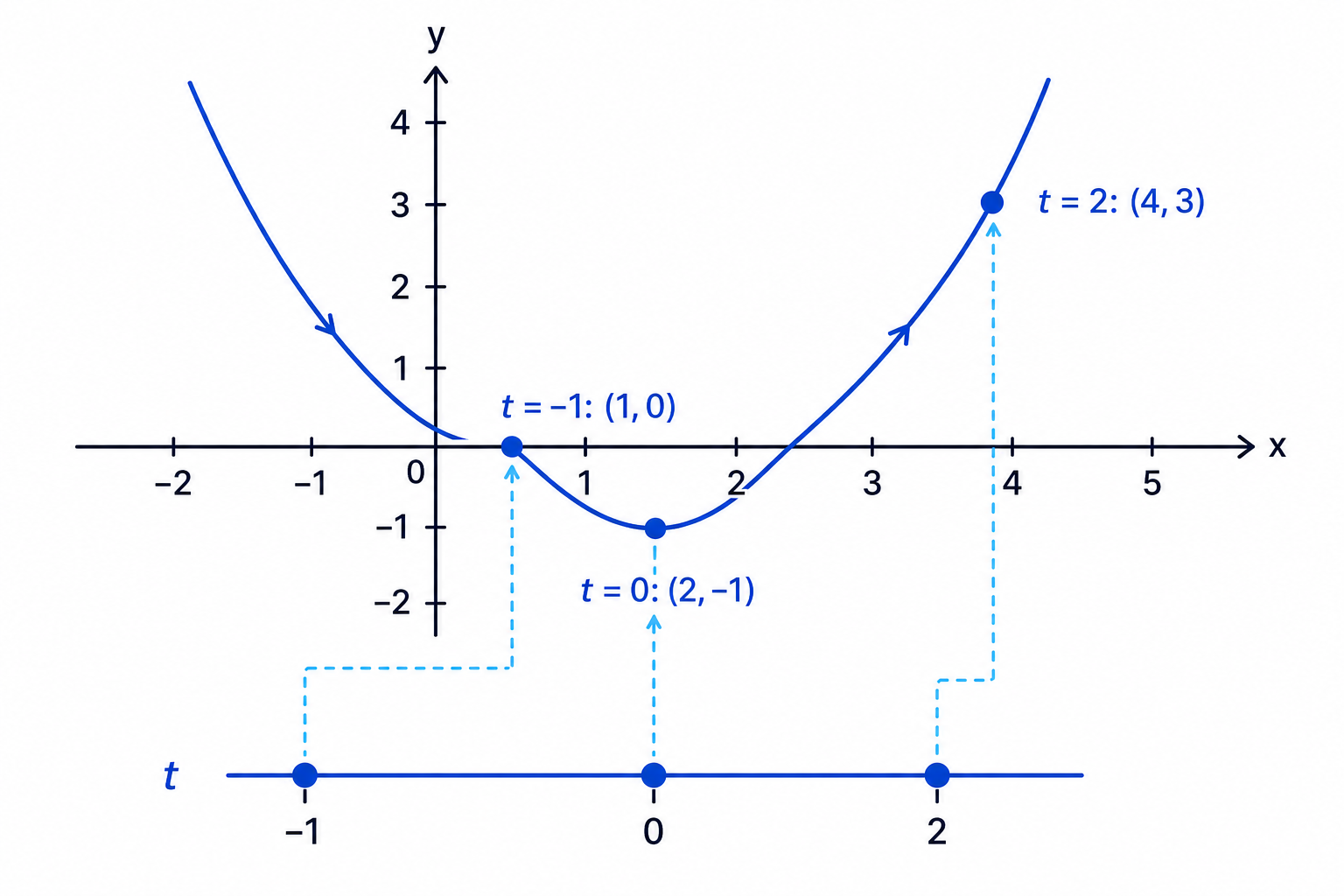
A curve is given by x=t+2, y=t2−1x=t+2,\ y=t^2-1x=t+2, y=t2−1.
-
Substitute t=−1t=-1t=−1:
x=1,y=0x=1,\quad y=0x=1,y=0 -
Substitute t=0t=0t=0:
x=2,y=−1x=2,\quad y=-1x=2,y=−1 -
Substitute t=2t=2t=2:
x=4,y=3x=4,\quad y=3x=4,y=3 -
So the curve passes through (1,0)(1,0)(1,0), (2,−1)(2,-1)(2,−1), and (4,3)(4,3)(4,3). As ttt increases, the points are traced in that order.
Key Idea
Big picture
Parametric equations describe a curve by saying where a moving point is at each value of the parameter.
2. Eliminating the parameter
To eliminate the parameter means to remove ttt or θ\thetaθ so that you get an equation involving only xxx and yyy.
The usual method is:
- rearrange one equation to make the parameter the subject;
- substitute into the other equation.
Example
Finding a Cartesian equation and sketching
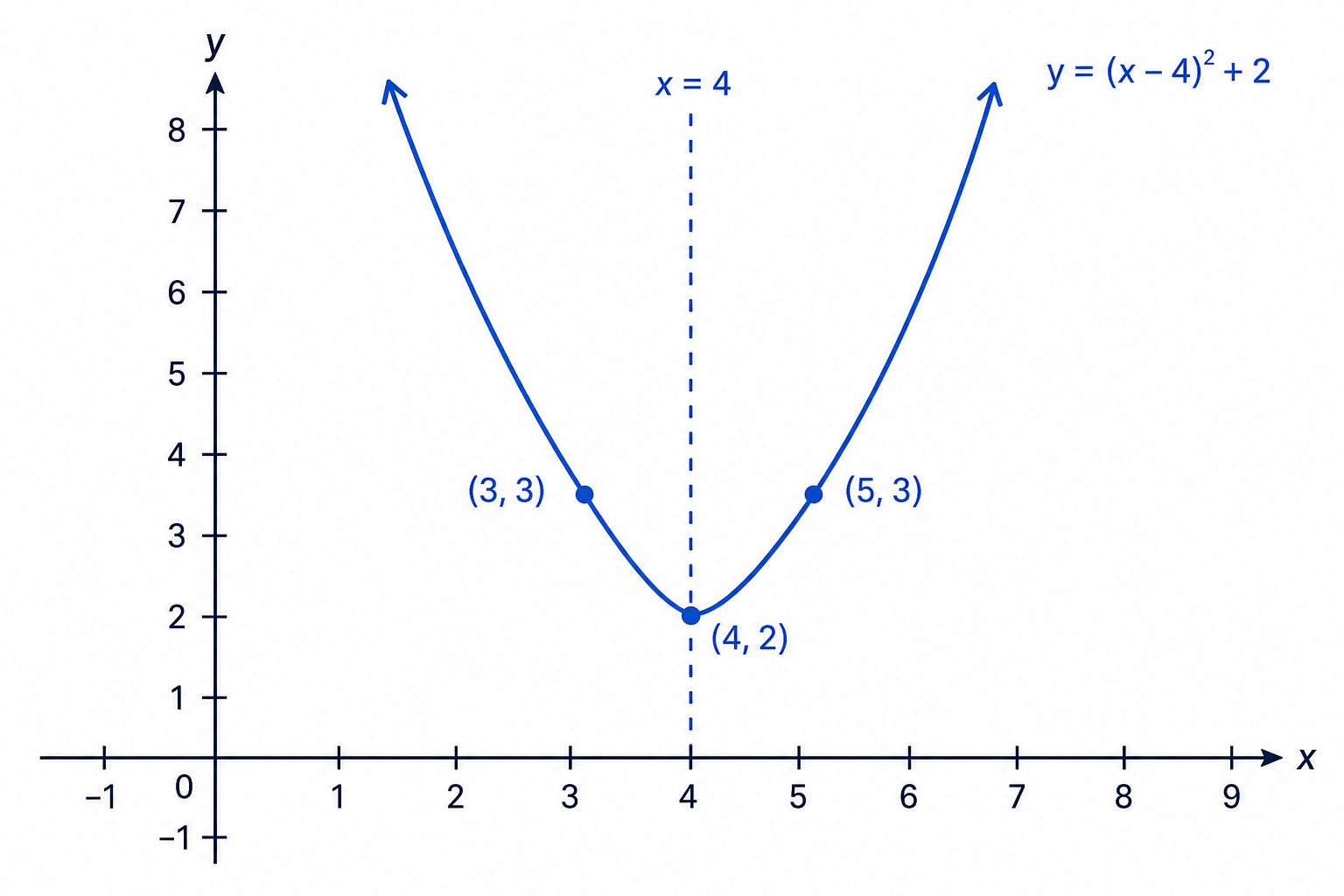
A curve has parametric equations x=t+4, y=t2+2x=t+4,\ y=t^2+2x=t+4, y=t2+2. Find a Cartesian equation and describe the sketch.
-
Rearrange x=t+4x=t+4x=t+4 to make ttt the subject:
t=x−4t=x-4t=x−4 -
Substitute into y=t2+2y=t^2+2y=t2+2:
y=(x−4)2+2y=(x-4)^2+2y=(x−4)2+2 -
Since ttt is unrestricted here, xxx can take any real value.
-
The graph is a parabola opening upwards, with vertex (4,2)(4,2)(4,2) and axis of symmetry x=4x=4x=4.
Common Mistake
Sign errors when rearranging
From x=t+4x=t+4x=t+4, the correct rearrangement is t=x−4t=x-4t=x−4, not t=x+4t=x+4t=x+4.
3. Finding where a curve crosses the axes
An x-intercept is where the curve crosses the x-axis, so y=0y=0y=0.
A y-intercept is where the curve crosses the y-axis, so x=0x=0x=0.
With parametric equations, you often find intercepts fastest by working with the parameter directly.
Example
Crossing the coordinate axes
A curve is given by x=ln(t+2), y=t2−9, t>−2x=\ln(t+2),\ y=t^2-9,\ t>-2x=ln(t+2), y=t2−9, t>−2. Find where it crosses the axes.
-
For an x-intercept, set y=0y=0y=0:
t2−9=0t^2-9=0t2−9=0 -
Solve for ttt and check the restriction t>−2t>-2t>−2:
t=3ort=−3t=3\quad \text{or}\quad t=-3t=3ort=−3 -
Reject t=−3t=-3t=−3 because it is not allowed. For t=3t=3t=3:
x=ln(5)x=\ln(5)x=ln(5) -
For a y-intercept, set x=0x=0x=0:
ln(t+2)=0\ln(t+2)=0ln(t+2)=0 -
Since ln(1)=0\ln(1)=0ln(1)=0, we get t+2=1t+2=1t+2=1, so t=−1t=-1t=−1. Then:
y=(−1)2−9=−8y=(-1)^2-9=-8y=(−1)2−9=−8 -
The curve crosses the axes at:
(ln5,0),(0,−8)(\ln 5,0),\quad (0,-8)(ln5,0),(0,−8)
Tip
Intercept shortcut
For intercepts, do not eliminate the parameter unless you need to. Set x=0x=0x=0 or y=0y=0y=0 in the parametric equations.
4. Recognising circles
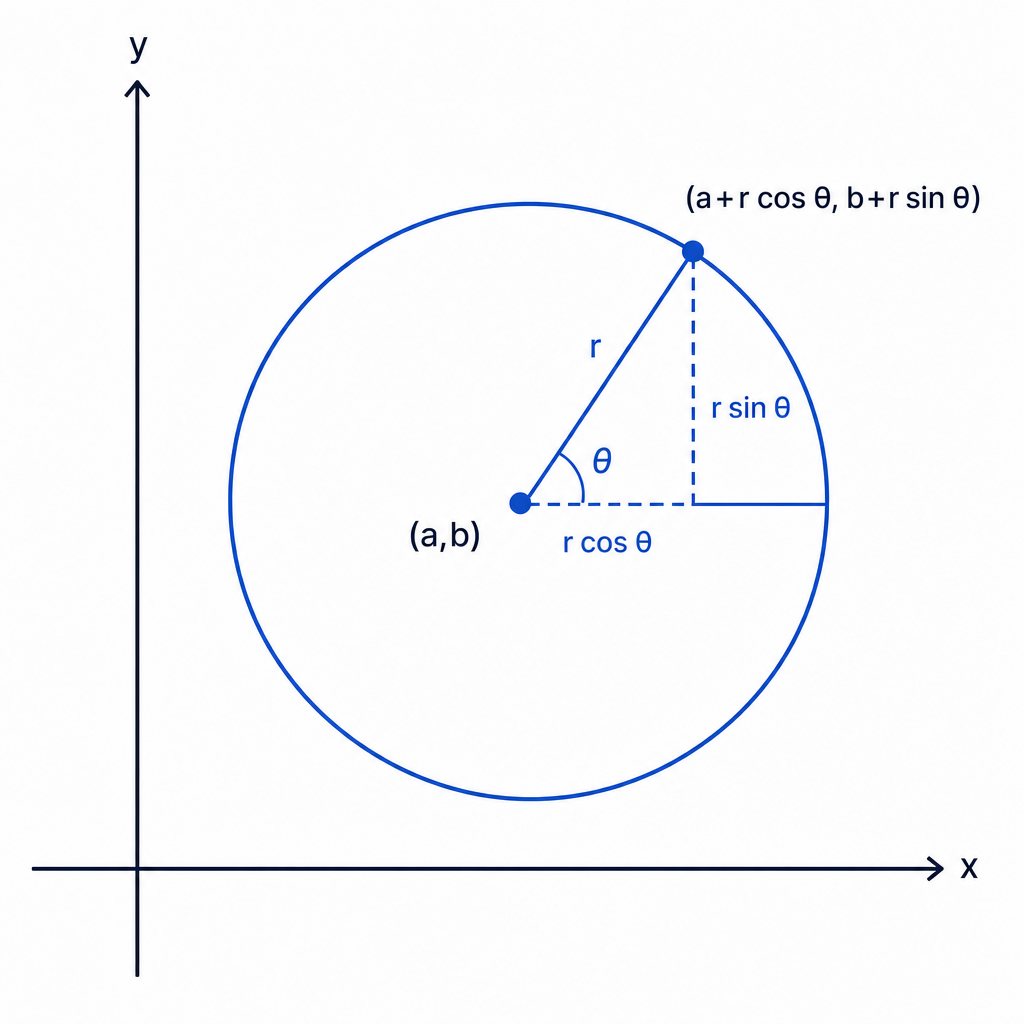
A very common parametric form for a circle is:
x=a+rcosθ,y=b+rsinθx=a+r\cos\theta,\quad y=b+r\sin\thetax=a+rcosθ,y=b+rsinθThis represents a circle with centre (a,b)(a,b)(a,b) and radius rrr.
Example
Finding the centre and radius
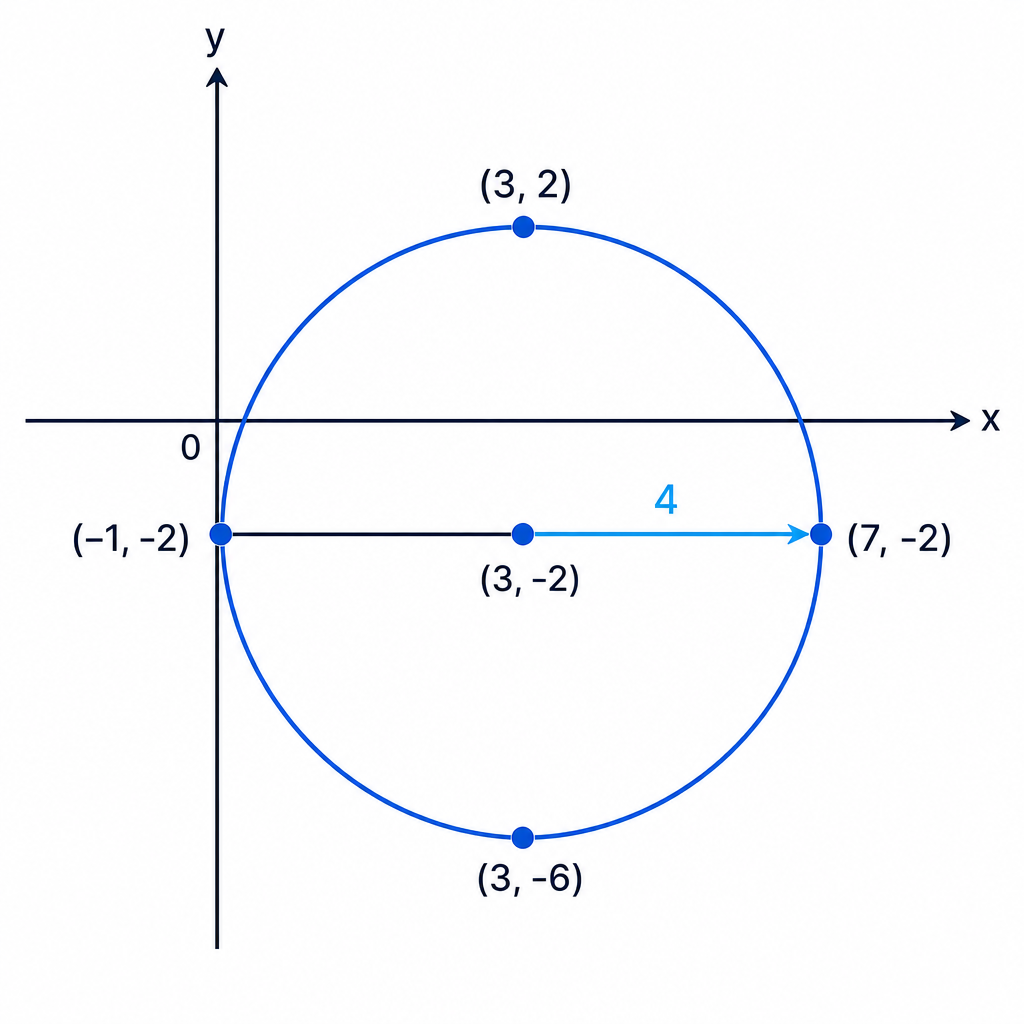
A circle is defined by x=3+4cosθ, y=−2+4sinθx=3+4\cos\theta,\ y=-2+4\sin\thetax=3+4cosθ, y=−2+4sinθ. Find its centre and radius.
-
Compare with the standard form x=a+rcosθ, y=b+rsinθx=a+r\cos\theta,\ y=b+r\sin\thetax=a+rcosθ, y=b+rsinθ.
-
The centre is (3,−2)(3,-2)(3,−2) because those are the horizontal and vertical shifts.
-
The radius is 4 because both the sine and cosine terms have coefficient 4.
-
To confirm using a Cartesian equation, rearrange:
x−34=cosθ,y+24=sinθ\frac{x-3}{4}=\cos\theta,\quad \frac{y+2}{4}=\sin\theta4x−3=cosθ,4y+2=sinθ -
Square and add, using cos2θ+sin2θ=1\cos^2\theta+\sin^2\theta=1cos2θ+sin2θ=1:
(x−34)2+(y+24)2=1\left(\frac{x-3}{4}\right)^2+\left(\frac{y+2}{4}\right)^2=1(4x−3)2+(4y+2)2=1 -
Therefore the Cartesian equation is:
(x−3)2+(y+2)2=16(x-3)^2+(y+2)^2=16(x−3)2+(y+2)2=16
5. Showing a parametric curve is a straight line segment
Sometimes the parametric equations look complicated, but the curve is actually part of a straight line.
A line segment is the finite part of a straight line between two endpoints. If the parameter has a restricted range, you usually only get a segment, not the whole line.
Example
A rational parametric curve that is a line
A curve is given by
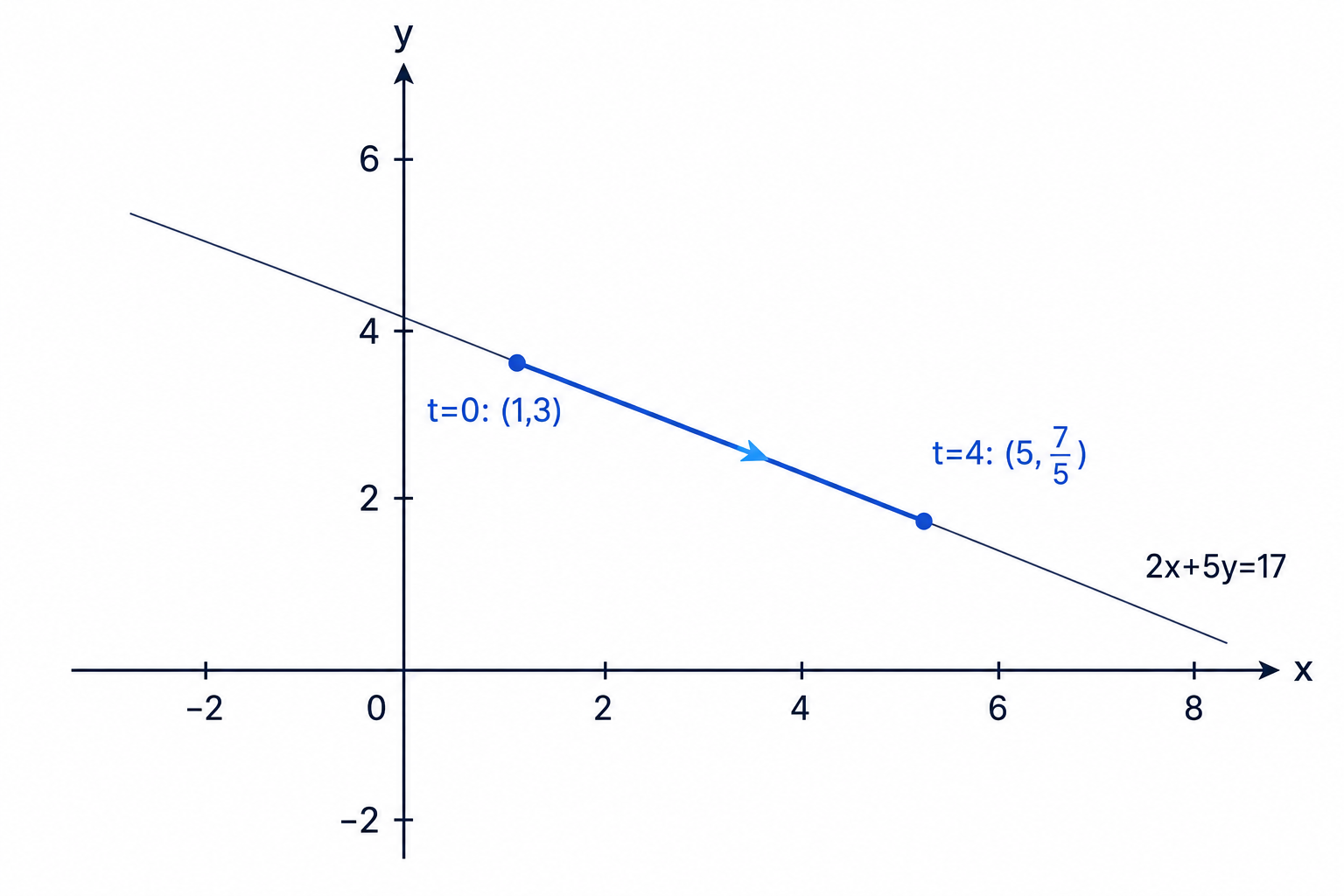
x=1+6tt+1,y=3+tt+1,0≤t≤4x=\frac{1+6t}{t+1},\quad y=\frac{3+t}{t+1},\quad 0\le t\le 4x=t+11+6t,y=t+13+t,0≤t≤4Show that it is part of a straight line and find the length of the segment.
-
Look for a linear combination of xxx and yyy. Try 2x+5y2x+5y2x+5y:
2x+5y=2(1+6t)+5(3+t)t+12x+5y=\frac{2(1+6t)+5(3+t)}{t+1}2x+5y=t+12(1+6t)+5(3+t) -
Simplify the numerator:
2x+5y=17+17tt+1=172x+5y=\frac{17+17t}{t+1}=172x+5y=t+117+17t=17 -
So the curve lies on the straight line:
2x+5y=172x+5y=172x+5y=17 -
Find the endpoints by using the endpoints of the parameter interval:
t=0: (1,3),t=4: (5,75)t=0:\ (1,3),\quad t=4:\ \left(5,\frac{7}{5}\right)t=0: (1,3),t=4: (5,57) -
Use the distance formula for the length LLL:
L=(5−1)2+(75−3)2=16+6425=4295\begin{aligned} L&=\sqrt{(5-1)^2+\left(\frac{7}{5}-3\right)^2}\\ &=\sqrt{16+\frac{64}{25}}\\ &=\frac{4\sqrt{29}}{5} \end{aligned}L=(5−1)2+(57−3)2=16+2564=5429
Common Mistake
Check the denominator
If a parametric equation has a denominator, check that it is not zero in the given parameter interval.
6. Using trigonometric identities and domains
For trig parametric equations, your main job is often to spot the right identity.
Useful identities include:
- sin2t+cos2t=1\sin^2 t+\cos^2 t=1sin2t+cos2t=1
- sec2t=1+tan2t\sec^2 t=1+\tan^2 tsec2t=1+tan2t
- cos2t=2cos2t−1\cos 2t=2\cos^2 t-1cos2t=2cos2t−1
Example
Using to eliminate the parameter
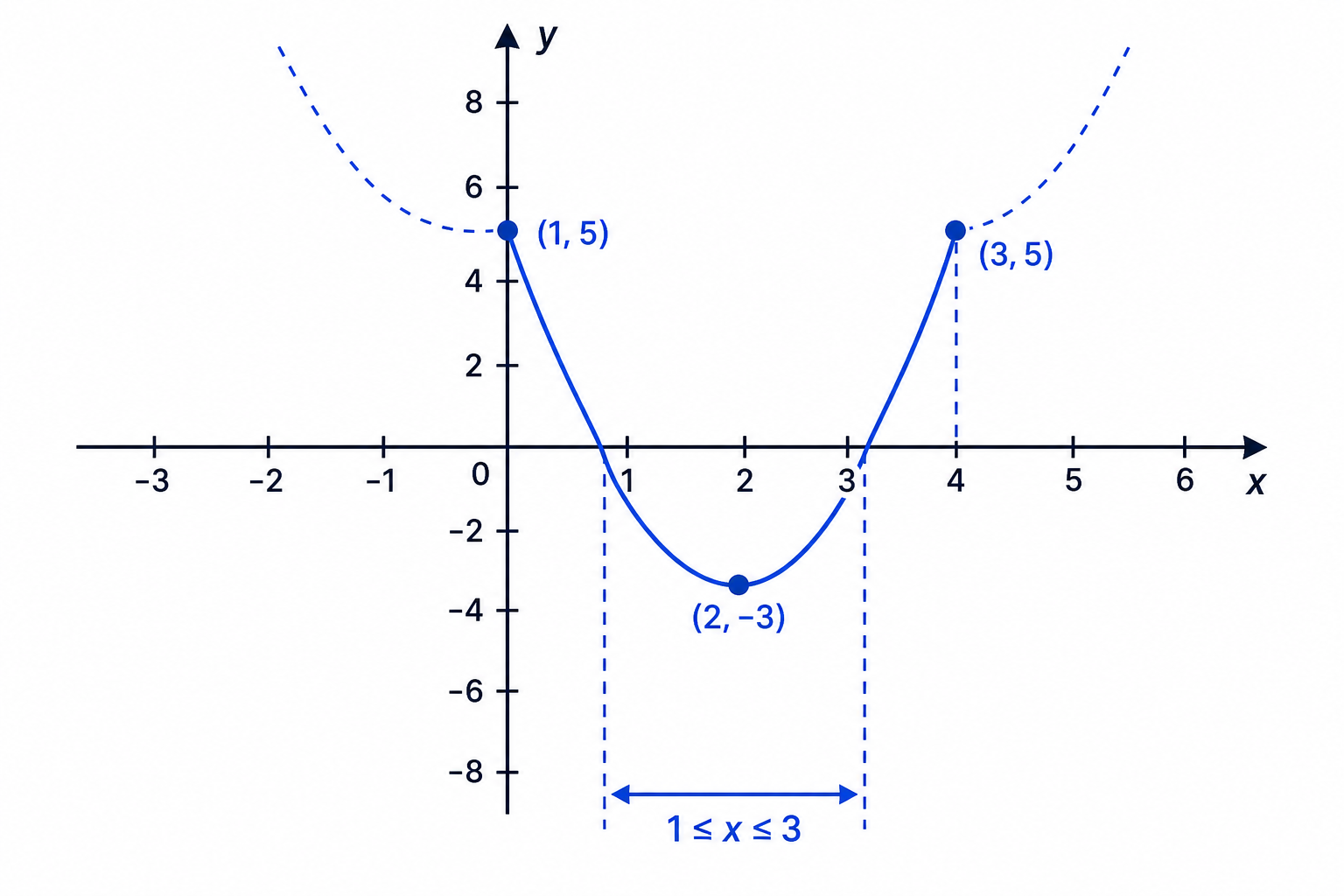
A curve is given by x=2+cost, y=1+4cos2t, 0≤t≤2πx=2+\cos t,\ y=1+4\cos 2t,\ 0\le t\le 2\pix=2+cost, y=1+4cos2t, 0≤t≤2π. Find yyy in terms of xxx and state the domain.
-
From x=2+costx=2+\cos tx=2+cost, rearrange to get:
cost=x−2\cos t=x-2cost=x−2 -
Use cos2t=2cos2t−1\cos 2t=2\cos^2 t-1cos2t=2cos2t−1:
y=1+4(2(x−2)2−1)y=1+4\left(2(x-2)^2-1\right)y=1+4(2(x−2)2−1) -
Simplify:
y=8(x−2)2−3y=8(x-2)^2-3y=8(x−2)2−3 -
Since −1≤cost≤1-1\le \cos t\le 1−1≤cost≤1, the possible values of xxx are:
1≤x≤31\le x\le 31≤x≤3 -
The sketch is the part of the upward parabola y=8(x−2)2−3y=8(x-2)^2-3y=8(x−2)2−3 between x=1x=1x=1 and x=3x=3x=3, with vertex (2,−3)(2,-3)(2,−3) and endpoints (1,5)(1,5)(1,5) and (3,5)(3,5)(3,5).
Common Mistake
Forgetting the domain
After eliminating the parameter, always ask what values of xxx are actually possible. A full parabola may only be a restricted arc or segment.
7. Intersections with another curve
To find intersections, substitute the parametric expressions for xxx and yyy into the other curve’s equation. Then solve for the parameter.
Example
Intersecting an ellipse and a circle
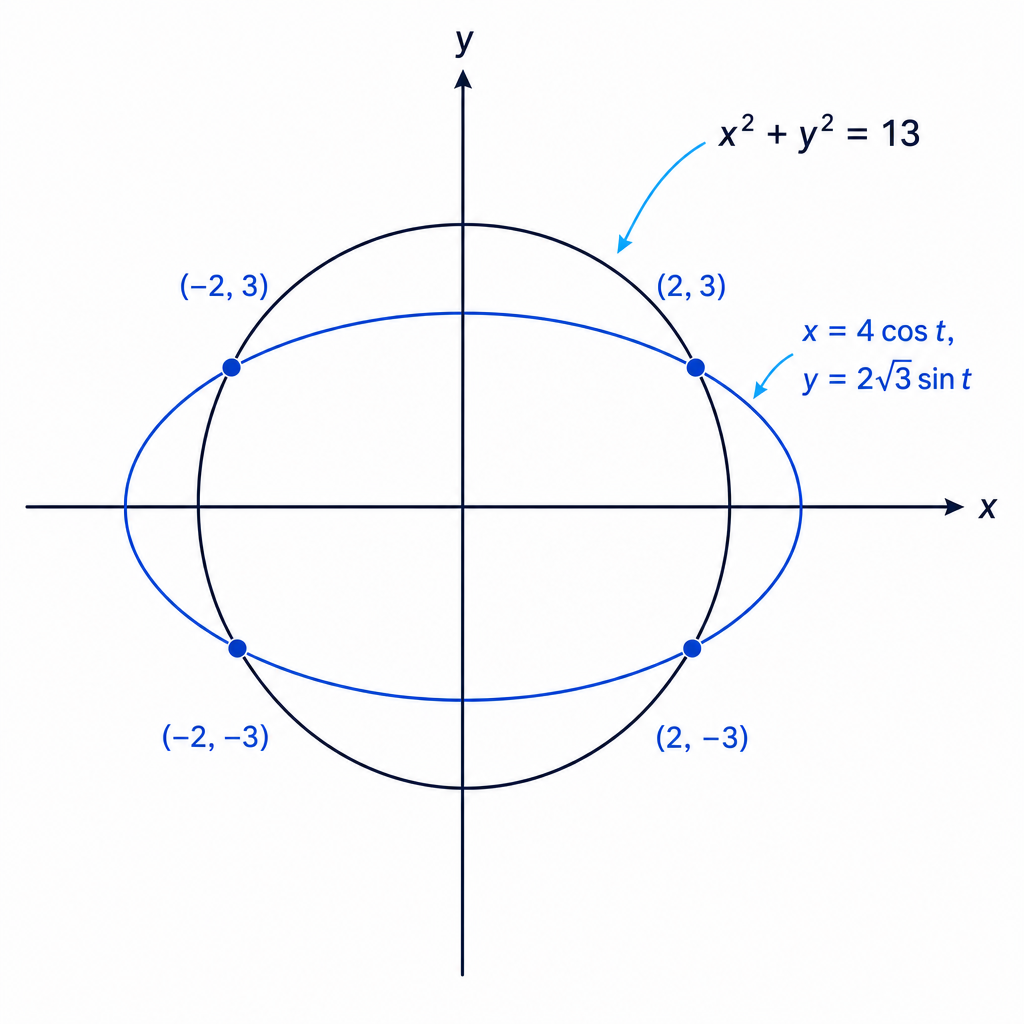
A curve has parametric equations x=4cost, y=23sintx=4\cos t,\ y=2\sqrt{3}\sin tx=4cost, y=23sint. It meets the circle x2+y2=13x^2+y^2=13x2+y2=13. Find the intersection points.
-
Substitute x=4costx=4\cos tx=4cost and y=23sinty=2\sqrt{3}\sin ty=23sint into the circle:
16cos2t+12sin2t=1316\cos^2 t+12\sin^2 t=1316cos2t+12sin2t=13 -
Use cos2t=1−sin2t\cos^2 t=1-\sin^2 tcos2t=1−sin2t:
16(1−sin2t)+12sin2t=1316(1-\sin^2 t)+12\sin^2 t=1316(1−sin2t)+12sin2t=13 -
Simplify:
sin2t=34\sin^2 t=\frac{3}{4}sin2t=43 -
Then cos2t=14\cos^2 t=\frac{1}{4}cos2t=41, so sint=±32\sin t=\pm\frac{\sqrt{3}}{2}sint=±23 and cost=±12\cos t=\pm\frac{1}{2}cost=±21.
-
Convert back to coordinates:
x=±2,y=±3x=\pm 2,\quad y=\pm 3x=±2,y=±3 -
All four sign combinations occur, giving the four points:
(2,3),(−2,3),(−2,−3),(2,−3)(2,3),\quad (-2,3),\quad (-2,-3),\quad (2,-3)(2,3),(−2,3),(−2,−3),(2,−3)
Exam technique
In the exam
-
First decide whether to eliminate the parameter directly, use a trig identity, or substitute into another equation.
-
Always carry parameter restrictions through to the final xxx-domain before sketching.
-
For intercepts and intersections, reject any parameter values that are outside the given range.
Self review
Check yourself
- If x=t−5x=t-5x=t−5 and y=t2+1y=t^2+1y=t2+1, what is the Cartesian equation and where is the vertex?
- For x=2+costx=2+\cos tx=2+cost, why can xxx never be 5?
- When finding an x-intercept, which coordinate must be zero?

Recap questions
Test yourself with 5 quick questions on this guide. Answer them all correctly to complete it.
You've reached the end
Test yourself on this topic, or move on to the next guide.
How was this guide?