Revision notes for Edexcel A Level Maths Functions and Graphs. Open each subtopic for explanations, worked examples, and summaries of 2.1 The Modulus Function, 2.2 Functions and Mappings, 2.3 Composite Functions, 2.4 Inverse Functions, 2.5 y=|f(x)| and y=f(|x|), 2.6 Combining Transformations, and 2.7 Solving Modulus Problems. Written against the Edexcel A Level Maths (9MA0) specification, so the content matches what's examinable rather than general Maths background.
Functions and Graphs
What you'll learn
- How to read function notation, including domains and ranges.
- How to work with composite and piecewise functions.
- How to find inverse functions and know when they exist.
- How to sketch modulus graphs and transformed graphs accurately.
1. Function notation, domain and range
A function is more than just a formula. At A-Level, you must also notice the allowed inputs.
Definition
Function, domain and range
A function is a rule that gives exactly one output for each allowed input. The domain is the set of allowed inputs; the range is the set of outputs actually produced.
If you are asked for the maximum possible domain, use the largest set of real values that makes the expression valid.
Useful restrictions:
- Denominators cannot be zero.
- For expression\sqrt{\text{expression}}expression, the expression must be at least zero.
- For 1expression\frac{1}{\sqrt{\text{expression}}}expression1, the expression must be greater than zero.
- For ln(expression)\ln(\text{expression})ln(expression), the expression must be greater than zero.
- For arcsinx\arcsin xarcsinx, the maximum possible domain is −1≤x≤1-1\le x\le 1−1≤x≤1.
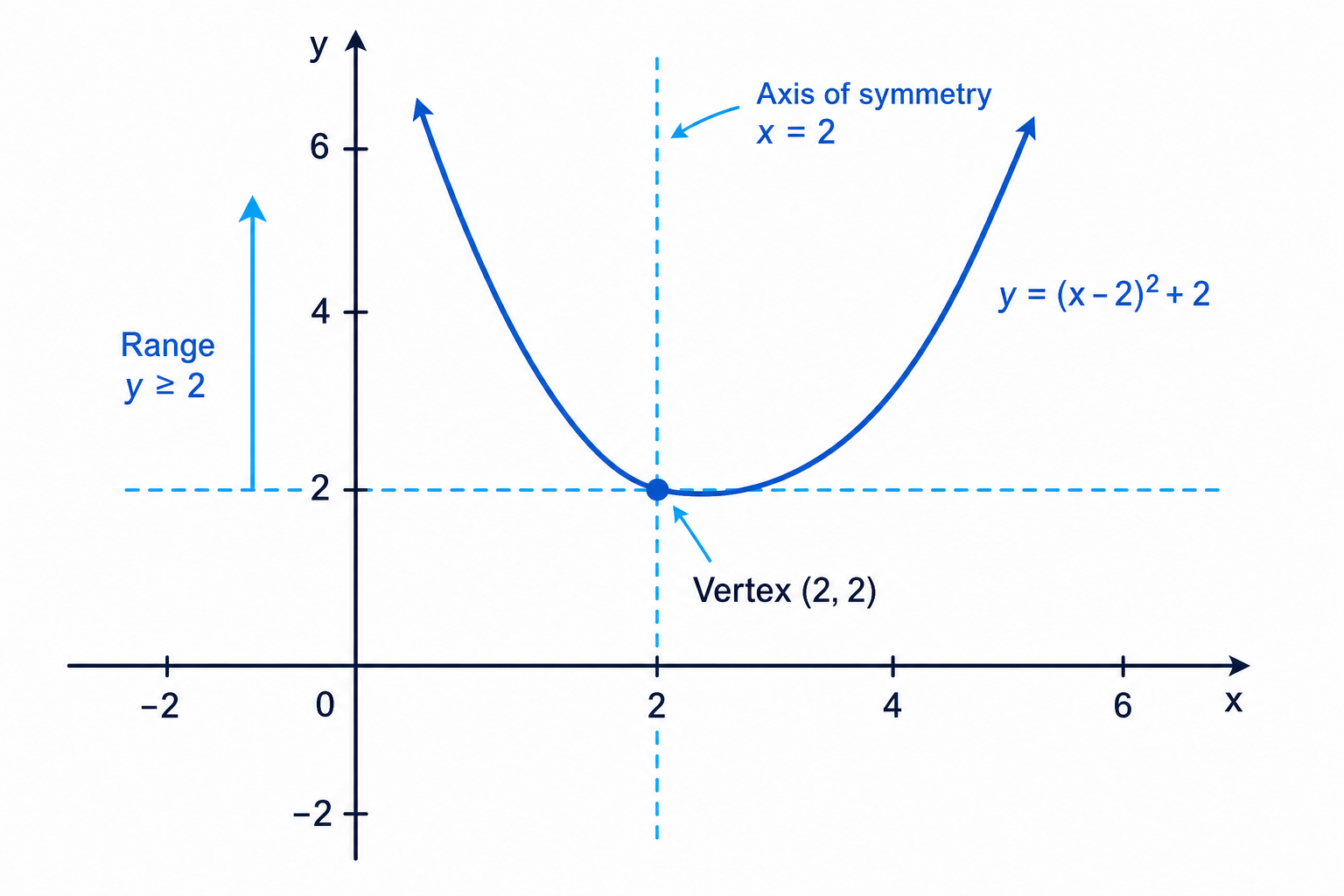
To find a range, think about the graph. For a quadratic, completing the square is often the quickest route.
Example
Maximum domain and range
Find the maximum possible domain of p(x)=17−2xp(x)=\frac{1}{\sqrt{7-2x}}p(x)=7−2x1. Also find the range of f(x)=x2−4x+6f(x)=x^2-4x+6f(x)=x2−4x+6 for x∈Rx\in\mathbb{R}x∈R.
-
For p(x)p(x)p(x), the square root is in the denominator, so 7−2x7-2x7−2x must be greater than zero.
-
Solve the inequality:
7−2x>0⇒x<727-2x>0 \Rightarrow x<\frac{7}{2}7−2x>0⇒x<27 -
So the maximum possible domain is x<72x<\frac{7}{2}x<27.
-
Complete the square for f(x)f(x)f(x):
x2−4x+6=(x−2)2+2x^2-4x+6=(x-2)^2+2x2−4x+6=(x−2)2+2 -
The square term is at least zero, so the minimum value is 2. Therefore the range is f(x)≥2f(x)\ge 2f(x)≥2.
Common Mistake
Square root in a denominator
A square root in the numerator can equal zero, but a square root in the denominator cannot. That is why 1x\frac{1}{\sqrt{x}}x1 needs x>0x>0x>0, not x≥0x\ge 0x≥0.
2. Composite and piecewise functions
Definition
Composite function
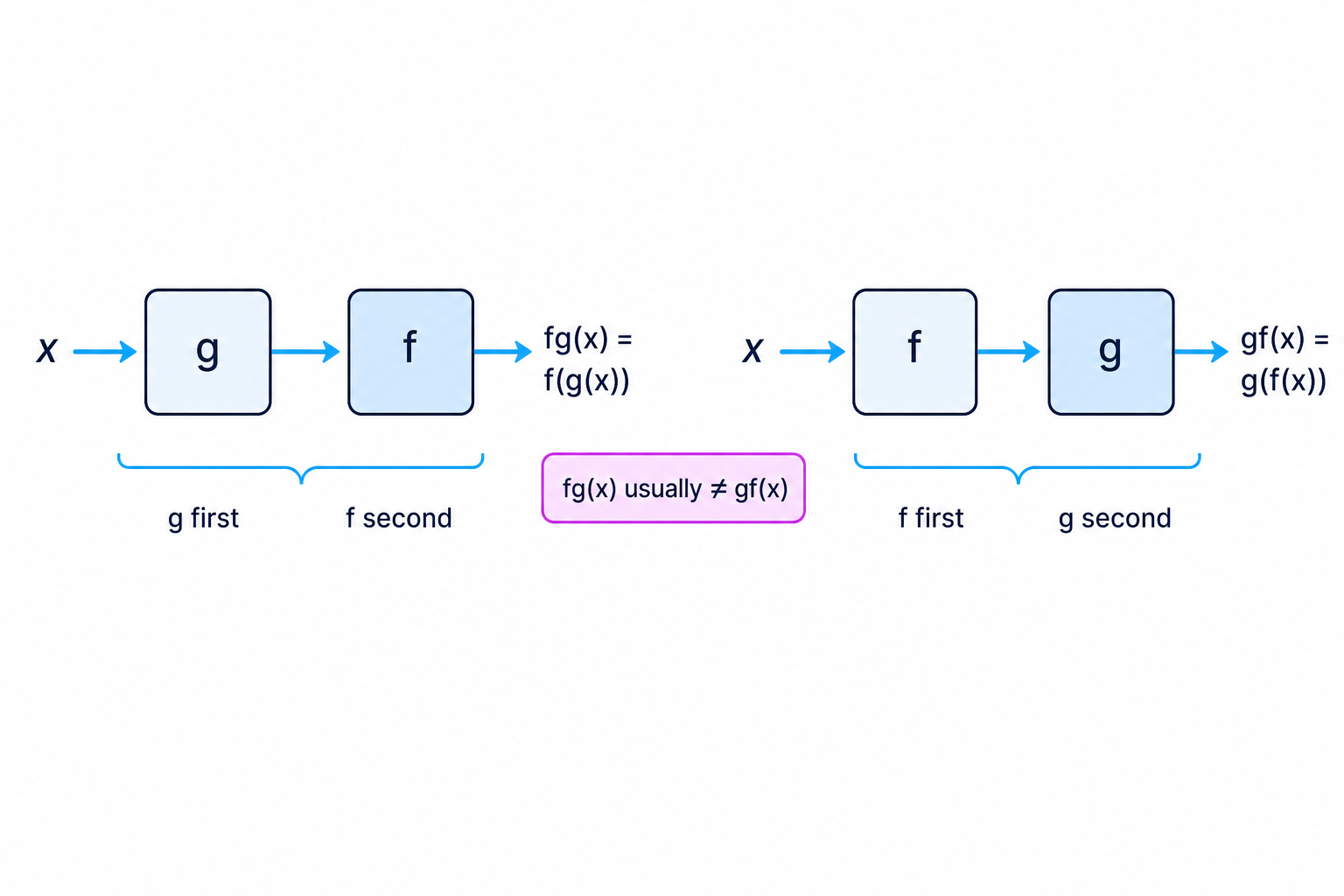
The composite fg(x)fg(x)fg(x) means f(g(x))f(g(x))f(g(x)): apply ggg first, then apply fff. Similarly, gf(x)=g(f(x))gf(x)=g(f(x))gf(x)=g(f(x)).
The function nearest to xxx happens first. This matters because, in general, fg(x)≠gf(x)fg(x)\neq gf(x)fg(x)=gf(x).
Example
Evaluating and solving composites
Let f(x)=4x−1f(x)=4x-1f(x)=4x−1 and g(x)=3x+2g(x)=\frac{3}{x+2}g(x)=x+23, where x≠−2x\neq -2x=−2. Find fg(1)fg(1)fg(1) and solve gf(x)=12gf(x)=\frac{1}{2}gf(x)=21.
-
For fg(1)fg(1)fg(1), work inside out: first find g(1)g(1)g(1).
g(1)=31+2=1g(1)=\frac{3}{1+2}=1g(1)=1+23=1 -
Now apply fff to that result.
f(1)=4(1)−1=3f(1)=4(1)-1=3f(1)=4(1)−1=3 -
So fg(1)=3fg(1)=3fg(1)=3.
-
For gf(x)gf(x)gf(x), apply fff first, then ggg:
gf(x)=g(f(x))=3(4x−1)+2=34x+1gf(x)=g(f(x))=\frac{3}{(4x-1)+2}=\frac{3}{4x+1}gf(x)=g(f(x))=(4x−1)+23=4x+13 -
Solve gf(x)=12gf(x)=\frac{1}{2}gf(x)=21:
34x+1=12⇒6=4x+1⇒x=54\frac{3}{4x+1}=\frac{1}{2}\Rightarrow 6=4x+1\Rightarrow x=\frac{5}{4}4x+13=21⇒6=4x+1⇒x=45 -
Check the denominator is not zero. Since 4x+1≠04x+1\neq 04x+1=0, the solution x=54x=\frac{5}{4}x=45 is valid.
Definition
Piecewise function
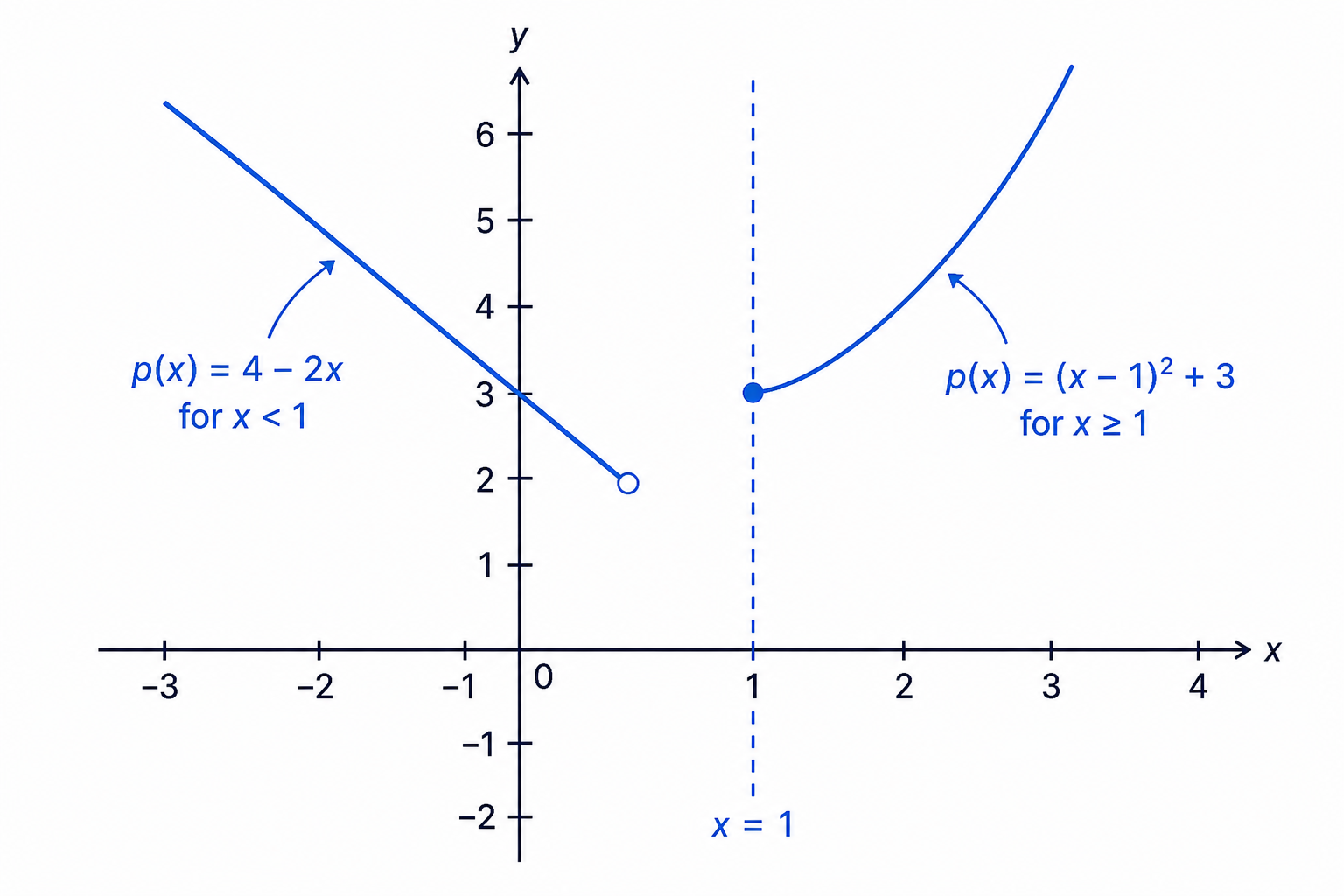
A piecewise function uses different formulas on different parts of its domain. Always choose the formula whose condition matches the current input.
Example
A repeated piecewise function
For
p(x)={4−2xx<1(x−1)2+3x≥1p(x)= \begin{cases} 4-2x & x<1\\ (x-1)^2+3 & x\ge 1 \end{cases}p(x)={4−2x(x−1)2+3x<1x≥1find pp(0)pp(0)pp(0) and solve p(x)>12p(x)>12p(x)>12.
-
Since 0<10<10<1, use the first branch:
p(0)=4−2(0)=4p(0)=4-2(0)=4p(0)=4−2(0)=4 -
Now find p(4)p(4)p(4). Since 4≥14\ge 14≥1, use the second branch:
p(4)=(4−1)2+3=12p(4)=(4-1)^2+3=12p(4)=(4−1)2+3=12 -
Therefore pp(0)=12pp(0)=12pp(0)=12.
-
For p(x)>12p(x)>12p(x)>12, test each branch. On x<1x<1x<1:
4−2x>12⇒−2x>8⇒x<−44-2x>12\Rightarrow -2x>8\Rightarrow x<-44−2x>12⇒−2x>8⇒x<−4 -
On x≥1x\ge 1x≥1:
(x−1)2+3>12⇒(x−1)2>9(x-1)^2+3>12\Rightarrow (x-1)^2>9(x−1)2+3>12⇒(x−1)2>9 -
Because this branch has x≥1x\ge 1x≥1, we have x−1≥0x-1\ge 0x−1≥0, so x−1>3x-1>3x−1>3. Hence x>4x>4x>4.
-
The solution is x<−4x<-4x<−4 or x>4x>4x>4.
3. Inverse functions
Definition
Inverse function
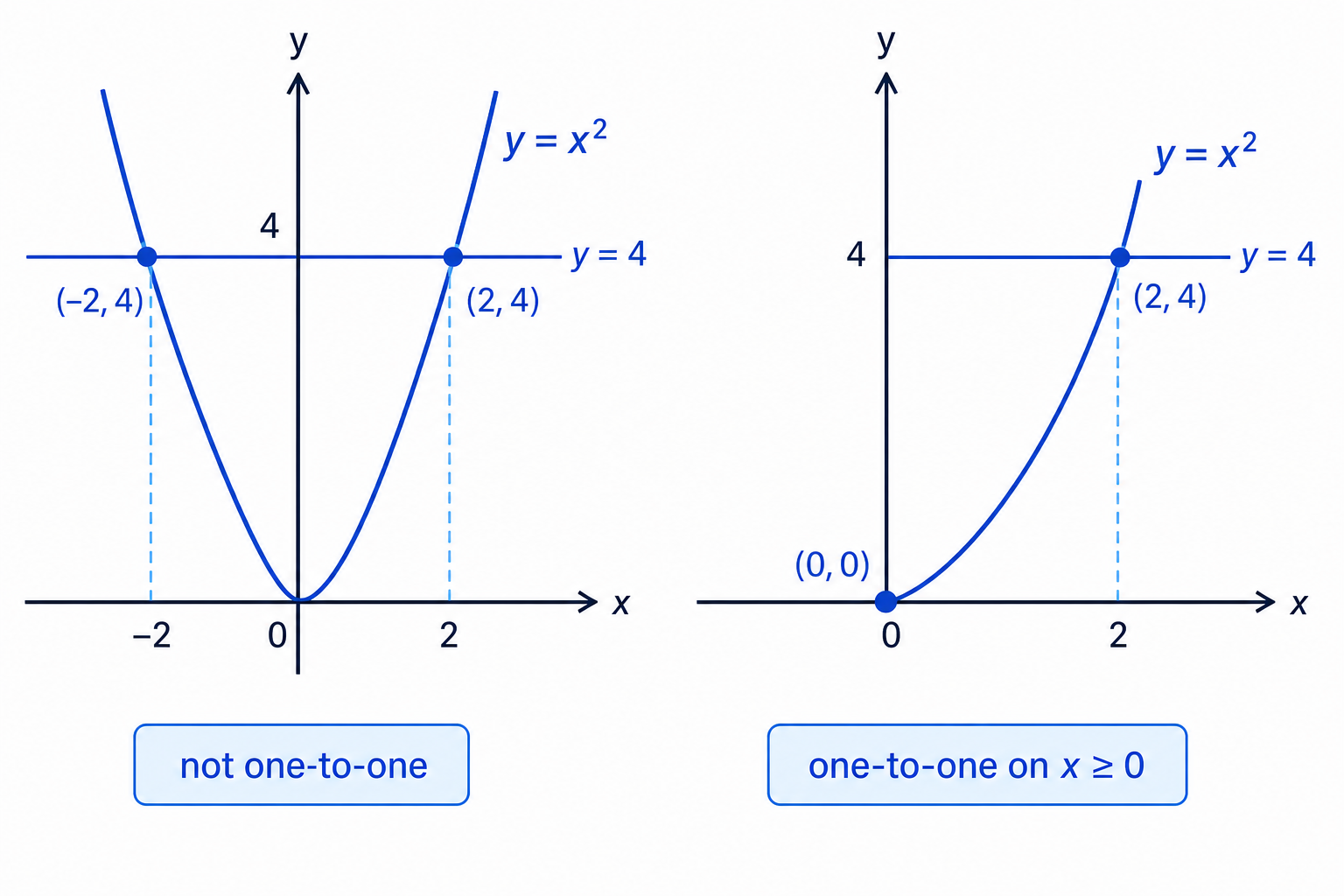
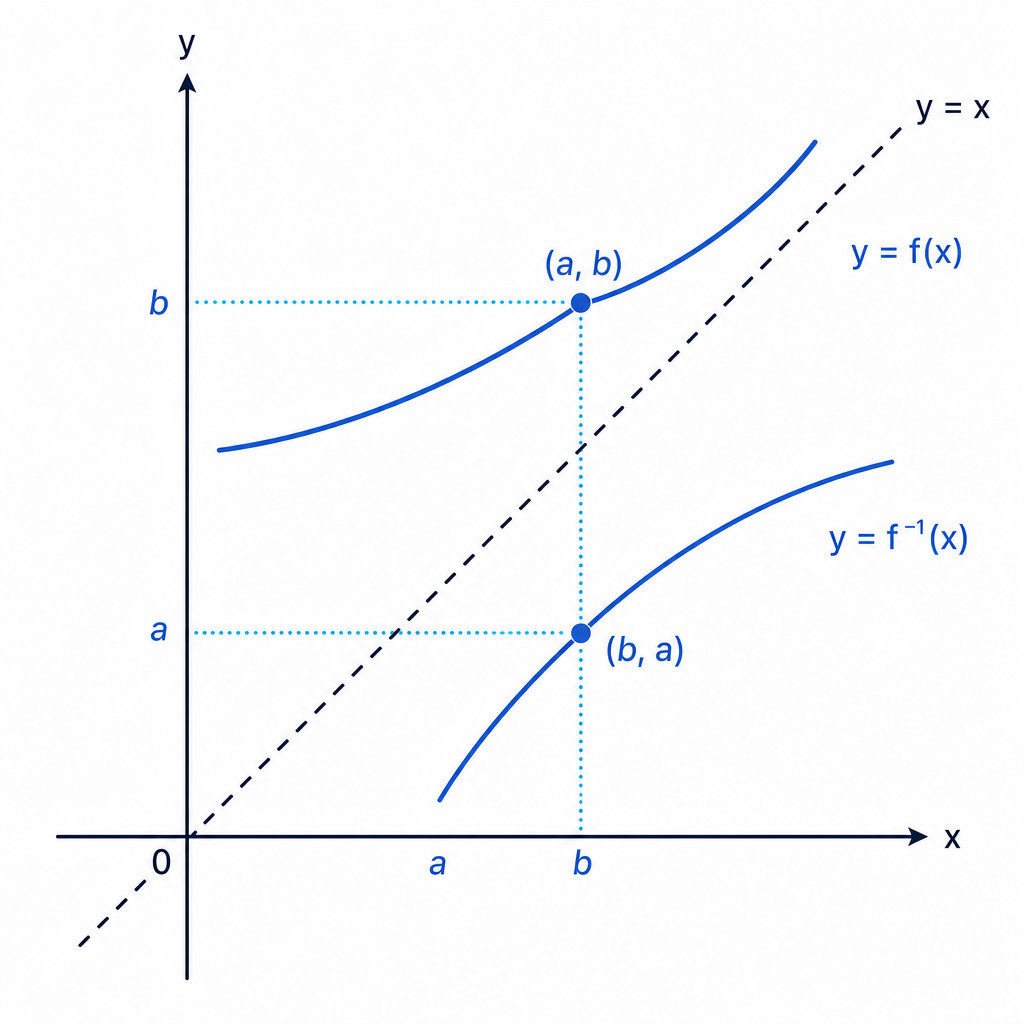
An inverse function, written f−1f^{-1}f−1, undoes fff: if f(a)=bf(a)=bf(a)=b, then f−1(b)=af^{-1}(b)=af−1(b)=a. It exists as a function only when fff is one-to-one, meaning no two different inputs give the same output.
A quadratic such as x2x^2x2 is not one-to-one on all real values, because two different inputs can give the same output. Restricting the domain can fix this.
Key Idea
Domain and range swap
If f−1f^{-1}f−1 exists, the domain of f−1f^{-1}f−1 is the range of fff, and the range of f−1f^{-1}f−1 is the domain of fff.
To find an inverse:
- Write y=f(x)y=f(x)y=f(x).
- Rearrange to make xxx the subject.
- Swap xxx and yyy.
- State the domain of the inverse.
The graphs of y=f(x)y=f(x)y=f(x) and y=f−1(x)y=f^{-1}(x)y=f−1(x) are reflections in the line y=xy=xy=x.
Example
Finding inverse functions
Find the inverse of u(x)=(x−2)2+5u(x)=(x-2)^2+5u(x)=(x−2)2+5, where x≥2x\ge 2x≥2. Also find the inverse of v(x)=3+ln(2x+1)v(x)=3+\ln(2x+1)v(x)=3+ln(2x+1).
-
For u(x)u(x)u(x), the smallest value occurs at x=2x=2x=2, so the range is u(x)≥5u(x)\ge 5u(x)≥5.
-
Start with y=(x−2)2+5y=(x-2)^2+5y=(x−2)2+5 and rearrange:
y−5=(x−2)2y-5=(x-2)^2y−5=(x−2)2 -
Since the domain is x≥2x\ge 2x≥2, choose the positive square root. Therefore u−1(x)=2+x−5u^{-1}(x)=2+\sqrt{x-5}u−1(x)=2+x−5, with domain x≥5x\ge 5x≥5.
-
For v(x)v(x)v(x), start by writing:
y=3+ln(2x+1)y=3+\ln(2x+1)y=3+ln(2x+1) -
Rearrange using exponentials to undo the logarithm:
ey−3=2x+1⇒x=ey−3−12e^{y-3}=2x+1\Rightarrow x=\frac{e^{y-3}-1}{2}ey−3=2x+1⇒x=2ey−3−1 -
Swap the letters. So v−1(x)=ex−3−12v^{-1}(x)=\frac{e^{x-3}-1}{2}v−1(x)=2ex−3−1, with domain x∈Rx\in\mathbb{R}x∈R.
Common Mistake
Inverse is not reciprocal
f−1(x)f^{-1}(x)f−1(x) means the inverse function, not 1f(x)\frac{1}{f(x)}f(x)1. These are completely different unless a question specifically defines a reciprocal.
4. Modulus graphs and inequalities
Definition
Modulus
The modulus ∣A∣|A|∣A∣ means the non-negative size of AAA:
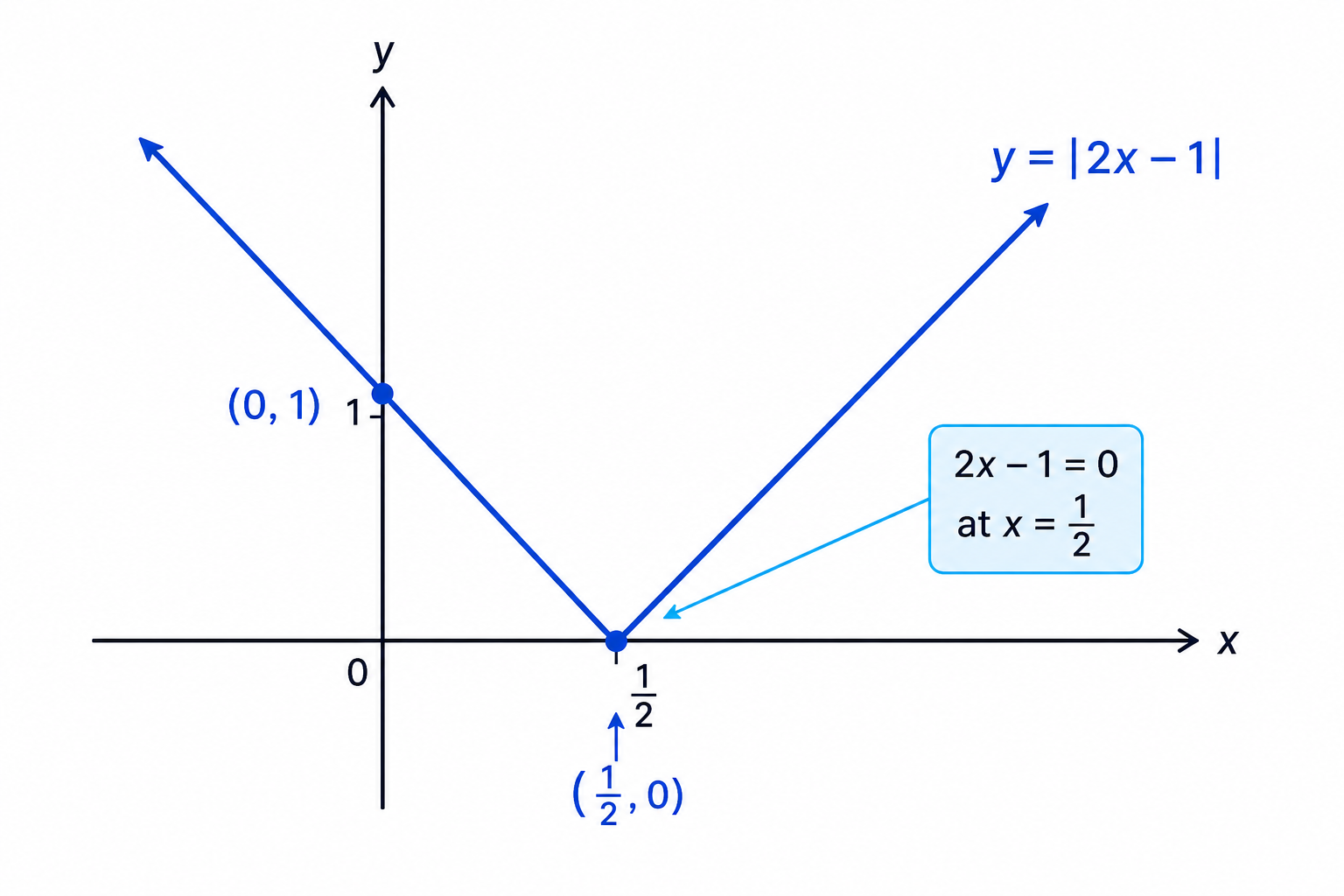
∣A∣={AA≥0−AA<0|A|= \begin{cases} A & A\ge 0\\ -A & A<0 \end{cases}∣A∣={A−AA≥0A<0A graph like y=∣2x−1∣y=|2x-1|y=∣2x−1∣ is V-shaped. The vertex occurs where the expression inside the modulus is zero.
For inequalities, if k>0k>0k>0, then ∣A∣<k|A|<k∣A∣<k means −k<A<k-k<A<k−k<A<k.
Example
A modulus sketch and inequality
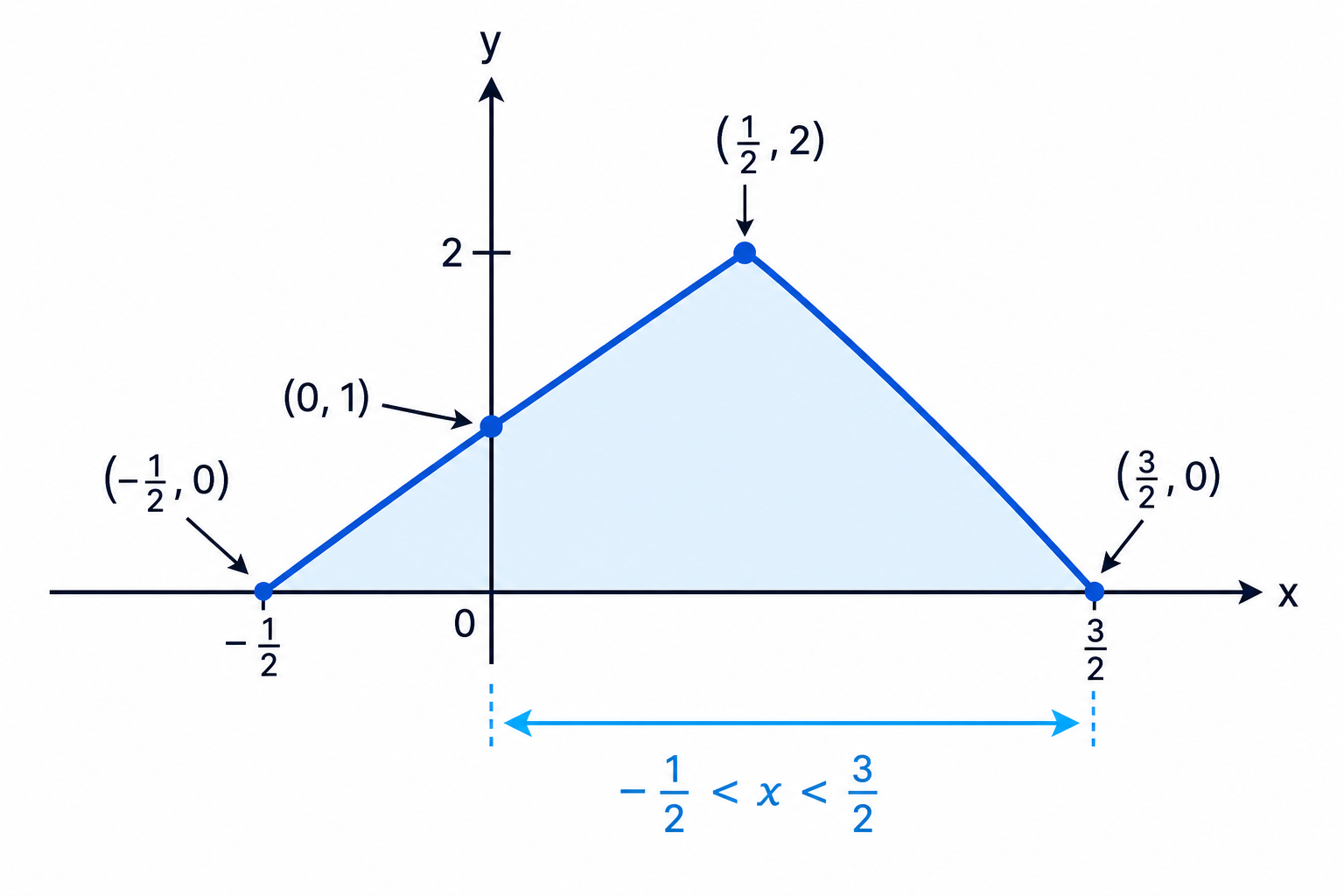
Sketch y=2−∣2x−1∣y=2-|2x-1|y=2−∣2x−1∣, state where it meets the axes, and solve 2−∣2x−1∣>02-|2x-1|>02−∣2x−1∣>0.
-
The vertex occurs when 2x−1=02x-1=02x−1=0, so x=12x=\frac{1}{2}x=21. At this point, y=2y=2y=2.
-
The graph is an upside-down V with vertex (12,2)\left(\frac{1}{2},2\right)(21,2).
-
For the y-intercept, set x=0x=0x=0: y=2−∣−1∣=1y=2-|-1|=1y=2−∣−1∣=1. So the y-intercept is (0,1)(0,1)(0,1).
-
For the x-intercepts, solve:
2−∣2x−1∣=0⇒∣2x−1∣=22-|2x-1|=0\Rightarrow |2x-1|=22−∣2x−1∣=0⇒∣2x−1∣=2 -
This gives 2x−1=22x-1=22x−1=2 or 2x−1=−22x-1=-22x−1=−2, so x=32x=\frac{3}{2}x=23 or x=−12x=-\frac{1}{2}x=−21.
-
For the inequality, solve ∣2x−1∣<2|2x-1|<2∣2x−1∣<2:
−2<2x−1<2⇒−1<2x<3⇒−12<x<32-2<2x-1<2\Rightarrow -1<2x<3\Rightarrow -\frac{1}{2}<x<\frac{3}{2}−2<2x−1<2⇒−1<2x<3⇒−21<x<23
Common Mistake
Variable right-hand sides
For an inequality like ∣2x−3∣<x+1|2x-3|<x+1∣2x−3∣<x+1, the right-hand side depends on xxx. Remember it must be positive, or split into cases carefully.
5. Graph transformations
Definition
Graph transformation
A graph transformation moves, stretches or reflects an existing graph without needing to plot every point from scratch.
Key transformations:
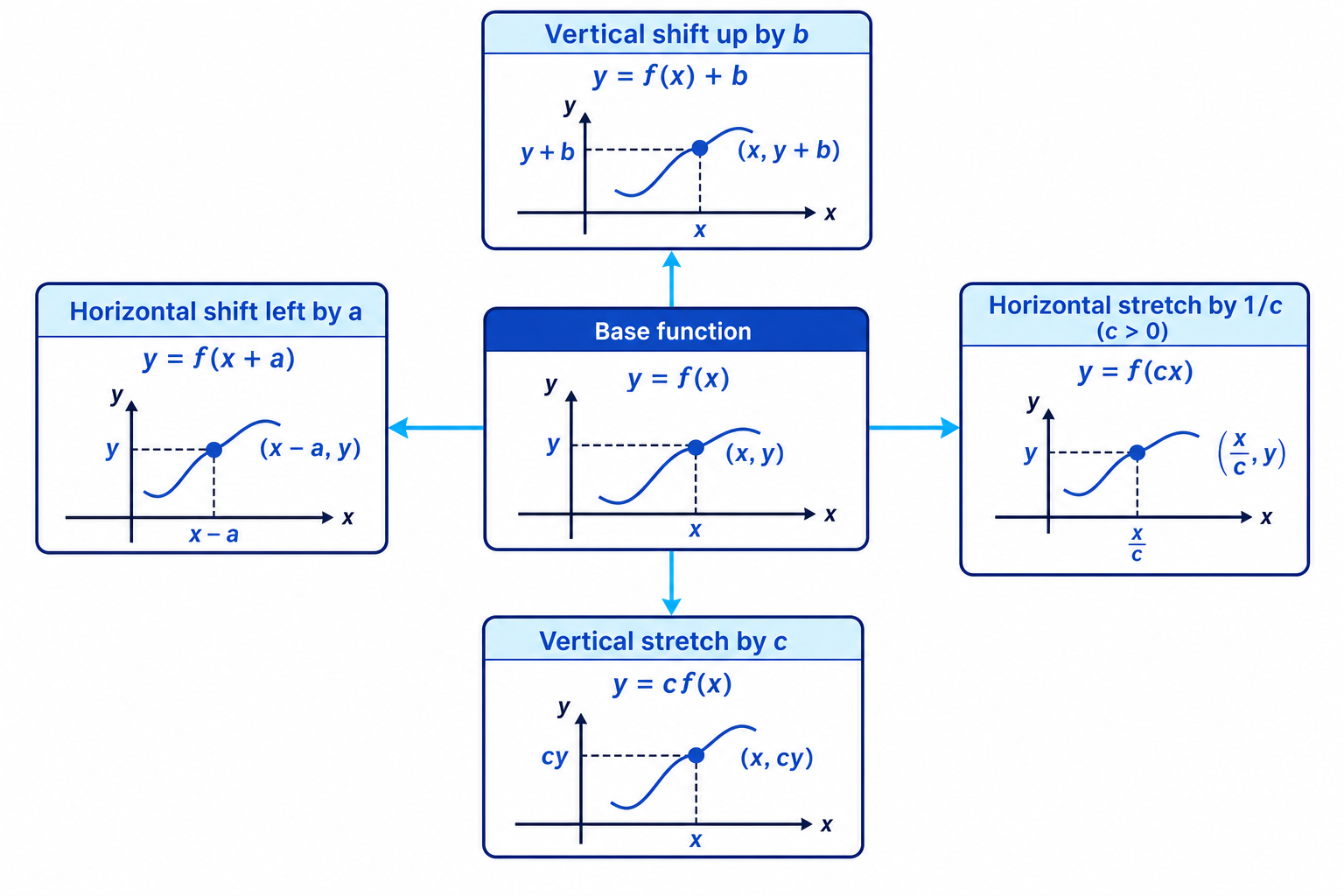
- y=f(x)+by=f(x)+by=f(x)+b shifts the graph vertically by bbb.
- y=f(x+a)y=f(x+a)y=f(x+a) shifts the graph left by aaa.
- y=cf(x)y=cf(x)y=cf(x) stretches vertically by scale factor ccc.
- y=f(cx)y=f(cx)y=f(cx) stretches horizontally by scale factor 1c\frac{1}{c}c1, for c>0c>0c>0.
- y=∣f(x)∣y=|f(x)|y=∣f(x)∣ reflects parts below the x-axis upwards.
- y=f(∣x∣)y=f(|x|)y=f(∣x∣) keeps the right-hand half and reflects it in the y-axis.
A stationary point is a point where the gradient is zero, such as a smooth maximum or minimum.
Example
Transforming key points
The graph of y=f(x)y=f(x)y=f(x) has stationary points at A(−2,4)A(-2,4)A(−2,4) and B(6,−1)B(6,-1)B(6,−1). Find the corresponding stationary points on y=3f(2x)y=3f(2x)y=3f(2x). Also find constants aaa and bbb so that y=f(x+a)+by=f(x+a)+by=f(x+a)+b moves BBB to the origin.
-
In f(2x)f(2x)f(2x), the x-coordinates are divided by 2. So AAA moves to (−1,4)(-1,4)(−1,4) and BBB moves to (3,−1)(3,-1)(3,−1).
-
The outside factor 3 multiplies the y-coordinates. So the new stationary points are (−1,12)(-1,12)(−1,12) and (3,−3)(3,-3)(3,−3).
-
For y=f(x+a)+by=f(x+a)+by=f(x+a)+b, the point B(6,−1)B(6,-1)B(6,−1) moves to (6−a,−1+b)(6-a,-1+b)(6−a,−1+b).
-
To move BBB to the origin, solve 6−a=06-a=06−a=0 and −1+b=0-1+b=0−1+b=0.
-
Hence a=6a=6a=6 and b=1b=1b=1.
Exam technique
In the exam
-
Write composites as nested functions first, for example gf(x)=g(f(x))gf(x)=g(f(x))gf(x)=g(f(x)), before simplifying.
-
For inverses, always state the domain of the inverse; it is the range of the original function.
-
On sketches, mark key points: vertices, intercepts, asymptotes, stationary points and any domain endpoints.
-
For modulus inequalities, check whether the right-hand side is constant or variable before splitting cases.
Self review
Check yourself
-
If f(x)=1x−4f(x)=\frac{1}{x-4}f(x)=x−41, what value can f(x)f(x)f(x) never take?
-
Why does x2+1x^2+1x2+1 not have an inverse on x∈Rx\in\mathbb{R}x∈R?
-
What happens to the point (6,−2)(6,-2)(6,−2) under the transformation y=3f(2x)y=3f(2x)y=3f(2x)?

Recap questions
Test yourself with 5 quick questions on this guide. Answer them all correctly to complete it.
You've reached the end
Test yourself on this topic, or move on to the next guide.
How was this guide?