Revision notes for Edexcel A Level Maths Numerical Methods. Open each subtopic for explanations, worked examples, and summaries of 10.1 Locating Roots, 10.2 Iteration, 10.3 The Newton-Raphson Method, and 10.4 Applications to Modelling. Written against the Edexcel A Level Maths (9MA0) specification, so the content matches what's examinable rather than general Maths background.
Numerical Methods
What you'll learn
- How to locate roots using a change of sign.
- How to use fixed-point iteration of the form xn+1=g(xn)x_{n+1}=g(x_n)xn+1=g(xn).
- How to prove a numerical answer is correct to a given number of decimal places.
- How to apply the Newton-Raphson method, including to stationary points.
Why numerical methods matter
Some equations cannot be solved neatly by factorising or rearranging. For example, equations mixing powers, exponentials, logarithms or trigonometric functions often need approximate solutions.
A numerical method is a repeated calculation that gets you closer to the answer. In A-Level questions, you are usually asked to show enough working to justify that your decimal answer is reliable.
Roots and sign changes
Definition
Roots and continuity
- A root of f(x)=0f(x)=0f(x)=0 is a value of xxx that makes the function equal to zero.
- A continuous function has no jumps or breaks. Polynomials are continuous everywhere; logarithms and roots are continuous only on their valid domains.
Key Idea
The sign-change test
If f(x)f(x)f(x) is continuous on [a,b][a,b][a,b] and f(a)f(a)f(a) and f(b)f(b)f(b) have opposite signs, then there is at least one root between aaa and bbb.
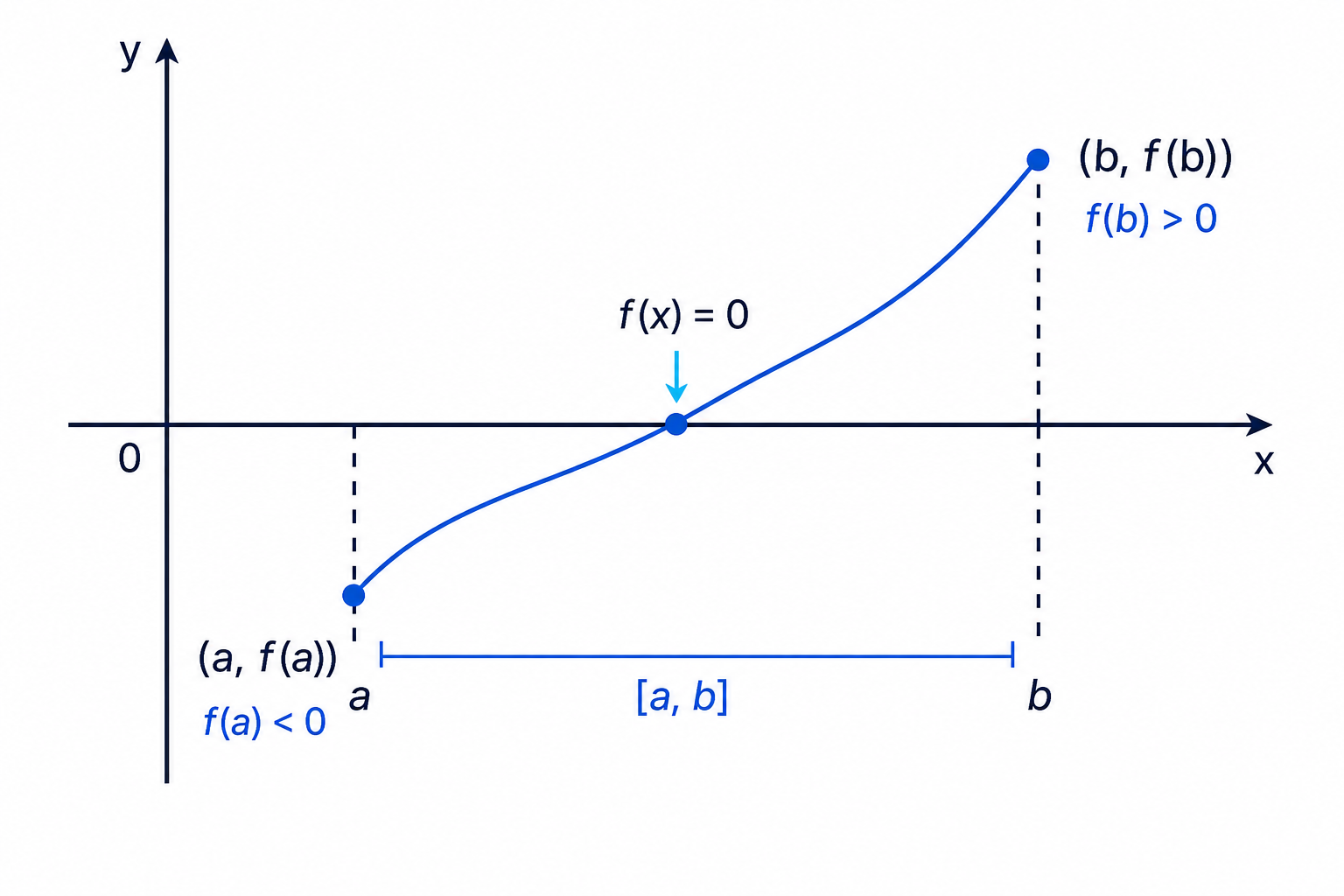
This is often worth 2 marks: one for evaluating both ends, and one for stating the sign change and continuity.
Example
Showing a root lies in an interval
Show that f(x)=x3+x2−2x−1f(x)=x^3+x^2-2x-1f(x)=x3+x2−2x−1 has a root between 1 and 1.5.
-
Check that f(x)f(x)f(x) is continuous. Since it is a polynomial, it is continuous for all real xxx.
-
Evaluate the function at both ends of the interval:
f(1)=13+12−2(1)−1=−1f(1.5)=1.53+1.52−2(1.5)−1=1.625\begin{aligned} f(1)&=1^3+1^2-2(1)-1=-1\\ f(1.5)&=1.5^3+1.5^2-2(1.5)-1=1.625 \end{aligned}f(1)f(1.5)=13+12−2(1)−1=−1=1.53+1.52−2(1.5)−1=1.625 -
The values have opposite signs, since f(1)<0f(1)<0f(1)<0 and f(1.5)>0f(1.5)>0f(1.5)>0.
-
Therefore, by continuity, there is a root between 1 and 1.5.
Common Mistake
Overclaiming from a sign change
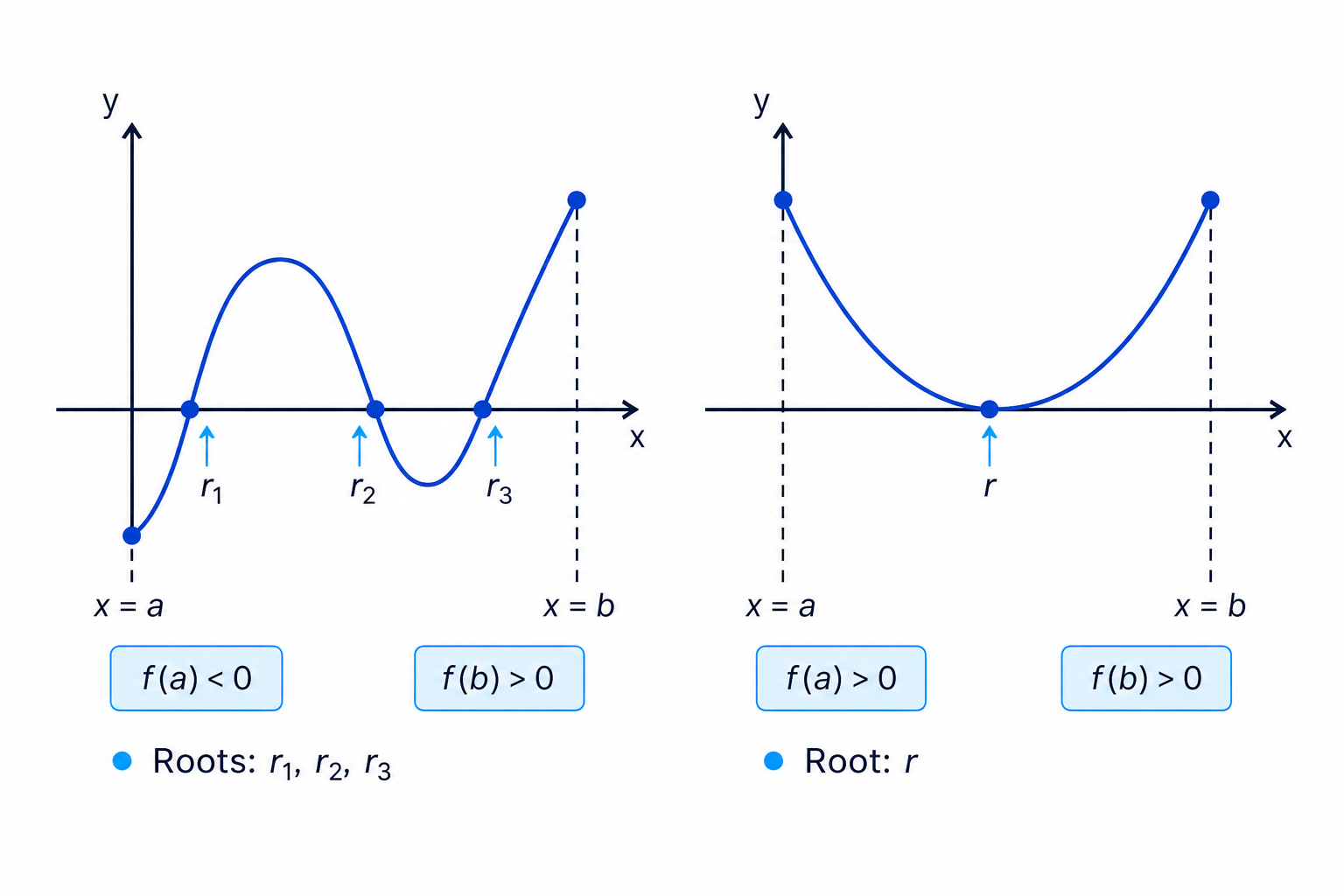
A sign change proves at least one root in the interval, not necessarily exactly one. Also, no sign change does not prove there is no root.
Turning a curve problem into an equation
Many numerical methods questions first ask you to differentiate a curve and find a stationary point.
Definition
Stationary point
A stationary point is a point on a curve where the gradient is zero, so you solve dydx=0\frac{dy}{dx}=0dxdy=0.
You may need the product rule, chain rule, and standard derivatives such as:
- ddxex=ex\frac{d}{dx}e^x=e^xdxdex=ex
- ddxlnx=1x\frac{d}{dx}\ln x=\frac{1}{x}dxdlnx=x1
- ddxx=12x\frac{d}{dx}\sqrt{x}=\frac{1}{2\sqrt{x}}dxdx=2x1
Example
Forming an equation for a stationary point
The curve has equation y=(10−x)lnxy=(10-x)\ln xy=(10−x)lnx, where x>0x>0x>0. Show that the xxx coordinate of a stationary point satisfies x=101+lnxx=\frac{10}{1+\ln x}x=1+lnx10.
-
Use the product rule with 10−x10-x10−x and lnx\ln xlnx.
-
Differentiate:
dydx=−1⋅lnx+(10−x)⋅1x=10x−1−lnx\begin{aligned} \frac{dy}{dx} &= -1\cdot \ln x+(10-x)\cdot \frac{1}{x}\\ &= \frac{10}{x}-1-\ln x \end{aligned}dxdy=−1⋅lnx+(10−x)⋅x1=x10−1−lnx -
At a stationary point, set the derivative equal to zero and rearrange:
10x−1−lnx=010x=1+lnxx=101+lnx\begin{aligned} \frac{10}{x}-1-\ln x&=0\\ \frac{10}{x}&=1+\ln x\\ x&=\frac{10}{1+\ln x} \end{aligned}x10−1−lnxx10x=0=1+lnx=1+lnx10 -
So the stationary point’s xxx coordinate satisfies x=101+lnxx=\frac{10}{1+\ln x}x=1+lnx10.
Fixed-point iteration
Definition
Fixed-point iteration
If an equation can be written as x=g(x)x=g(x)x=g(x), then a fixed-point iteration uses xn+1=g(xn)x_{n+1}=g(x_n)xn+1=g(xn), starting from an initial value x0x_0x0 or x1x_1x1.
The idea is simple: put your current estimate into the right-hand side, and the output becomes the next estimate.
Example
Using an iteration formula
Show that ex+1+x−6=0e^{x+1}+x-6=0ex+1+x−6=0 can be written as x=ln(6−x)−1x=\ln(6-x)-1x=ln(6−x)−1. Then use x0=0.5x_0=0.5x0=0.5 to find x1x_1x1, x2x_2x2 and x3x_3x3 to 3 decimal places.
-
Rearrange the equation:
ex+1+x−6=0ex+1=6−xx+1=ln(6−x)x=ln(6−x)−1\begin{aligned} e^{x+1}+x-6&=0\\ e^{x+1}&=6-x\\ x+1&=\ln(6-x)\\ x&=\ln(6-x)-1 \end{aligned}ex+1+x−6ex+1x+1x=0=6−x=ln(6−x)=ln(6−x)−1 -
Therefore the iteration formula is xn+1=ln(6−xn)−1x_{n+1}=\ln(6-x_n)-1xn+1=ln(6−xn)−1.
-
Substitute repeatedly, keeping full calculator accuracy between lines:
x1=ln(6−0.5)−1=0.704748…x2=ln(6−0.704748…)−1=0.666811…x3=ln(6−0.666811…)−1=0.673949…\begin{aligned} x_1&=\ln(6-0.5)-1=0.704748\ldots\\ x_2&=\ln(6-0.704748\ldots)-1=0.666811\ldots\\ x_3&=\ln(6-0.666811\ldots)-1=0.673949\ldots \end{aligned}x1x2x3=ln(6−0.5)−1=0.704748…=ln(6−0.704748…)−1=0.666811…=ln(6−0.666811…)−1=0.673949… -
So, to 3 decimal places, x1=0.705x_1=0.705x1=0.705, x2=0.667x_2=0.667x2=0.667 and x3=0.674x_3=0.674x3=0.674.
Tip
Keep full accuracy
Do not type the rounded value back into your calculator unless the question explicitly tells you to. Store or reuse the full displayed value.
Proving an answer to a given accuracy
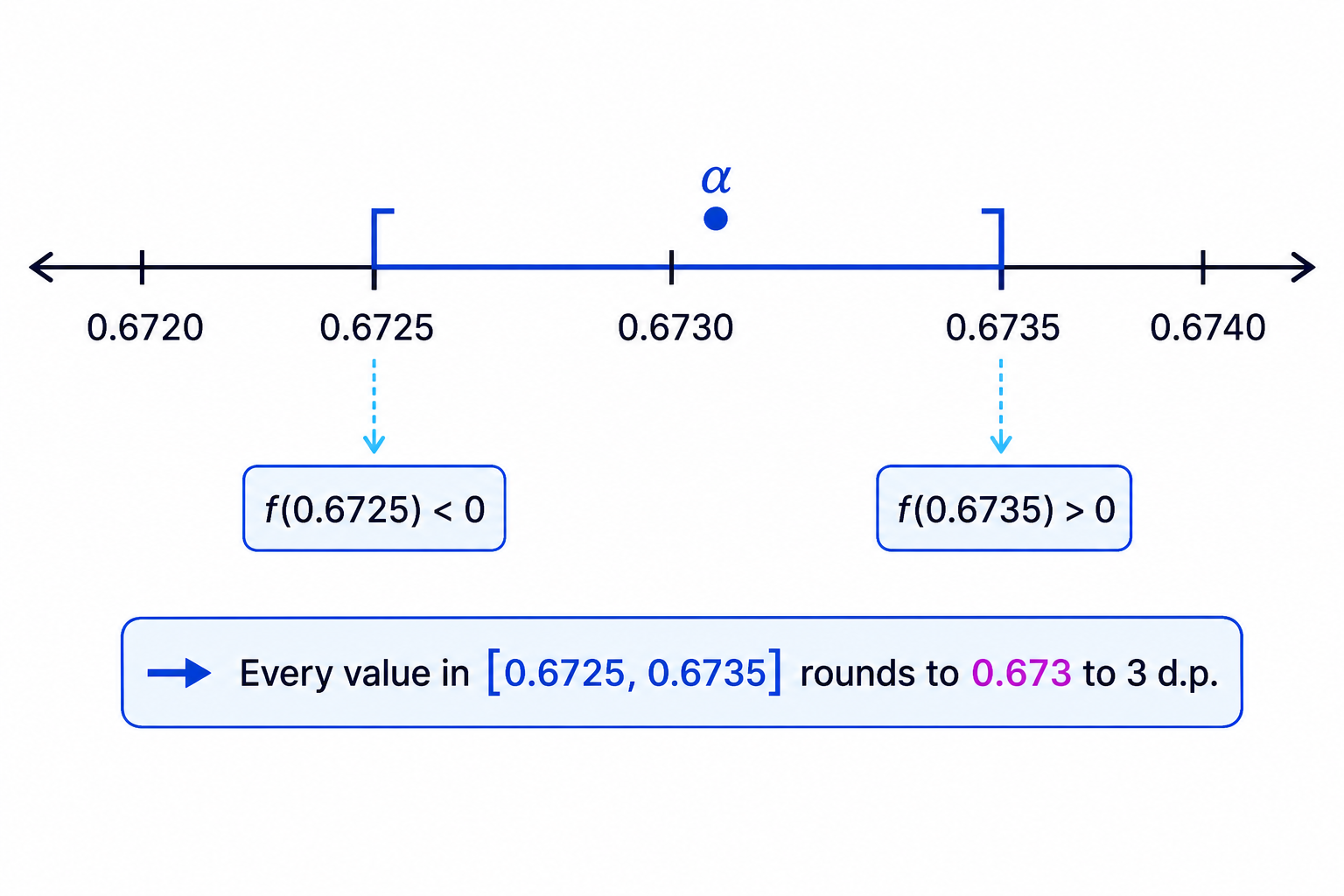
Getting an iteration value is not always enough. If asked to prove a root is correct to 3 decimal places, choose a tiny interval that rounds to that value.
For example, to prove α=0.673\alpha=0.673α=0.673 to 3 decimal places, test the endpoints 0.6725 and 0.6735.
Example
Proving a root to 3 decimal places
Let f(x)=ex+1+x−6f(x)=e^{x+1}+x-6f(x)=ex+1+x−6. Prove that the root α\alphaα near the iterates is 0.673 to 3 decimal places.
-
To prove 0.673 to 3 decimal places, use the interval [0.6725,0.6735][0.6725,0.6735][0.6725,0.6735].
-
Evaluate f(x)f(x)f(x) at both endpoints:
f(0.6725)=e1.6725+0.6725−6=−0.00204…f(0.6735)=e1.6735+0.6735−6=0.00429…\begin{aligned} f(0.6725)&=e^{1.6725}+0.6725-6=-0.00204\ldots\\ f(0.6735)&=e^{1.6735}+0.6735-6=0.00429\ldots \end{aligned}f(0.6725)f(0.6735)=e1.6725+0.6725−6=−0.00204…=e1.6735+0.6735−6=0.00429… -
Since the signs are different and f(x)f(x)f(x) is continuous, there is a root between 0.6725 and 0.6735.
-
Every number in this interval rounds to 0.673 to 3 decimal places, so α=0.673\alpha=0.673α=0.673 to 3 decimal places.
Convergence of fixed-point iteration
Definition
Convergence
An iteration converges if the sequence of values gets closer and closer to a fixed point. It diverges if the values move away or fail to settle.
Graphically, fixed points are intersections of y=g(x)y=g(x)y=g(x) and y=xy=xy=x. A cobweb or staircase diagram shows whether repeated vertical and horizontal moves approach the intersection.
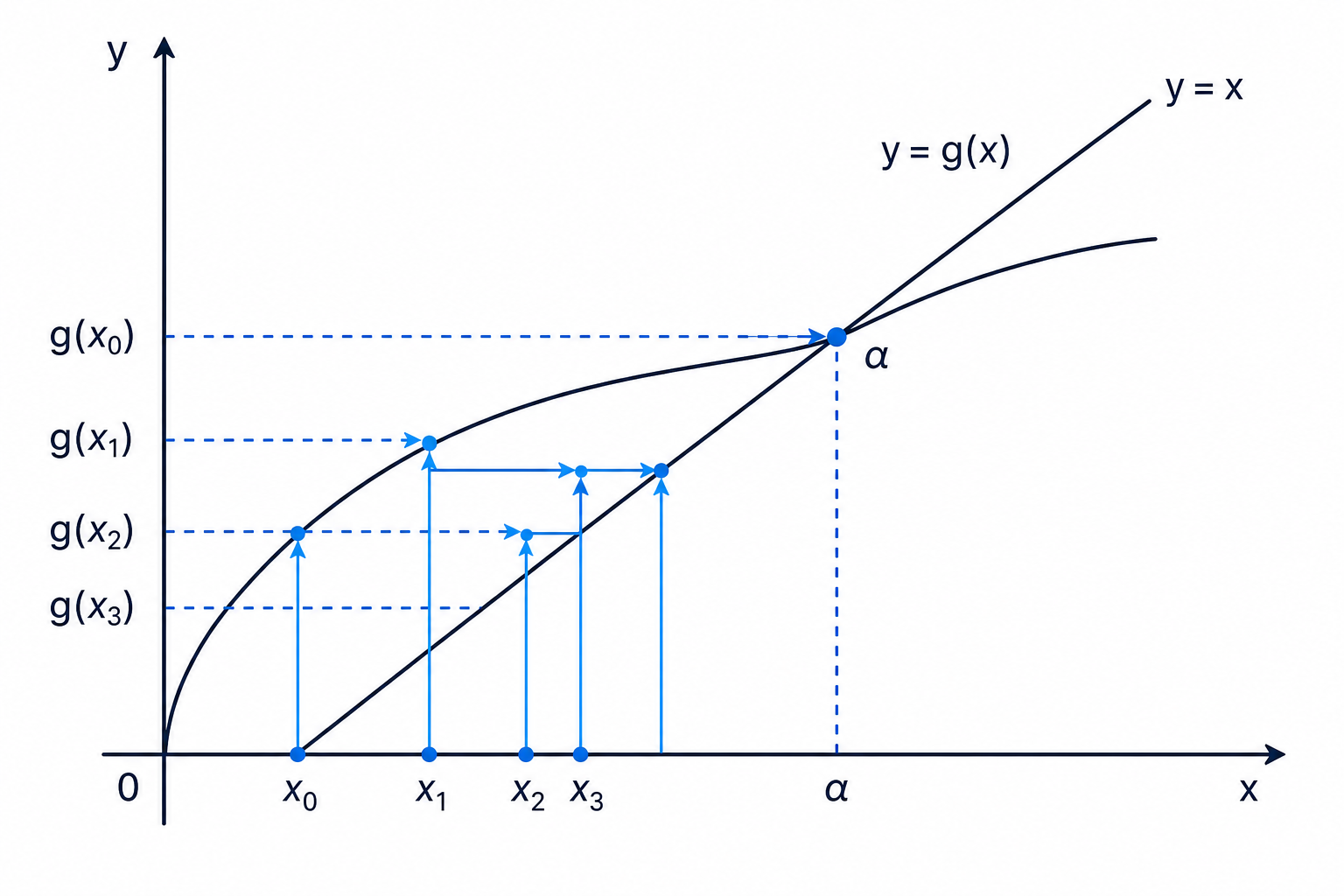
A useful test near the root is: if ∣g′(α)∣<1|g'(\alpha)|<1∣g′(α)∣<1, the iteration usually converges; if ∣g′(α)∣>1|g'(\alpha)|>1∣g′(α)∣>1, it usually diverges.
Example
Deciding whether an iteration can be used
Consider xn+1=ln(6−xn)x_{n+1}=\ln(6-x_n)xn+1=ln(6−xn), starting with x1=2x_1=2x1=2. Decide whether the iteration is likely to find the fixed point.
-
The fixed point is where y=ln(6−x)y=\ln(6-x)y=ln(6−x) meets y=xy=xy=x.
-
Here g(x)=ln(6−x)g(x)=\ln(6-x)g(x)=ln(6−x), so g′(x)=−16−xg'(x)=-\frac{1}{6-x}g′(x)=−6−x1. Near the fixed point, the gradient has magnitude less than 1.
-
Calculate the first few terms:
x2=ln(4)=1.386…x3=ln(6−1.386…)=1.529…x4=ln(6−1.529…)=1.497…\begin{aligned} x_2&=\ln(4)=1.386\ldots\\ x_3&=\ln(6-1.386\ldots)=1.529\ldots\\ x_4&=\ln(6-1.529\ldots)=1.497\ldots \end{aligned}x2x3x4=ln(4)=1.386…=ln(6−1.386…)=1.529…=ln(6−1.529…)=1.497… -
The values bounce either side but move closer, so the iteration can be used.
Common Mistake
Domain checks
Iteration can fail immediately if a value makes the next calculation undefined, such as taking ln\lnln of a negative number or dividing by zero.
Newton-Raphson method
Newton-Raphson is usually faster than fixed-point iteration, but it needs a derivative.
Key Idea
Newton-Raphson formula
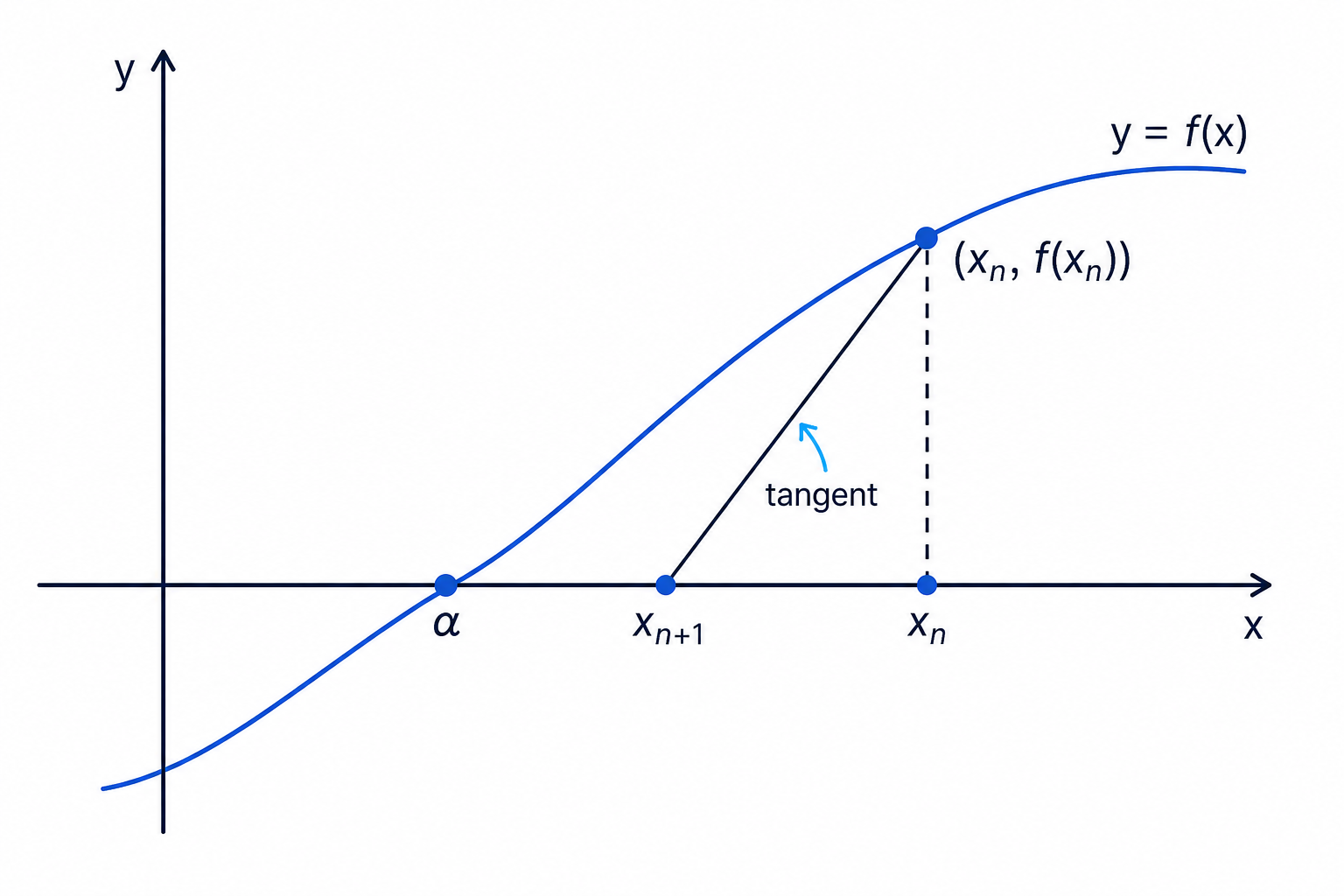
To solve f(x)=0f(x)=0f(x)=0, use xn+1=xn−f(xn)f′(xn)x_{n+1}=x_n-\frac{f(x_n)}{f'(x_n)}xn+1=xn−f′(xn)f(xn). This comes from drawing a tangent to the curve and seeing where it meets the xxx-axis.
Example
Applying Newton-Raphson
Use Newton-Raphson with x0=1.5x_0=1.5x0=1.5 to solve x3+2x−5=0x^3+2x-5=0x3+2x−5=0 to 3 decimal places.
-
Let f(x)=x3+2x−5f(x)=x^3+2x-5f(x)=x3+2x−5.
-
Differentiate:
f′(x)=3x2+2f'(x)=3x^2+2f′(x)=3x2+2 -
Substitute into the Newton-Raphson formula:
xn+1=xn−xn3+2xn−53xn2+2x_{n+1}=x_n-\frac{x_n^3+2x_n-5}{3x_n^2+2}xn+1=xn−3xn2+2xn3+2xn−5 -
Starting with x0=1.5x_0=1.5x0=1.5, calculate:
x1=1.342857…x2=1.328384…x3=1.328269…\begin{aligned} x_1&=1.342857\ldots\\ x_2&=1.328384\ldots\\ x_3&=1.328269\ldots \end{aligned}x1x2x3=1.342857…=1.328384…=1.328269… -
Since x2x_2x2 and x3x_3x3 agree to 3 decimal places, the root is x=1.328x=1.328x=1.328.
Common Mistake
Forgetting the derivative
Newton-Raphson always needs both f(x)f(x)f(x) and f′(x)f'(x)f′(x). A common error is to substitute into the original function twice instead of using the derivative in the denominator.
Newton-Raphson for stationary points
For a stationary point, solve dydx=0\frac{dy}{dx}=0dxdy=0. You can do this by applying Newton-Raphson to the derivative.
If F(x)=dydxF(x)=\frac{dy}{dx}F(x)=dxdy, then use:
xn+1=xn−F(xn)F′(xn)x_{n+1}=x_n-\frac{F(x_n)}{F'(x_n)}xn+1=xn−F′(xn)F(xn)Example
Approximating a stationary point
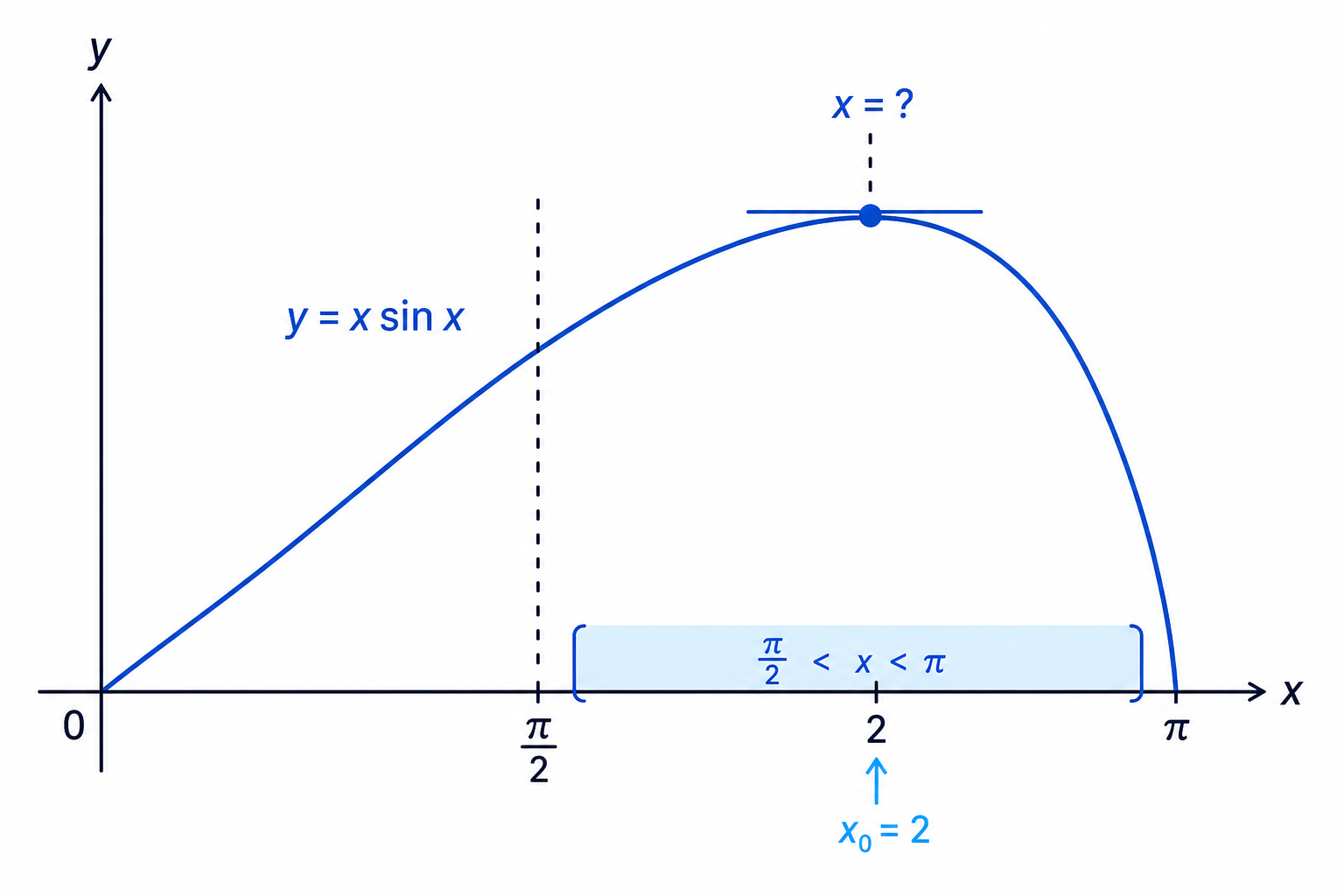
The curve y=xsinxy=x\sin xy=xsinx has a maximum for π2<x<π\frac{\pi}{2}<x<\pi2π<x<π. Use Newton-Raphson starting with x0=2x_0=2x0=2 to approximate the xxx coordinate.
-
Differentiate:
dydx=sinx+xcosx\frac{dy}{dx}=\sin x+x\cos xdxdy=sinx+xcosx -
Set the derivative equal to zero. Since cosx≠0\cos x\neq 0cosx=0 in this interval, divide by cosx\cos xcosx:
tanx+x=0\tan x+x=0tanx+x=0 -
Let F(x)=tanx+xF(x)=\tan x+xF(x)=tanx+x, so F′(x)=sec2x+1F'(x)=\sec^2 x+1F′(x)=sec2x+1.
-
Apply Newton-Raphson:
xn+1=xn−tanxn+xnsec2xn+1x_{n+1}=x_n-\frac{\tan x_n+x_n}{\sec^2 x_n+1}xn+1=xn−sec2xn+1tanxn+xn -
Starting with x0=2x_0=2x0=2:
x1=2.0273…x2=2.0288…x3=2.0288…\begin{aligned} x_1&=2.0273\ldots\\ x_2&=2.0288\ldots\\ x_3&=2.0288\ldots \end{aligned}x1x2x3=2.0273…=2.0288…=2.0288… -
The xxx coordinate is approximately 2.0288 to 4 decimal places.
Tip
Radians mode
For calculus with trigonometric functions, your calculator must be in radians unless a question explicitly says degrees.
Common Mistake
When Newton-Raphson breaks
Newton-Raphson cannot be used if f′(xn)=0f'(x_n)=0f′(xn)=0 or if f′(xn)f'(x_n)f′(xn) is undefined. It may also fail if the starting value is too far from the root.
Exam technique
In the exam
- For interval questions, write both endpoint values, state the sign change, and mention continuity.
- For iteration, show the formula used and keep full calculator accuracy between terms.
- To prove 3 decimal places, test the two half-way endpoints around the rounded value.
- For Newton-Raphson, clearly write f′(x)f'(x)f′(x) and the substitution formula before giving iterates.
- Check domains carefully, especially with lnx\ln xlnx, square roots and fractions.
Self review
Check yourself
- What interval would you test to prove that a root is 1.426 to 3 decimal places?
- Why does a sign change prove a root only when the function is continuous?
- What goes wrong in Newton-Raphson if f′(xn)=0f'(x_n)=0f′(xn)=0?

Recap questions
Test yourself with 5 quick questions on this guide. Answer them all correctly to complete it.
You've reached the end
Test yourself on this topic, or move on to the next guide.
How was this guide?