2 Unit AS 2: Applied Mathematics
123456789101112131415161718192021222324252627282930313233343536373839404142434445464748495051525354555657585960616263646566676869707172737475767778798081828384858687888990919293949596979899100101102103104105106107108109110111112113114115116117118119120121122123124125126127128129130131132133134135136137138139140141142143144145146147148149150151152153154155156157
Question 39
In this question use g=9.8g = 9.8g=9.8 m s−2^{-2}−2.
Two blocks AAA, of mass 2 kg, and BBB, of mass 3 kg, are connected by a light inextensible string.
Initially A A\,A is held at rest on a rough plane inclined at an angle θ \theta\,θ to the horizontal, where tanθ=34\displaystyle \tan\theta = \frac{3}{4}tanθ=43. The string passes over a smooth fixed pulley at the top of the plane, parallel to a line of greatest slope, and B B\,B hangs freely.
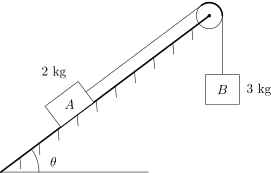
The coefficient of friction between A A\,A and the plane is 58\displaystyle \frac{5}{8}85. The blocks are released and A A\,A moves up the plane. The blocks are modelled as particles.
a.[5]
Find the tension in the string.
b.[2]
After B B\,B reaches the ground, A A\,A continues up the plane and comes to rest before reaching the pulley. Determine whether A A\,A remains at rest.
c.[2]
Suggest two refinements to the model that would make it more realistic.