Question 11
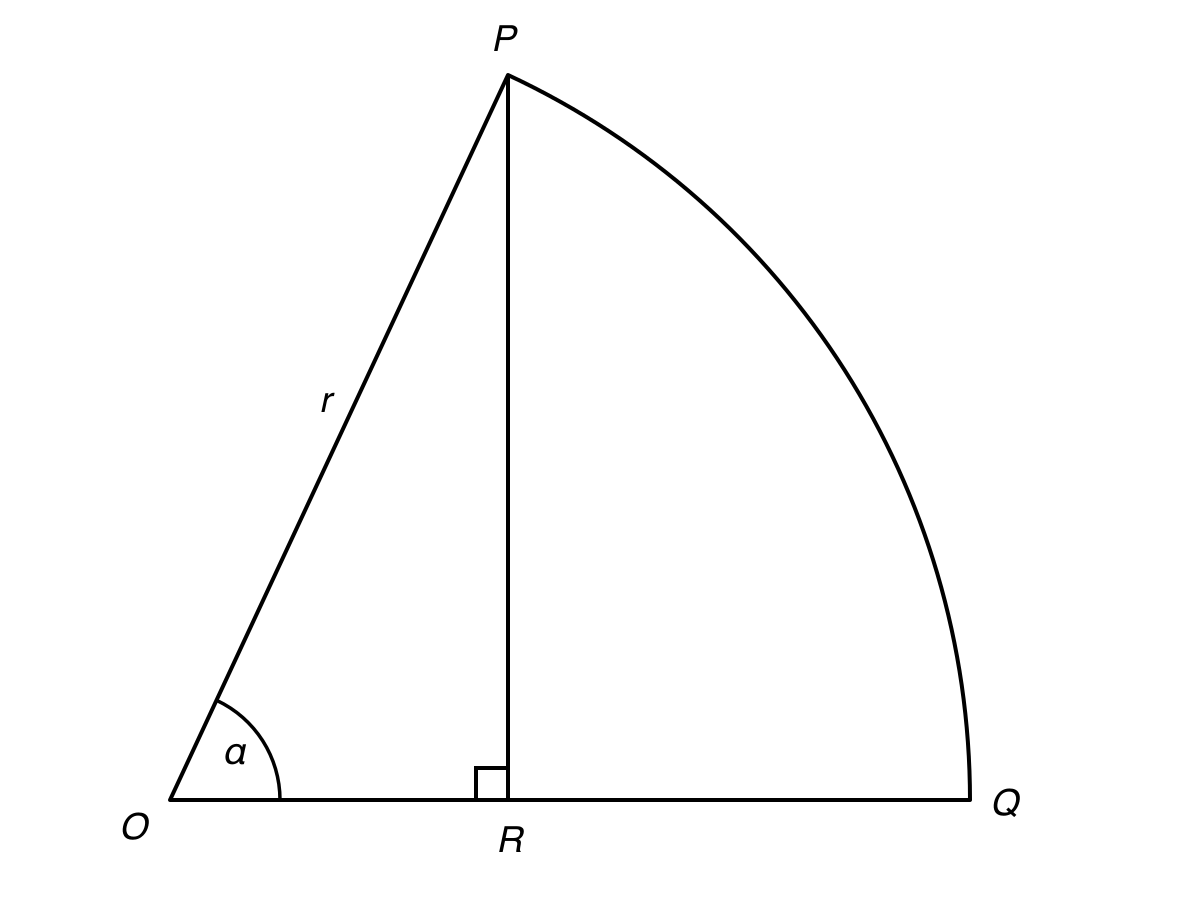
The diagram shows the scanning field of a radar sensor, modeled as a sector of a circle OPQ OPQ\,OPQ with radius rrr. A point R R\,R lies on the radius OQ OQ\,OQ such that the segment PR PR\,PR is perpendicular to OQOQOQ. The angle POQ POQ\,POQ is denoted by α \alpha\,α radians.
a.[4]
Given that the area of the sector OPQ OPQ\,OPQ is exactly three times the area of the right-angled triangle OPROPROPR, show that 2α=3sin2α2\alpha = 3\sin 2\alpha2α=3sin2α.
b.[3]
Use a sign change method to show that a solution to the equation 2α−3sin2α=02\alpha - 3\sin 2\alpha = 02α−3sin2α=0 lies in the interval 1.1<α<1.21.1 < \alpha < 1.21.1<α<1.2.
c.[5]
The Newton-Raphson method is used to determine an approximate value for α\alphaα. (i) Using α1=1.1\alpha_1 = 1.1α1=1.1 as a first approximation, calculate the value of α2 \alpha_2\,α2 to three decimal places. (ii) Explain why choosing a first approximation where cos2α=13\displaystyle \cos 2\alpha = \frac{1}{3}cos2α=31 would cause the Newton-Raphson method to fail.
3.7 Numerical methods (A-level only) Questions
125 exam-style questions on CCEA A Level Maths 3.7 Numerical methods (A-level only), covering 3.7.1 Numerical methods (A-level only), 3.7.2 Numerical methods (A-level only), 3.7.3 Numerical methods (A-level only), and 3.7.4 Numerical methods (A-level only). Each one has a worked solution and a mark scheme showing where the marks go.