Projectiles
What you'll learn
- How to split a launch velocity into horizontal and vertical components.
- How to use SUVAT separately in the two directions.
- How to find greatest height, time of flight, range, and speed.
- How to handle raised launch points, trajectory equations, and collisions.
The projectile model
A projectile is an object that has been launched and then moves only under gravity.
Projectile model
In the standard A-Level model, the object is treated as a particle, air resistance is ignored, and the acceleration is constant: vertically downwards with magnitude ggg, where g=9.8g=9.8g=9.8 m s⁻².
This means:
- horizontal acceleration is zero
- vertical acceleration is −g-g−g if you take upwards as positive
- horizontal and vertical motion happen at the same time, but you calculate them separately
Separate the motion
Projectile questions become much easier when you treat the horizontal direction and vertical direction as two linked SUVAT problems with the same time ttt.
Splitting the initial velocity
If a particle is projected with speed UUU at angle θ\thetaθ above the horizontal, its initial velocity components are:
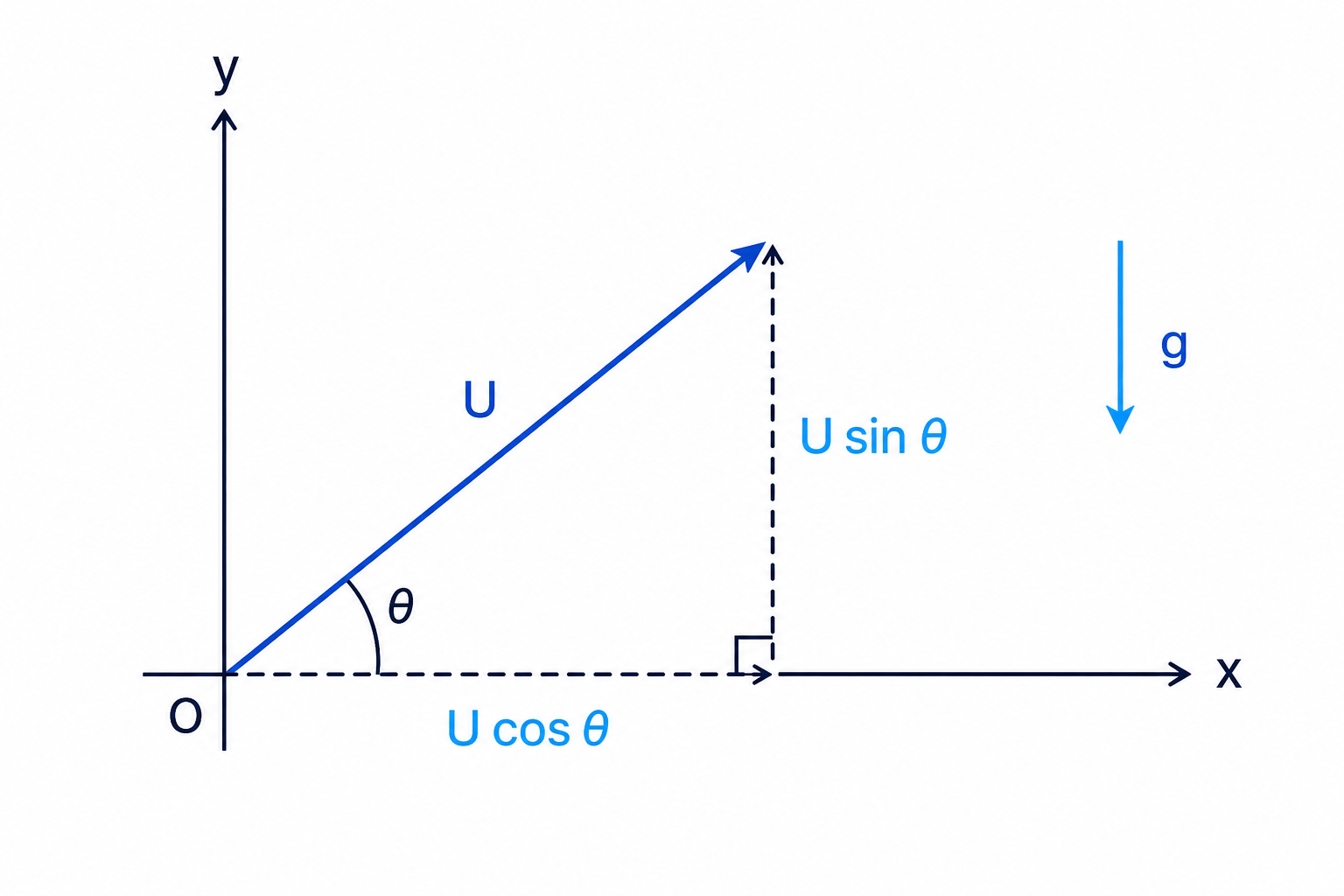
- horizontal component: UcosθU\cos\thetaUcosθ
- vertical component: UsinθU\sin\thetaUsinθ
If the velocity is given as ai+bja\mathbf{i}+b\mathbf{j}ai+bj, then:
- i\mathbf{i}i is the horizontal unit vector
- j\mathbf{j}j is the vertical unit vector
- initial horizontal velocity is aaa
- initial vertical velocity is bbb
Core equations
Taking the launch point as the origin and upwards as positive:
x=uxtx = u_x tx=uxt y=uyt−12gt2y = u_y t - \frac{1}{2}gt^2y=uyt−21gt2 vx=uxv_x = u_xvx=ux vy=uy−gtv_y = u_y - gtvy=uy−gtwhere uxu_xux and uyu_yuy are the initial horizontal and vertical components.
Velocity after a given time
A particle is projected with speed 18 m s⁻¹ at an angle of 50∘50^\circ50∘ above the horizontal. Find its velocity after 2 seconds.
-
Resolve the initial velocity into components:
ux=18cos50∘=11.57u_x = 18\cos 50^\circ = 11.57ux=18cos50∘=11.57 uy=18sin50∘=13.79u_y = 18\sin 50^\circ = 13.79uy=18sin50∘=13.79 -
The horizontal velocity stays constant:
vx=11.57v_x = 11.57vx=11.57 -
Use vertical motion with acceleration −9.8-9.8−9.8:
vy=13.79−9.8(2)=−5.81v_y = 13.79 - 9.8(2) = -5.81vy=13.79−9.8(2)=−5.81 -
Write the velocity as a vector:
v=11.6i−5.81j\mathbf{v} = 11.6\mathbf{i} - 5.81\mathbf{j}v=11.6i−5.81j
Putting gravity in the horizontal direction
Do not use ggg in the horizontal equation. Gravity acts vertically, so the horizontal velocity is constant unless air resistance is included.
Greatest height
At the greatest height, the vertical velocity is zero. The particle is still moving horizontally, but momentarily it is not moving up or down.
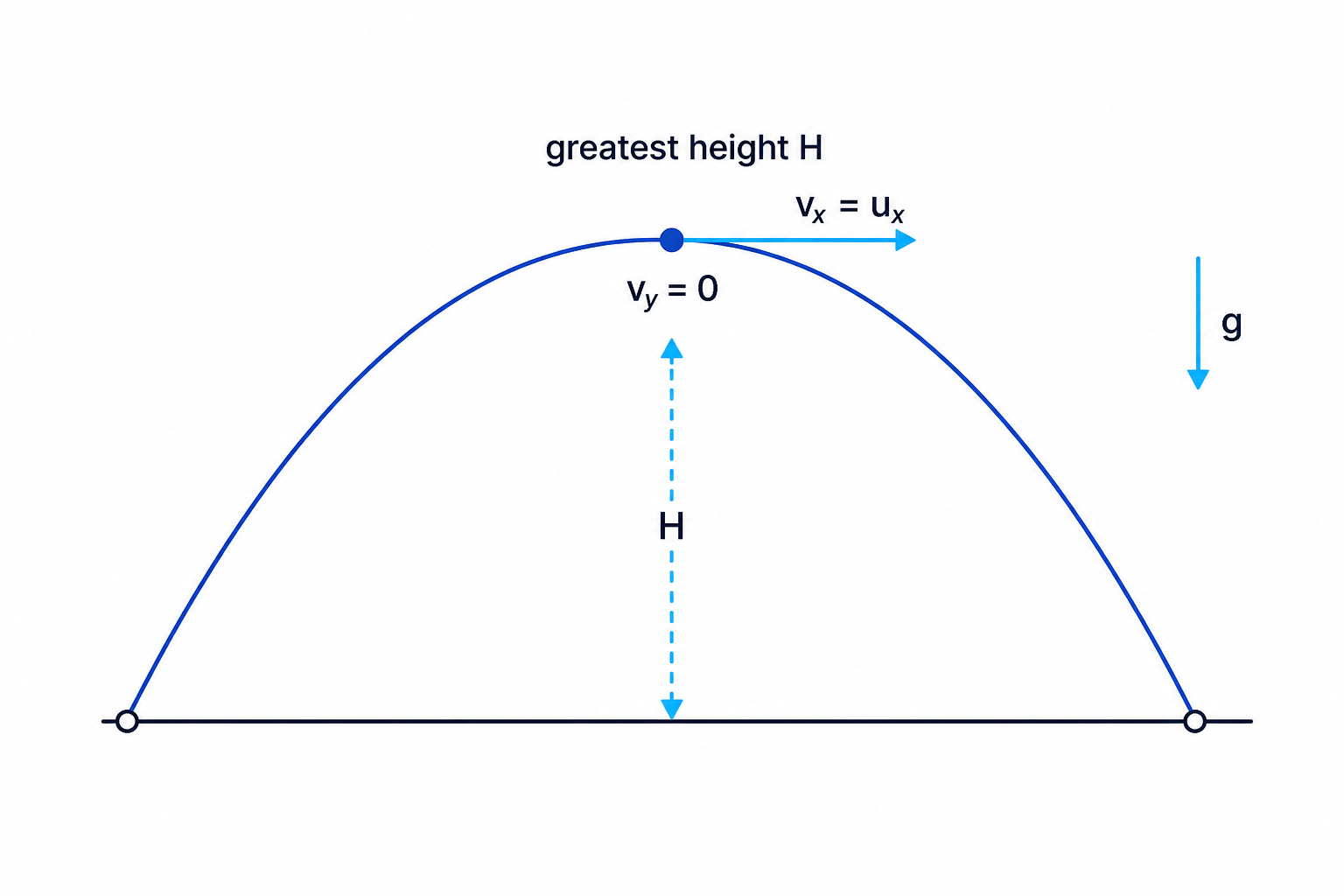
Use vertical SUVAT only:
vy2=uy2+2asv_y^2 = u_y^2 + 2asvy2=uy2+2asAt the top, vy=0v_y=0vy=0, a=−ga=-ga=−g, and s=Hs=Hs=H, where HHH is the height gained above the launch point.
Finding the greatest height
A particle is projected from level ground with speed 22 m s⁻¹ at an angle of 50∘50^\circ50∘ to the horizontal. Find its greatest height above the ground.
-
Find the initial vertical velocity:
uy=22sin50∘=16.85u_y = 22\sin 50^\circ = 16.85uy=22sin50∘=16.85 -
At the highest point, the vertical velocity is zero:
0=16.852−2(9.8)H0 = 16.85^2 - 2(9.8)H0=16.852−2(9.8)H -
Solve for HHH:
H=16.85219.6=14.5H = \frac{16.85^2}{19.6} = 14.5H=19.616.852=14.5 -
The greatest height is 14.5 m.
Top of the flight
At maximum height, only the vertical velocity is zero. The horizontal velocity is not zero.
Time of flight and horizontal range
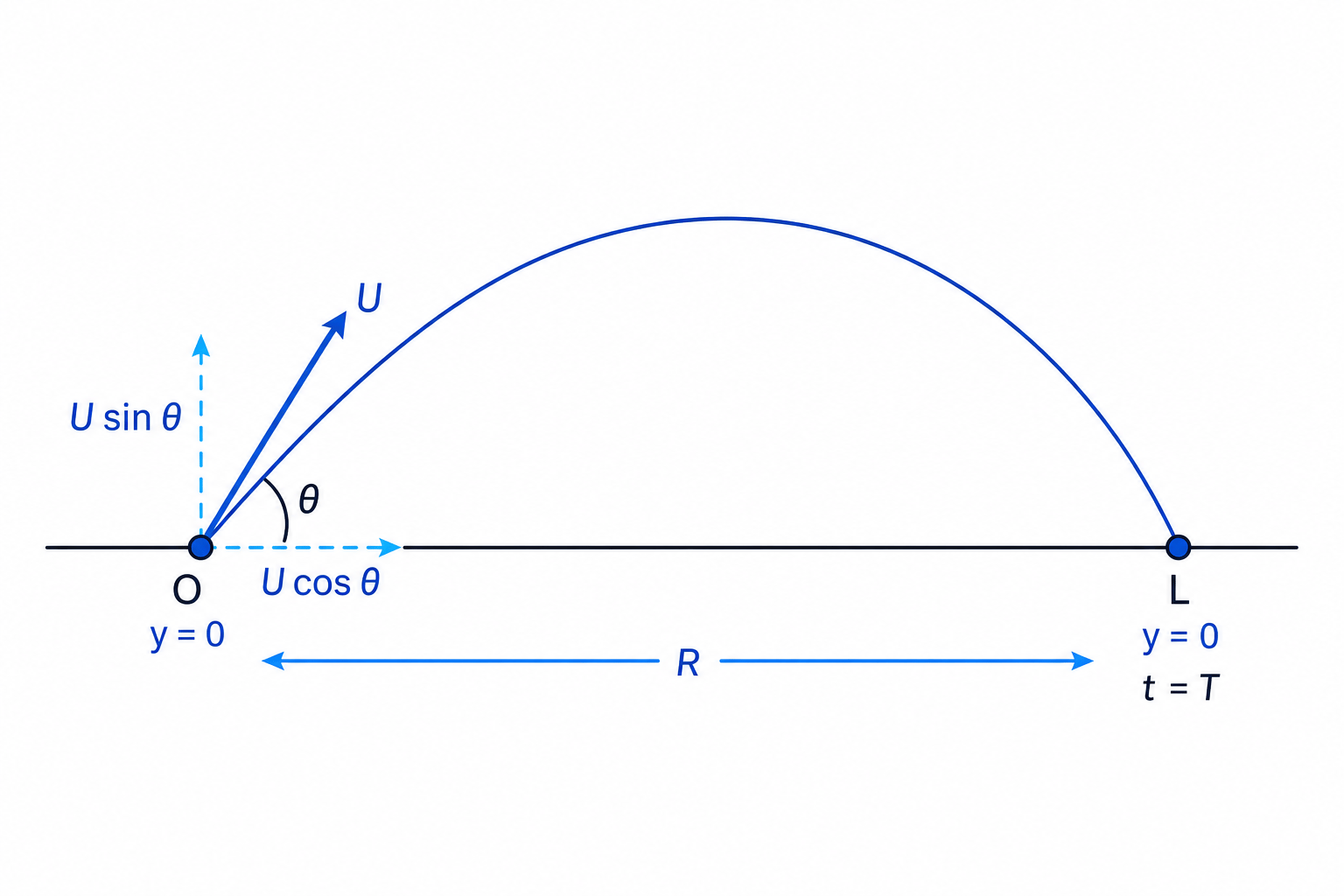
The range is the horizontal distance travelled before the projectile lands.
Range
The range of a projectile is the horizontal distance from its launch point to its landing point.
If the particle lands at the same height it was launched from, set y=0y=0y=0 and solve for the non-zero value of ttt.
Then use:
x=uxtx = u_x tx=uxtFinding the range on level ground
A ball is projected from the ground with speed 22 m s⁻¹ at an angle of 50∘50^\circ50∘. Find how far away it lands.
-
Use the same components:
ux=22cos50∘=14.14u_x = 22\cos 50^\circ = 14.14ux=22cos50∘=14.14 uy=22sin50∘=16.85u_y = 22\sin 50^\circ = 16.85uy=22sin50∘=16.85 -
Since it lands back on the ground, vertical displacement is zero:
0=16.85t−4.9t20 = 16.85t - 4.9t^20=16.85t−4.9t2 -
Factorise to find the non-zero time:
t(16.85−4.9t)=0t(16.85 - 4.9t)=0t(16.85−4.9t)=0 t=16.854.9=3.44t = \frac{16.85}{4.9} = 3.44t=4.916.85=3.44 -
Use horizontal motion to find the range:
x=14.14(3.44)=48.6x = 14.14(3.44) = 48.6x=14.14(3.44)=48.6 -
The horizontal distance is 48.6 m.
Range formula limitation
The shortcut R=U2sin2θgR=\frac{U^2\sin 2\theta}{g}R=gU2sin2θ only works when the projectile lands at the same vertical height as it was launched.
Starting above the ground
If the projectile starts at height hhh above the ground, use:
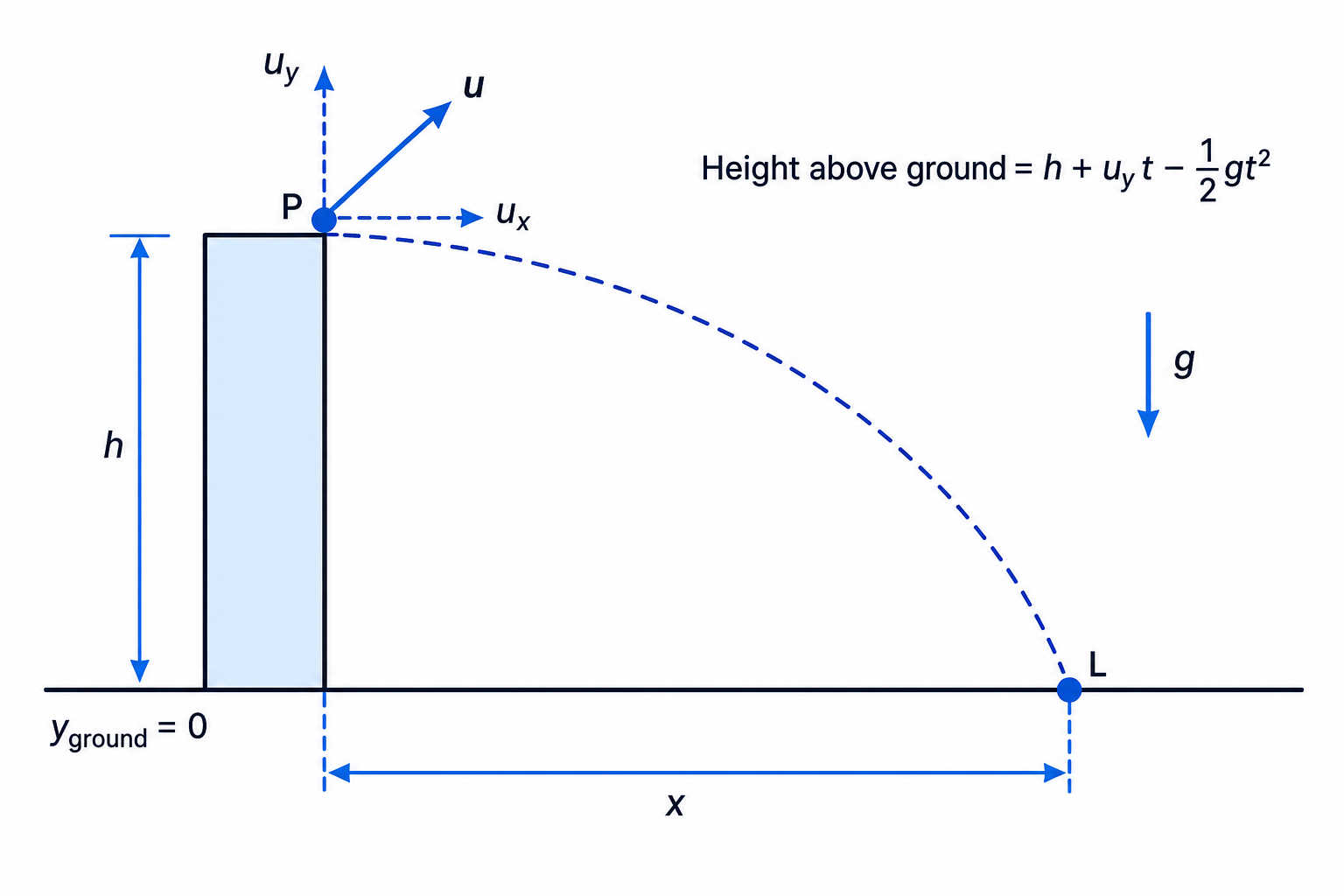
To find when it hits the ground, set the height equal to zero.
Projection from a raised point
A particle is projected from a point 12 m above horizontal ground with velocity 5i+8j5\mathbf{i}+8\mathbf{j}5i+8j m s⁻¹. Find its greatest height above the ground and the horizontal distance travelled before it lands.
-
Read off the initial components:
ux=5,uy=8u_x = 5,\qquad u_y = 8ux=5,uy=8 -
Find the extra height gained above the launch point:
H=822(9.8)=3.27H = \frac{8^2}{2(9.8)} = 3.27H=2(9.8)82=3.27 -
Add the starting height:
greatest height above ground=12+3.27=15.3\text{greatest height above ground} = 12 + 3.27 = 15.3greatest height above ground=12+3.27=15.3 -
Set the height above ground equal to zero:
0=12+8t−4.9t20 = 12 + 8t - 4.9t^20=12+8t−4.9t2 -
Rearrange and solve the quadratic, taking the positive root:
4.9t2−8t−12=04.9t^2 - 8t - 12 = 04.9t2−8t−12=0 t=2.58t = 2.58t=2.58 -
Use horizontal motion:
x=5(2.58)=12.9x = 5(2.58) = 12.9x=5(2.58)=12.9 -
The particle travels 12.9 m horizontally before landing.
Finding unknown speed or angle
Sometimes you are given the time of flight, greatest height, or a point on the path, and you need to find UUU or θ\thetaθ.
A useful method is to set up equations using the components:
ux=Ucosθu_x = U\cos\thetaux=Ucosθ uy=Usinθu_y = U\sin\thetauy=UsinθFinding an unknown angle from the flight time
A particle is projected from the ground with speed 30 m s⁻¹ at angle θ\thetaθ above the horizontal. It lands back on the ground after 4 seconds. Find θ\thetaθ and the range.
-
Use vertical displacement equal to zero:
0=(30sinθ)(4)−4.9(42)0 = (30\sin\theta)(4) - 4.9(4^2)0=(30sinθ)(4)−4.9(42) -
Simplify:
120sinθ=78.4120\sin\theta = 78.4120sinθ=78.4 -
Find θ\thetaθ:
sinθ=0.6533\sin\theta = 0.6533sinθ=0.6533 θ=40.8∘\theta = 40.8^\circθ=40.8∘ -
Use horizontal motion:
x=(30cos40.8∘)(4)x = (30\cos 40.8^\circ)(4)x=(30cos40.8∘)(4) -
Calculate the range:
x=90.9x = 90.9x=90.9 -
The range is 90.9 m.
The trajectory equation
The trajectory is the path followed by the projectile. You can remove time from the equations to connect horizontal distance xxx and vertical displacement yyy directly.
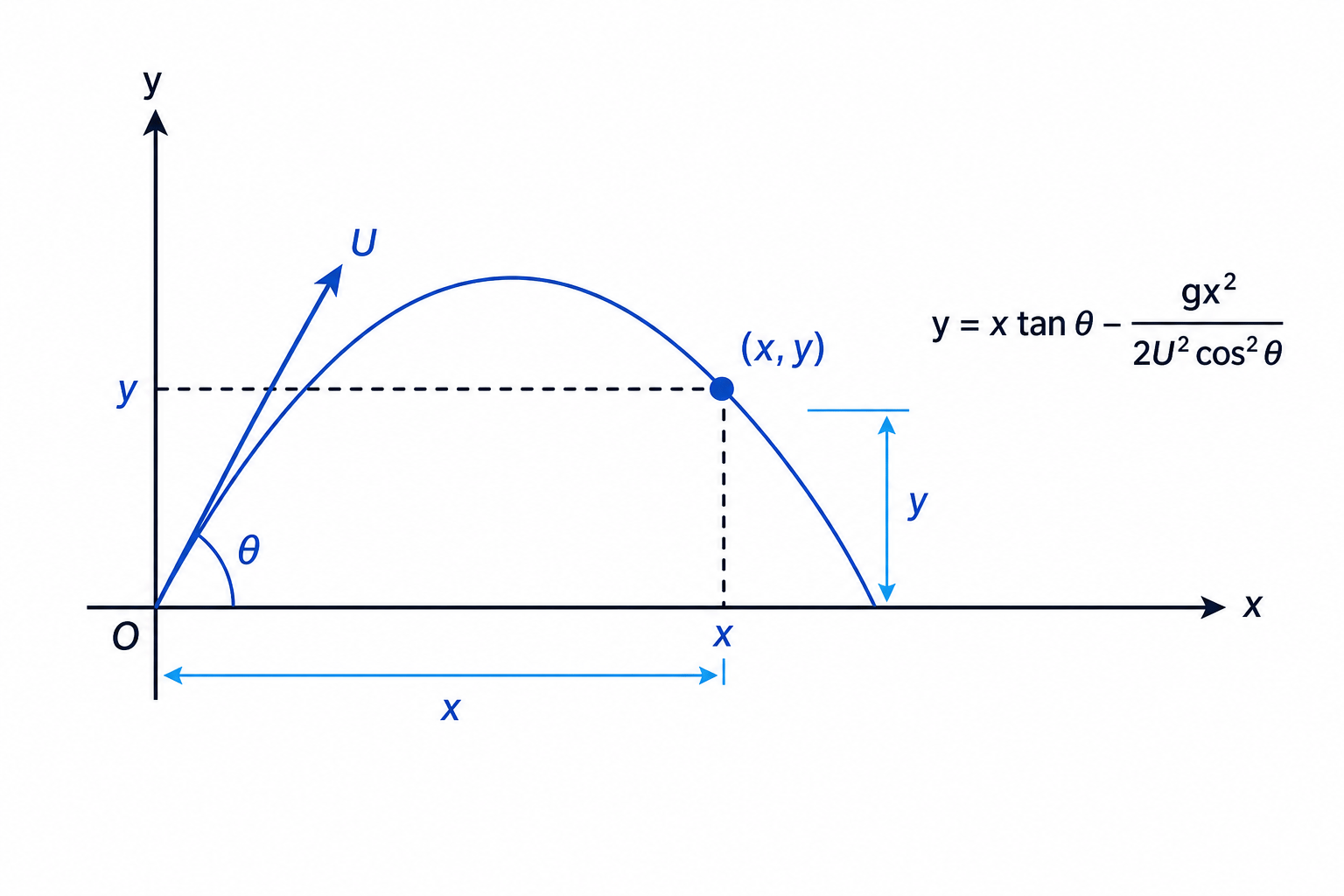
From horizontal motion:
t=xUcosθt = \frac{x}{U\cos\theta}t=UcosθxSubstitute this into the vertical equation:
y=xtanθ−gx22U2cos2θy = x\tan\theta - \frac{gx^2}{2U^2\cos^2\theta}y=xtanθ−2U2cos2θgx2This is especially useful when a projectile passes through a known point.
Using a point on the path to find the launch speed
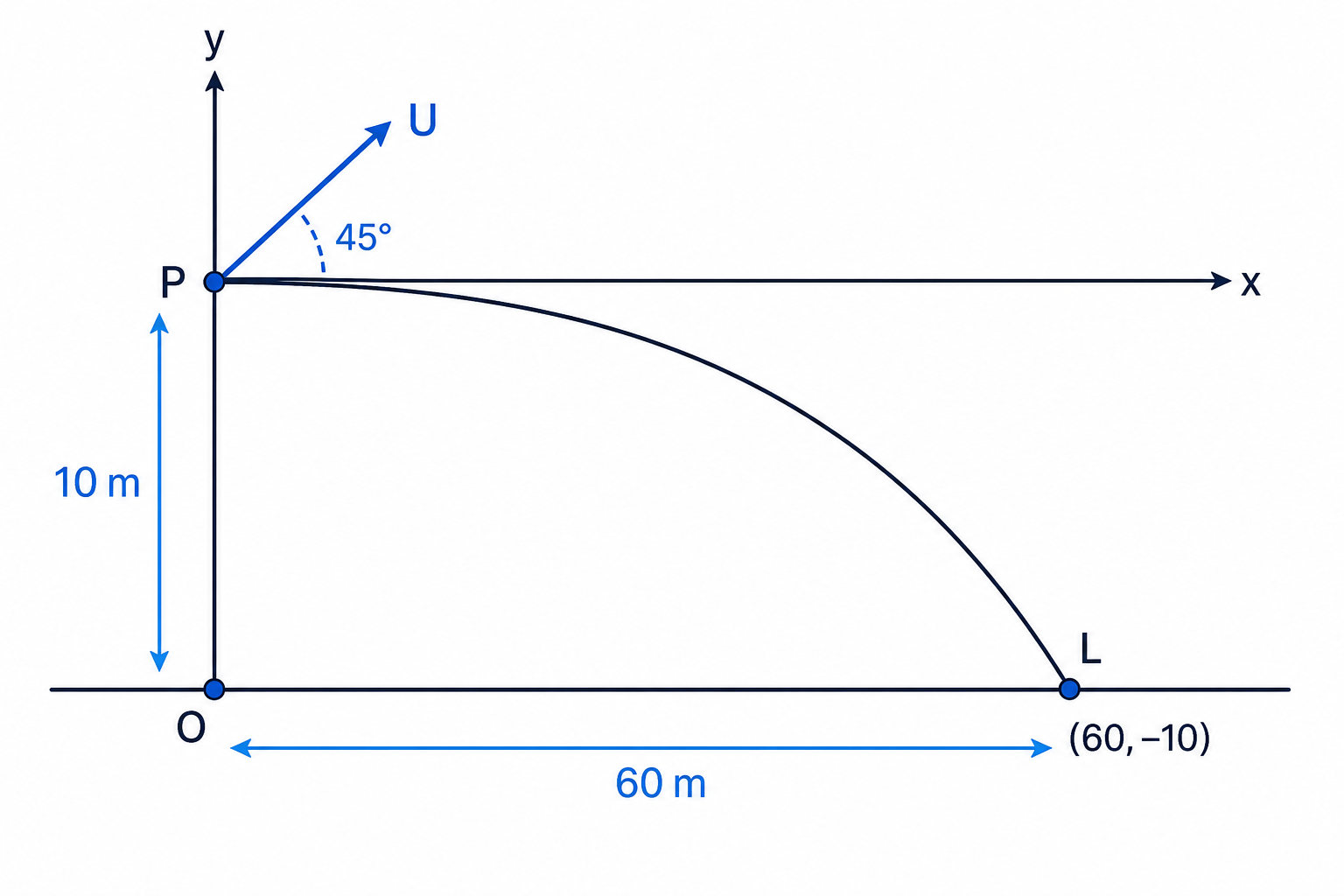
A ball is projected at 45∘45^\circ45∘ from a point 10 m above the ground. It lands on the ground 60 m horizontally from the point below launch. Find the launch speed.
-
Work relative to the launch point. At landing:
x=60,y=−10x = 60,\qquad y = -10x=60,y=−10 -
Use the trajectory equation with θ=45∘\theta=45^\circθ=45∘:
−10=60tan45∘−9.8(602)2U2cos245∘-10 = 60\tan45^\circ - \frac{9.8(60^2)}{2U^2\cos^2 45^\circ}−10=60tan45∘−2U2cos245∘9.8(602) -
Use tan45∘=1\tan45^\circ=1tan45∘=1 and cos245∘=12\cos^2 45^\circ=\frac{1}{2}cos245∘=21:
−10=60−9.8(3600)U2-10 = 60 - \frac{9.8(3600)}{U^2}−10=60−U29.8(3600) -
Solve for U2U^2U2:
35280U2=70\frac{35280}{U^2} = 70U235280=70 U2=504U^2 = 504U2=504 -
Find UUU:
U=504=22.4U = \sqrt{504} = 22.4U=504=22.4 -
The launch speed is 22.4 m s⁻¹.
Collisions between two projectiles
For two projectiles to collide, they must have the same position at the same time.
Choose a coordinate system carefully. A common choice is:
- origin at the left-hand launch point
- positive horizontal direction to the right
- positive vertical direction upwards
Two balls colliding
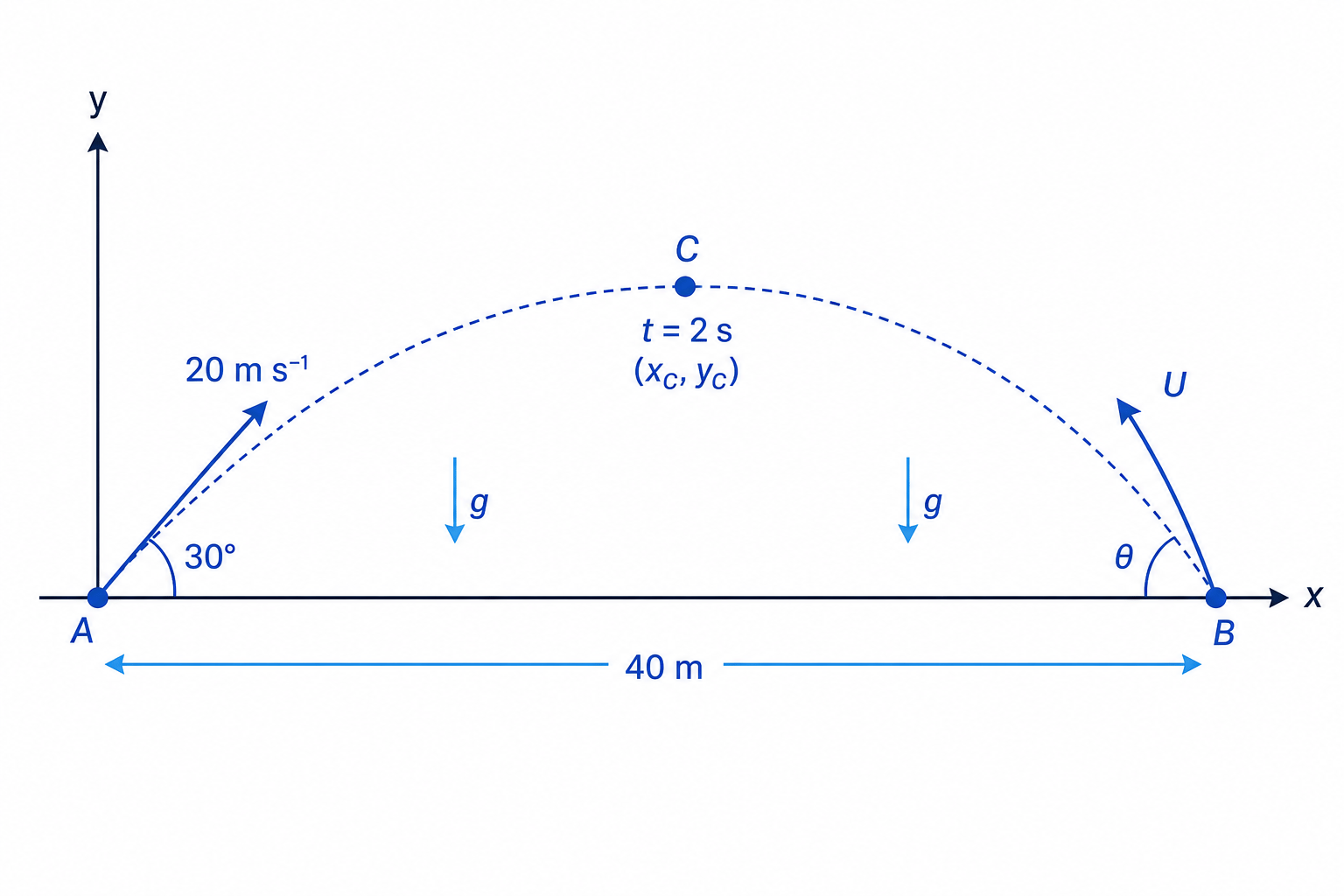
Two points A and B are 40 m apart on horizontal ground. Ball P is projected from A with speed 20 m s⁻¹ at 30∘30^\circ30∘ above the horizontal towards B. Ball Q is projected from B towards A and collides with P after 2 seconds. Find the velocity of P just before collision, and find the initial speed and angle of Q.
-
Resolve P’s initial velocity:
uPx=20cos30∘=17.32u_{Px}=20\cos30^\circ=17.32uPx=20cos30∘=17.32 uPy=20sin30∘=10u_{Py}=20\sin30^\circ=10uPy=20sin30∘=10 -
Find P’s velocity at t=2t=2t=2:
vPx=17.32v_{Px}=17.32vPx=17.32 vPy=10−9.8(2)=−9.6v_{Py}=10-9.8(2)=-9.6vPy=10−9.8(2)=−9.6 -
So P’s velocity just before collision is:
vP=17.3i−9.6j\mathbf{v}_P = 17.3\mathbf{i}-9.6\mathbf{j}vP=17.3i−9.6j -
Find P’s position at t=2t=2t=2:
xP=17.32(2)=34.64x_P=17.32(2)=34.64xP=17.32(2)=34.64 yP=10(2)−4.9(22)=0.4y_P=10(2)-4.9(2^2)=0.4yP=10(2)−4.9(22)=0.4 -
Ball Q starts at x=40x=40x=40, so its horizontal displacement is:
34.64−40=−5.3634.64-40=-5.3634.64−40=−5.36 -
Therefore Q’s horizontal component towards A has magnitude:
Ucosθ=5.362=2.68U\cos\theta=\frac{5.36}{2}=2.68Ucosθ=25.36=2.68 -
Use Q’s vertical displacement:
0.4=(Usinθ)(2)−4.9(22)0.4 = (U\sin\theta)(2)-4.9(2^2)0.4=(Usinθ)(2)−4.9(22) Usinθ=10U\sin\theta=10Usinθ=10 -
Find θ\thetaθ:
tanθ=102.68\tan\theta=\frac{10}{2.68}tanθ=2.6810 θ=75.0∘\theta=75.0^\circθ=75.0∘ -
Find UUU:
U=2.682+102=10.4U=\sqrt{2.68^2+10^2}=10.4U=2.682+102=10.4 -
Q is projected at 10.4 m s⁻¹ at an angle of 75.0∘75.0^\circ75.0∘ above the horizontal, towards A.
In the exam
- Draw a quick diagram and choose positive directions before writing equations.
- Resolve the initial velocity first; most errors happen before SUVAT even begins.
- Use vertical motion for height and time, then horizontal motion for distance.
- If the launch and landing heights differ, do not use the level-ground range formula.
- For collisions, make the two position vectors equal at the same time.
Check yourself
- Why is the horizontal acceleration zero in the standard projectile model?
- At the greatest height, which component of velocity is zero?
- If a projectile starts 15 m above the ground, what vertical displacement should you use when it lands?