Defences in tort
What you'll learn
- How a defendant uses a defence after the claimant has shown the tort.
- How contributory negligence reduces damages under s1(1) Law Reform (Contributory Negligence) Act 1945.
- How volenti non fit injuria (“no injury is done to a willing person”) can completely defeat a claim.
- Which defences are available — and not available — in private nuisance and Rylands v Fletcher claims.
The starting point: what is a defence?
In tort, the claimant is the person bringing the claim, and the defendant is the person being sued. Usually, the claimant must first prove the elements of the tort: for example, duty, breach, causation and damage in negligence.
A defence is different from simply saying, “the claimant has not proved the tort.” A defence usually says: “Even if the tort is made out, the defendant should not pay all — or any — of the damages.”
Defence
A defence is a legal argument raised by the defendant to avoid liability completely or reduce the amount of damages payable. In civil law, the defendant normally proves the defence on the balance of probabilities, meaning “more likely than not”.
Some defences are complete: the claimant gets nothing. Others are partial: the claimant wins, but damages are reduced.
Here is the big picture before we look at each defence in detail.
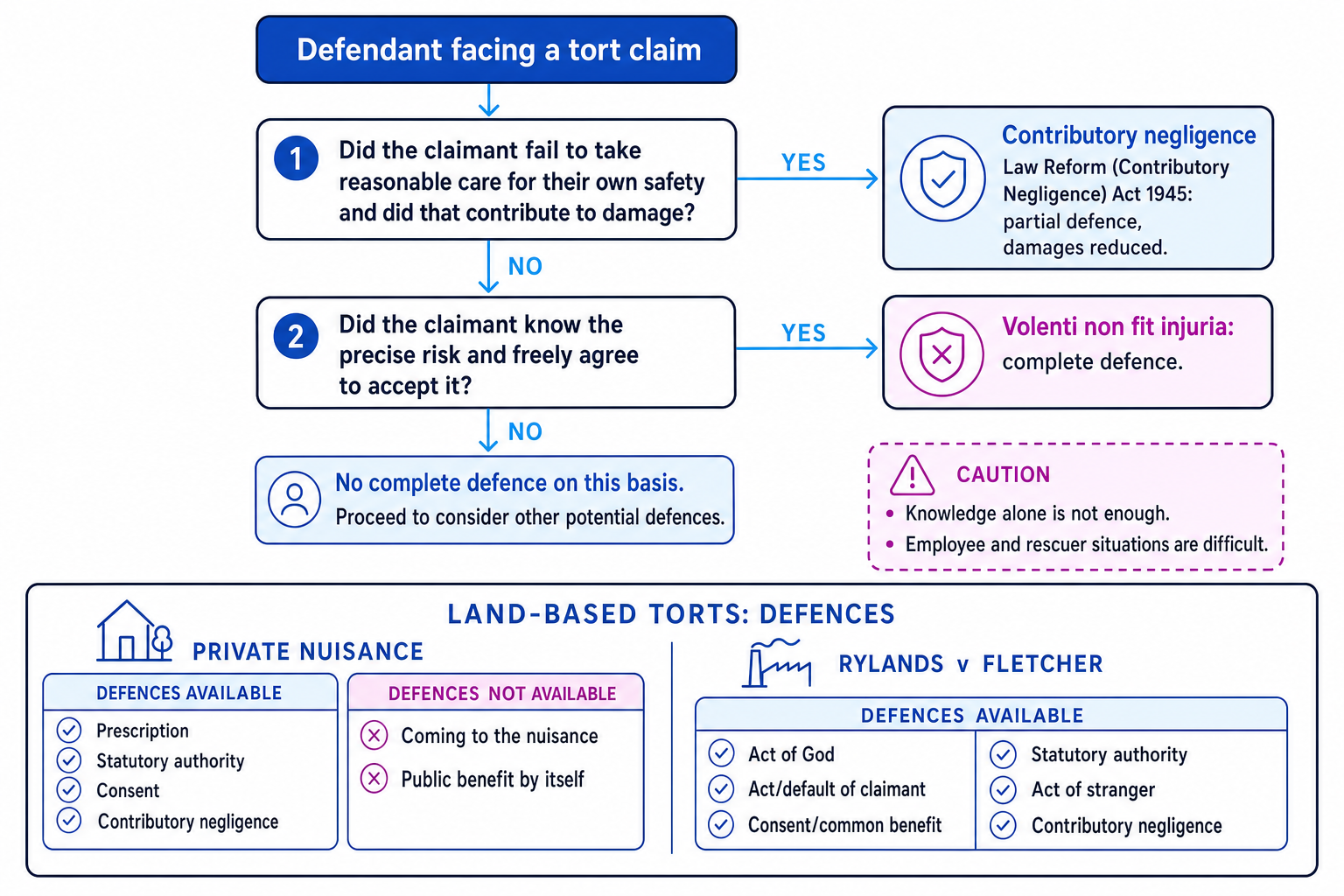
Contributory negligence
Contributory negligence is a partial defence. It applies where the claimant’s own lack of reasonable care contributed to the damage they suffered.
The key statute is s1(1) Law Reform (Contributory Negligence) Act 1945. It allows the court to reduce damages to an amount it thinks is “just and equitable”, having regard to the claimant’s share in responsibility.
Contributory negligence is about shared responsibility
The defendant remains liable, but the claimant’s damages are reduced because the claimant’s own fault helped cause the damage or made it worse.
How it operates
The defendant must show:
- the claimant failed to take reasonable care for their own safety or property;
- that failure contributed to the damage, not just to the situation generally;
- the court should reduce damages by a fair percentage.
Useful authorities:
- Jones v Livox Quarries (1952): a worker rode on the tow-bar of a vehicle and was injured in a collision; contributory negligence requires the claimant’s fault to contribute to the damage.
- Froom v Butcher (1976): a car passenger failed to wear a seatbelt; damages may be reduced where a safety precaution would have prevented or reduced injury.
- Sayers v Harlow UDC (1958): a woman trapped in a public toilet climbed out and fell; the council was liable, but damages were reduced because her escape attempt was partly careless.
Unfastened safety equipment
-
Identify the issue: Ben negligently knocks Alice off her motorcycle. Alice’s helmet strap was unfastened, and her head injury is worse than it would have been with a properly fastened helmet.
-
State the rule: Under s1(1) Law Reform (Contributory Negligence) Act 1945, damages can be reduced if Alice failed to take reasonable care for herself and that failure contributed to the damage. In Capps v Miller (1989), an unfastened motorcycle helmet justified a reduction in damages.
-
Apply to the facts: Alice did not cause the crash, so Ben is still liable. However, medical evidence suggests the unfastened helmet made the head injury worse, so Alice’s carelessness contributed to the extent of damage.
-
Conclude: Contributory negligence is likely to succeed as a partial defence. Alice still recovers damages, but they are reduced by a percentage the court thinks fair.
Damage, not just accident
In contributory negligence, ask: did the claimant’s fault contribute to the injury or loss? It does not have to cause the accident itself.
Volenti non fit injuria
Volenti non fit injuria means “no injury is done to a willing person.” It is a complete defence: if it succeeds, the claimant receives no damages.
Volenti non fit injuria
Volenti non fit injuria is a defence where the claimant had full knowledge of the risk and freely agreed to accept that legal risk.
How it operates
The defendant must prove both:
- knowledge of the nature and extent of the risk; and
- free and voluntary acceptance of that risk.
This is a high test. Mere awareness of danger is not enough.
Useful authorities:
- Smith v Baker (1891): a quarry worker knew stones might fall from a crane but continued working; knowledge of risk did not equal consent, especially in an employment context.
- Morris v Murray (1991): the claimant went flying with a visibly drunk pilot and was injured in a crash; volenti succeeded because he knowingly and freely accepted an obvious extreme risk.
- Haynes v Harwood (1935): a police officer was injured stopping runaway horses; rescuers are not usually treated as consenting to injury.
Knowledge is not consent
Do not write “the claimant knew it was dangerous, so volenti applies.” You must prove voluntary acceptance of the legal risk, not just awareness of danger.
Choosing to fly with a drunk pilot
-
Identify the issue: Cara accepts a flight with Dan, who is obviously drunk, slurring his words and struggling to walk. The plane crashes and Cara sues Dan’s estate.
-
State the rule: Volenti requires full knowledge and free acceptance of the risk. Morris v Murray (1991) shows the defence can succeed where the claimant joins a flight with a clearly drunk pilot.
-
Apply to the facts: Cara saw Dan’s condition and still chose to board the plane. This is stronger than merely accepting an ordinary risk of flying; it is acceptance of a serious and obvious risk created by Dan’s drunkenness.
-
Conclude: Volenti is likely to succeed as a complete defence. Cara may receive no damages.
Defences in private nuisance
Private nuisance is an unlawful, indirect interference with a claimant’s use or enjoyment of land. Typical examples include noise, smells, vibrations or escaping substances.
Defences available
The main available defences are:
- Prescription: the defendant has carried on the nuisance openly and continuously “as of right” for at least 20 years after it became actionable. Sturges v Bridgman (1879) involved noisy confectionery equipment near a doctor’s consulting room; the defence failed because the nuisance had not been actionable for 20 years against that use of the land.
- Statutory authority: Parliament has authorised the activity, and the nuisance is the inevitable result of carrying it out properly. Allen v Gulf Oil Refining (1981) involved an oil refinery authorised by statute; statutory authority defeated the nuisance claim.
- Consent: the claimant genuinely agreed to the interference, for example through a legal right or permission. This is not the same as merely moving near the nuisance.
- Contributory negligence: damages may be reduced if the claimant’s own fault contributes to the loss.
Defences not available
Some arguments sound tempting but are not true defences:
- Coming to the nuisance is not a defence. Sturges v Bridgman (1879) also shows that a claimant is not barred just because they moved to the area after the defendant’s activity began.
- Public benefit is not, by itself, a defence. Miller v Jackson (1977) involved cricket balls landing on neighbouring property; the public value of cricket affected the remedy, but did not automatically defeat liability.
- Planning permission is not the same as statutory authority. Wheeler v JJ Saunders Ltd (1996) shows that planning permission for pig units did not automatically authorise a private nuisance.
Planning permission is not a magic shield
If the defendant says, “The council approved it,” check whether there is true statutory authority. Ordinary planning permission does not automatically defeat private nuisance.
Noise from a workshop
-
Identify the issue: Maya buys a house next to Noah’s workshop. The machinery causes loud vibrations at night. Noah argues that Maya “came to the nuisance” and that the workshop benefits the local economy.
-
State the rule: Coming to the nuisance is not a defence under Sturges v Bridgman (1879). Public benefit is not a complete defence, as shown by Miller v Jackson (1977). Statutory authority requires more than ordinary planning permission, as shown by Wheeler v JJ Saunders Ltd (1996).
-
Apply to the facts: Maya is not barred simply because she moved in later. The economic usefulness of the workshop may influence the remedy, but it does not automatically prevent liability. Unless Noah has true statutory authority or a 20-year prescription defence, his arguments are weak.
-
Conclude: Noah is unlikely to have a complete defence. The court may still consider whether damages are more suitable than an injunction.
Defences in Rylands v Fletcher
Rylands v Fletcher (1868) creates liability where the defendant brings something dangerous onto land, makes a non-natural use of the land, and it escapes causing foreseeable damage. In Rylands v Fletcher (1868) itself, water escaped from a reservoir into the claimant’s mine; the principle is strict liability for dangerous escapes from land.
Modern cases narrow the tort:
- Cambridge Water v Eastern Counties Leather (1994): chemical seepage into groundwater was not foreseeable at the time; foreseeable damage is required.
- Transco v Stockport MBC (2003): ordinary domestic water pipes were not a non-natural use; the tort is limited to exceptional or extraordinary uses of land.
Defences available
The main defences are:
- Act of God: an extraordinary natural event no human foresight could reasonably anticipate. Nichols v Marsland (1876) involved exceptional rainfall bursting artificial lakes; the defence succeeded.
- Act or default of the claimant: the claimant’s own actions cause the escape or damage. Ponting v Noakes (1894) involved a horse eating poisonous leaves by reaching over a fence; the defendant was not liable.
- Act of a stranger: an unforeseeable act of a third party outside the defendant’s control. Rickards v Lothian (1913) involved an unknown person blocking a sink and causing flooding; the defence succeeded.
- Consent or common benefit: the dangerous thing is kept with the claimant’s consent or for mutual benefit. Peters v Prince of Wales Theatre (1943) involved a sprinkler system for common benefit; no liability without negligence.
- Statutory authority: the activity is authorised or required by statute. Green v Chelsea Waterworks (1894) involved a burst water main maintained under statutory authority; no liability without negligence.
- Contributory negligence: damages may be reduced if the claimant’s own fault contributed to the loss.
Vandal opening a chemical tank
-
Identify the issue: A factory stores chemicals in a secure tank. A trespasser breaks in at night, opens the valve, and chemicals escape onto Priya’s neighbouring land.
-
State the rule: Under Rylands v Fletcher, escape of a dangerous thing may create liability, but Rickards v Lothian (1913) allows a defence where the escape is caused by an unforeseeable act of a stranger outside the defendant’s control.
-
Apply to the facts: If the tank was properly secured and the trespasser’s act was not reasonably foreseeable, the factory can argue act of a stranger. If break-ins were common and the valve was left unsecured, the defence is less likely because the risk was foreseeable.
-
Conclude: The defence depends on foreseeability and control. A carefully secured site has a stronger defence than a careless one.
AO3 evaluation: are these defences fair?
These defences show tort law balancing competing interests.
Advantages: contributory negligence is flexible because it shares loss fairly instead of using an all-or-nothing rule. Volenti respects personal autonomy where someone truly accepts a risk. In nuisance and Rylands v Fletcher, defences like statutory authority and act of God stop defendants becoming insurers against every loss.
Disadvantages: contributory negligence percentages can feel uncertain. Volenti is harsh because it is a complete defence, so courts apply it narrowly. Statutory authority can seem unfair to individual claimants who suffer loss for the public benefit.
Balancing interests: tort law aims to compensate claimants, deter unreasonable behaviour and distribute losses fairly. Contributory negligence often supports those aims well. Volenti is more controversial because it can defeat compensation entirely. In land-based torts, the law tries to balance private property rights against socially useful activities.
In the exam
-
Prove the tort first, then deal with the defence. State whether the defence is complete or partial.
-
For contributory negligence, link the claimant’s fault to the damage and explain why a reduction is fair.
-
For volenti, prove both knowledge and free acceptance. Use Smith v Baker (1891) to show knowledge alone is not enough.
-
For private nuisance and Rylands v Fletcher, name the exact defence and authority, and deal with non-defences such as coming to the nuisance or public benefit.
Check yourself
- Why does contributory negligence reduce damages rather than defeat the whole claim?
- Why is “coming to the nuisance” not the same as consent?
- What is the difference between an act of a stranger and statutory authority in Rylands v Fletcher?