x

Britain and Ireland after Rome

Britain and Ireland after Rome
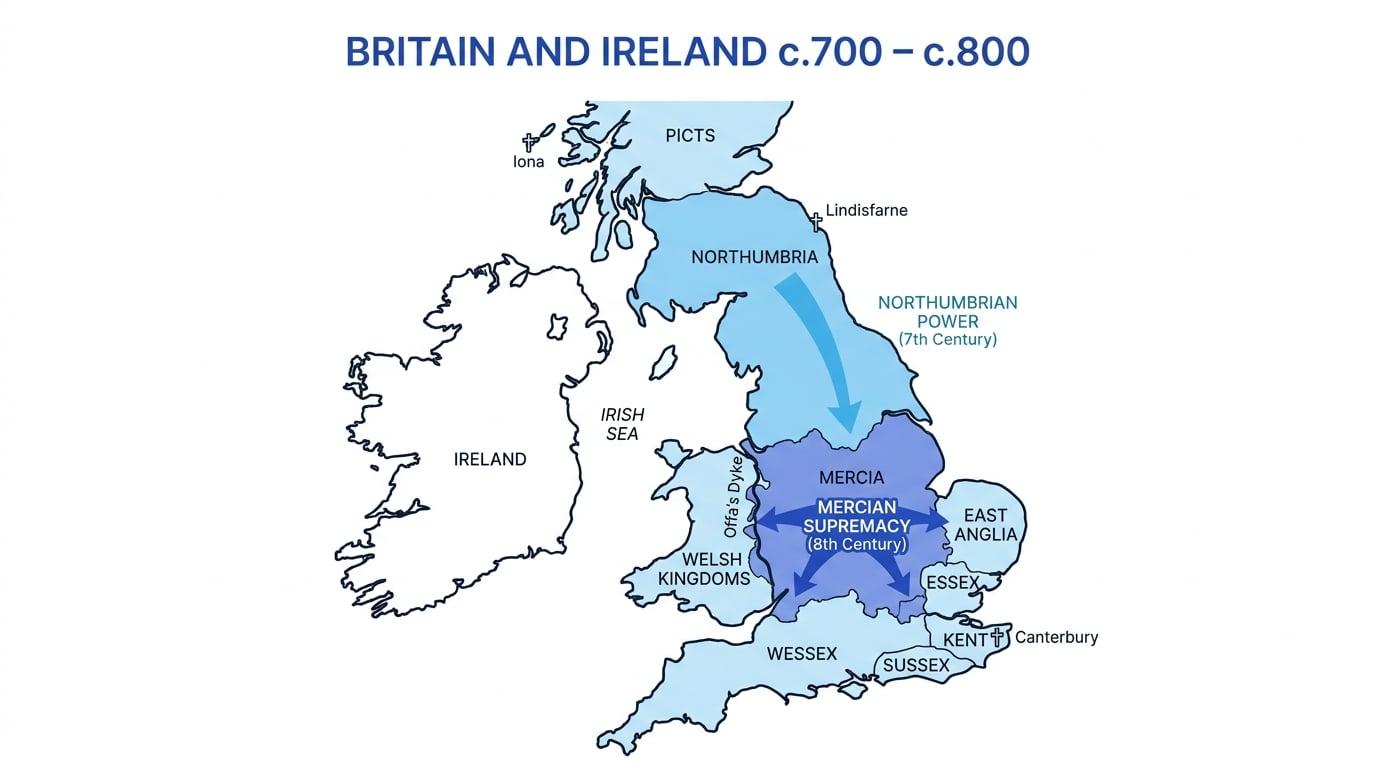
Map of Britain and Ireland c.700-c.800 showing Northumbria, Mercia, Wessex, Kent, East Anglia, Essex, Sussex, Welsh kingdoms, Picts, Ireland, Canterbury, Lindisfarne, Iona, and Offa's Dyke

After Roman rule ended in the early fifth century, Britain and Ireland did not become one new kingdom. They remained a patchwork of British/Welsh, Pictish, Irish and Anglo-Saxon peoples, with power shifting between many rulers.

The Early-Anglo Saxons c.400–800 Lesson

  1. A Level
  2. /History
  3. /The Early-Anglo Saxons c.400–800

Step-by-step lessons covering OCR A Level History The Early-Anglo Saxons c.400–800 for A Level History. Each lesson works through exam-style questions in Unit group 1, Unit group 2 and Unit group 3, plus the Y100 non-exam assessment format. Build a secure grasp of the outline narrative for your breadth and depth periods first, since the source-evaluation and historical-interpretations questions that carry a large share of the marks depend on that contextual knowledge.

Lessons

The Early-Anglo Saxons c.400–800The Viking Age c.790–1066English Government and the Church 1066–1216The Church and Medieval Heresy c.1100–1437The Renaissance c.1400–c.1600Tudor Foreign Policy 1485–1603The Catholic Reformation 1492–1610The Ascendancy of the Ottoman Empire 1453–1606The Development of the Nation State: France 1498–1610The Origins and Growth of the British Empire 1558–1783Popular Culture and the Witchcraze of the 16th and 17th CenturiesThe Ascendancy of France 1610–1715The Challenge of German Nationalism 1789–1919The Changing Nature of Warfare 1792–1945Britain and Ireland 1791–1921China and its Rulers 1839–1989Russia and its Rulers 1855–1964Civil Rights in the USA 1865–1992From Colonialism to Independence: The British Empire 1857–1965The Middle East 1908–2011: Ottomans to Arab Spring