The Trade Cycle
Definition
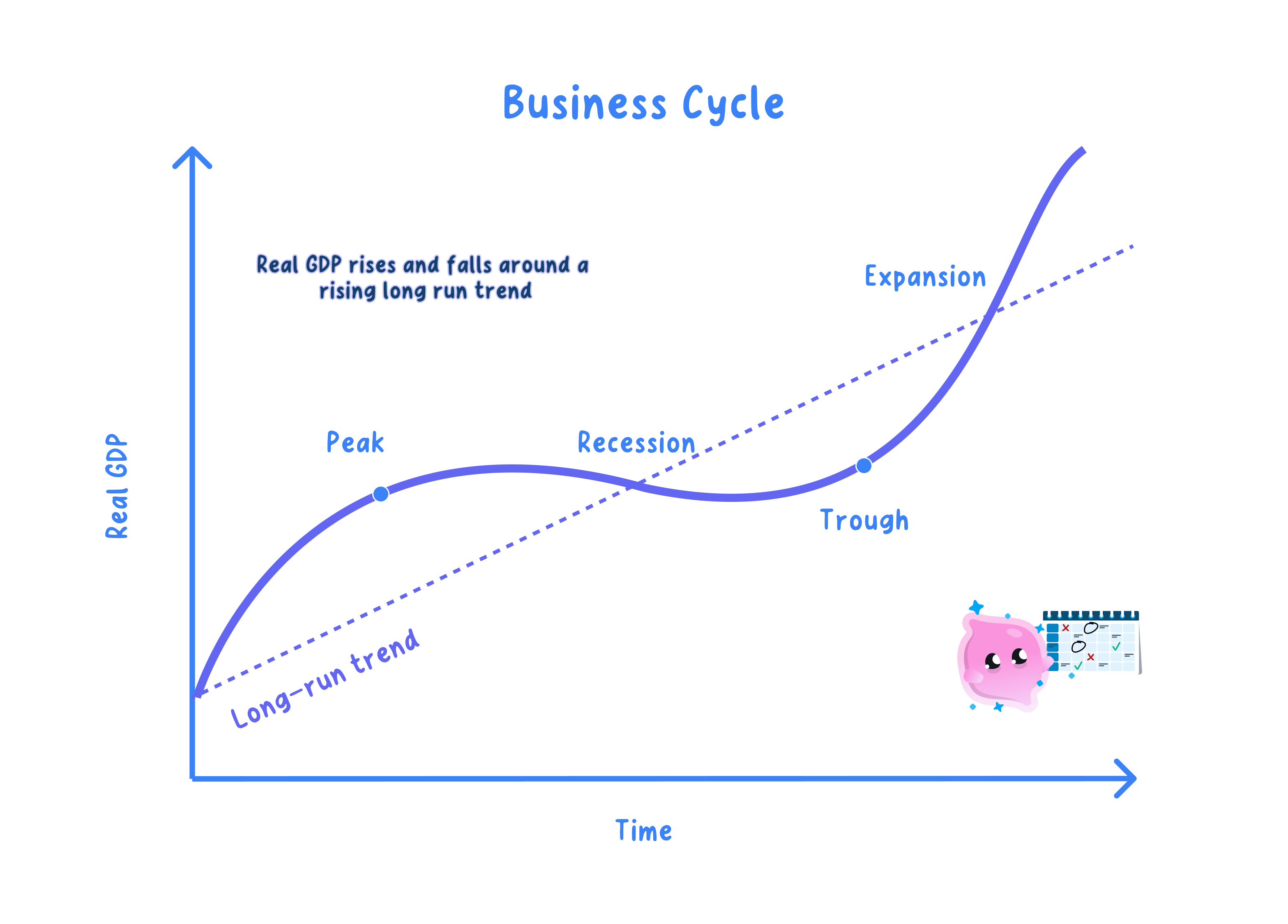
Trade (business) cycle: the recurring short-run fluctuation of real GDP around its long-run growth trend, passing through boom, downturn, recession and recovery.
Real GDP: the total output of an economy in a year measured at constant prices, so it strips out the effect of inflation.
- The cycle moves through four phases: boom, downturn, recession (slump or trough) and recovery.
- Real output rises and falls through these phases, but the long-run trend line still slopes upward, so every downturn is temporary.
Analogy
- Picture a train climbing a long hill: it speeds up and slows down, but the track still rises over the whole journey.
- Each dip in output is temporary, yet the long-run trend keeps heading upward.
The Boom
Definition
Boom: a phase of rapid real GDP growth at or above the trend rate, when the economy is at or near full capacity.
- Unemployment is low and confidence is high, so households consume more and firms invest more, and this extra spending reinforces the expansion.
- As spare capacity disappears, firms compete for scarce workers and wages are bid up, which feeds through into demand-pull inflation.
- If CPI inflation is pushed above the 2%2\%2% target, the Bank of England's Monetary Policy Committee is likely to raise Bank Rate to cool demand.
Example
- In the late-1980s Lawson boom, UK unemployment fell sharply but CPI-style inflation climbed into double digits as the economy overheated.
- Firms struggle to recruit and wages rise as spare capacity vanishes, so the MPC raises Bank Rate to keep CPI near its target.
Recession, Slowdown and Recovery
Definition
Recession: a fall in real GDP for two consecutive quarters, that is, two quarters of negative economic growth.
Slowdown: a fall in the rate of growth while growth stays positive, so output still rises but more slowly.
Recovery: the phase after a trough when real GDP rises back towards its long-run trend.
- In a recession real output falls, unemployment rises and confidence and investment weaken, so inflationary pressure eases as total spending drops.
- A downturn is the loss of momentum before a possible recession; if positive growth turns negative, the economy tips into recession.
- During recovery, returning confidence and spending lift real output back towards trend and unemployment starts to fall.
Example
- In the 2008-09 recession that followed the global financial crisis, UK real GDP contracted for several consecutive quarters and unemployment climbed towards 8%8\%8%.
- Confidence and investment collapsed, so inflationary pressure faded and the Bank of England cut Bank Rate to 0.5%0.5\%0.5% and launched quantitative easing from 2009 to support demand.
Is a boom always good for an economy?
- It holds because a boom brings low unemployment, rising real incomes and strong profits, which raise living standards and boost government tax revenue.
- But an overheating boom generates demand-pull inflation, and if CPI rises well above the 2%2\%2% target the MPC must raise Bank Rate, which can choke off the very expansion that created the boom.
- It can also be unsustainable, widening a current account deficit as higher incomes pull in imports and adding to pollution and congestion.
- On balance it depends on whether output is growing near trend or overheating above capacity: steady growth is desirable, but an unsustainable boom often sows the seeds of the next recession.
Exam technique
- Read several indicators together, such as real GDP, unemployment and inflation, to name the phase.
- State clearly whether growth is positive but slower, or actually negative.
Common Mistake
- Do not confuse a slowdown with a recession.
- A slowdown is slower positive growth, while a recession is negative growth.
Self review
- What does the trade cycle describe?
- Name the four phases of the trade cycle.
- Give three characteristics of a boom.
- Give three characteristics of a recession.
- How does a slowdown differ from a recession?
