Trade Restrictions
Free trade: exchange of goods and services between countries without barriers such as tariffs or quotas.
Protectionism: the use of barriers to shield domestic industries from foreign competition.
Reasons for restrictions
Infant industry argument: the case for protecting a new industry until it grows large enough to exploit economies of scale and compete unaided.
Dumping: selling exports abroad below cost or below the home-market price, often to drive out rivals.
- The infant industry argument protects new firms until they can compete, as South Korea did in shielding its car and steel industries while building up manufacturing.
- Anti-dumping action guards against foreign goods sold below cost, e.g. the EU and US anti-dumping duties on cheap Chinese steel.
- Protection can defend jobs in threatened industries and safeguard strategic or security sectors such as food and defence.
- Tariffs can also raise government revenue, which matters most for developing economies, or help correct a current account deficit.
Types of restriction
Tariff: a tax on imports that raises their price.
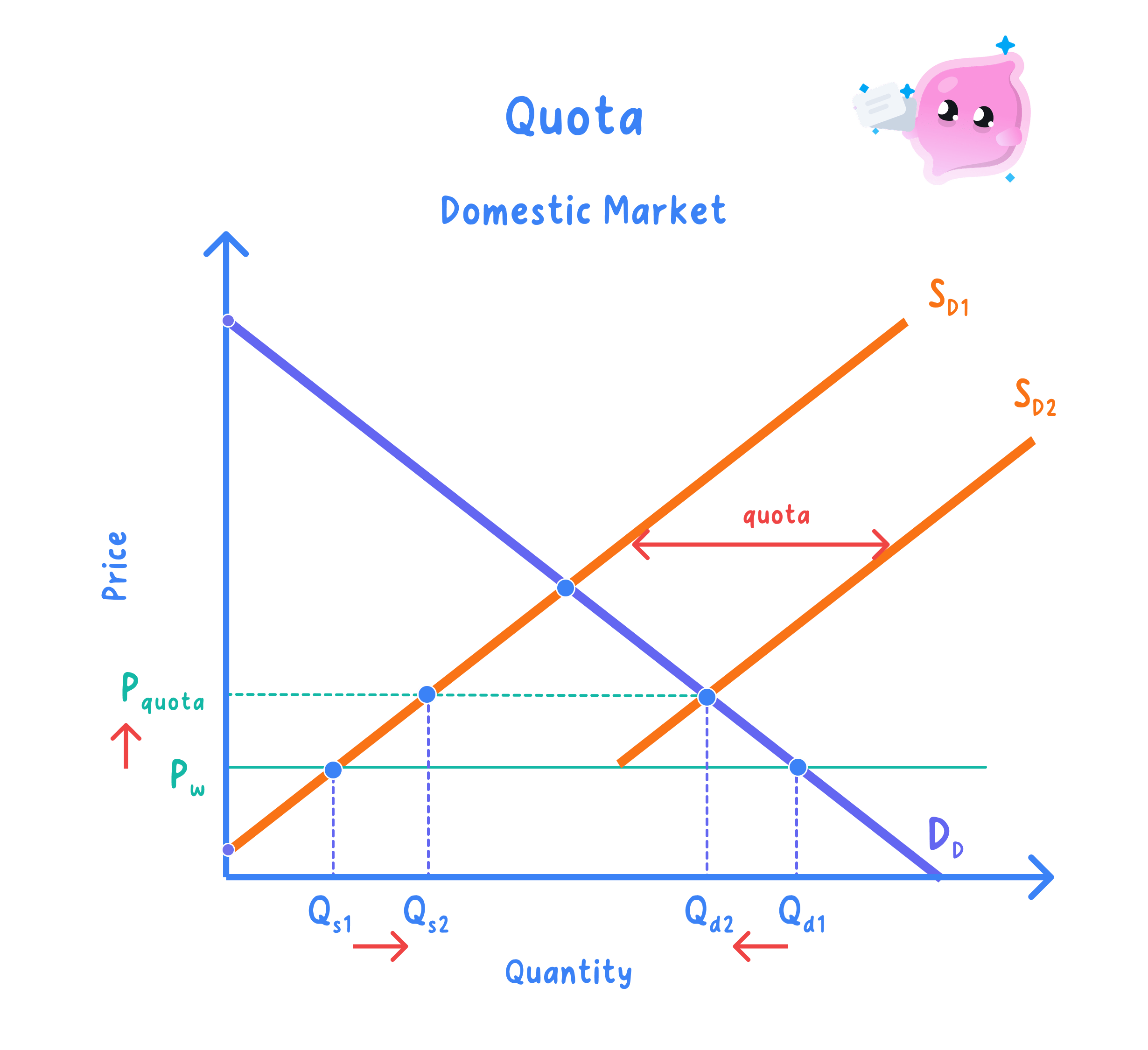
Quota: a physical limit on the quantity of a good that can be imported.
Subsidy to domestic producers: a payment that lowers home producers' costs so they can undercut imports.
Non-tariff barrier: any obstacle to imports other than a tax, such as regulations, standards, licensing, embargoes or administrative red tape.
If the world price of a good is £10 and a £2 tariff is added, the domestic price rises to £12, so imports fall and home output rises.
Pdomestic=Pworld+t=10+2=12 P_{domestic} = P_{world} + t = 10 + 2 = 12 Pdomestic=Pworld+t=10+2=12The government then collects the tariff on each unit still imported, so its revenue is the tariff rate times the imports that remain.
tariff revenue=t×Qimports \text{tariff revenue} = t \times Q_{imports} tariff revenue=t×Qimports- A quota limits volume but, unlike a tariff, raises no revenue for the government: the scarcity gain goes to whoever holds the import licences, as with the EU textile and clothing quotas under the former Multi Fibre Arrangement.
- Subsidies to domestic producers are common in agriculture, e.g. the EU Common Agricultural Policy (CAP) and US farm subsidies.
- Non-tariff barriers such as EU regulatory standards on food and chemicals, import licensing or embargoes like the long-standing US embargo on Cuba can block imports as effectively as a tax.
Impact of protection
- On a tariff diagram the world price is a horizontal line, and the tariff shifts it upward, raising the domestic price.
- Consumers lose, as they pay a higher price and buy less, cutting consumer surplus.
- Domestic producers gain, as they supply more at the higher price.
- The government gains tariff revenue equal to the tariff times the imports that remain, though a quota yields no such revenue.
- Two welfare triangles are lost as a deadweight welfare loss, so there is a net efficiency loss for the economy.
- Living standards can fall as prices rise, and sheltered producers may become less efficient over time.
- Effects on equality are mixed, as protected workers gain but higher prices hit poorer consumers hardest.
- Protection also risks retaliation and a trade war, as in the US-China tariff war from 2018 when US Section 301 tariffs met Chinese retaliation on soybeans, and the US Section 232 steel and aluminium tariffs that drew EU counter-tariffs.
Are tariffs ever justified?
- They can be justified because a genuine infant industry, dumping by foreign rivals, or a strategic sector may warrant temporary, targeted protection, and tariffs raise revenue for governments with weak tax systems.
- But tariffs create a deadweight welfare loss, raise prices for consumers, let protected firms grow inefficient, and invite retaliation that can shrink a country's own exports.
- On balance it depends on whether the protection is temporary and targeted at a real market failure, how trading partners respond, and whether a subsidy or supply-side policy would correct the problem at lower cost.
- Describe the tariff diagram in words: the higher price, lower imports, tariff revenue and the two deadweight loss triangles.
- Distinguish the tools, remembering a tariff raises revenue but a quota does not.
- Set each reason for protection against the free-trade reply and reach a supported judgement.
- Do not omit the deadweight welfare loss or confuse the revenue effect of a tariff with that of a quota.
- Do not assert the infant industry argument without noting that temporary protection is hard to remove once granted.
- Give two reasons for restricting free trade.
- What is a tariff and what is a quota?
- Name two non-tariff barriers.
- How does a tariff affect consumers, producers and the government?
- Why can protection reduce living standards?
