4.5.3a Deficits, national debt and stabilisers
Deficits and National Debt
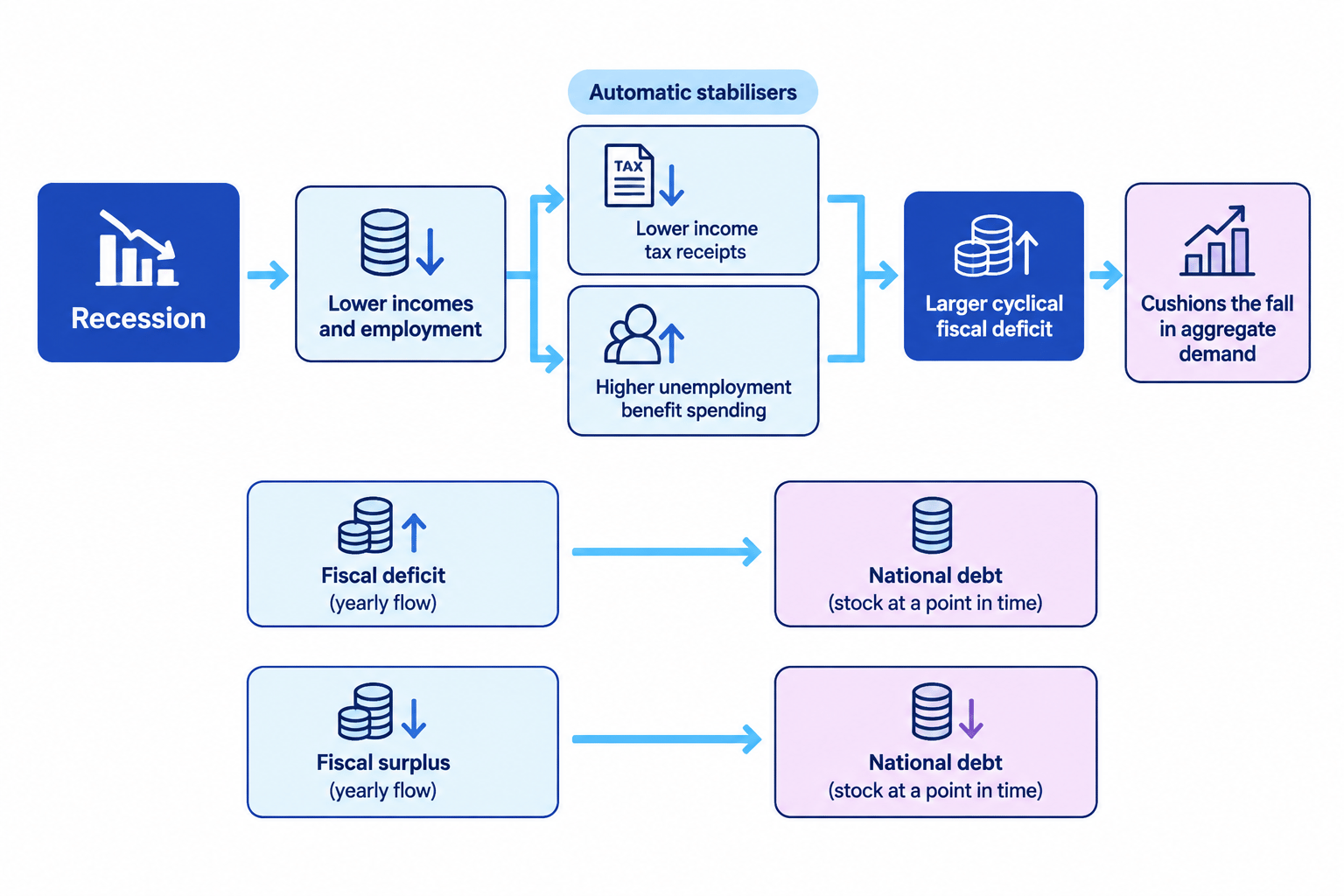
Fiscal deficit: the amount a government borrows in one year when its spending exceeds its tax revenue; a yearly flow.
National debt: the total stock of government borrowing built up over time; a stock at a point in time.
- Each year's deficit adds to the national debt, while a surplus reduces it.
- So a government can shrink its deficit yet still watch its debt rise, as long as it keeps borrowing.
- Both are usually expressed as a share of GDP, for example a deficit of 4%4\%4% of GDP or debt of 95%95\%95% of GDP, so they can be compared across countries and over time.
Suppose national debt is 2,700 and GDP is 2,800 (both in billions of pounds). The debt-to-GDP ratio is:
27002800×100≈96% \dfrac{2700}{2800} \times 100 \approx 96\% 28002700×100≈96%A ratio close to 100% is high by recent UK standards, yet far below Japan's, whose national debt exceeds 250% of GDP, showing why the ratio matters more than the cash amount.
Structural and Cyclical Deficits
Cyclical deficit: the part of a deficit that arises because output is below trend, with lower tax revenue and higher benefit spending in a downturn.
Structural deficit: the part of a deficit that remains even when output is at its trend level.
- The cyclical part shrinks as recovery raises tax revenue and cuts benefit spending.
- The structural part persists even at trend output, signalling that spending is set permanently above revenue and so needs tax rises or spending cuts to close.
- A deficit that shrinks as recovery raises tax revenue is cyclical.
- A deficit that persists even in a boom is structural.
- In the 2008 financial crisis UK borrowing jumped as a large cyclical deficit; the OBR later judged much of it structural, so austerity followed to close it.
- Greece entered the 2010 debt crisis with a large structural deficit, forcing severe spending cuts once its cyclical support faded.
Stabilisers and Discretionary Policy
Automatic stabilisers: built-in features of the tax and benefit system that dampen the economic cycle without any new government decision.
Discretionary fiscal policy: a deliberate change to government spending or taxation.
- In a recession taxes take less and benefit spending rises, cushioning demand automatically; in a boom the reverse restrains it.
- Discretionary policy needs a deliberate decision and works with time lags, so it can act too late.
- Unemployment benefit rises automatically in a downturn.
- Income tax receipts fall automatically when incomes fall.
- In the 2008 recession these automatic stabilisers, falling tax receipts and rising benefit payments, cushioned the drop in UK aggregate demand with no new decision needed.
- Keep the flow of yearly borrowing distinct from the stock of national debt.
- Attribute part of a deficit to the cycle and part to structure before judging it.
- Do not confuse a fiscal deficit with the national debt, since one is a flow and the other a stock.
- Do not describe automatic stabilisers as deliberate actions, since they are built-in and self-acting.
- Distinguish a fiscal deficit from the national debt.
- Distinguish a cyclical deficit from a structural deficit.
- What are automatic stabilisers?
- What is discretionary fiscal policy?
- How does each year's deficit affect the national debt?
4.5.3b Influences on and significance of deficits and debt
Deficits and Debt
Fiscal deficit: the amount a government borrows in one year when spending exceeds tax revenue; a flow.
National debt: the accumulated stock of past government borrowing.
Debt-to-GDP ratio: the national debt expressed as a percentage of GDP, used to compare debt across countries and over time.
Factors Influencing Fiscal Deficits
- The trade cycle is a major influence, since recessions raise a cyclical deficit through lower tax revenue and higher benefit spending.
- Discretionary policy choices, such as tax cuts or higher spending, widen the deficit.
- One-off shocks such as financial crises, pandemics or wars raise government borrowing sharply.
- An ageing population and rising health and pension costs raise the structural deficit over time.
Factors Influencing the National Debt
- The national debt rises whenever the government runs a fiscal deficit, so it reflects the sum of past deficits, while a surplus reduces it.
- The debt-to-GDP ratio can fall even while a deficit continues, provided nominal GDP grows faster than the debt.
- The interest rate on debt matters, since higher rates raise servicing costs and add to borrowing.
- Inflation can erode the real value of existing debt.
Suppose national debt is 2,000 and nominal GDP is 2,500 (both in billions of pounds), so the ratio is 80%. The next year the government still borrows, lifting debt to 2,100, but nominal GDP grows to 2,700. The new ratio is:
21002700×100≈78% \dfrac{2100}{2700} \times 100 \approx 78\% 27002100×100≈78%The ratio falls from 80% to about 78% despite the continuing deficit, because nominal GDP grew faster than the debt; this is how many countries reduce their debt burden without ever running a surplus.
Significance of Deficits and Debt
- Large deficits and debt raise interest payments, which have an opportunity cost in lost spending elsewhere.
- Very high debt can risk a credit-rating downgrade and higher borrowing costs.
- There are questions of fairness between generations, since future taxpayers service today's debt.
- But borrowing to fund productive investment can raise future output, so a rising debt is not automatically harmful.
- UK debt rose above 80%80\%80% of GDP after the 2008 crisis and passed 100%100\%100% after the Covid-19 pandemic.
- The OBR and IMF assess whether a country's debt is on a sustainable path.
- Japan's debt exceeds 250% of GDP yet stays manageable because most is held domestically at very low interest rates, showing high debt need not trigger a crisis.
- Greece's debt above 180% of GDP triggered a bailout and severe austerity from 2010, showing the risk when lenders lose confidence.
Should a government cut its fiscal deficit?
- It can help because cutting the deficit slows debt growth, reduces interest payments and reassures lenders, lowering the risk of higher borrowing costs.
- But cutting spending or raising taxes in a downturn lowers AD, which can deepen a recession, widen the cyclical deficit and prove self-defeating.
- If the borrowing funds productive investment such as infrastructure, it can raise future output and partly pay for itself, so cutting it may sacrifice growth.
- On balance it depends on the state of the cycle, whether the deficit is structural or cyclical, the debt-to-GDP ratio and what the borrowing finances.
- Judge deficits and debt relative to GDP, not in cash terms alone.
- Weigh the cost of borrowing against the return on what it funds.
- Do not assume any rise in the national debt is automatically harmful, since it depends on what the borrowing finances.
- Do not treat the cyclical part of a deficit as a lasting problem, since it fades as the economy recovers.
- Give two factors that influence the size of a fiscal deficit.
- Give two factors that influence the size of the national debt.
- How can the debt-to-GDP ratio fall even when there is a deficit?
- Why are large deficits and debt significant?
- Why is a rising national debt not automatically harmful?