1.1.4a Uses of production possibility frontiers
The Production Possibility Frontier
Production possibility frontier (PPF): a curve showing the maximum combinations of two goods an economy can produce when all its resources are used fully and efficiently.
- It is drawn with one good on each axis, for example capital goods against consumer goods, and usually curves outwards, concave to the origin.
- Its power is capturing scarcity, choice and opportunity cost in a single picture: the trade-off is built into the shape of the curve itself.
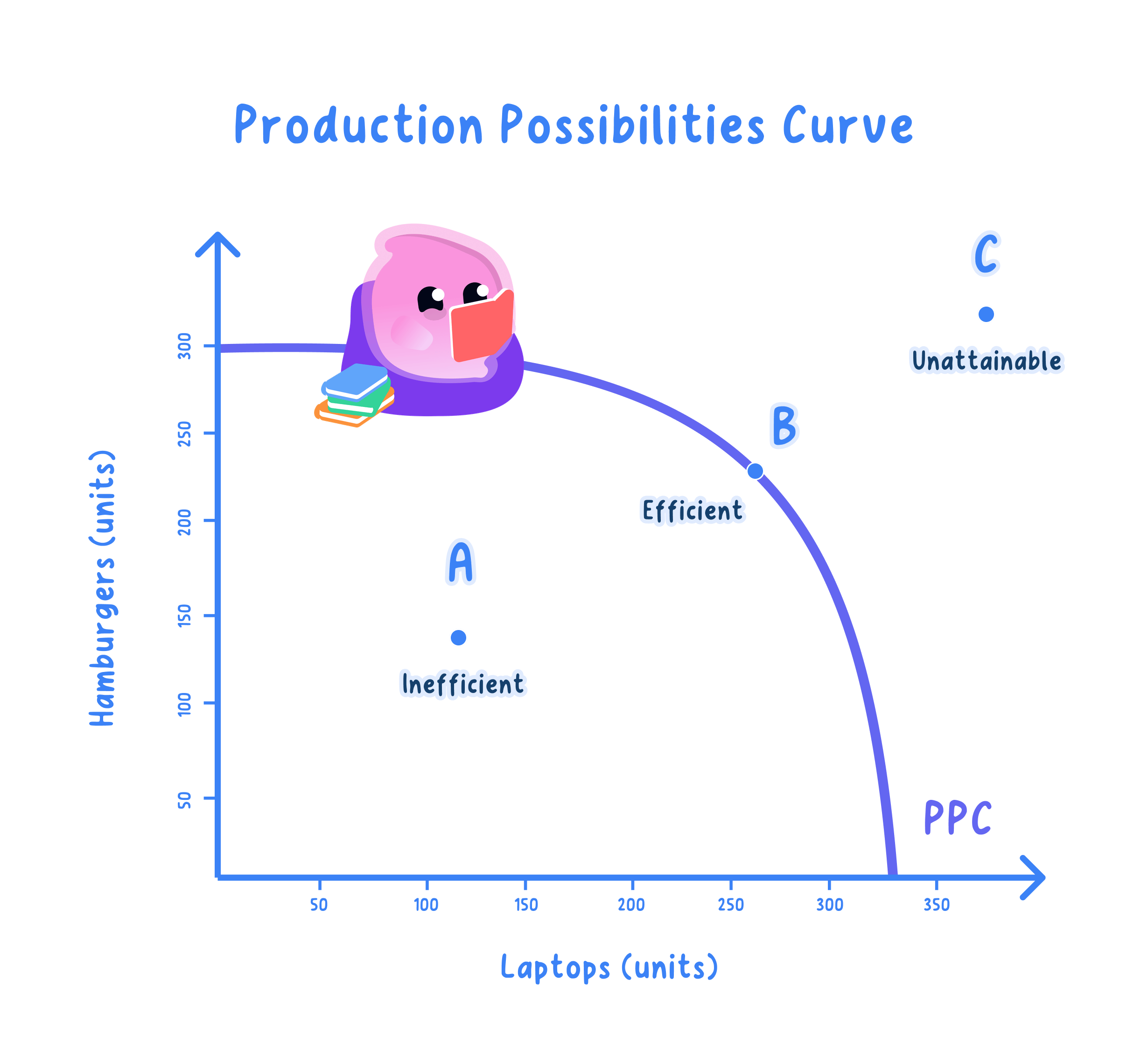
Points On, Inside and Outside
- Any point on the PPF shows the economy at its maximum productive potential, using all resources fully and efficiently.
- At such a point more of one good can only be made by producing less of the other.
- A point inside the curve shows an inefficient allocation of resources, with factors unemployed or underused.
- The economy could produce more of both goods, so output is being wasted.
- A point outside the curve is currently unobtainable with existing resources and technology.
- It could only be reached after economic growth shifts the frontier outwards.
- In a deep recession, such as the UK in 2008-09 or during the 2020 Covid-19 lockdown, factories stand idle and workers are unemployed, so the economy sits inside its PPF.
- As those idle resources are brought back into use, output rises towards the frontier without any new investment.
Opportunity Cost
Opportunity cost: the next best alternative given up when a choice is made; on the PPF it is the quantity of one good sacrificed to produce more of the other.
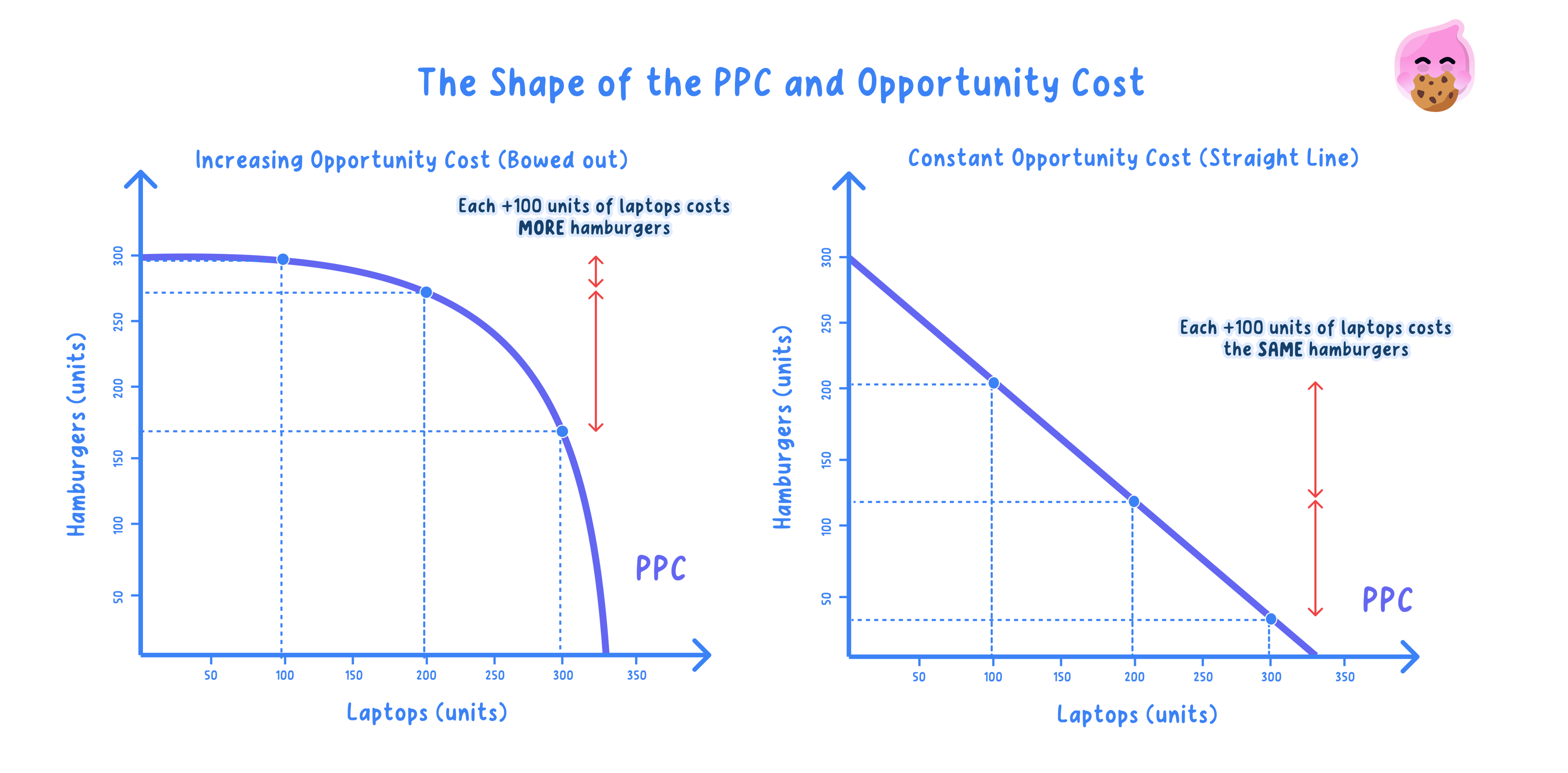
- Because the curve is concave, opportunity cost rises as more of one good is produced.
- Resources are not equally suited to both goods, so switching them becomes increasingly costly.
- Marginal analysis reads this as the extra amount of one good sacrificed for each additional unit of the other.
- Imagine switching a country's resources from growing food to building cars.
- The workers moved first are those least suited to farming, but as the switch continues even skilled farmers must move, so each extra car costs more food than the last.
Economic Growth or Decline
Economic growth: an increase in an economy's productive potential, shown by an outward shift of the whole PPF.
Economic decline: a fall in productive potential, shown by an inward shift of the whole PPF.
- Growth can come from more or better resources, such as investment, a larger workforce or improved technology.
- Decline can follow a natural disaster, a shrinking workforce or the depletion of key resources.
- A move from inside the curve towards it is a recovery using spare capacity, not growth, because potential is unchanged.
Is the PPF a realistic model?
- It holds because it captures scarcity, choice and opportunity cost more clearly than almost any other model, all in a single diagram.
- But it simplifies to just two goods and assumes resources and technology are fixed, which is only true at a single point in time.
- But it shows what an economy can produce, not what it should produce, since that depends on society's value judgements.
- On balance, its usefulness depends on treating it as a snapshot: it is a powerful analytical tool, but it must not be read as a forecast or a policy recommendation.
- Describe the axes and the concave shape in words before analysing any point or shift.
- Distinguish a movement along the curve, which reallocates resources, from a shift of the curve, which changes potential.
- Link every point back to scarcity, choice and opportunity cost to earn the analysis marks.
- Do not confuse a move from inside the curve to the curve with economic growth.
- That is a recovery using spare capacity, whereas growth is an outward shift of the whole frontier.
- Do not assume opportunity cost is constant along the PPF.
- The concave shape means opportunity cost rises as more of one good is produced.
- Do not treat points outside the current curve as achievable now.
- They stay unobtainable until the frontier shifts outwards.
- What does a point on, inside and outside the PPF each show?
- How does the PPF illustrate opportunity cost?
- Why does the PPF usually curve outwards?
- What is the difference between an outward shift and a movement towards the curve?
- Give two causes of an outward shift in the PPF.
1.1.4b Movements along and shifts in the PPF
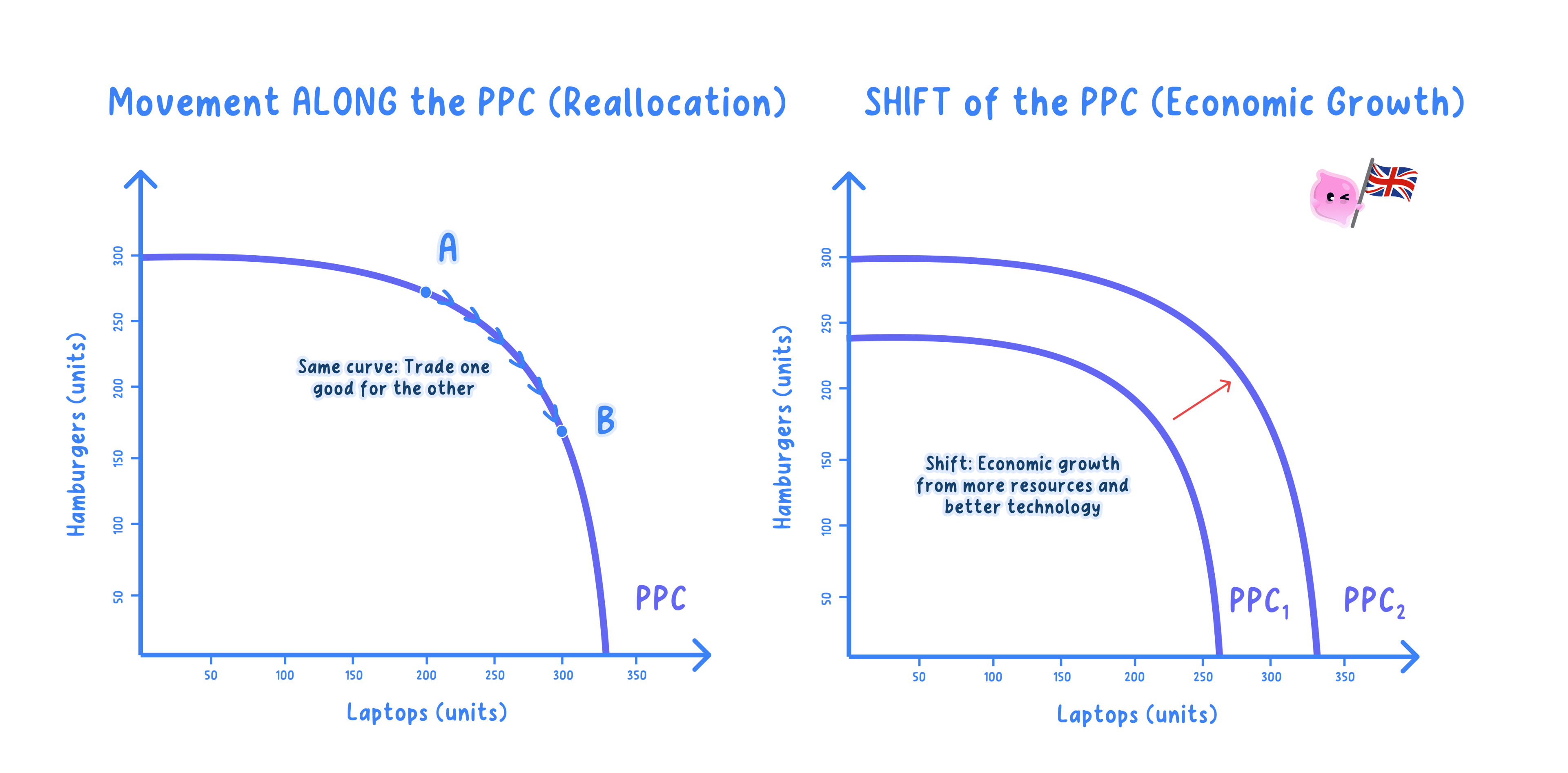
Movements and Shifts
Movement along the PPF: a reallocation of existing resources between the two goods, which carries an opportunity cost.
Shift of the PPF: a change in the position of the whole frontier that alters the economy's total productive capacity.
- An outward shift represents economic growth, while an inward shift represents decline.
- The key contrast is that a movement changes only what the economy chooses to make, whereas a shift changes what it is capable of making at all.
Causes of Shifts
- More resources shift the frontier outward.
- A larger workforce, more capital or newly discovered raw materials all raise capacity.
- Better quality resources also shift the frontier outward.
- Improved technology, education and higher productivity let the same resources produce more.
- Loss of resources shifts the frontier inward.
- Natural disasters, war or a falling workforce reduce what the economy can produce.
- An outward shift raises potential capacity, not just short-run output.
- Choosing capital goods over consumer goods today is a key way to shift the frontier out over time.
Significance of the Distinction
- It separates a reallocation of resources from a genuine change in capacity.
- It shows growth as an expansion of what is possible, not just producing more within current limits.
- It links the micro PPF to the macro idea of long-run growth.
- When firms invest in new machinery and the workforce grows, the UK's productive capacity rises and the PPF shifts outward.
- By contrast, the COVID-19 pandemic in 2020 pushed the economy well inside its frontier as workplaces closed, without moving the frontier itself.
Does an outward shift always raise living standards?
- It holds because a larger frontier means more can be produced, which usually supports higher living standards.
- But it depends on whether the extra capacity is actually used, since an economy can still operate inside the frontier.
- But it also depends on the mix: growth in goods people do not value, or in capital goods that sacrifice today's consumption, may not raise welfare now.
- On balance, whether a shift improves living standards depends on both using the new capacity and producing the goods people actually want.
- State clearly whether you are describing a movement along or a shift of the curve.
- For a shift, give a specific cause, such as investment or a change in the workforce.
- Link an outward shift to a rise in productive potential, not a short-run rise in output.
- Do not describe growth as a movement along the PPF.
- Growth is an outward shift of the whole frontier, not a reallocation within it.
- Do not assume an outward shift means output actually rises.
- Capacity rises, but the economy may still produce inside the new frontier.
- What is the difference between a movement along and a shift of the PPF?
- Give two causes of an outward shift.
- Give one cause of an inward shift.
- Why does an outward shift represent growth in capacity rather than output?
- Does an outward shift guarantee higher living standards? Explain.
1.1.4c Capital and consumer goods
Capital and Consumer Goods
Consumer goods: goods bought for final satisfaction, such as food and clothing.
Capital goods: man-made aids used to produce other goods, such as machines and factories.
- The balance an economy strikes between the two shapes its future growth: more capital today means more of everything tomorrow.
- The link runs through the PPF: producing more capital goods now pushes the whole frontier outward later.
The Trade-Off
- Choosing consumer goods raises living standards today.
- It does little for future capacity, because it does not expand the economy's ability to produce.
- Choosing capital goods sacrifices some consumption now but expands future production.
- More capital goods today shift the whole PPF outward in the future.
- A country that builds factories and trains workers now can produce more of everything later.
- The opportunity cost is the consumer goods given up in the present.
- A baker's industrial oven and a builder's crane are capital goods; a loaf of bread and a family's groceries are consumer goods.
- The same item can be either, depending on use: a car bought by a household is a consumer good, but the identical car bought by a driving school is a capital good.
Capital and Long-Run Growth
- Capital goods raise productivity, so each worker can produce more.
- Higher productivity expands the economy's productive capacity over time.
- This is why investment in capital is central to long-run economic growth.
- Choosing capital goods over consumer goods is like a farmer keeping back some grain as seed rather than eating the whole harvest.
- Eating less now means a larger harvest next year, just as investing in machines means more output in the future.
Is more capital always better?
- It holds because investing in capital raises future output and productivity, expanding what the economy can produce.
- But it reduces consumption today, which may be painful if incomes are already low.
- But the gain depends on the quality of the investment, since poorly chosen capital adds little.
- On balance, the right amount depends on striking a balance, because an economy that never consumes gains nothing from its extra capacity.
- Frame the choice as consumption now against capacity later.
- Show more capital goods shifting the PPF outward in a future period.
- Identify the opportunity cost as the consumer goods sacrificed today.
- Do not confuse capital goods with money.
- Capital goods are physical aids to production, not finance.
- Do not assume choosing capital goods raises output immediately.
- The gain comes later, once the extra capacity is put to use.
- What is the difference between capital goods and consumer goods?
- What is the opportunity cost of producing more capital goods?
- How does producing more capital goods affect the future PPF?
- Why are capital goods important for growth?
- Give one reason more capital is not always better.
