1.4.1a Taxation, subsidies and price controls
Correcting Market Failure
- The purpose of intervention is to correct market failure and move output closer to the social optimum.
- The main price-based tools are indirect taxes, subsidies, and maximum and minimum prices.
Indirect Taxation
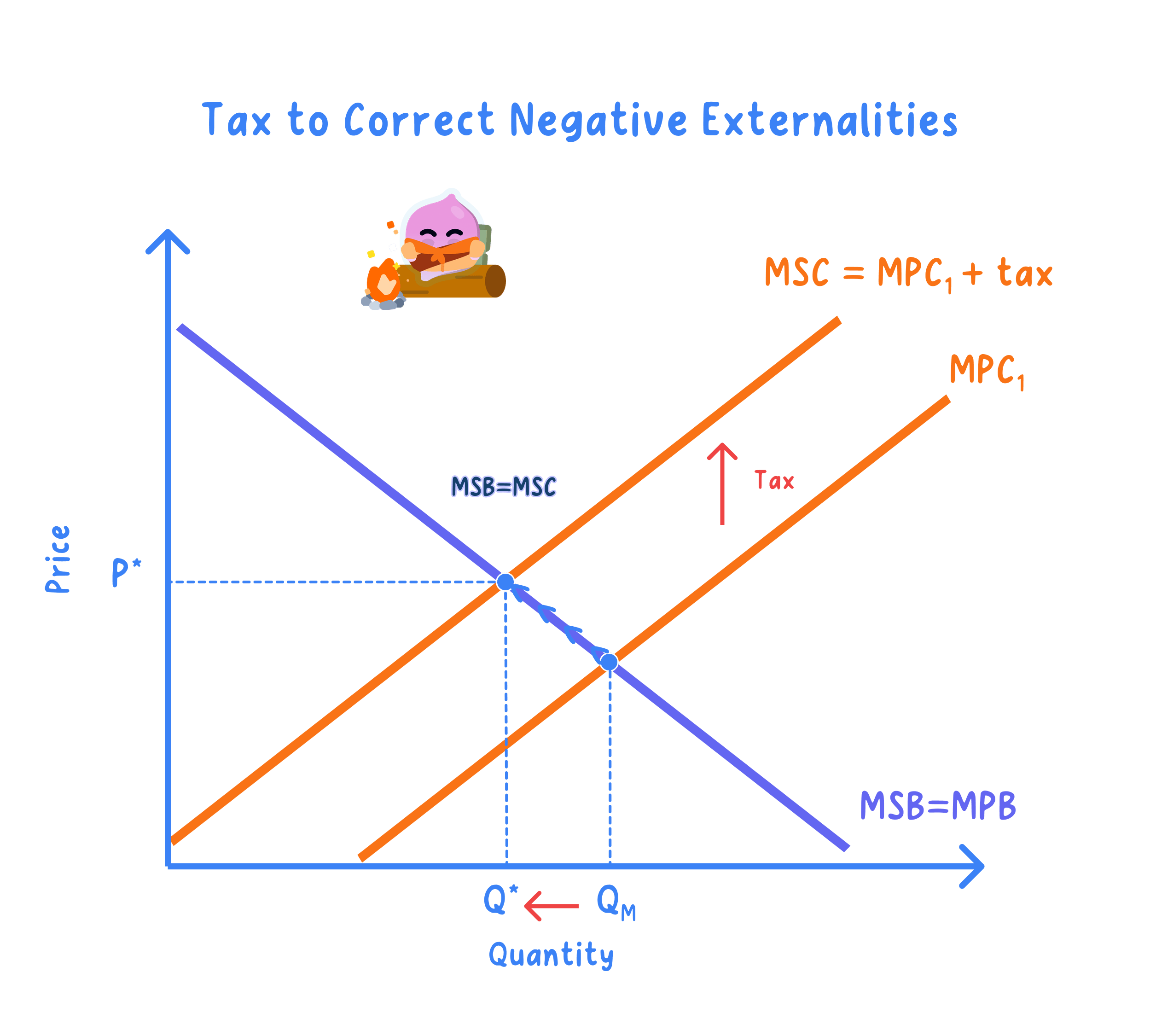
Indirect tax: a tax on spending that raises firms' costs and shifts the supply curve up and to the left.
Specific tax: a fixed amount per unit, so supply shifts up by the same distance at every quantity (a parallel shift).
Ad valorem tax: a percentage of the price, so the gap widens as price rises and the supply curve pivots, as with VAT.
- An indirect tax raises the price and lowers the quantity, so consumers face more of the external cost and output moves toward the social optimum.
- The government raises tax revenue equal to the tax per unit multiplied by the quantity sold.
- The more inelastic demand is, the more of the tax burden falls on consumers rather than producers.
- The Soft Drinks Industry Levy (sugar levy, collected by HMRC) and fuel duty are specific taxes aimed at cutting consumption of demerit goods with external costs.
- VAT is an ad valorem tax charged as a percentage of the selling price.
A specific sugar levy of £0.24 per litre is placed on a high-sugar drink.
If 500 million litres are still sold, tax revenue is:
0.24×500,000,000=120,000,000 0.24 \times 500{,}000{,}000 = 120{,}000{,}000 0.24×500,000,000=120,000,000so the government collects £120 million.
Subsidies
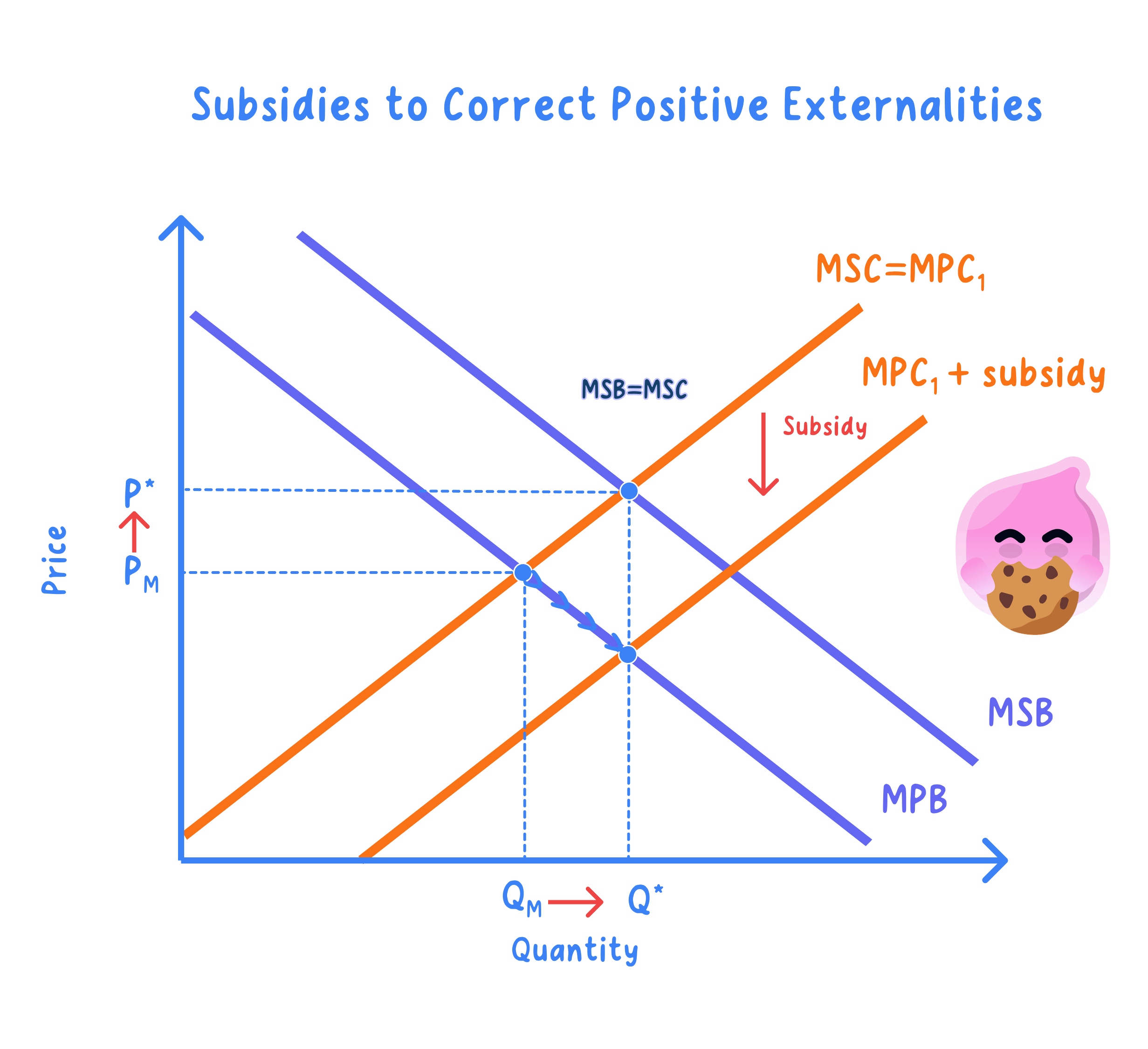
Subsidy: a payment to producers that lowers their costs and shifts the supply curve down and to the right.
- A subsidy lowers price and raises quantity, encouraging consumption of goods with external benefits or merit goods.
- The cost to the government equals the subsidy per unit multiplied by the quantity.
- How far the price falls for consumers depends on the elasticity of demand.
- Subsidies for public transport and renewable energy lower prices and raise take-up.
- Free state provision of vaccination tackles under-consumption of a merit good with external benefits.
Maximum and Minimum Prices
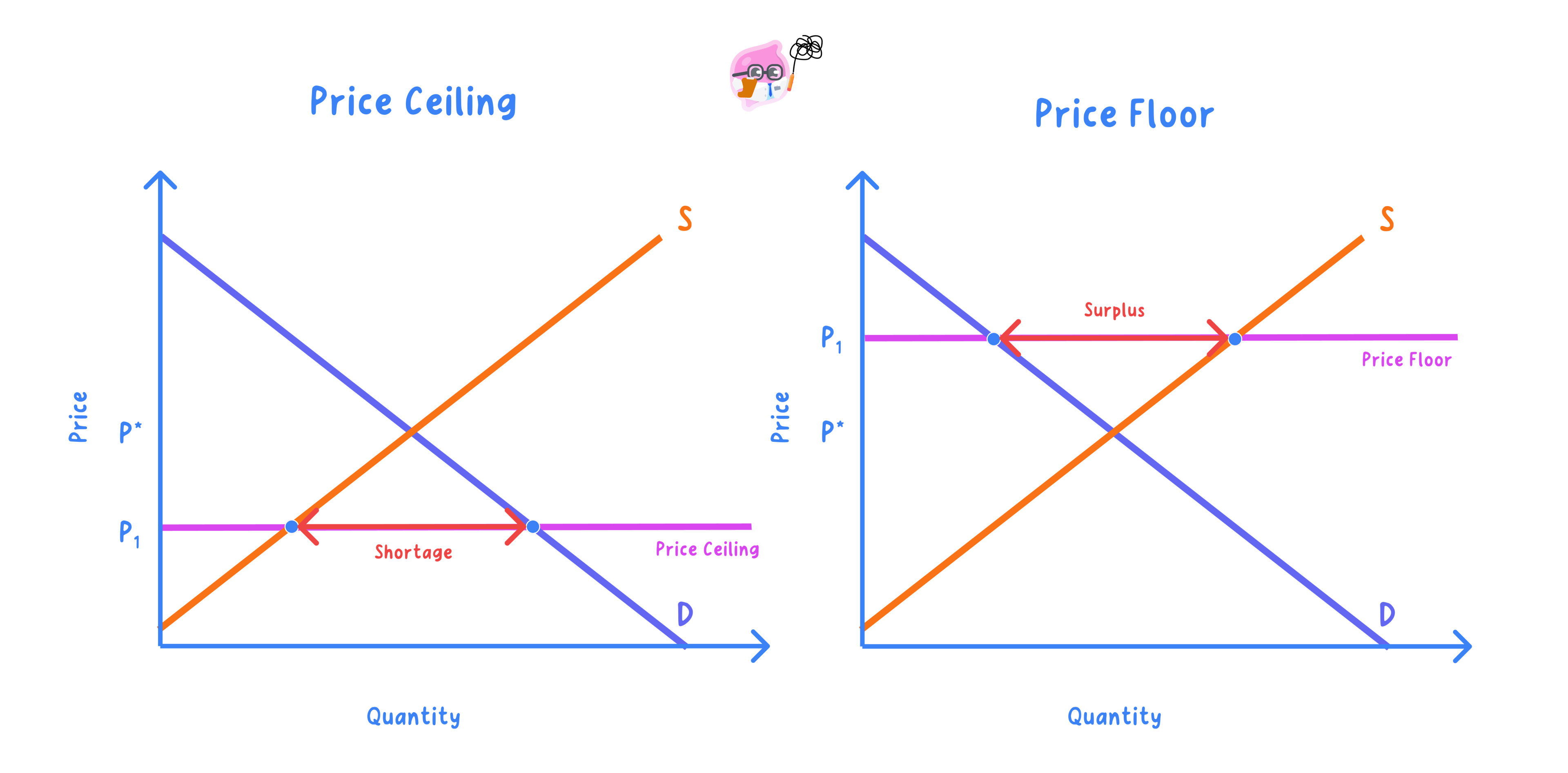
Maximum price: a legal price ceiling; it only bites if set below the equilibrium price.
Minimum price: a legal price floor; it only bites if set above the equilibrium price.
- A maximum price set below equilibrium makes demand exceed supply, causing a shortage.
- Shortages can lead to queues, rationing and black markets.
- A minimum price set above equilibrium makes supply exceed demand, causing a surplus.
- The government or another buyer may have to purchase the surplus, as seen with the minimum unit price on alcohol and the National Living Wage.
- Rent controls are a maximum price that holds rents down but leaves a housing shortage.
- Scotland's minimum unit price on alcohol is a minimum price set above equilibrium, aimed at cutting consumption of a demerit good.
Do indirect taxes solve market failure?
- It holds because a well-set tax internalises the external cost, raises price towards the social optimum and cuts the harmful quantity, while raising revenue that can fund further correction.
- But if demand is price-inelastic, as with cigarettes or fuel, quantity barely falls, so the tax mainly raises revenue rather than curing the failure.
- But governments struggle to value the externality precisely, so the tax may be set too high or too low, and it can be regressive, hitting poorer households hardest.
- On balance, whether an indirect tax solves the failure depends on the elasticity of demand, the accuracy of the valuation and whether it is combined with measures such as information or regulation.
- On a supply and demand diagram, shift supply left for a tax and right for a subsidy, and shade the tax revenue or subsidy cost.
- Draw a maximum price below equilibrium and a minimum price above it, then mark the shortage or surplus.
- Match the instrument to the market failure and note its cost to set up evaluation.
- A subsidy shifts supply, not demand.
- Do not draw a maximum price above equilibrium or a minimum price below it, as neither would then have any effect.
- A ceiling causes a shortage while a floor causes a surplus, so do not confuse the two.
- What is the difference between a specific tax and an ad valorem tax?
- How does an indirect tax move output toward the social optimum?
- How does a subsidy affect price and quantity?
- Where must a maximum price be set, and what does it cause?
- Where must a minimum price be set, and what does it cause?
1.4.1b Other methods of intervention
Tradable Pollution Permits
Tradable pollution permit: a licence to emit a set amount of pollution that firms can buy and sell.
Cap and trade: the government caps total emissions and lets firms trade permits, putting a market price on pollution.
- A tradable pollution permit scheme caps total emissions and issues permits that firms can buy and sell.
- Firms that cut emissions cheaply can sell spare permits, while heavy polluters must buy more.
- This puts a price on pollution and gives every firm an incentive to produce more cleanly.
- The UK Emissions Trading Scheme (UK ETS) caps carbon emissions and lets firms trade allowances, putting a price on the negative production externality of pollution.
State Provision
State provision: the government supplying a good directly, funded by taxation, rather than leaving it to the market.
- The government provides public goods directly, funded by taxation, because the free-rider problem otherwise leaves a missing market.
- It can also provide merit goods to raise their consumption toward the social optimum.
- National defence and street lighting are public goods (non-rival and non-excludable) provided directly by the state.
- The NHS and state education tackle the under-consumption of merit goods with positive externalities.
Provision of Information
Provision of information: government action to close information gaps, such as labelling and campaigns, so people can judge true costs and benefits.
- The government provides information to close information gaps and help people judge the true costs and benefits.
- Better-informed consumers are more likely to reach the socially optimal level of consumption.
- Calorie labelling, cigarette health warnings and anti-smoking campaigns supply information to correct over-consumption of demerit goods.
- After the PPI mis-selling scandal, the FCA required clearer disclosure so buyers face less asymmetric information.
Regulation
Regulation: rules that require or ban behaviour, backed by penalties for breaking them.
- Regulation sets rules that require or ban behaviour, backed by penalties for breaking them.
- It can force output toward the social optimum, but needs monitoring and enforcement to work.
- Examples include emissions limits, minimum age laws for alcohol and bans on harmful products.
Is regulation better than market-based tools for cutting pollution?
- It holds because regulation sets a firm limit that is simple to understand and, when properly enforced, guarantees a change in behaviour.
- But it needs costly monitoring and enforcement, and a uniform rule ignores that firms can cut pollution at very different costs, so it can be inefficient.
- But market-based tools such as permits or a carbon tax let cuts happen where they are cheapest and keep giving firms an incentive to go greener, provided the price or cap is set accurately.
- On balance, the best choice depends on how measurable the pollution is, the cost of enforcement and the risk of government failure in setting the rule, tax or cap.
- Match each method to the market failure it best addresses.
- Note the cost or enforcement problem of each method to set up your evaluation.
- A permit scheme caps the quantity of pollution, whereas a tax sets a price on it.
- Regulation without effective enforcement will not change behaviour.
- How does a tradable pollution permit scheme reduce emissions?
- Why does the state provide public goods directly?
- How does provision of information correct market failure?
- What is regulation and what does it need to work?