1.3.2a Private, external and social costs and benefits
Costs and Benefits
Private cost: the cost of an activity that falls on the decision maker, such as a firm's wages and raw materials.
External cost: a cost that spills over onto third parties who are not part of the transaction, such as pollution from a factory.
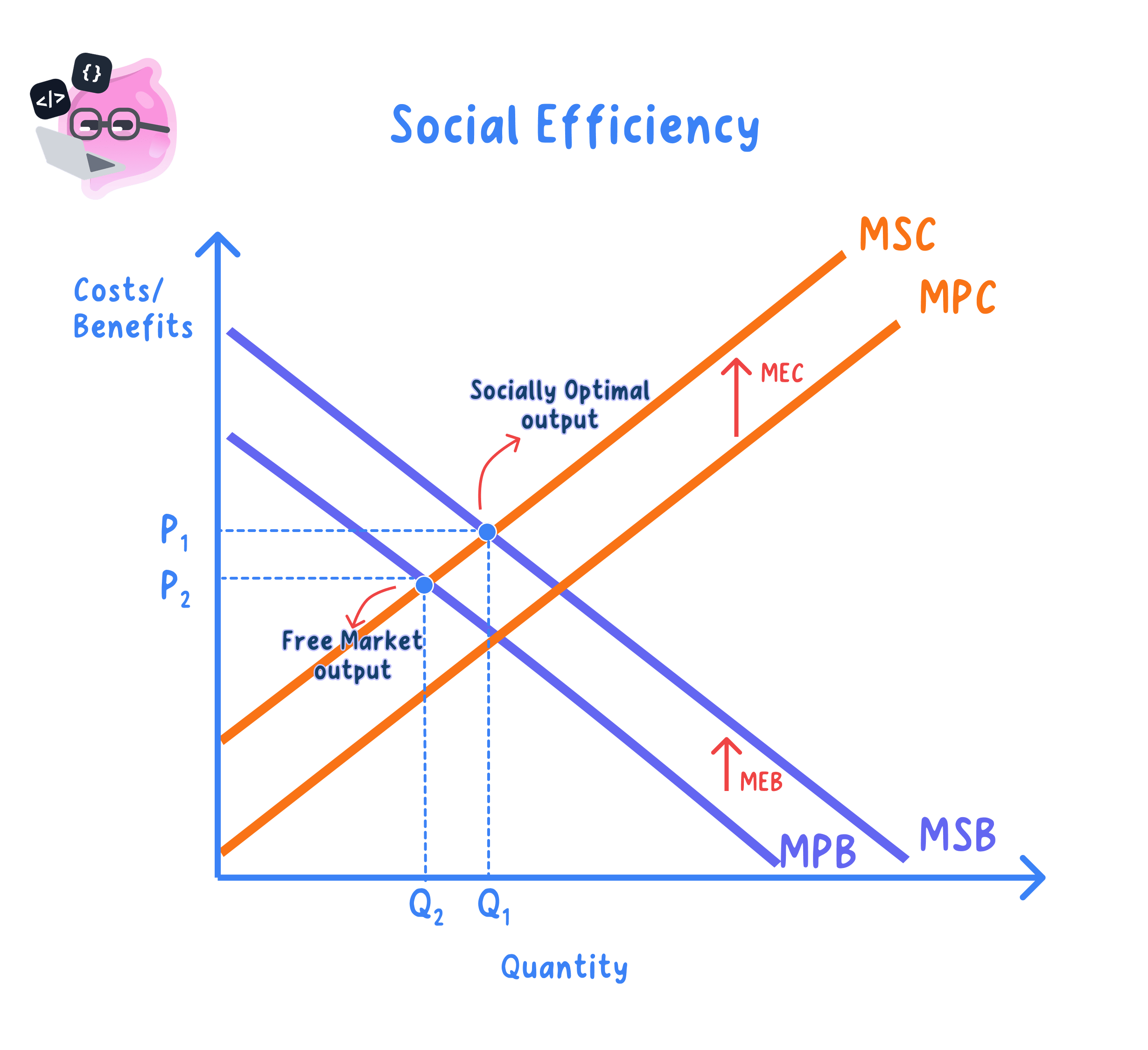
Social cost: the total cost of an activity to society, equal to private cost plus external cost.
- A firm bases its decisions on its private cost alone and ignores any external cost it imposes on others.
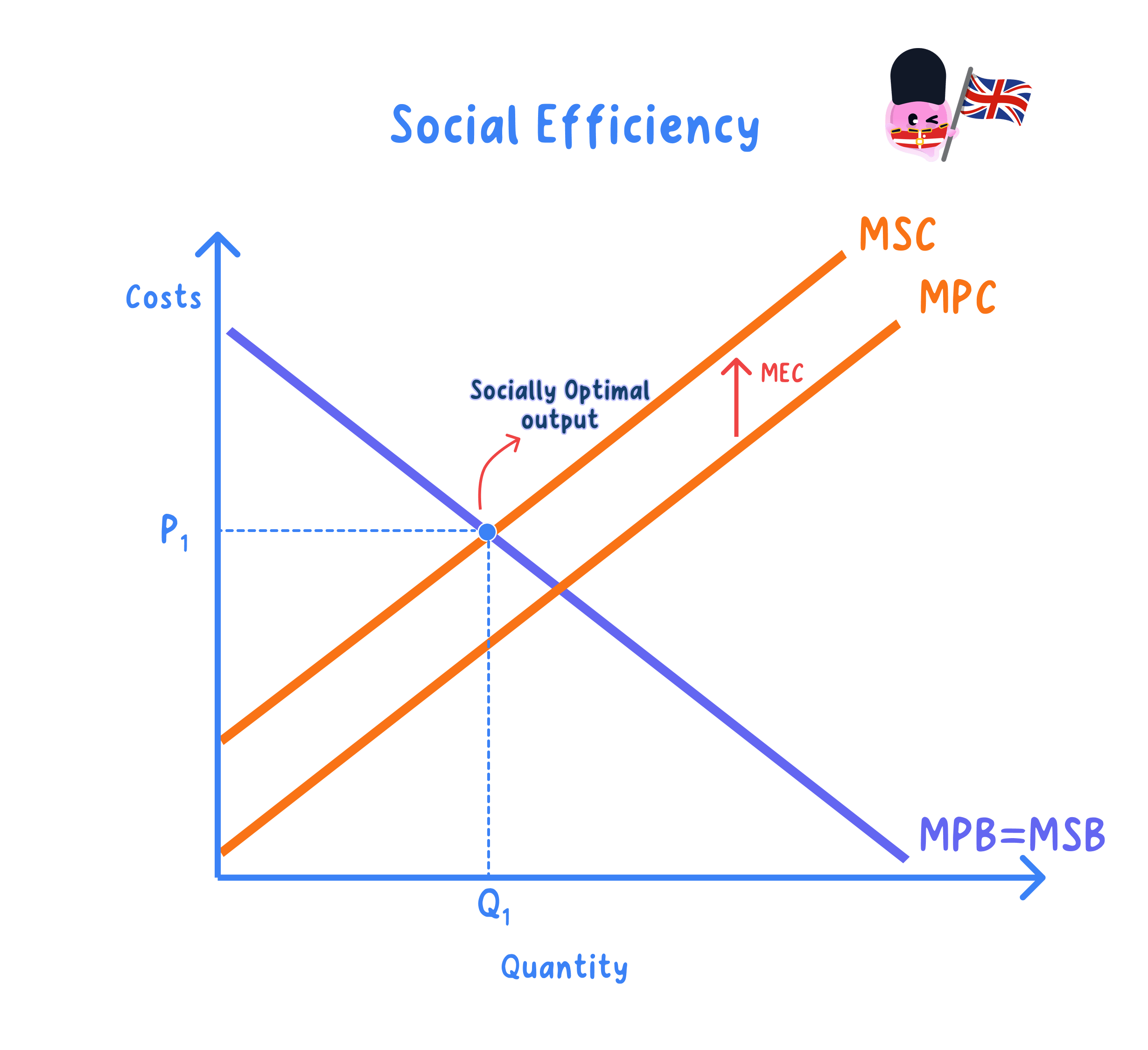
- Whenever an external cost exists, social cost exceeds private cost, so the true cost to society is higher than the firm accounts for.
- A factory polluting a river is a negative production externality: its private cost is wages and materials, while the external cost is the pollution borne by nearby residents.
- The social cost of the factory's output is the two added together, so social cost lies above private cost.
Private, External and Social Benefits
Private benefit: the benefit of an activity enjoyed by the decision maker who produces or consumes the good.
External benefit: a benefit that spills over to third parties, such as the lower infection risk when someone is vaccinated.
Social benefit: the total benefit to society, equal to private benefit plus external benefit.
- A consumer values only the private benefit they personally gain and ignores any external benefit enjoyed by others.
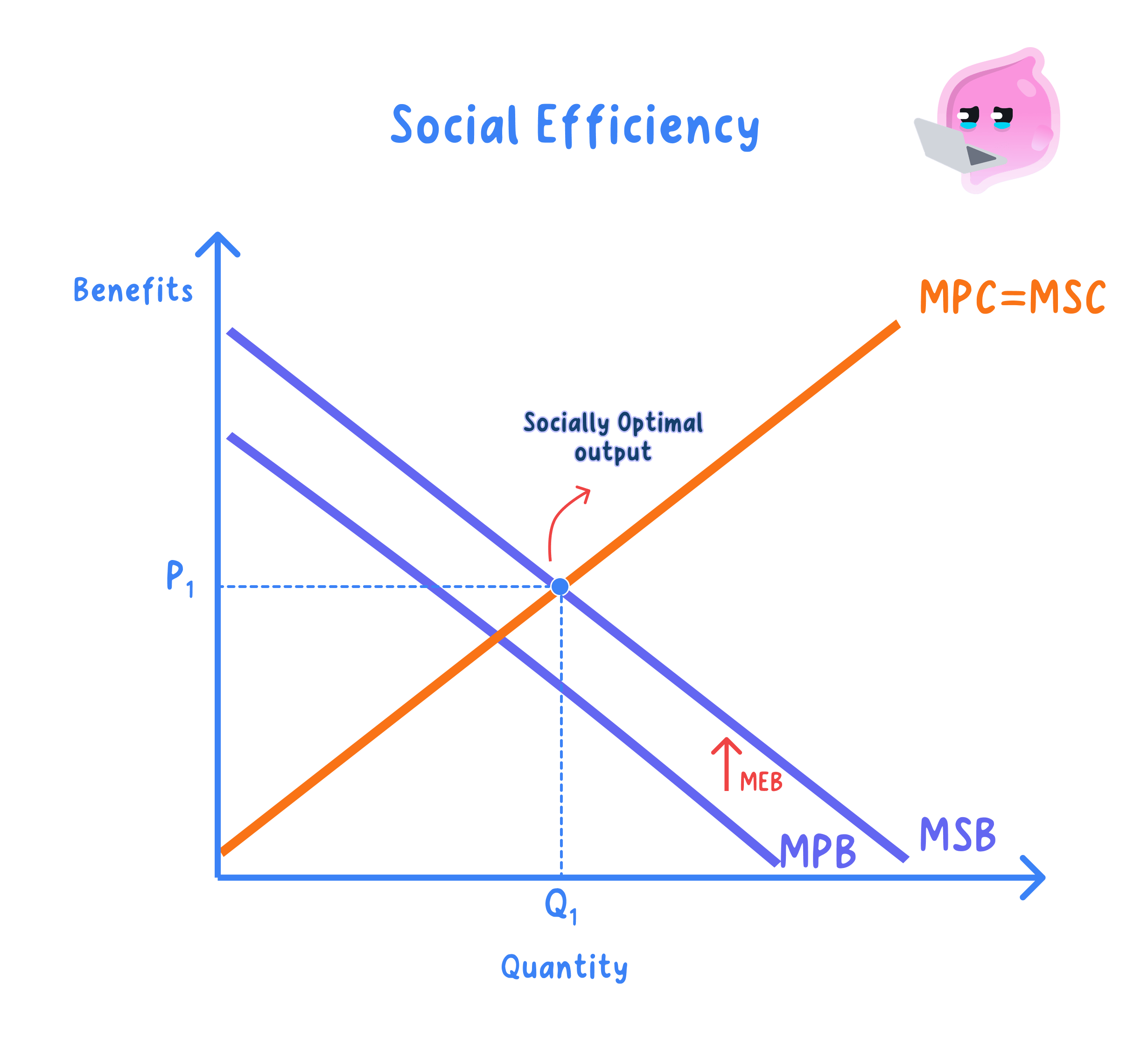
- Whenever an external benefit exists, social benefit exceeds private benefit, so society values the good more highly than the individual does.
- In the UK the MMR vaccination is provided free through the NHS.
- Each person vaccinated lowers the infection risk for others, an external benefit to the community.
- This herd immunity, a positive consumption externality, is why the government funds vaccination rather than leaving the market to under-provide this merit good.
Marginal Analysis and the Social Optimum
Marginal social cost (MSC): the cost to society of producing one more unit, equal to marginal private cost plus marginal external cost.
Marginal social benefit (MSB): the benefit to society from one more unit, equal to marginal private benefit plus marginal external benefit.
Social optimum: the output where marginal social benefit equals marginal social cost, so society's welfare is maximised.
- Decision makers equate their own marginal private cost and benefit, so the free market settles where MPB = MPC.
- Because they ignore the external element, this private equilibrium diverges from the social optimum where MSB = MSC.
- The gap between the private and social positions is exactly the externality, and it is the source of the welfare loss.
- Always build the social figure from the private one by adding the external cost or benefit.
- State whether the externality is a cost or a benefit and who the third party is.
- Work in marginal terms when a question gives a cost or benefit per unit.
- Do not treat social cost as separate from private cost, since social cost is private cost plus external cost.
- Do not confuse an external cost with an external benefit, as one harms third parties and the other helps them.
- Do not assume decision makers consider external effects, because they act on private costs and benefits only.
- What is an external cost?
- How is social cost calculated?
- What is the difference between private benefit and social benefit?
- What does marginal social benefit equal?
- Why does the market outcome differ from the social optimum?
1.3.2b Diagrams of external costs and benefits
External Cost Diagrams
Marginal private cost (MPC): the cost to the producer of making the last unit; on the diagram this is the market supply curve.
Marginal social cost (MSC): the full cost to society of the last unit, equal to marginal private cost plus the marginal external cost.
Welfare loss: the net loss of welfare from the units where marginal social cost exceeds marginal social benefit, shown as a triangle on the diagram.
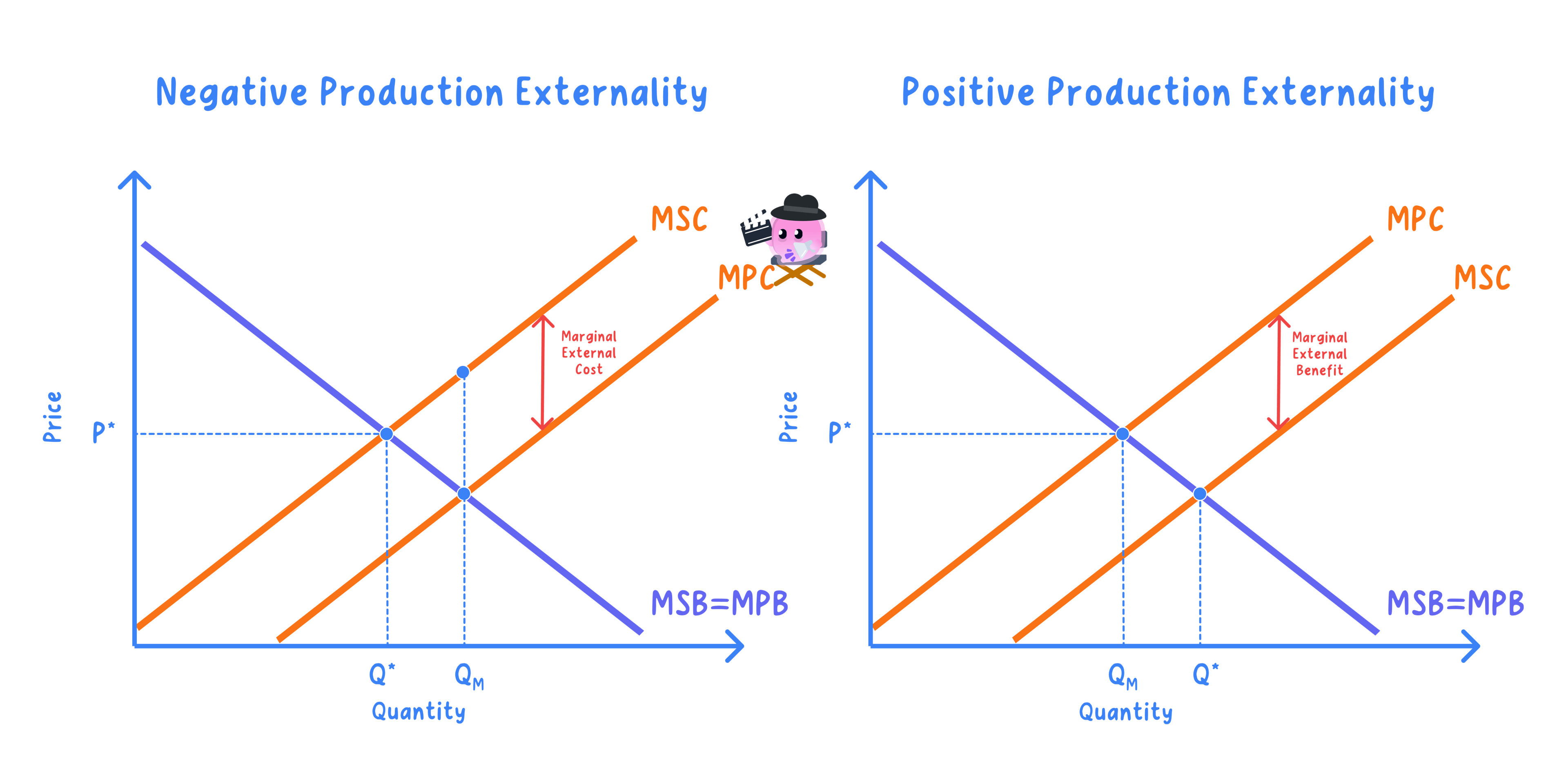
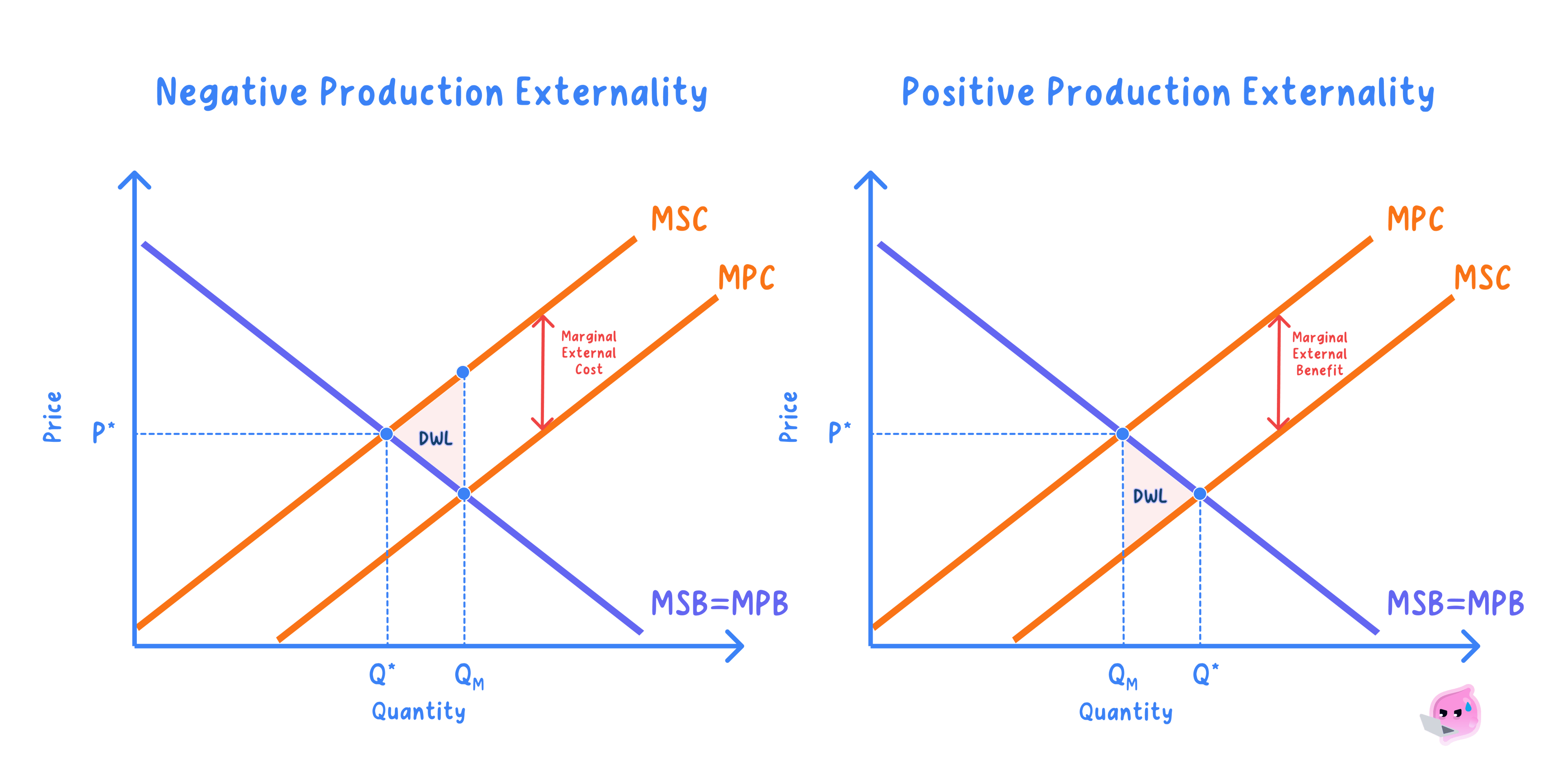
- An external cost of production makes MSC lie above MPC.
- On axes of cost and benefit against output, the MSC curve sits above the MPC curve by the value of the marginal external cost.
- The market equilibrium is where MPC crosses demand (MPB), giving output Q1.
- The social optimum is where MSC crosses MSB, at the lower output Q2.
- Because the firm ignores the external cost, Q1 exceeds Q2, so the market over-produces.
- The welfare loss is the triangle between MSC and demand across the units from Q2 to Q1.
- Over those units the extra social cost exceeds the extra social benefit, so society would be better off producing less.
- A coal power station is a negative production externality: it imposes pollution costs on residents who are not party to the sale.
- The firm ignores these costs, so it produces beyond the socially optimal level; the UK ETS makes firms pay for each tonne of carbon to close the gap.
External Benefit Diagrams
Marginal private benefit (MPB): the benefit to the consumer of the last unit; on the diagram this is the market demand curve.
Marginal social benefit (MSB): the full benefit to society of the last unit, equal to marginal private benefit plus the marginal external benefit.
Welfare gain: the net gain in welfare society could enjoy by moving output from the market equilibrium up to the social optimum.
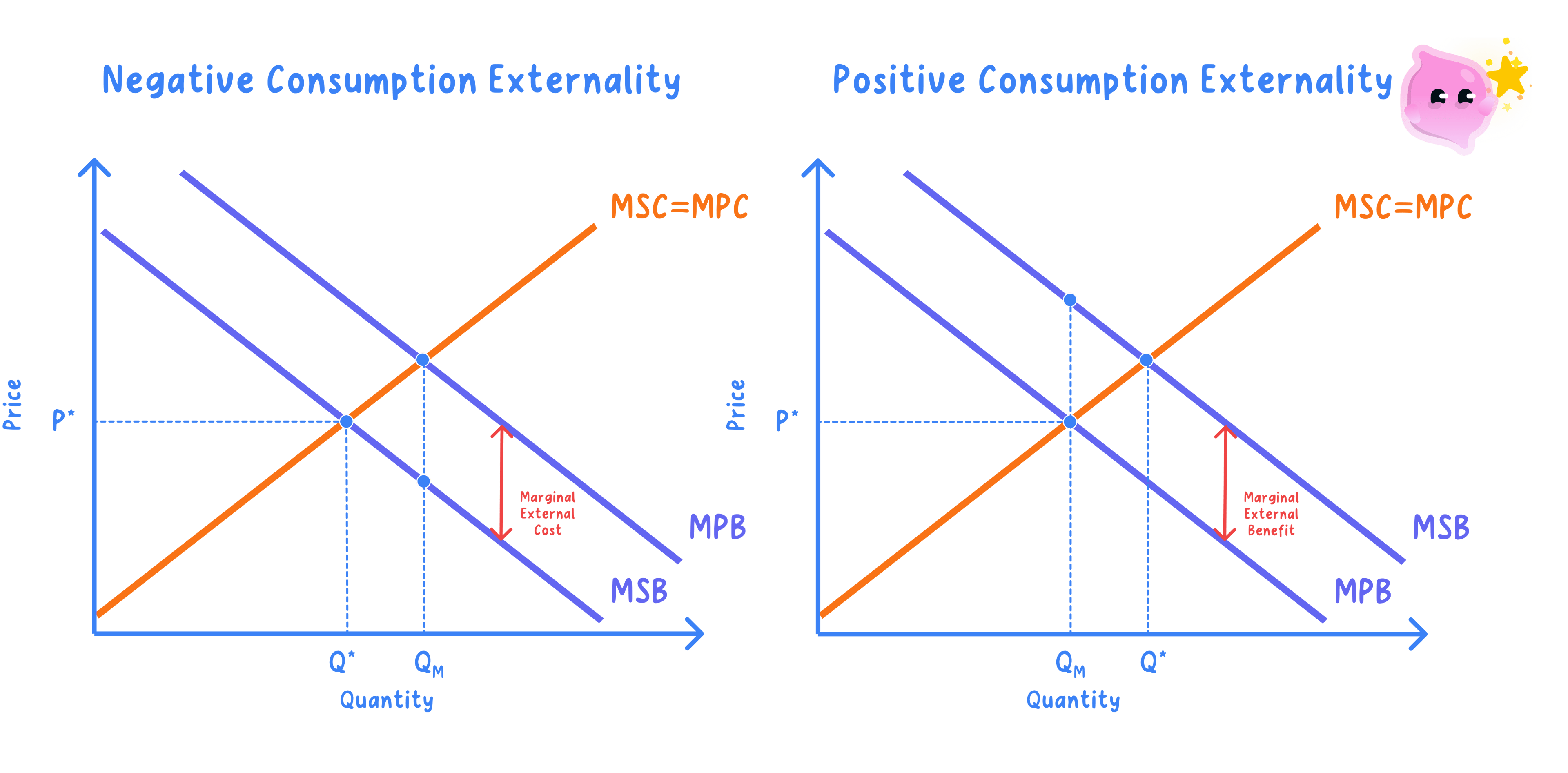
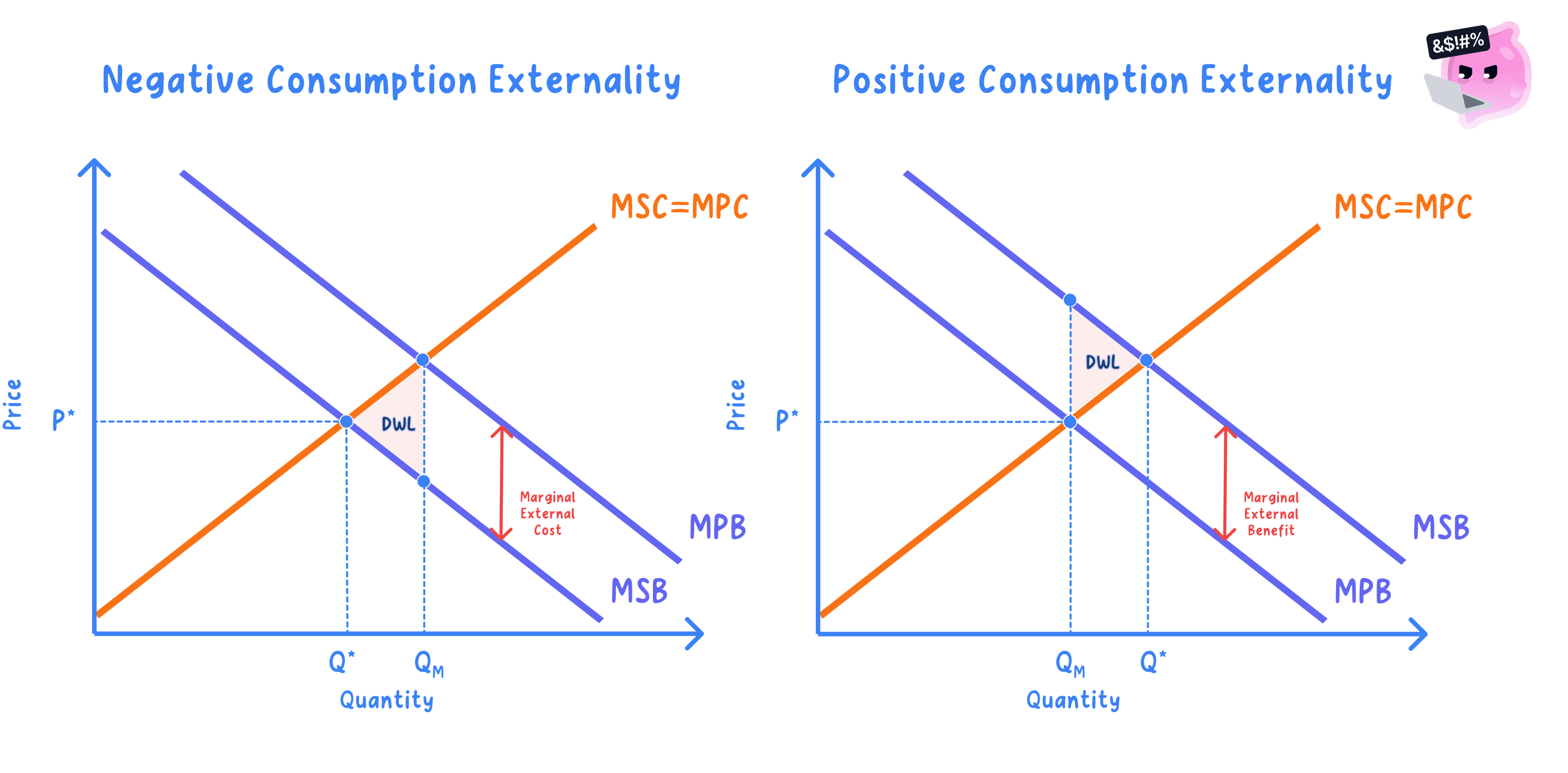
- An external benefit of consumption makes MSB lie above MPB.
- The MSB curve sits above the demand curve (MPB) by the value of the marginal external benefit.
- The market equilibrium is where demand (MPB) crosses supply (MSC), giving output Q1.
- The social optimum is where MSB crosses supply, at the higher output Q2.
- Because consumers ignore the external benefit, Q1 lies below Q2, so the market under-consumes.
- The welfare gain is the triangle between MSB and supply across the units from Q1 to Q2.
- It is the net benefit society would gain by moving from under-consumption up to the optimum.
- The MMR vaccine is a positive consumption externality (a merit good): it protects the wider community through herd immunity as well as the person receiving it.
- Consumers weigh only their private benefit, so demand and consumption fall short of the optimum.
- Label the axes as cost and benefit against output, and mark both Q1 and Q2.
- Shade the welfare loss beyond the optimum for external costs, and the welfare gain up to the optimum for external benefits.
- Anchor the analysis in a real context such as pollution or vaccination.
- Do not place the welfare triangle on the wrong side of the social optimum.
- For external costs the divergence is between MSC and MPC, not between the benefit curves.
- Under-consumption of a good with external benefits is still a market failure.
- Where does MSC sit relative to MPC when production has external costs?
- How do the market equilibrium and social optimum differ for an external cost of production?
- Where is the welfare loss area on the external cost diagram?
- Where does MSB sit relative to MPB when consumption has external benefits?
- Where is the welfare gain area on the external benefit diagram?
1.3.2c Impact of externalities on economic agents
Externalities and Agents
Economic agents: the decision makers in a market, namely consumers (households), producers (firms), the government and any third parties affected.
Third party: someone who is neither the buyer nor the seller in a transaction but who bears its external cost or enjoys its external benefit.
- Consumers and producers act only on private costs and benefits, so they over-produce goods with external costs and under-consume goods with external benefits.
- Third parties bear the external cost or enjoy the external benefit without payment or compensation.
- The government and wider society carry the resulting welfare loss and face the pressure to intervene.
- Residents near a factory polluting a river bear a health cost they never agreed to, the third party in a negative production externality.
- Neighbours of a vaccinated household gain herd-immunity protection they never paid for, the third party in a positive consumption externality.
Impact of Government Intervention
Indirect tax: a tax on spending, added to the price of a good, used to internalise the external cost of a negative externality.
Subsidy: a payment to producers or consumers that lowers price and raises output, used to encourage goods with external benefits.
Regulation: rules and standards that limit or require certain behaviour, backed by legal penalties.
- An indirect tax on a negative externality raises producer costs and consumer prices, but cuts output toward the optimum and raises revenue for the government.
- A subsidy for a positive externality lowers the price consumers pay and raises producer revenue, but is funded by taxpayers.
- Regulation constrains producers and can add compliance costs, while shielding third parties from harm.
- In each case the aim is to move output closer to the social optimum, raising overall welfare.
- The UK Soft Drinks Industry Levy (the sugar levy) taxes producers on high-sugar soft drinks, a demerit good.
- Many producers reformulated their recipes to cut sugar and avoid the charge.
- Consumers pay more for remaining sugary drinks, while HMRC collects the revenue raised.
- In a different market, the London congestion charge applies the same logic, taxing the negative externality of driving into the city so drivers face the external cost of congestion and pollution.
Should the government always intervene to correct externalities?
- It holds because intervention can internalise the externality and move output towards the social optimum, raising society's welfare.
- But the size of the gain depends on how large the externality is and how many people it affects, and some effects on health or the environment are very hard to value in money terms.
- But intervention creates its own winners and losers and may over-correct or under-correct if the externality is mismeasured, risking government failure.
- On balance, whether intervention is worthwhile depends on the scale of the externality, the accuracy of the valuation and whether the policy's benefits exceed its administrative and distortionary costs.
- Name the specific agent that generates the externality and the one that bears it.
- Tie each welfare change to a named agent rather than to society in the abstract.
- Do not blur the party causing the externality with the third party bearing it.
- Remember that a corrective policy imposes costs on some agents even as it benefits others.
- Who is a third party in externality analysis?
- How do externalities affect the behaviour of consumers and producers?
- How does an indirect tax on a negative externality affect consumers, producers and the government?
- Who gains and who pays when a positive externality is subsidised?
- What determines the size of an externality's impact?
