Economic Growth
Definition
Economic growth: an increase in the real output of an economy over time, usually measured by the percentage change in real GDP.
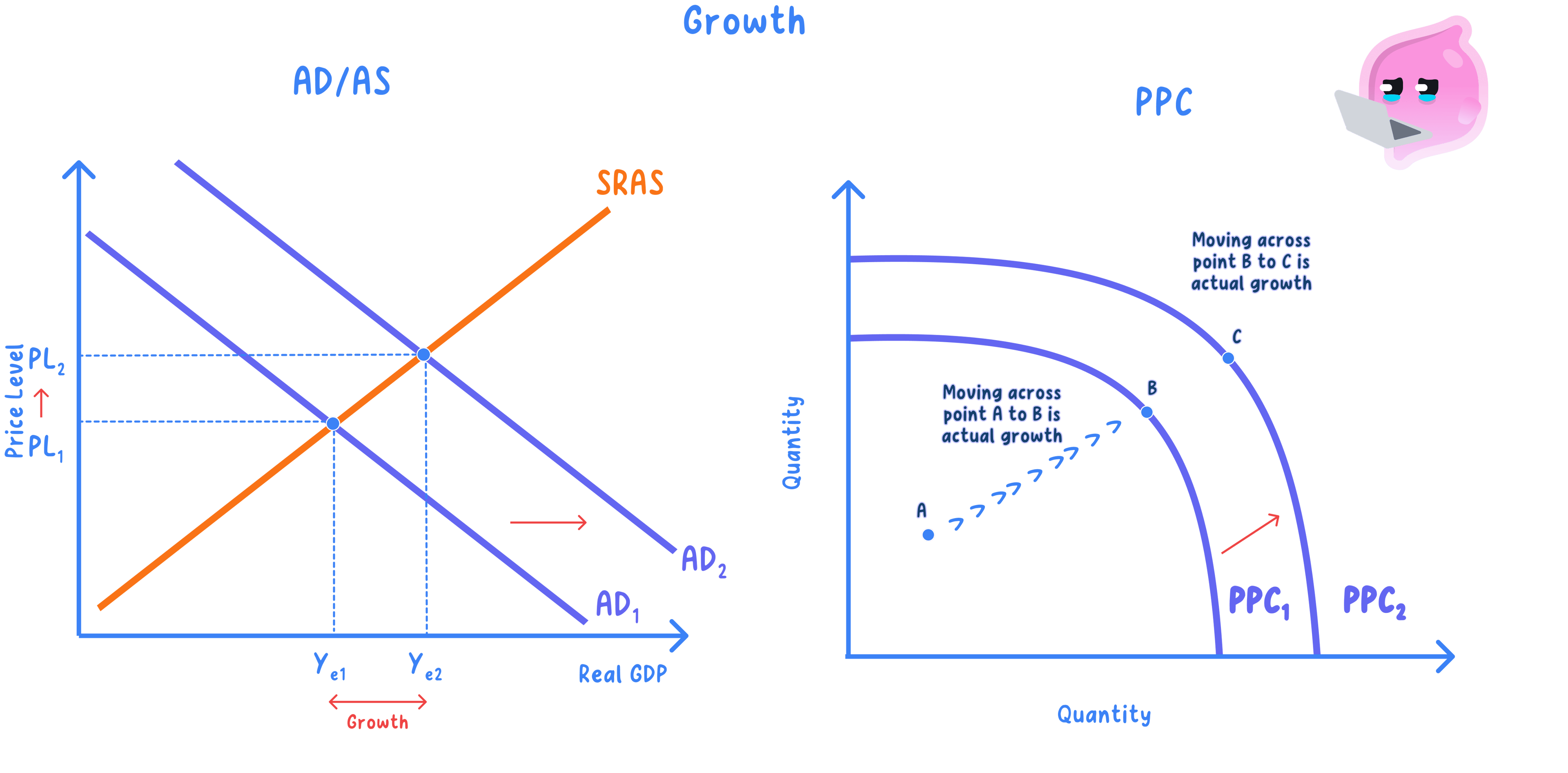
Actual growth: the rate of change of real GDP as existing capacity is used more fully.
Potential growth: an increase in the productive capacity of the economy.
- Real GDP is used so that a rise in prices alone does not count as growth.
- Actual growth draws on spare capacity, whereas potential growth raises the ceiling on what the economy can produce.
Analogy
- Actual growth is like a factory running extra shifts to use idle machines.
- Potential growth is like building a bigger factory that can produce more in future.
Causes of Growth
- Actual growth comes from rises in aggregate demand, through consumption, investment, government spending or net exports, when there is spare capacity.
- Investment in physical capital raises the quantity and quality of capital, lifting potential output.
- Education and training raise the quality of labour, building human capital and productivity.
- Technological progress and innovation raise output from the same resources.
- A larger labour force, from net migration or higher participation, and newly discovered natural resources also expand capacity.
Example
- In a construction boom, rapidly rising demand for housing prompts firms to invest heavily in new plant and equipment; this accelerator effect makes investment rise faster than output itself.
- That surge in investment adds to aggregate demand now and to productive capacity later, driving both actual and potential growth.
Export-Led Growth
Definition
Export-led growth: economic growth driven mainly by rising exports and access to large world markets.
- Exports are a component of aggregate demand, so rising exports raise actual growth.
- Access to large world markets lets firms specialise and exploit comparative advantage, raising productivity.
- Trade also brings in imported capital and technology that raise productive capacity, supporting potential growth.
Case study
- China, Germany and South Korea have raised real GDP rapidly through export-led growth.
- Selling into large world markets let their firms specialise and expand capacity.
Growth on Diagrams
- On a production possibility frontier, actual growth is a movement from inside the frontier towards it.
- Potential growth is an outward shift of the whole frontier.
- On an AD/AS diagram, potential growth is a rightward shift of long-run aggregate supply, with the average price level on the vertical axis and real output on the horizontal axis.
How reliable is export-led growth?
- It holds because selling into large world markets lets firms specialise, exploit comparative advantage and import capital, raising both actual and potential growth.
- But it leaves an economy exposed to a fall in world demand, a rising exchange rate or protectionism abroad, any of which can stall growth.
- On balance, how reliable export-led growth is depends on how diverse the export markets and products are and on the economy's competitiveness.
Exam technique
- Define growth as a rise in real GDP and separate actual from potential growth.
- Match the cause to the diagram: a move towards the PPF for actual growth, and an outward shift or rightward LRAS for potential growth.
Common Mistake
- Do not count a rise in prices alone as growth; growth is a rise in real output.
- Do not treat every rise in GDP as extra capacity, as it may be spare capacity being used up.
Self review
- Define economic growth and state how it is measured.
- Distinguish actual from potential growth.
- Give three factors that can cause economic growth.
- How is potential growth shown on a PPF and on an AD/AS diagram?
- How can international trade drive export-led growth?
