2.6.2a Comparative advantage and benefits of trade (A-level only)
Trade Is Based on Comparative Advantage, Not Absolute Advantage
Comparative advantage: a country has a comparative advantage in a good if it can produce it at a lower opportunity cost than another country.
- Absolute advantage is producing a good using fewer resources than another country.
- Comparative advantage is producing a good at a lower opportunity cost.
- The law of comparative advantage is the basis for the gains from trade.
- Total output rises when each country specialises in its lower opportunity-cost good.
- Comparative advantage rests on opportunity cost, not absolute output.
- A country can gain from trade even with an absolute advantage in both goods.
- Specialisation then raises total world output.
A Two-Country Example Shows How Opportunity Costs Differ
- Suppose one worker in Country A makes 101010 wheat or 555 cloth.
- One worker in Country B makes 444 wheat or 444 cloth.
- In A, one cloth costs 105=2\dfrac{10}{5} = 2510=2 wheat; in B, one cloth costs 44=1\dfrac{4}{4} = 144=1 wheat.
- So B has the lower opportunity cost in cloth and A in wheat.
- Country A specialises in wheat, its lower opportunity-cost good.
- Country B specialises in cloth, its lower opportunity-cost good.
- Trading cloth for wheat at a rate between the two ratios leaves both better off.
A Country with an Absolute Advantage in Both Goods Still Gains From Trade
- Country A has an absolute advantage in both goods here.
- But it cannot make everything, so it must choose.
- Comparative advantage shows where that choice should fall.
- So even the more productive country gains by specialising.
- The idea traces to David Ricardo's work in the early nineteenth century.
- A trading possibility curve can show output beyond each country's own limits.
- It explains why even advanced economies import goods they could make themselves.
- Specialisation by comparative advantage raises total output.
- Trade then lets both countries consume beyond their own frontier.
- So both can end up with more of both goods.
- This is the core case for international trade.
Compare Opportunity Costs to Decide Who Should Specialise
- Work out the opportunity cost of each good in each country.
- Assign specialisation to the lower opportunity-cost producer.
- Show total output rising after specialisation.
- Do not confuse absolute with comparative advantage, or think a country with an absolute advantage in both cannot gain.
- Gains from trade rest on opportunity cost, not absolute output.
Trade Brings Gains From Lower Prices and Scale, but Also Real Costs
- International trade brings gains beyond the basic model.
- These include lower prices, wider choice and economies of scale.
- But specialisation and trade also carry costs.
- The gains are unevenly spread between and within countries.
- Trade widens choice, lowers prices and raises consumer surplus.
- It also brings economies of scale, competition and technology transfer.
- But the gains are not shared equally.
The Main Gains Are Lower Prices, Wider Choice and Economies of Scale
- Consumers gain a wider range of goods at lower prices.
- Firms exploit economies of scale by selling to a larger market.
- Greater competition raises efficiency and choice.
- Trade can also transfer technology between countries.
- UK consumers buy cheaper imported electronics and clothing.
- Exporters such as carmakers gain scale by selling worldwide.
- Access to foreign technology can raise domestic productivity.
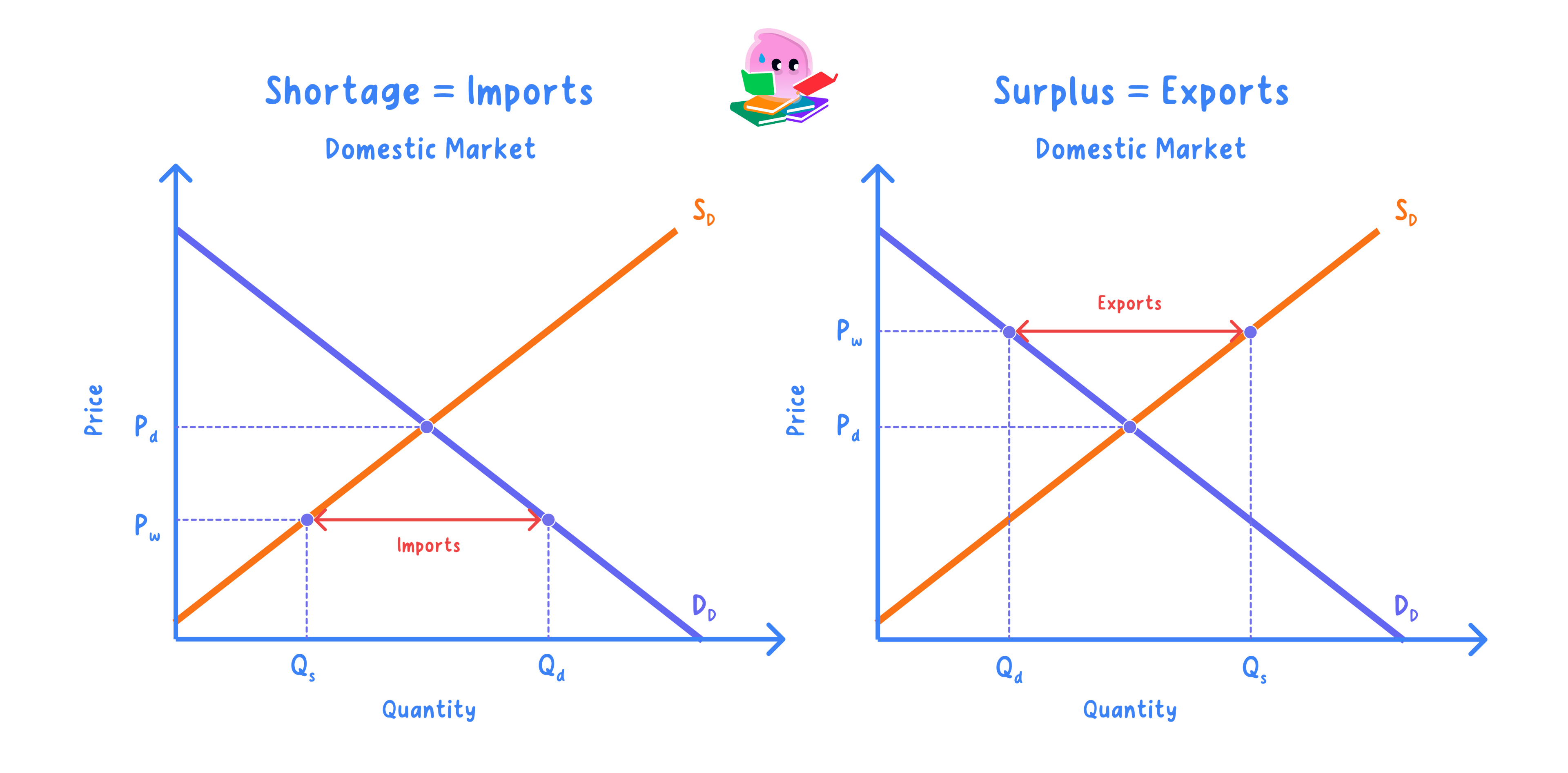
Trade Also Brings Costs Such as Structural Unemployment and Dependence
- A country can become over-dependent on a few trading partners.
- Declining sectors can suffer structural unemployment.
- Open economies are more exposed to external shocks.
- Trade can also bring environmental damage.
- UK coal and steel declined as cheaper imports won out, costing jobs.
- A shock abroad can quickly spread to a trade-dependent economy.
- So the losers from trade are often concentrated in particular regions.
Whether the Gains Outweigh the Costs Depends on How They Are Distributed
- For trade: lower prices, wider choice and scale raise living standards.
- Against: structural unemployment, dependence and shocks impose costs.
- The gains are spread unevenly, so some groups lose out.
- On balance, trade tends to raise total welfare, but the uneven spread of gains and losses means the outcome depends on how far the losers are supported.
Weigh the Gains Against the Costs and Note Their Uneven Distribution
- Set the gains against the costs rather than listing benefits alone.
- Stress that gains and losses are unevenly distributed.
- Reach a supported judgement.
- Do not list benefits without recognising the gains are unevenly distributed.
- Some groups and regions can lose even when a country gains overall.
Comparative Advantage Relies on Simplifying Assumptions That Limit the Model
- The theory of comparative advantage rests on simplifying assumptions.
- These include constant returns to scale and no transport costs.
- It also assumes factor mobility within countries but not between them.
- And it assumes just two countries, two goods and costless trade.
- The assumptions make the model simple but unrealistic.
- Transport costs, barriers and externalities are all ignored.
- So the model is a framework, not a literal account of trade.
The Main Assumptions Are Constant Returns, No Transport Costs and Limited Factor Mobility
- It assumes constant returns to scale as output changes.
- It assumes no transport costs between countries.
- It assumes factors move freely within but not between countries.
- It assumes only two countries and two goods and costless trade.
- In reality, transport costs can wipe out a small cost advantage.
- Workers cannot switch instantly from a declining to a growing sector.
- Trade barriers such as tariffs are assumed away by the model.
The Assumptions Matter Because Transport Costs, Externalities and Shifting Advantage All Limit the Model
- Transport costs reduce or reverse the gains from trade.
- Externalities such as pollution are left out.
- Comparative advantage is dynamic and can shift over time.
- Trade barriers exist and distort the pattern of trade.
- A country's comparative advantage can change as it invests in skills.
- South Korea moved from simple goods to advanced electronics over decades.
- So today's advantage is not fixed for all time.
The Model Remains a Useful Framework Despite Its Unrealistic Assumptions
- For the model: it captures the core insight that opportunity cost drives trade.
- Against: its assumptions are unrealistic and static.
- Transport costs, externalities and shifting advantage all limit it.
- On balance, comparative advantage is a useful framework for why trade happens, but its unrealistic assumptions mean it should guide thinking rather than describe trade literally.
State the Assumptions Clearly Before Evaluating Them
- State the assumptions clearly before criticising them.
- Explain why each assumption limits the model.
- Treat the model as a framework, not a literal description.
- Do not present the model as a literal description of real trade.
- It is a simplifying framework built on strong assumptions.
The Pattern of Trade Is Continually Reshaped by Comparative Advantage and Policy
- The pattern of trade is which goods a country trades and with whom.
- It is shaped by comparative advantage and how that changes.
- It also reflects trading blocs, exchange rates and relative costs.
- Trade flows shift over time as competitiveness and policy change.
- Comparative advantage is a key driver of the pattern of trade.
- Emerging economies, blocs and exchange rates reshape it.
- So trade patterns are continually changing, not fixed.
Comparative Advantage, Emerging Economies, Blocs and Exchange Rates Shape the Pattern
- Comparative advantage sets the initial pattern of trade.
- The rise of emerging economies shifts where goods are made.
- Trading blocs and bilateral deals redirect trade flows.
- Exchange rates and relative productivity change competitiveness.
- China's rise made it the source of much of the world's manufacturing.
- EU membership shaped much of the UK's trade with Europe.
- A weaker pound can make UK exports more competitive.
Patterns Change as Comparative Advantage, Productivity and Exchange Rates Shift
- A country can gain or lose comparative advantage over time.
- Rising productivity abroad shifts production there.
- New trade agreements open or divert flows.
- A change in the exchange rate alters relative prices.
- UK manufacturing shrank as production moved to lower-cost economies.
- Services such as finance became a larger share of UK exports.
- So the composition of trade shifts as the economy changes.
Trade Data Should Be Read as Dynamic and Linked to Underlying Causes
- Trade data show the direction and composition of flows.
- Shifts in the data can be linked to underlying causes.
- Competitiveness and policy explain much of the change.
- So patterns should be read as dynamic, not fixed.
Link Shifts in Trade Data to Their Underlying Causes
- Identify the main determinants of the pattern of trade.
- Link a change in the data to an underlying cause.
- Treat the pattern as continually reshaped.
- Do not treat trade patterns as fixed.
- They are continually reshaped by competitiveness and policy.
- What is the difference between absolute and comparative advantage?
- How do you work out where a country's comparative advantage lies?
- Why can a country with an absolute advantage in both goods still gain from trade?
- State three benefits and two costs of international trade.
- Give two assumptions of the comparative advantage model and explain why each one limits it.
- Name three factors that can change the pattern of trade over time.
2.6.2b Protectionist policies (A-level only)
Protectionist Policies Use Tariffs, Quotas and Export Subsidies to Shield Domestic Industry From Imports
Protectionism: the use of measures such as tariffs, quotas and subsidies to restrict imports and protect domestic industries from foreign competition.
- Protection uses barriers to shield domestic industries from imports.
- A tariff is a tax on imports; a quota is a limit on the quantity imported.
- Export subsidies lower costs for domestic producers, helping them undercut foreign rivals at home and abroad.
- Non-tariff barriers include regulations, embargoes and administrative red tape.
- A tariff raises the price of imports and cuts the quantity imported.
- A quota limits quantity directly and yields no government revenue.
- Every method tends to create a deadweight welfare loss.
Tariffs, Quotas, Subsidies and Non-Tariff Barriers Each Restrict Trade in a Different Way
- A tariff is a tax added to the price of an import.
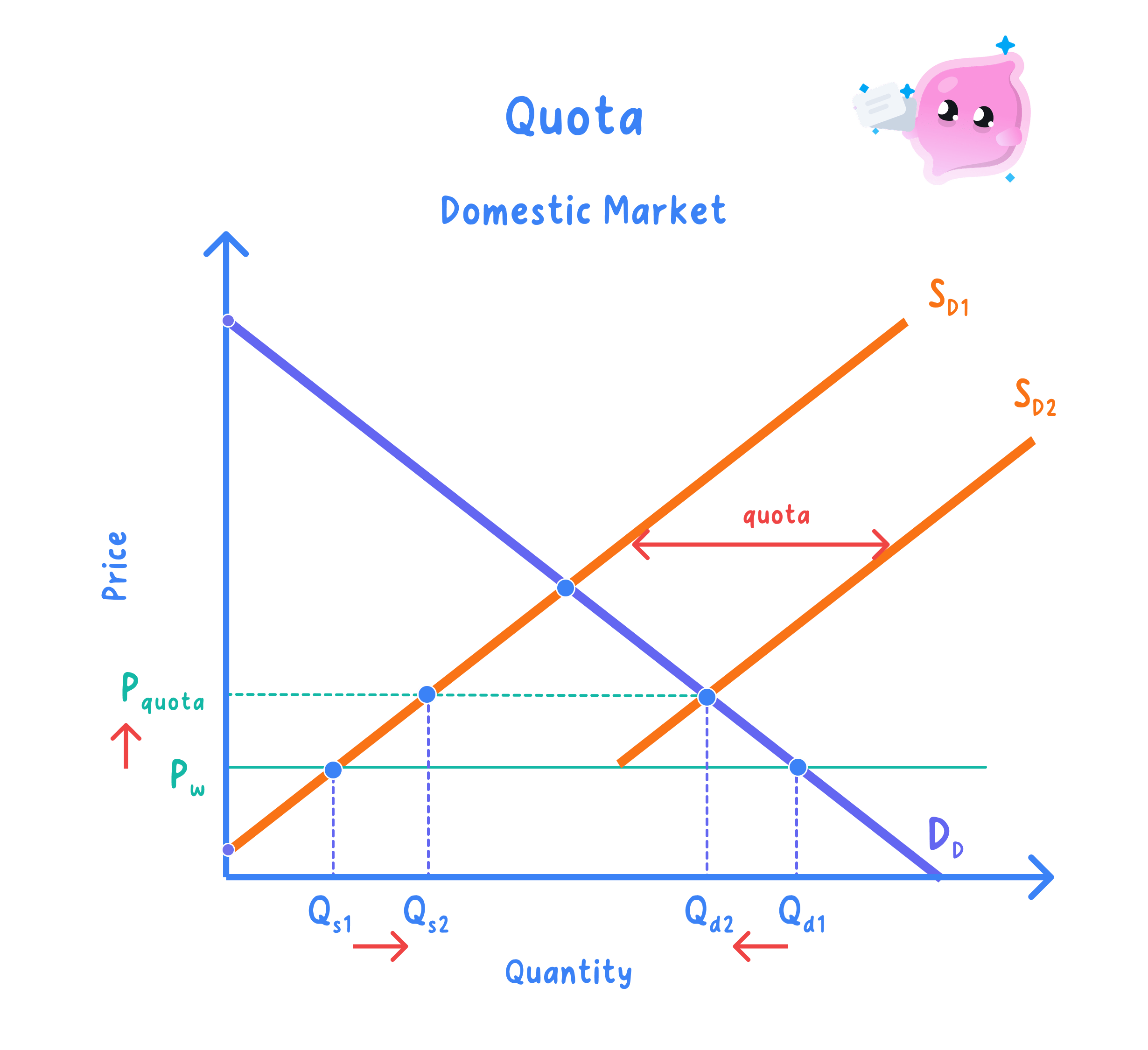
- A quota caps the volume of a good that can be imported.
- Export subsidies cut the costs faced by domestic producers and exporters.
- Non-tariff barriers raise the cost or difficulty of importing.
Worked example: a £2 tariff
On a tariff diagram the axes are price and quantity, with the domestic demand and supply curves and a horizontal world-supply line at the world price. At the world price of £10, domestic consumers demand 100 units while domestic firms supply 20, so imports are 100−20=80100 - 20 = 80100−20=80 units.
A £2 tariff raises the price paid to £10+£2=£12\pounds 10 + \pounds 2 = \pounds 12£10+£2=£12. Demand falls to 90 and domestic supply rises to 40, so imports shrink to 90−40=5090 - 40 = 5090−40=50 units. Government revenue is the £2 tariff times the 50 units still imported, £2×50=£100\pounds 2 \times 50 = \pounds 100£2×50=£100.
Domestic producers gain and the government gains revenue, but consumers lose more than both combined. The net loss is two deadweight welfare-loss triangles: one from higher-cost domestic output replacing cheaper imports, and one from the consumption given up because the price is higher.
A Tariff Raises the Domestic Price, Cuts Imports and Creates a Deadweight Welfare Loss
- The tariff raises price, so consumers buy less and pay more.
- Domestic producers supply more at the higher price.
- The government gains tariff revenue on the imports that remain.
- Two welfare triangles are lost as deadweight loss.
- A quota raises price like a tariff but yields no government revenue.
- Any scarcity gain from a quota goes to importers, not the state.
- So the revenue effect of a tariff and a quota differ.
A Tariff Earns Government Revenue, Whereas a Quota Hands the Scarcity Gain to Importers
- Tariffs raise revenue; quotas do not.
- Export subsidies support producers without taxing consumers directly.
- Non-tariff barriers work through cost and complexity.
- So the tools differ in how they restrict trade and who pays.
Always Label Price, Imports, Government Revenue and the Welfare Loss on Your Tariff Diagram
- Draw the tariff diagram and mark price, imports, revenue and welfare loss.
- Show that a quota raises price but yields no revenue.
- Identify the deadweight loss in each case.
- Do not omit the deadweight welfare loss or confuse the revenue effect of a tariff with that of a quota.
- A tariff raises revenue; a quota does not.
Protection Can Defend Jobs and Infant Industries, but It Risks Inefficiency, Higher Prices and Retaliation
- Protectionism can be defended on several grounds.
- These include the infant industry and anti-dumping arguments.
- It is also used to protect jobs and strategic industries.
- But free trade raises efficiency and protection risks retaliation.
- There is a case for protection and a case for free trade.
- Protection can shield jobs and infant industries.
- But it risks inefficiency, higher prices and retaliation.
Infant Industries, Anti-Dumping, Jobs and Revenue Form the Main Case for Protection
- The infant industry argument protects new firms until they grow.
- Anti-dumping action guards against goods sold below cost.
- Protection can defend jobs and strategic or security industries.
- Tariffs can also raise revenue or ease a current account deficit.
- Developing economies have used infant industry protection to build sectors.
- The EU and others have imposed anti-dumping duties on cheap steel imports.
- Tariffs on strategic goods aim to protect national security.
Free Trade Raises Efficiency and Consumer Choice, so Protection Carries a Real Cost
- Free trade raises efficiency through comparative advantage.
- It gives consumers lower prices and wider choice.
- Protection can shelter inefficient producers from competition.
- It can also trigger retaliation and a trade war.
- The US and China raised tariffs on each other in a trade war from 2018.
- Both sides faced higher prices and disrupted supply chains.
- So retaliation can leave everyone worse off.
Targeted, Temporary Protection Can Be Justified, but Broad or Permanent Protection Tends to Reduce Welfare
- For protection: it can defend jobs and nurture infant industries.
- Against: it raises prices, shelters inefficiency and invites retaliation.
- Infant industry protection is hard to remove once granted.
- On balance, targeted and temporary protection can be justified in specific cases, but broad or permanent protection tends to reduce welfare, so the case depends on how narrowly and briefly it is applied.
Set Each Argument for Protection Against the Free-Trade Reply, Then Reach a Supported Judgement
- Set each argument for protection against the free-trade reply.
- Note who gains and who loses among consumers, producers and government.
- Reach a supported judgement.
- Do not assert the infant industry argument without noting how hard protection is to remove once granted.
- Temporary support can become permanent.
- What is a tariff, and what is a quota?
- How does an export subsidy help domestic producers?
- Why does a tariff raise government revenue while a quota does not?
- State the infant industry argument for protection.
- Why can adopting protectionist policies provoke retaliation?
2.6.2c Customs unions, the SEM and the WTO (A-level only)
A Customs Union, the Single European Market and the WTO Each Deepen Trade Integration in a Distinct Way
Customs union: a group of countries that trade freely with one another and impose a common external tariff on imports from non-member countries.
A Customs Union Combines Free Internal Trade with a Common External Tariff
- A customs union removes tariffs on trade between its members.
- It also applies a common external tariff to imports from non-members.
- This distinguishes it from a free trade area, where members keep their own separate external tariffs.
- Members trade freely with one another behind a shared external tariff wall.
- The common external tariff is set and negotiated jointly by the members.
- So members give up an independent trade policy towards the rest of the world.
A Customs Union Can Both Create and Divert Trade
- Trade creation occurs when cheaper output from a partner replaces costly home production, raising welfare.
- Trade diversion occurs when the common external tariff shifts trade from a lower-cost outside producer to a dearer member, lowering welfare.
- Whether joining a customs union raises welfare depends on which of the two effects is larger.
- If a partner can supply a good for £80 that a country made at home for £100, joining saves £100−£80=£20\pounds 100 - \pounds 80 = \pounds 20£100−£80=£20 per unit through trade creation.
- If an outside producer's true cost is £70 but a £20 common external tariff lifts its price to £70+£20=£90\pounds 70 + \pounds 20 = \pounds 90£70+£20=£90, buyers switch to the £80 member, diverting trade.
The Single European Market Rests on Four Freedoms
- The Single European Market (SEM) allows free movement of goods, services, capital and people across member states.
- It removes not only tariffs but also many non-tariff barriers, such as differing product standards and regulations.
- It is deeper than a customs union because factors of production, not just goods, can move freely.
- The four freedoms widen markets and let firms exploit economies of scale.
- Free movement of capital and labour helps resources flow to their most productive use.
- A larger, more competitive market can attract foreign investment seeking access.
Membership of the Single Market Brings Gains and Costs
- Firms gain tariff-free access to a large market and can achieve economies of scale.
- Consumers gain wider choice and lower prices from stronger competition.
- But members pool some sovereignty, contribute to shared budgets and expose weaker industries to competition.
- The UK left the Single European Market and the customs union at the end of 2020.
- It now trades with the EU under a free trade agreement, which removes tariffs but not all the checks and paperwork that single-market membership had eliminated, a concrete illustration of how a free trade area is shallower than deeper integration.
- Carmakers built UK plants partly for tariff-free access to the single market.
- Workers could move freely between member states to find employment.
- Some sectors faced stronger competition once barriers within the market fell.
The WTO Provides a Rules-Based System for Multilateral Trade
- The World Trade Organisation (WTO) sets and enforces the rules of international trade.
- It negotiates multilateral agreements, through trade rounds, that lower barriers between its members.
- It runs a dispute settlement process and can authorise retaliation when a member breaks the rules.
- The WTO succeeded the earlier GATT framework in 1995.
- Its aim is multilateral free trade across all members, not just regional partners.
- But it cannot force members to remove every barrier and relies on their agreement.
The WTO's Effectiveness Is Debated
- In its favour, it has lowered many barriers and settled numerous disputes between members.
- Against it, recent rounds such as Doha have stalled and its enforcement powers are limited, with its appellate body left unable to hear new appeals in recent years.
- Regional blocs, which favour members over outsiders, can also pull against its multilateral goal.
- What is a customs union, and how does it differ from a free trade area?
- Explain the difference between trade creation and trade diversion.
- What are the four freedoms of the Single European Market?
- What are the main roles of the World Trade Organisation?
- In what ways has the WTO succeeded, and where has it struggled?
