2.5.2a Nature and effects of supply-side policies
Supply-Side Policies Raise Productive Potential, Shifting LRAS to the Right
Supply-side policies: government measures designed to increase the productive potential of the economy by improving the quantity or quality of the factors of production, shifting long-run aggregate supply to the right.
Supply-side policies are government measures that improve the quantity or quality of factors of production and the efficiency of markets, shifting long-run aggregate supply to the right. A supply-side improvement is any gain in productive potential, whether or not it comes from policy.
Policies Versus Improvements
- A supply-side policy is a deliberate government measure, such as tax changes to sharpen incentives, spending on education and training, or deregulation.
- A supply-side improvement is any actual gain in productive potential, which can also come from the private sector or new technology without policy.
- So a policy is the intervention, while an improvement is the outcome, and policy is only one route to it.
How They Raise Potential Output and Trend Growth
- By improving the quantity and quality of factors of production and the efficiency of markets, they raise productivity and capacity.
- Tax changes designed to change personal incentives, such as lower marginal income tax rates, can encourage work, saving and investment, raising potential output and the underlying trend rate of economic growth.
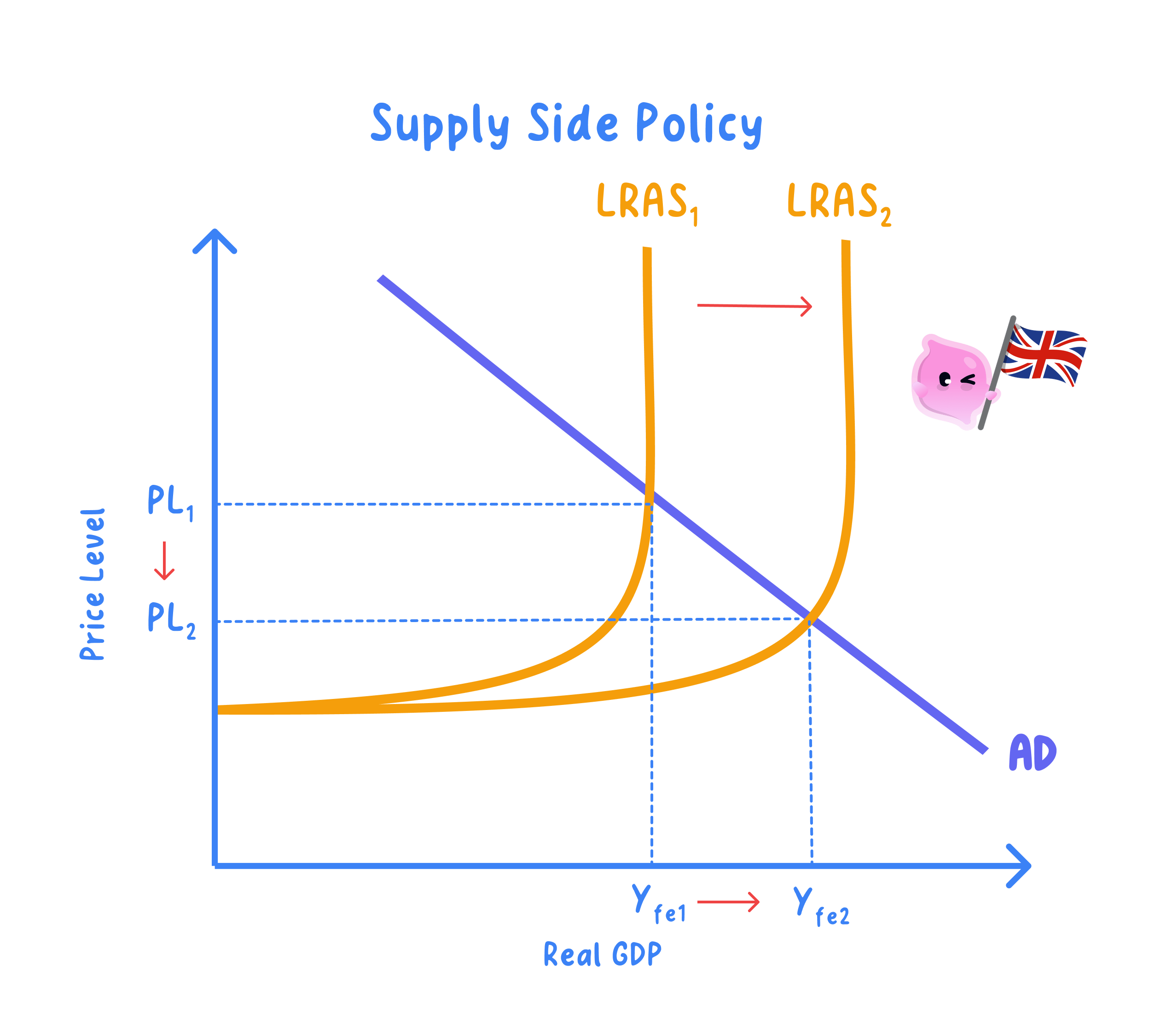
- On an AD/AS diagram this is a rightward shift in long-run aggregate supply, with the axes as the average price level and real output.
Effects on the Macroeconomic Objectives
- Growth: higher capacity supports faster, non-inflationary growth.
- Unemployment: more efficient labour markets, better skills and stronger incentives to work reduce the natural rate of unemployment (its frictional and structural components), so employment can rise.
- Inflation: greater capacity eases upward pressure on the price level, lowering the rate of change of prices.
- External performance: lower costs and higher competitiveness can improve the current account of the balance of payments.
- The gains are not automatic: supply-side effects are often long-term and uncertain, and they vary by policy.
Suppose the government funds apprenticeships that raise workers' skills. Labour productivity rises, so firms can produce more at each price level and long-run aggregate supply shifts right. With aggregate demand unchanged, the economy settles at higher real output and a lower average price level, so growth and inflation improve together. The catch is that training takes years to feed through, so the benefit is delayed and hard to guarantee.
So How Much Do Supply-Side Policies Actually Deliver?
- On the plus side, well-designed supply-side policies can raise potential output, cut the natural rate of unemployment and ease inflation at the same time, which demand-side policies cannot achieve together.
- Against this, the gains are slow to arrive, uncertain and often expensive, and a misjudged measure can widen inequality or fail if the government targets the wrong constraint.
- The size of the payoff also depends on whether the economy's binding constraint is genuinely on the supply side, since these measures do little to close a demand-deficient output gap in a recession.
- On balance, supply-side policies matter most for long-run trend growth and work best alongside demand management, so the judgement turns on the time horizon and on whether the productivity gain outweighs the fiscal cost of achieving it.
- Show a supply-side policy as a rightward LRAS shift, with the axes as the average price level and real output.
- Distinguish a supply-side policy (the intervention) from a supply-side improvement (the outcome).
- Trace effects across growth, unemployment (including the natural rate), inflation and the current account, then evaluate with time lags and uncertainty.
- Do not confuse a supply-side policy with a demand-side policy; supply-side policy shifts aggregate supply, not aggregate demand.
- Do not show a supply-side policy raising the price level like a demand expansion; a rightward LRAS shift eases price pressure.
- Do not assume supply-side gains are quick or certain.
- Distinguish a supply-side policy from a supply-side improvement.
- How can tax changes raise potential output and the trend rate of growth?
- How can supply-side policies reduce the natural rate of unemployment?
- How are supply-side policies shown on an AD/AS diagram?
- Why might supply-side gains be slow and uncertain?
2.5.2b Free-market and interventionist measures
Supply-Side Policies Come in Two Types: Free-Market and Interventionist
Supply-side policies: government measures designed to increase the productive potential of the economy by improving the quantity or quality of the factors of production, shifting long-run aggregate supply to the right.
Supply-side policies shift long-run aggregate supply to the right. Free-market (market-based) policies reduce the role of the state to sharpen incentives, while interventionist policies use direct government action to raise capacity. Both have microeconomic as well as macroeconomic effects.
Free-Market (Market-Based) Policies
- They reduce government intervention and strengthen incentives.
- Examples: tax cuts, privatisation, deregulation and some labour market reforms.
- Lower taxes strengthen incentives to work and invest, privatisation and deregulation can raise efficiency, and labour market reform can make wages and hiring more flexible.
- But market-based measures can widen inequality, and deregulation can carry risks if it is taken too far.
Interventionist Policies
- They use direct government action to raise the economy's productive potential.
- Examples: government spending on education and training, industrial policy, and subsidising research and development.
- Education and training raise workforce skills, infrastructure investment lowers firms' costs, and support for research and development raises innovation.
- But these policies are costly, take years to affect potential output and carry a risk of government failure.
Microeconomic as Well as Macroeconomic Effects
- Macroeconomic: a rightward LRAS shift can raise growth and employment while easing inflation and improving competitiveness.
- Microeconomic: individual markets and firms are affected too, for example lower costs in a deregulated industry or better-matched workers in the labour market, which also help cut the natural rate of unemployment.
The UK has used both types. Free-market measures include privatising utilities such as British Telecom in the 1980s and cutting the headline rate of corporation tax to attract investment. Interventionist measures include the apprenticeship levy that funds training and research and development tax credits that reward innovation.
Which works best depends on the context. Free-market reforms can lift efficiency relatively quickly but may widen inequality, while interventionist spending targets long-term capacity but is costly and slow to bear fruit. A judgement should weigh the size of the likely gain against these costs for the specific policy in question.
- Classify a policy as free-market or interventionist, and link it to a rightward shift in long-run aggregate supply.
- Explain the mechanism rather than just listing policies.
- Weigh the trade-offs: time lags, costs, the risk of government failure and effects on equity.
- Do not list policies without explaining the mechanism; link each to a shift in long-run aggregate supply.
- Do not assume supply-side policies work quickly or cheaply; their effects are often slow, costly and uncertain.
- Distinguish free-market from interventionist supply-side policies.
- Give two examples of each.
- How does a tax cut act as a supply-side policy?
- Give one microeconomic effect of a supply-side policy.
- Why might the gains be slow and uncertain?
