Production and Productivity: Not the Same Thing
Definition
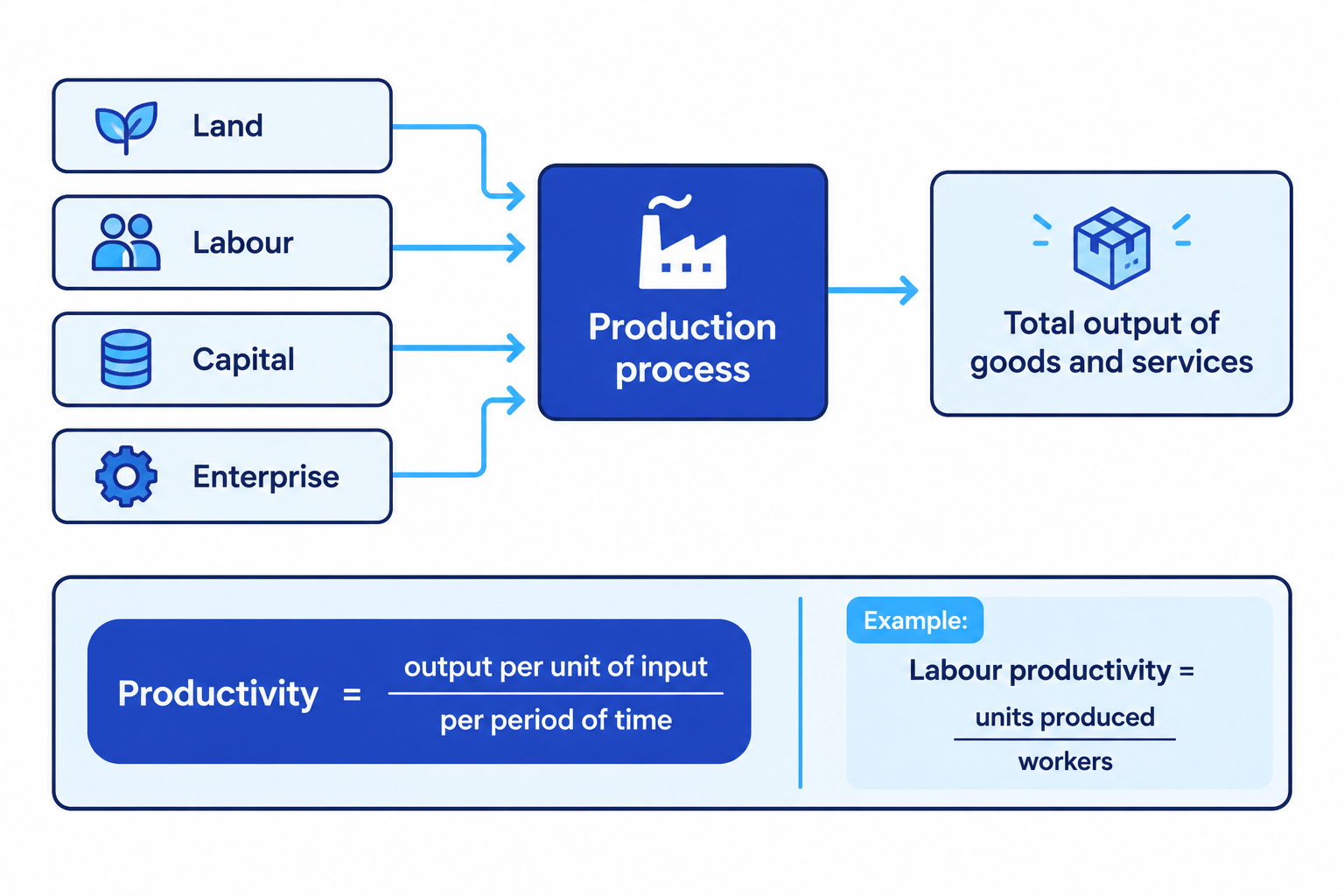
Production: the process that turns inputs (the factors of production) into output of goods and services; it refers to the total quantity produced.
Productivity: output per unit of input per period of time, a measure of how efficiently factors such as labour and capital are converted into output.
- Production is about the size of output: the total quantity of goods and services made in a period.
- The inputs used are the factors of production: land, labour, capital and enterprise.
- Productivity is about efficiency: how much output each unit of input generates, not the total.
- The two can move apart: adding more workers can raise production while productivity falls, if each extra worker adds less output than those already employed.
Note
- Rising productivity lowers average costs and so raises competitiveness at home and abroad.
Measuring Productivity: Output per Worker or per Machine
- Labour productivity
- Output per worker or per hour worked.
- Capital productivity
- Output per unit of capital employed.
Example
- A team of 10 workers produces 400 units a week, so labour productivity is 40010=40\dfrac{400}{10} = 4010400=40 units per worker.
- If better machines lift output to 480 units with the same 10 workers, productivity rises to 48010=48\dfrac{480}{10} = 4810480=48 units per worker, a gain of 20%20\%20%.
- Output (production) rose from 400 to 480 while the labour input stayed fixed, which is precisely why productivity, not just production, increased.
What Raises Productivity: Investment and Skills
- Investment in better capital and technology raises output per worker.
- Education and training improve the skills of the workforce.
- Higher productivity cuts unit costs and improves competitiveness at home and abroad.
Note
- UK labour productivity has grown unusually slowly since the 2008 financial crisis, a pattern often called the productivity puzzle.
- Weak business investment and skills shortages are among the causes cited, which helps explain why UK real wages have stagnated for long periods.
Keep Production and Productivity Apart
Exam technique
- Use production for total output and productivity for output per input.
- Link a productivity rise to lower average costs, then to competitiveness.
Common Mistake
- Do not confuse production with productivity.
- Production is the total, while productivity is output per unit of input.
Self review
- Define production.
- Define productivity.
- Distinguish labour from capital productivity.
- Why does higher productivity lower average costs?
- If 8 workers make 240 units, what is labour productivity, and what happens to it if output rises to 320 with the same team?