1.8.9a Rationale and objectives for intervention
Market Failure Provides the Rationale for Government Intervention
Definition
Government intervention: action taken by the government, through methods such as taxation, subsidies, regulation and state provision, to correct market failure and influence the allocation of resources.
- Market failure provides the case for government intervention to improve allocation.
- Governments pursue objectives such as efficiency, equity and stability.
- These objectives shape how they intervene in a mixed economy.
Note
- Intervention aims to correct the misallocation that market failure causes.
- But intervention itself carries costs and can go wrong.
Governments Use a Range of Instruments to Change the Allocation of Resources
- Taxes and subsidies change prices to reflect external costs and benefits.
- Public expenditure, price controls, regulation and state provision act more directly.
- Permits, information and property rights round out the toolkit.
Example
- A carbon tax raises the price of high-emission goods.
- Free state education tackles the under-consumption of a merit good.
Intervention Can Raise Welfare but May Cause Government Failure
- Well-designed intervention can raise welfare towards the optimum.
- But it can also misfire, creating government failure.
- On balance, the case for intervention must be weighed against that risk.
Match the Instrument to the Market Failure
Exam technique
- Name the market failure, then choose an instrument that fits it.
- Note that intervention has costs, which sets up your evaluation.
Common Mistake
- Do not assume intervention always corrects the failure.
- Intervention can introduce government failure of its own.
Worked Example: Sizing a Pigouvian Tax to the External Cost
- Suppose burning a tonne of coal creates a marginal external cost of £40\pounds 40£40 in air pollution and climate damage that the market price does not reflect.
- A Pigouvian tax of exactly £40\pounds 40£40 per tonne shifts the private marginal cost curve up so that it now coincides with the marginal social cost curve, and output falls to the socially efficient level where marginal social benefit equals marginal social cost.
- If the government instead sets the tax at only £20\pounds 20£20, some of the external cost stays unpriced and output remains above the social optimum; if it sets the tax at £60\pounds 60£60, output is pushed below the optimum, so the size of the correction depends on accurately estimating the externality, not just on taxing the activity at all.
Example
- A tax only fully corrects a negative externality when it is set equal to the marginal external cost at the socially optimal quantity.
- Under- or over-estimating that cost is itself a source of government failure, since the market simply moves to a different, still inefficient, level of output.
UK Applications: Matching Instruments to Market Failures
- The UK Emissions Trading Scheme (UK ETS) caps total carbon emissions and lets firms buy and sell permits, with the carbon price fluctuating to correct the pollution externality without the government having to know the exact tax rate needed.
- The Soft Drinks Industry Levy (the sugar tax) charges manufacturers 18p18\text{p}18p per litre for drinks with 5–8g5\text{–}8\text{g}5–8g of sugar per 100ml100\text{ml}100ml and 24p24\text{p}24p per litre above 8g8\text{g}8g, using price to correct the negative externality and information failure linked to excess sugar consumption.
- Free state secondary education and NHS healthcare are direct state provision, used because a subsidy alone might not be enough to overcome severe under-consumption of a merit good driven by information failure.
Self review
- What is the rationale for government intervention?
- Name three government objectives.
- List three ways governments influence the allocation of resources.
- Why does intervention not always improve welfare?
- If the marginal external cost of an activity is £40\pounds 40£40 but the government taxes it at only £20\pounds 20£20, what happens to output relative to the social optimum?
- Give one UK example of a tradeable permit scheme and one UK example of a corrective tax.
1.8.9b Instruments to correct market failure
Governments Have Several Instruments to Correct Market Failure
Definition
Indirect tax: a tax levied on spending on goods and services, such as VAT or excise duty, which raises firms' costs of production and can be used to correct negative externalities.
- Where a market fails, the government can use a range of instruments to shift output towards the social optimum.
- The main tools are indirect taxation, subsidies, price controls, state provision, regulation, the extension of property rights and pollution permits.
- The right instrument depends on the type of market failure.
Note
- Taxes and permits raise the private cost of goods with negative externalities.
- Subsidies and state provision raise the consumption of merit goods and goods with positive externalities.
Indirect Taxation Makes Polluters Pay for External Costs
- An indirect tax raises the price of a good with a negative externality.
- Set equal to the external cost, it internalises the externality and cuts output towards the social optimum.
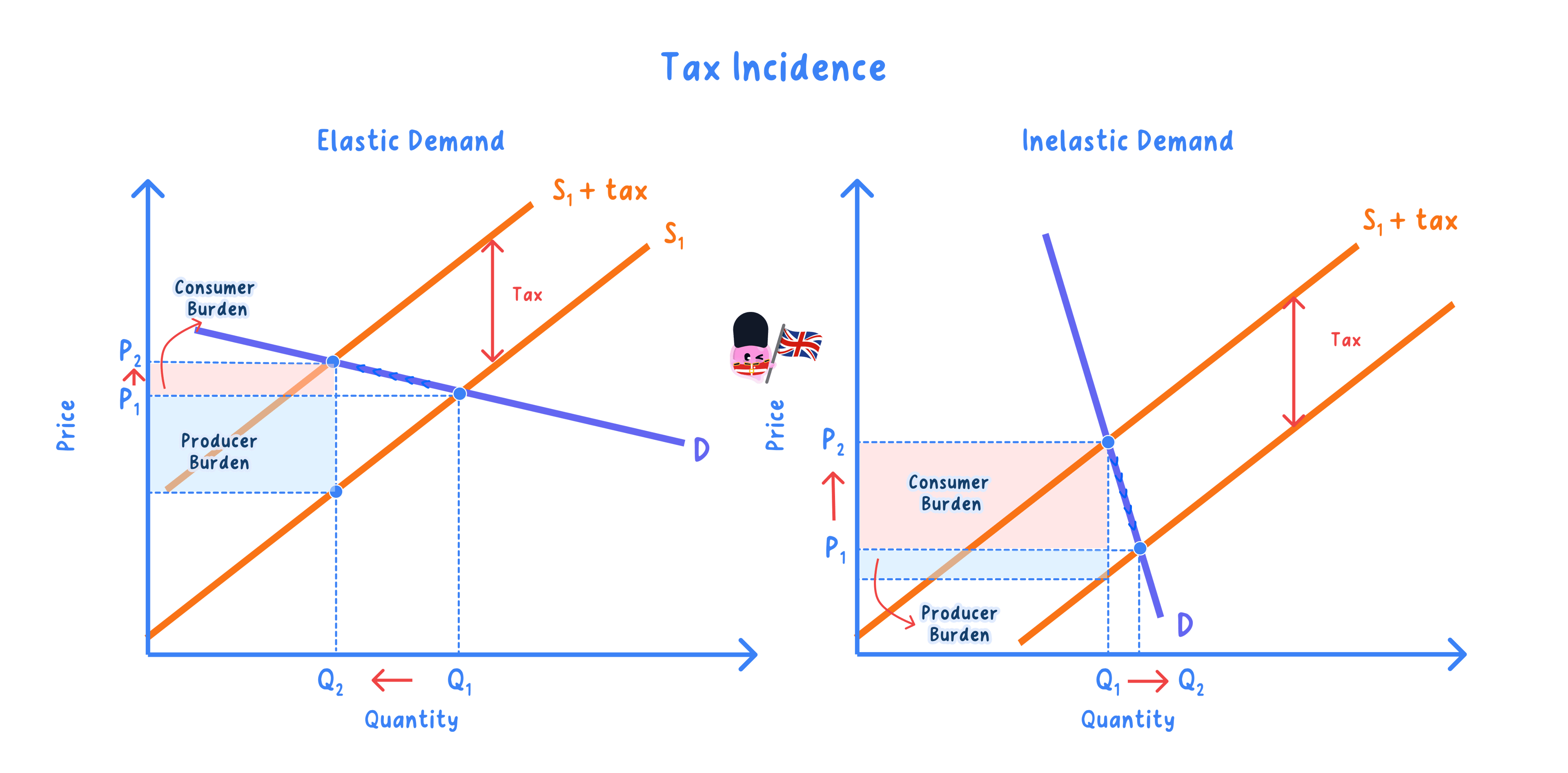
- How far the burden falls on consumers or producers depends on price elasticity.
Worked Example: Splitting an Indirect Tax Between Consumers and Producers
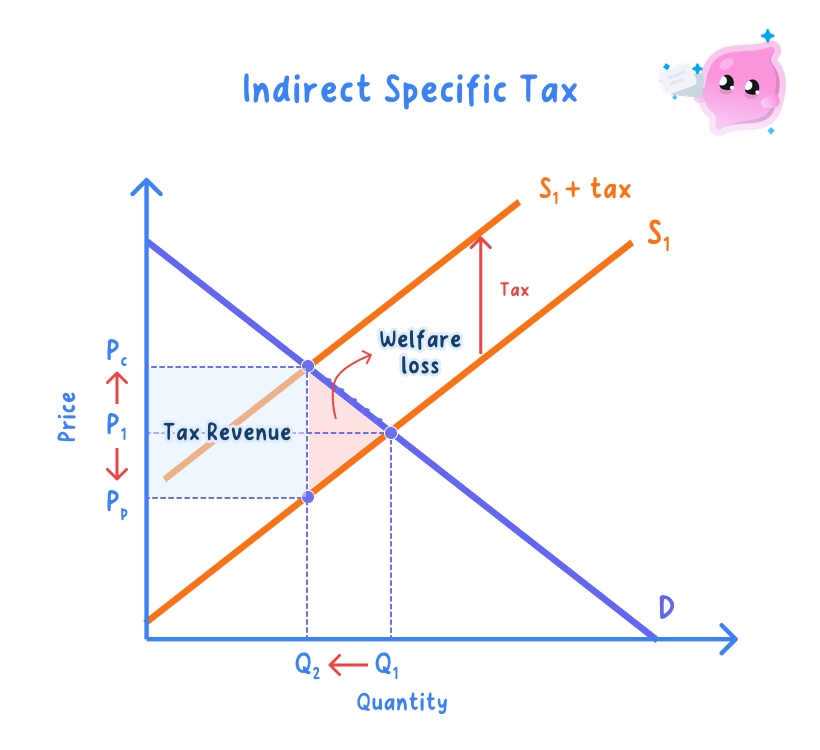
- A per-unit indirect tax shifts the supply curve vertically upwards from SSS to S+taxS+\text{tax}S+tax by the exact amount of the tax, since producers need a higher price at every quantity to cover both their costs and the tax.
- The new equilibrium sits where S+taxS+\text{tax}S+tax crosses demand: price rises from P1P_1P1 to P2P_2P2 and quantity falls from Q1Q_1Q1 to Q2Q_2Q2, and the price rise is normally less than the full tax unless demand is perfectly inelastic.
- The more price inelastic demand is relative to supply, the larger the share of the tax passed on to consumers, so the price rise moves closer to the full tax amount.
- Consumer incidence is (P2−P1)×Q2(P_2 - P_1) \times Q_2(P2−P1)×Q2, the producer incidence is (tax−(P2−P1))×Q2(\text{tax} - (P_2 - P_1)) \times Q_2(tax−(P2−P1))×Q2, and government revenue is tax×Q2\text{tax} \times Q_2tax×Q2, which equals the sum of the two incidence rectangles.
- The deadweight welfare loss is the triangle bounded by the demand curve above and the original supply curve below, sitting between Q2Q_2Q2 and Q1Q_1Q1: it represents the mutually beneficial trades that the tax has eliminated.
Example
- A market is initially in equilibrium at P1=£3.00P_1 = \pounds 3.00P1=£3.00 and Q1=100Q_1 = 100Q1=100 units. The government imposes a £2\pounds 2£2 per-unit tax, and the new equilibrium is P2=£4.20P_2 = \pounds 4.20P2=£4.20 and Q2=80Q_2 = 80Q2=80 units.
- The price rise is £4.20−£3.00=£1.20\pounds 4.20 - \pounds 3.00 = \pounds 1.20£4.20−£3.00=£1.20, which is £1.20÷£2.00=60%\pounds 1.20 \div \pounds 2.00 = 60\%£1.20÷£2.00=60% of the tax, so consumers bear 60%60\%60% of the burden and producers bear the remaining 40%40\%40% (£0.80\pounds 0.80£0.80 per unit).
- Consumer incidence =£1.20×80=£96= \pounds 1.20 \times 80 = \pounds 96=£1.20×80=£96. Producer incidence =£0.80×80=£64= \pounds 0.80 \times 80 = \pounds 64=£0.80×80=£64. Government revenue =£2×80=£160= \pounds 2 \times 80 = \pounds 160=£2×80=£160, which checks out as £96+£64=£160\pounds 96 + \pounds 64 = \pounds 160£96+£64=£160.
- Deadweight loss =12×(Q1−Q2)×tax=12×20×£2=£20= \dfrac{1}{2} \times (Q_1 - Q_2) \times \text{tax} = \dfrac{1}{2} \times 20 \times \pounds 2 = \pounds 20=21×(Q1−Q2)×tax=21×20×£2=£20, the value of trades between 80 and 100 units that the tax has wiped out.
Case study
- HMRC's fuel duty and the Soft Drinks Industry Levy (the sugar tax) are UK per-unit taxes designed to correct externalities.
- Because demand for petrol and diesel is relatively price inelastic in the short run, the same incidence logic explains why motorists bear most of fuel duty, while producers absorb only a small share.
Subsidies Encourage Goods We Under-Consume
- A subsidy lowers the price of a merit good or a good with a positive externality.
- It raises consumption towards the socially optimal level.
- The gain is shared between consumers and producers according to elasticity, and the subsidy has an opportunity cost.
Worked Example: Splitting a Subsidy Between Consumers and Producers
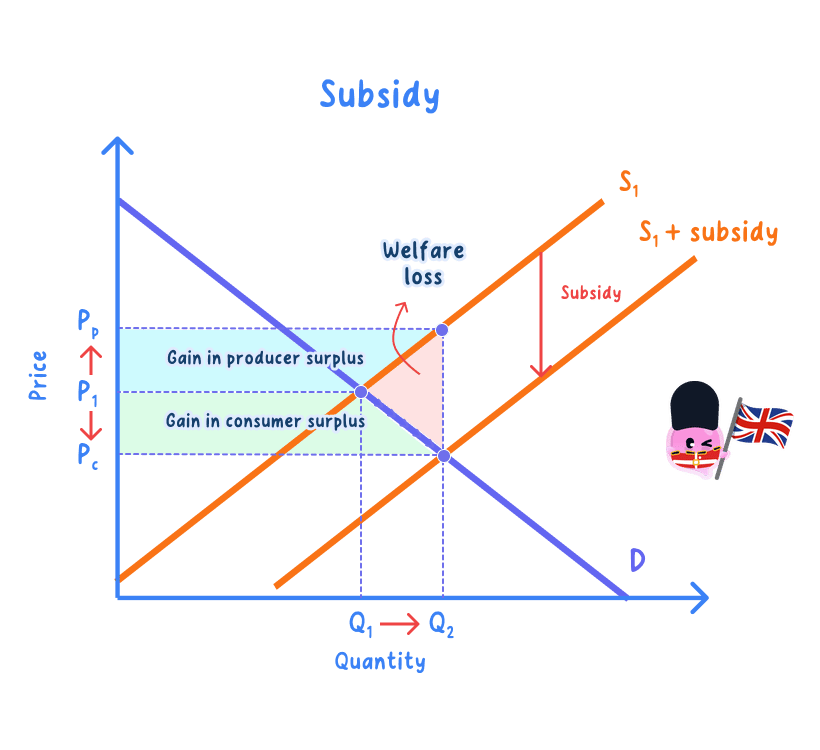
- A per-unit subsidy shifts the supply curve vertically downwards from SSS to S−subsidyS-\text{subsidy}S−subsidy by the exact amount of the subsidy, because producers can accept a lower price at every quantity and still cover their costs once the subsidy is added; the subsidy shifts supply, not demand, even though its purpose is to raise consumption.
- The new equilibrium is where S−subsidyS-\text{subsidy}S−subsidy crosses demand: the price paid by consumers falls from P1P_1P1 to P2P_2P2, and quantity rises from Q1Q_1Q1 to Q2Q_2Q2.
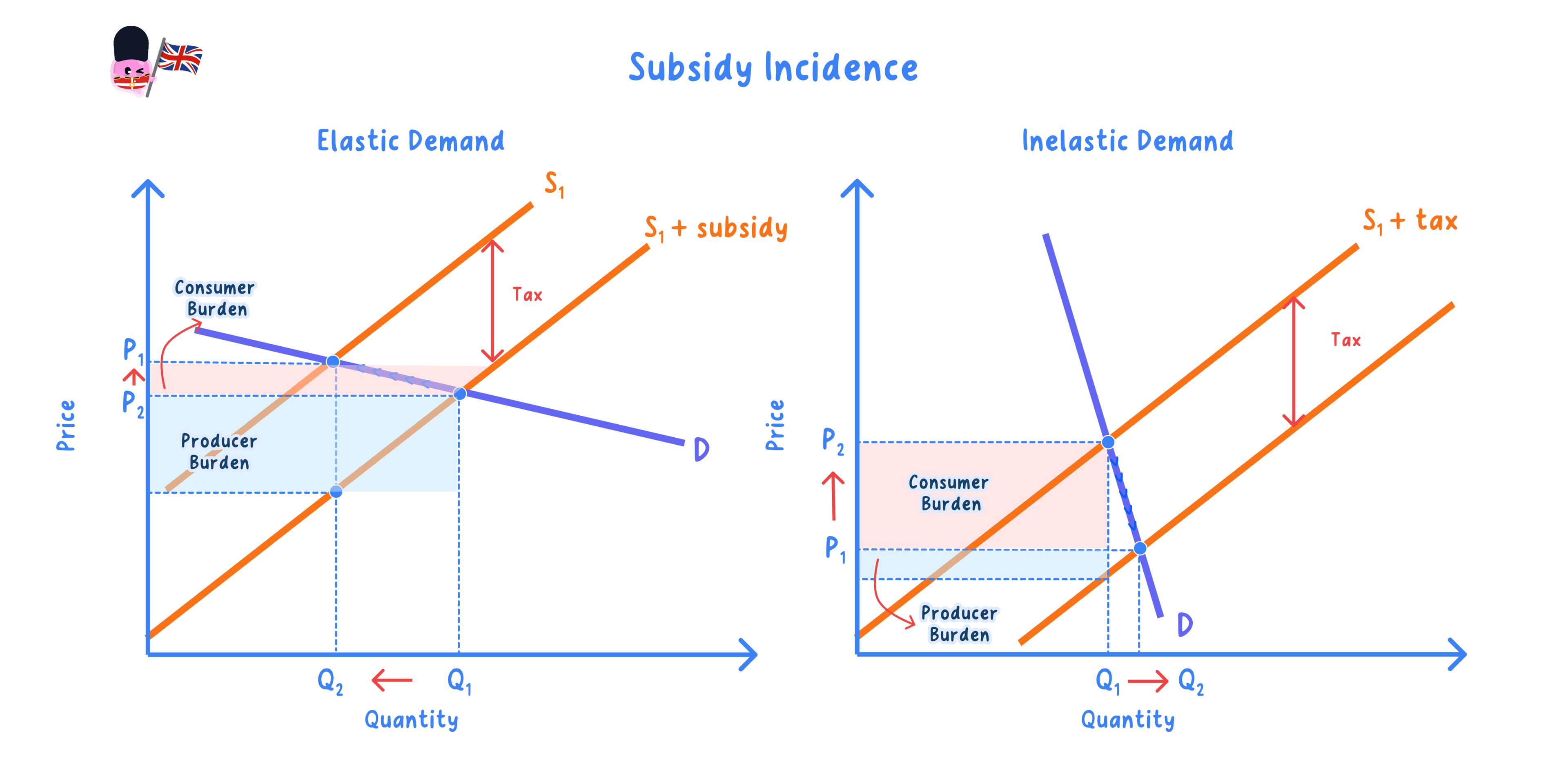
- The more price inelastic demand is relative to supply, the larger the share of the subsidy that is passed on to consumers as a lower price.
- Consumer gain is (P1−P2)×Q2(P_1 - P_2) \times Q_2(P1−P2)×Q2, producer gain is (subsidy−(P1−P2))×Q2(\text{subsidy} - (P_1 - P_2)) \times Q_2(subsidy−(P1−P2))×Q2, and total government spending is subsidy×Q2\text{subsidy} \times Q_2subsidy×Q2, since every unit sold receives the subsidy.
- If the subsidy is set larger than the true marginal external benefit, it pushes output beyond the social optimum, creating a welfare loss triangle between the original supply curve and demand, running from the social optimum out to the new, over-subsidised quantity.
Example
- A merit good is initially in equilibrium at P1=£5.00P_1 = \pounds 5.00P1=£5.00 and Q1=100Q_1 = 100Q1=100 units. The government introduces a £2\pounds 2£2 per-unit subsidy, and the new equilibrium is P2=£3.80P_2 = \pounds 3.80P2=£3.80 and Q2=120Q_2 = 120Q2=120 units.
- The price fall is £5.00−£3.80=£1.20\pounds 5.00 - \pounds 3.80 = \pounds 1.20£5.00−£3.80=£1.20, which is £1.20÷£2.00=60%\pounds 1.20 \div \pounds 2.00 = 60\%£1.20÷£2.00=60% of the subsidy, so consumers gain 60%60\%60% of the benefit and producers keep the remaining 40%40\%40% (£0.80\pounds 0.80£0.80 per unit).
- Consumer gain =£1.20×120=£144= \pounds 1.20 \times 120 = \pounds 144=£1.20×120=£144. Producer gain =£0.80×120=£96= \pounds 0.80 \times 120 = \pounds 96=£0.80×120=£96. Total government spending =£2×120=£240= \pounds 2 \times 120 = \pounds 240=£2×120=£240, which checks out as £144+£96=£240\pounds 144 + \pounds 96 = \pounds 240£144+£96=£240.
- That £240\pounds 240£240 is the opportunity cost of the subsidy: the same money could instead have funded other public spending, so a subsidy is never a free way of raising output.
Case study
- Contracts for Difference for offshore wind, and the former plug-in car grant for electric vehicles, are UK examples of subsidies used to correct positive externalities.
- Because total government spending on a subsidy rises with the quantity subsidised, schemes like these are often capped or tapered once take-up is stronger than expected.
Hint
- A subsidy shifts the supply curve (to the right, or downwards), never the demand curve.
- It is producers who receive the payment from the government, so the diagram must show a new, lower supply curve, even though the policy's aim is to raise consumption.
Price Controls Set Maximum or Minimum Prices
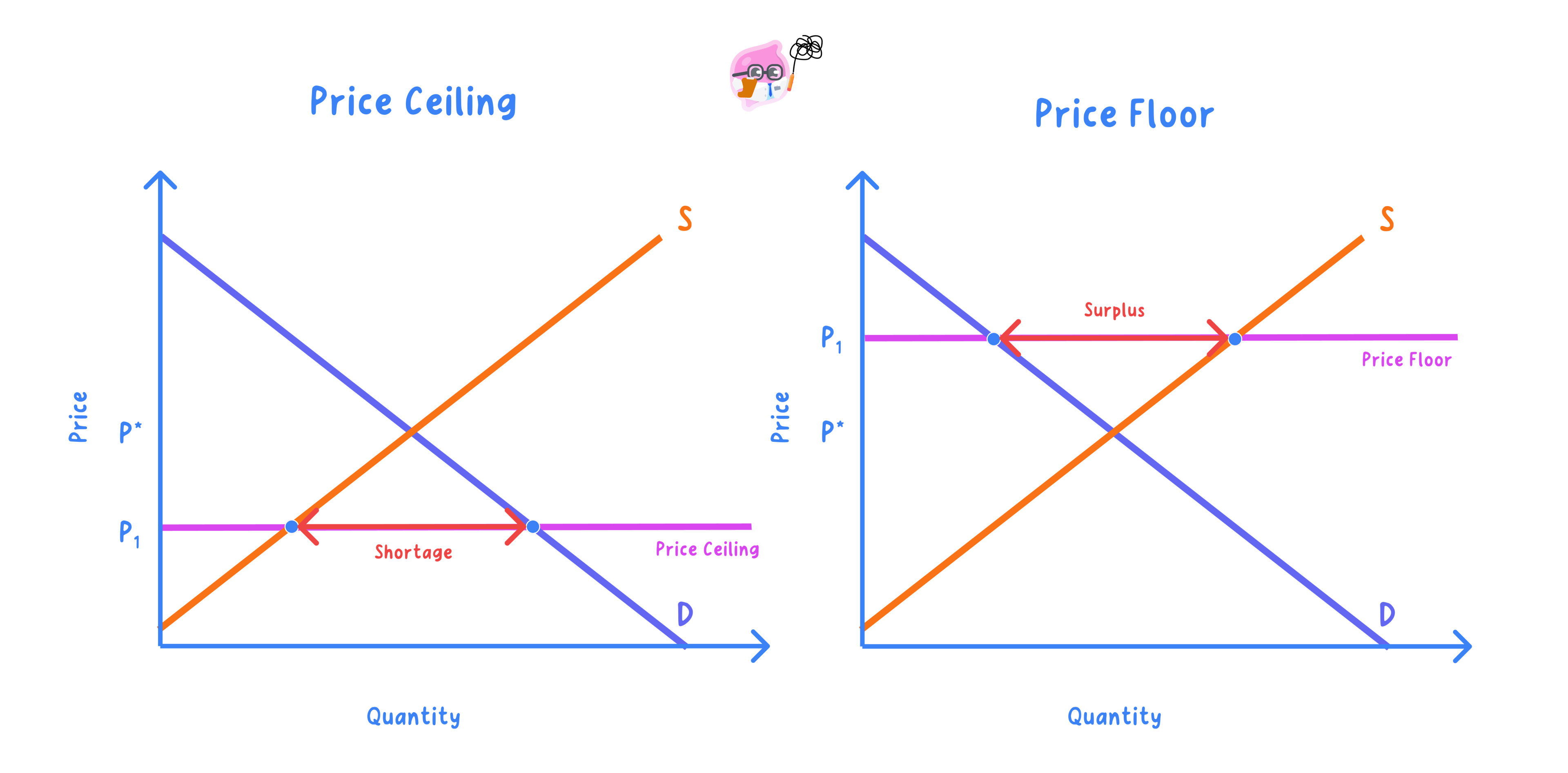
- A maximum price (ceiling) set below equilibrium keeps a good affordable but causes excess demand and shortages.
- A minimum price (floor) set above equilibrium supports producers or cuts consumption of demerit goods but causes excess supply.
Example
- A rent cap is a maximum price: it protects tenants but the resulting shortage can mean queues, waiting lists or a decline in the quality of rented housing.
- Scotland's minimum unit price for alcohol is a minimum price on a demerit good, set above the market price to cut the quantity consumed.
Self review
- Name four instruments a government can use to correct market failure.
- How does an indirect tax set equal to the external cost move output to the social optimum?
- Why does more inelastic demand mean consumers bear a larger share of an indirect tax?
- Does a subsidy shift the demand curve or the supply curve, and in which direction?
- In the tax worked example, a £2\pounds 2£2 tax raised price from £3.00\pounds 3.00£3.00 to £4.20\pounds 4.20£4.20 and cut quantity from 100100100 to 808080. Recalculate consumer incidence, producer incidence and government revenue if the price had instead risen to £4.60\pounds 4.60£4.60.
- Explain why a maximum price causes a shortage and a minimum price causes a surplus.
