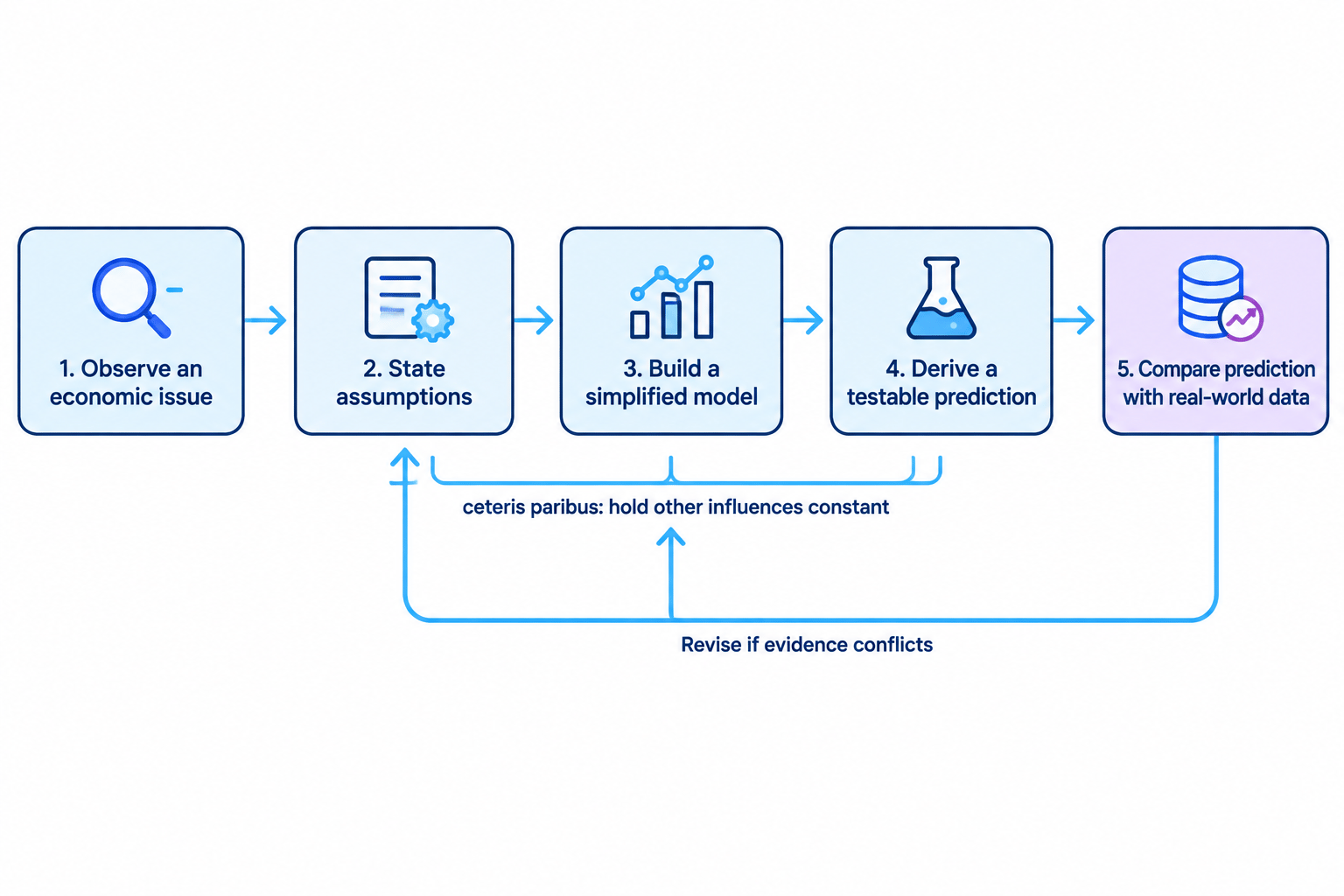
Economics as a Social Science: A Way of Thinking, Not a List of Facts
Definition
Positive statement: an objective statement about what is, which can in principle be tested against factual evidence.
Normative statement: a subjective statement about what ought to be, based on a value judgement and so cannot be proven true or false by evidence.
- Economics is a social science: it studies how people and societies choose to use scarce resources.
- Like the natural sciences it builds and tests theories, but its subject is human behaviour, which is far less predictable.
- Because a whole economy cannot be put in a laboratory, economists rely on simplifying models instead of controlled experiments.
Note
- A model is a deliberate simplification that isolates one relationship at a time.
- Ceteris paribus, meaning other things equal, is the assumption that makes this possible.
Building a Model: Assumptions, Ceteris Paribus and Testing
- Assumptions
- Simplifications, such as rational behaviour, that make a problem manageable.
- Ceteris paribus
- Holding all other influences constant so the effect of one variable can be isolated.
- Testing
- Comparing a model's predictions against real-world data to judge whether it holds.
Example
- Saying a fall in price raises quantity demanded, ceteris paribus, isolates price from income, tastes and other influences.
- Without that assumption, too many things would change at once to see any single relationship.
Simplified Models Are Still Useful
- A model does not need to be realistic in every detail to make accurate predictions.
- Isolating one variable reveals cause and effect that would otherwise be buried in the data.
- Models give economists a shared framework for debating policy precisely.
Modelling Human Behaviour Has Real Limits
- People are not always rational, so models built on that assumption can mispredict, a theme developed in behavioural economics (1.2).
- Because controlled experiments are rarely possible, it is hard to prove one theory right and another wrong.
- A model is only as good as its assumptions, so unrealistic ones can produce misleading conclusions.
- Used carefully, though, models remain the most powerful tool economists have for making sense of a complex world.
Always State the Assumptions Behind a Model
Exam technique
- Say ceteris paribus when you isolate one variable, to show you know other things are held constant.
- Treat models as tools, and be ready to question their assumptions in evaluation.
- Support claims with real-world evidence where you can, since economics is empirical.
Common Mistake
- Do not dismiss a model simply because it is unrealistic.
- A simplification can still predict well, which is what matters.
- Do not treat ceteris paribus as a claim that nothing else ever changes.
- It is an analytical assumption used to isolate one effect, not a description of the real world.
Positive and Normative: Separating What Is from What Ought to Be
- A positive statement is an objective claim about what is, which can in principle be tested against evidence.
- A normative statement is a subjective claim about what ought to be, resting on a value judgement.
- Telling them apart matters because facts and opinions play very different roles in economic argument.
Note
- Positive statements can be shown true or false by evidence.
- Normative statements express what someone believes is desirable and cannot be settled by data alone.
Signal Words Reveal Which Kind of Statement You Are Reading
- A positive statement
- For example, a rise in the minimum wage increases unemployment among low-skilled workers.
- A normative statement
- For example, the government ought to raise the minimum wage.
- The signal words
- Words such as should, ought, fair or too high usually flag a normative claim.
Note
- The positive claim can be checked by looking at what actually happens to employment.
- The normative claim cannot, because whether the government ought to act depends on values, not just facts.
Value Judgements Shape Economic Policy
- Economists often agree on the positive analysis but disagree on policy because they hold different values.
- A policy choice combines a positive judgement about likely effects with a normative judgement, shaped by moral and political values, about what is desirable.
- Being clear about which is which makes economic debate more honest and precise.
Example
- In the UK debate over austerity after 2010, economists broadly agreed on the positive analysis that cutting government spending would, ceteris paribus, reduce aggregate demand in the short run.
- They still disagreed sharply on policy, because whether faster deficit reduction was worth the lost output and jobs was a normative judgement resting on political and moral values.
Economics Can Never Be Entirely Value-Free
- Even choosing which questions to study and which data to collect involves value judgements.
- Positive statements can carry hidden assumptions, so the line between the two is not always clean.
- Keeping the distinction in view still improves reasoning, because it separates evidence from opinion.
Exam technique
- Scan a statement for words like should, ought or fair to identify a normative claim.
- Ask whether the statement could in principle be tested against evidence to identify a positive one.
- In evaluation, separate the positive effects of a policy from the normative question of whether it is worth it.
Common Mistake
- Do not assume a positive statement must be true.
- Positive means testable, not correct, so a positive claim can still turn out false.
- Do not treat a confident opinion as a fact.
- Strong wording does not turn a value judgement into a positive statement.
Self review
- Why is economics classed as a social science, and how does its method differ from the natural sciences?
- Explain the ceteris paribus assumption and why economists use it.
- Why can a model be useful even if its assumptions are unrealistic?
- Define a positive statement and a normative statement, and give one test for telling them apart.
- How do value judgements influence economic decision making and policy?
- Why do economists often agree on the analysis but disagree on the policy?