UK Competition Policy Keeps Markets Competitive in Consumers' Interests
Definition
Competition policy: the set of government measures designed to promote competition and prevent the abuse of monopoly power, in order to protect consumers from higher prices and restricted output.
- Competition policy is the set of measures that keep markets competitive.
- It aims to stop firms abusing market power, in consumers' interests.
- In the UK the Competition and Markets Authority (CMA) enforces it, alongside sector regulators.
Note
- Policy is a package of measures, not a single tool.
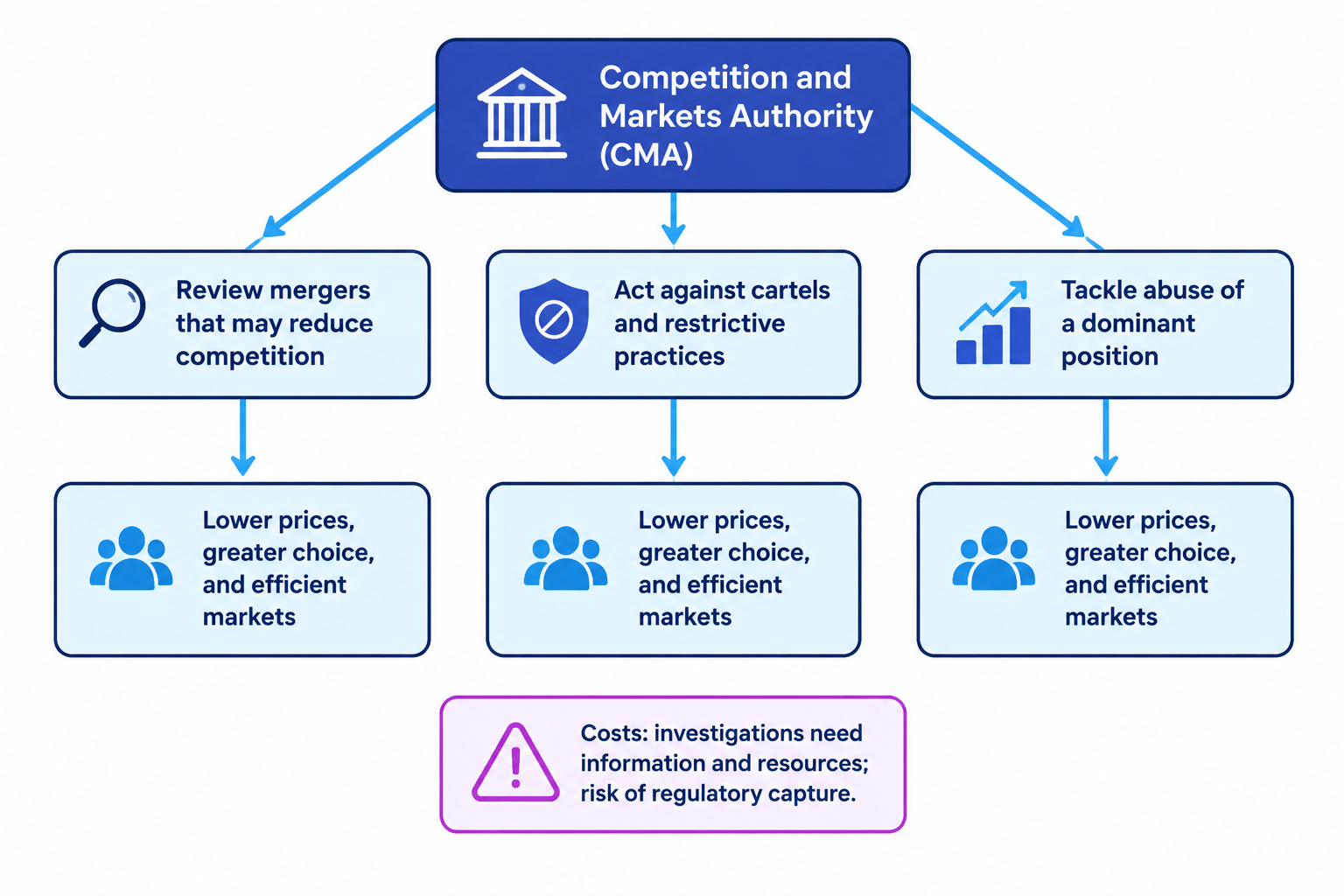
- The CMA investigates mergers, restrictive practices and abuse of dominance.
What the CMA Does
- It investigates mergers that would reduce competition.
- It acts against cartels and restrictive practices.
- It tackles firms abusing a dominant position.
Example
- The CMA can block a merger that would create a dominant firm.
- It can fine firms found running a price-fixing cartel.
UK Policy Sits Alongside EU Competition Policy
- EU competition policy pursues the same broad aims across member states: controlling mergers, banning cartels and restricting abuse of a dominant position.
- UK policy has long mirrored these principles, and large cross-border cases can still fall under EU rules.
- Both regimes exist to protect competition and consumers.
Governments Intervene to Curb the Harms of Monopoly Power
- Monopoly power can bring higher prices and restricted output.
- It can also cause allocative and productive inefficiency.
- Policy aims to curb these harms, though enforcement has costs.
The Benefits Must Be Weighed Against the Costs
- Well-designed policy can lower prices, raise output and improve efficiency and consumer welfare.
- But enforcement and information costs can be high, and firms may find ways around the rules.
- There is also a risk of regulatory capture blunting the intended gains.
- On balance, competition policy works only as well as it is designed, informed and enforced.
Case study
- In 2019 the CMA blocked the proposed merger of Sainsbury's and Asda, ruling that combining two of the UK's largest supermarket chains would likely raise prices and reduce choice for shoppers, including at their fuel forecourts.
- The case shows the trade-off in practice: consumers were protected from higher prices, but the blocked deal also meant the two firms lost any efficiency savings the merger might genuinely have delivered.
Treat Policy as a Package and Weigh Its Costs
Exam technique
- List several tools, from merger control to tackling abuse of dominance.
- Name the CMA as the UK enforcer and note EU policy as wider context.
- Weigh the benefits of intervention against enforcement costs and the risk of capture.
Common Mistake
- Do not treat competition policy as a single tool; it is a package of measures enforced by the CMA.
- Do not assume intervention always improves outcomes; it can carry unintended costs and be hard to enforce.
Self review
- What is competition policy and who enforces it in the UK?
- Name three things the CMA investigates.
- How does UK policy relate to EU competition policy?
- Why do governments intervene against monopoly power?
- Give one benefit and one cost of competition policy.
- Using the Sainsbury's-Asda case, explain one benefit and one cost of the CMA blocking the merger.