Revision notes for AQA A Level Computer Science Relational databases. Open the guide for explanations and worked examples. Written against the AQA A Level Computer Science specification, so the content matches what's examinable rather than general Computer Science background.
Relational databases
What you'll learn
- How a relational database stores data in tables called relations.
- What attributes, primary keys, composite primary keys and foreign keys mean.
- How keys connect separate tables without duplicating the same data everywhere.
- How to choose sensible keys in a simple database design.
The big idea: data in related tables
A database is an organised collection of data that can be searched, updated and managed. In a relational database, the data is not stored as one enormous list. Instead, it is split into tables that represent different things, such as students, courses or enrolments.
An entity is a thing about which data is stored. For example, STUDENT could be an entity, and each student would be one row in the student table.
Definition
Relational database
A relational database is a database made up of related tables, called relations. Each table stores data about one type of entity, and relationships between tables are represented using matching key values.
Key Idea
Tables are linked by data values
A relational database does not usually store one table physically “inside” another. Instead, rows in different tables are connected by shared identifier values, such as a StudentID appearing in both STUDENT and ENROLMENT.
Why split data into tables?
Suppose a school stored every course enrolment in one large table:
| StudentID | StudentName | CourseID | CourseName | Teacher |
|---|---|---|---|---|
| 1001 | Amelia Roberts | C101 | Mathematics | Mr Smith |
| 1002 | Benjamin Clark | C101 | Mathematics | Mr Smith |
| 1003 | Chloe Patel | C104 | Computer Science | Mr Brown |
The course name and teacher may be repeated many times. If Mr Smith is replaced, every matching row must be updated. If one row is missed, the data becomes inconsistent.
A relational design stores course details once in a COURSE table, then uses a key value such as CourseID to refer to that course from other tables.
Example
Reducing duplicated course data
-
Identify the repeated data:
CourseNameandTeacherare repeated for every student taking the same course. -
Separate the repeated course data into its own table:
COURSEcan storeCourseID,CourseNameandTeacheronce per course. -
Keep only the link in the enrolment table:
ENROLMENTstoresStudentIDandCourseID, so each row says which student takes which course. -
The design now needs fewer repeated values, and changing a course teacher requires one update in
COURSErather than many updates inENROLMENT.
Relations, records and attributes
Definition
Relation
A relation is a table in a relational database. It is made up of rows and columns, and it normally stores one type of entity.
A record is one row in a table. It represents one instance of the entity. For example, one row in STUDENT represents one student.
Definition
Attribute
An attribute is a named column in a table. It stores one piece of data about each record, such as Surname, DateOfBirth or CourseID.
For example:
STUDENT(StudentID, Forename, Surname, TutorGroup)
Here, StudentID, Forename, Surname and TutorGroup are attributes of the STUDENT relation.
Primary keys
When a table contains many records, the database needs a reliable way to identify exactly one row.
Definition
Primary key
A primary key is an attribute, or set of attributes, chosen to uniquely identify each record in a table. A primary key value must not be repeated in that table, and every record must have a value for it.
A good primary key should be:
- unique — no two rows have the same value
- present — every row has a value
- stable — it should not need to change often
Names are usually poor primary keys because two people can have the same name, and names can change.
Example
Choosing a primary key
Consider this STUDENT table:
| StudentID | Name | DateOfBirth | TutorGroup |
|---|---|---|---|
| 1001 | Amelia Roberts | 2008-06-05 | 12A |
| 1002 | Amelia Roberts | 2008-06-05 | 12B |
| 1003 | Ben Clark | 2008-02-21 | 12A |
-
Test
Name: two students are called Amelia Roberts, soNamecannot uniquely identify a row. -
Test
DateOfBirthandTutorGroup: both values can repeat, so neither attribute uniquely identifies a student. -
Test
StudentID: each value is different, and the school controls the assignment of IDs, soStudentIDis the best primary key.
Common Mistake
Using a name as a primary key
A person’s name is rarely safe as a primary key. The exam may include duplicate names deliberately, so always check whether the attribute uniquely identifies every record.
Composite primary keys
Sometimes one attribute alone is not enough to identify a row, but a combination of attributes is enough.
Definition
Composite primary key
A composite primary key is a primary key made from two or more attributes. The combination of values must be unique, although each individual attribute may repeat.
Composite primary keys are common in tables that represent a relationship between two other tables. For example, a student can enrol on many courses, and a course can have many students. The pair StudentID and CourseID can identify one specific enrolment.
Foreign keys
A relational database becomes “relational” because tables can refer to each other.
Definition
Foreign key
A foreign key is an attribute, or set of attributes, in one table that refers to the primary key of another table. It creates a relationship between the tables and helps maintain referential integrity, meaning links point to existing records.
For example, if ENROLMENT.StudentID is a foreign key referring to STUDENT.StudentID, then every student ID stored in ENROLMENT should match a real student in STUDENT.
Tip
Spotting a foreign key
If an attribute’s values look like identifiers from another table, ask: “Can this value be checked against that other table’s primary key?” If yes, it is probably a foreign key.
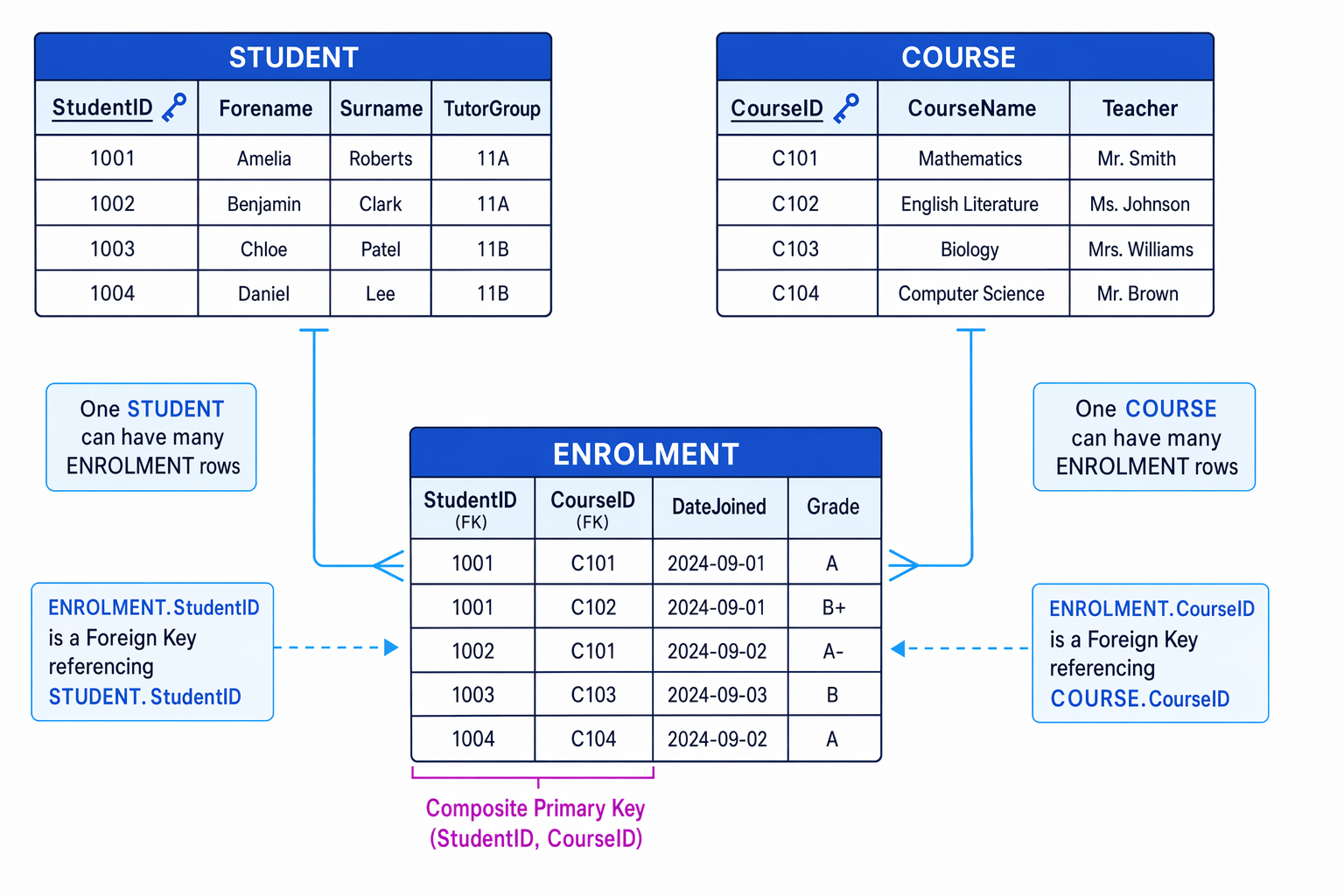
The diagram below shows the complete picture: STUDENT and COURSE each have their own primary key, while ENROLMENT uses foreign keys to connect them. Notice that the same identifier can appear many times in ENROLMENT, but only once in the table where it is the primary key.
Example
Choosing keys for enrolments
Suppose ENROLMENT contains these pairs of values: (1001, C101), (1001, C102), (1002, C101) and (1003, C103).
-
Test
StudentIDalone:1001appears in two rows, so it does not identify one enrolment uniquely. -
Test
CourseIDalone:C101appears in two rows, so it also does not identify one enrolment uniquely. -
Test the combination
StudentIDandCourseID: each pair appears once, so the pair identifies one student on one course. -
Decide the key roles:
StudentIDandCourseIDtogether form the composite primary key ofENROLMENT, while each individual attribute is also a foreign key to its original table.
Common Mistake
Foreign keys are not necessarily unique
A foreign key value often repeats. For example, many enrolment rows may contain CourseID C101 because many students can take the same course.
Writing table designs clearly
In exam answers, it is useful to write each relation with its attributes in brackets. Flag the primary key attributes clearly.
For example:
STUDENT(StudentID, Forename, Surname, TutorGroup)COURSE(CourseID, CourseName, Teacher)ENROLMENT(StudentID,CourseID, DateJoined, Grade)
In ENROLMENT, the primary key is composite: StudentID and CourseID together identify each row. Both are also foreign keys:
ENROLMENT.StudentIDrefers toSTUDENT.StudentIDENROLMENT.CourseIDrefers toCOURSE.CourseID
Relationships in plain English
You should be able to explain relationships without overcomplicating them:
- One student can have many enrolment records.
- One course can have many enrolment records.
- Each enrolment record belongs to one student and one course.
This is how a many-to-many relationship between students and courses is represented using an extra table. A many-to-many relationship means many records in one table can be associated with many records in another table.
Key Idea
Keys give tables their meaning
A table’s primary key identifies its own rows. A foreign key points to rows in another table. A composite primary key uses a combination of attributes when one attribute alone is not enough.
Exam technique
In the exam
-
When defining a relational database, mention tables/relations, rows/records, columns/attributes and links using keys.
-
For a primary key, always state that it uniquely identifies a record in its table.
-
For a composite primary key, make clear that the combination is unique, even if the individual attributes repeat.
-
For a foreign key, state both sides: the table containing the foreign key and the primary key table it refers to.
Self review
Check yourself
- Why would
Nameusually be a poor choice of primary key for aSTUDENTtable? - In
ENROLMENT(StudentID, CourseID, DateJoined), why mightStudentIDandCourseIDtogether form a composite primary key? - What problem could occur if a foreign key value did not match any primary key value in the referenced table?