Alkenes
What you'll learn
- What alkenes are, and why the carbon–carbon double bond is reactive.
- How to name alkenes and recognise structural and E/Z stereoisomers.
- How electrophilic addition reactions happen, including the curly-arrow mechanism.
- The key reactions of alkenes: bromine water, hydrogen halides, hydrogenation and hydration.
Starting point: what is an alkene?
Alkenes are hydrocarbons, meaning they contain only carbon and hydrogen. They are part of a homologous series: a family of organic compounds with the same functional group and similar chemical reactions.
The functional group in alkenes is the carbon–carbon double bond, C=C.
Alkene
An alkene is an unsaturated hydrocarbon containing at least one carbon–carbon double bond. Acyclic alkenes with one C=C bond have the general formula CnH2n\text{C}_n\text{H}_{2n}CnH2n.
“Unsaturated” means the molecule does not contain the maximum possible number of hydrogen atoms. This is because a C=C double bond could be opened up to add more atoms.
For example:
- ethene: C₂H₄
- propene: C₃H₆
- butene: C₄H₈
The C=C bond: sigma and pi bonding
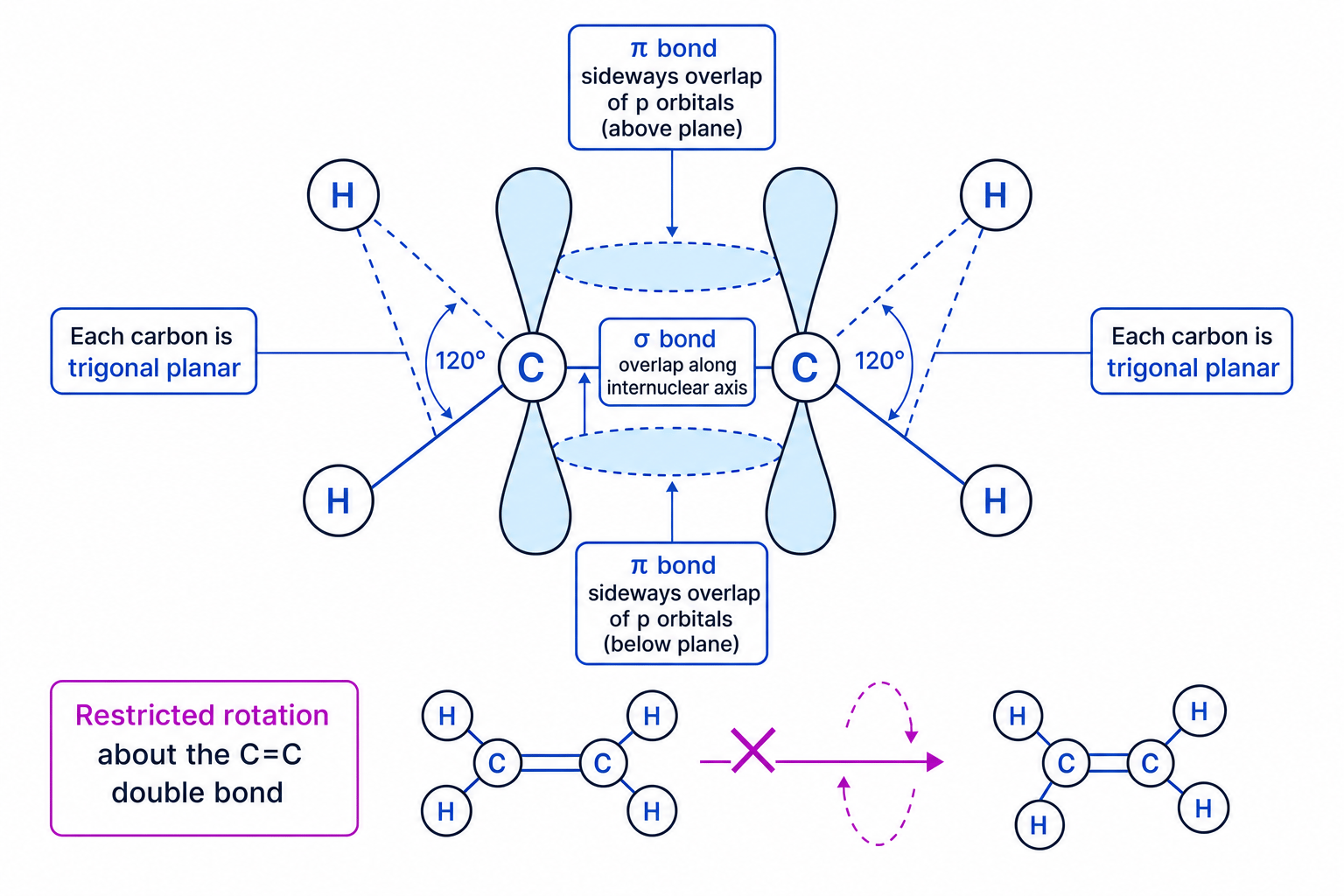
A carbon–carbon double bond is not simply “two identical bonds”. It contains:
- one sigma bond, formed by direct overlap of orbitals along the line between the two carbon nuclei
- one pi bond, formed by sideways overlap of p orbitals above and below the plane of the molecule
Pi bond
A pi bond is a covalent bond formed by sideways overlap of p orbitals. In alkenes, the pi bond sits above and below the C–C sigma bond and contains electron density exposed to attack by electrophiles.
The pi bond is weaker than the sigma bond and is more exposed. This makes alkenes much more reactive than alkanes.
Each carbon in the C=C bond is trigonal planar, with bond angles of about 120°. Rotation about the C=C bond is restricted because rotating would break the pi bond.
Why alkenes react
Alkenes react mainly because the C=C bond is electron-rich. The pi bond can attract electrophiles and then break, allowing new sigma bonds to form.
Naming alkenes
Alkenes use the suffix -ene. The parent chain must include the C=C bond, and the double bond is given the lowest possible number.
For example:
- CH₂=CH₂ is ethene
- CH₂=CHCH₃ is propene
- CH₂=CHCH₂CH₃ is but-1-ene
- CH₃CH=CHCH₃ is but-2-ene
The number tells you the position of the first carbon in the C=C bond.
Naming an alkene
Name the compound CH₃CH₂CH=CHCH₃.
-
Find the longest carbon chain containing the double bond: there are 5 carbons, so the parent name is pentene.
-
Number the chain from the end nearer the double bond. From the right-hand end, the C=C starts on carbon 2; from the left-hand end, it starts on carbon 3.
-
Choose the lower number, so the name is pent-2-ene.
Numbering from the wrong end
Do not number the chain to make a substituent number low before considering the double bond. In alkenes, the C=C bond must get the lowest possible number.
Isomerism in alkenes
An isomer has the same molecular formula as another compound but a different arrangement of atoms.
Alkenes commonly show two types of isomerism:
- structural isomerism, where atoms are connected in different orders
- stereoisomerism, where atoms are connected in the same order but arranged differently in space
Positional isomerism
But-1-ene and but-2-ene are positional isomers because the C=C bond is in a different position.
- but-1-ene: CH₂=CHCH₂CH₃
- but-2-ene: CH₃CH=CHCH₃
E/Z stereoisomerism
Because rotation about the C=C bond is restricted, groups attached to the double bond can be locked into different arrangements.
E/Z stereoisomerism
E/Z stereoisomerism occurs when each carbon atom in a C=C bond has two different groups attached, so restricted rotation creates different spatial arrangements.
To decide whether an alkene is E or Z, use priority rules:
- On each carbon of the C=C bond, compare the two attached atoms.
- The atom with the higher atomic number has higher priority.
- If the two higher-priority groups are on the same side, the isomer is Z.
- If they are on opposite sides, the isomer is E.
Remembering E and Z
Think Z = zame zide. It is not perfect spelling, but it helps: Z means the higher-priority groups are on the same side.
Identifying E/Z isomerism
Decide whether CHCl=CHBr can show E/Z isomerism, and describe the E form.
-
Check each carbon in the C=C bond. The left carbon is attached to H and Cl; the right carbon is attached to H and Br. Each carbon has two different groups, so E/Z isomerism is possible.
-
Assign priorities using atomic number. On the left carbon, Cl has higher priority than H. On the right carbon, Br has higher priority than H.
-
In the E form, the higher-priority groups, Cl and Br, are on opposite sides of the C=C bond.
Confusing E/Z with cis/trans
Cis/trans only works reliably when the same group appears on both carbons of the C=C bond. E/Z is more general because it uses priority rules.
Addition reactions of alkenes
Alkenes usually undergo addition reactions.
Addition reaction
An addition reaction is a reaction where two reactants join together to form one product, with no atoms lost.
In alkene addition reactions, the C=C double bond becomes a C–C single bond. The pi bond breaks and new sigma bonds form.
A general pattern is:
C=C+X−Y→X−C−C−Y\text{C}=\text{C} + \text{X}-\text{Y} \to \text{X}-\text{C}-\text{C}-\text{Y}C=C+X−Y→X−C−C−YElectrophilic addition
Most alkene reactions in this topic are examples of electrophilic addition.
Electrophile
An electrophile is an electron-pair acceptor. It is attracted to electron-rich regions, such as the pi bond in an alkene.
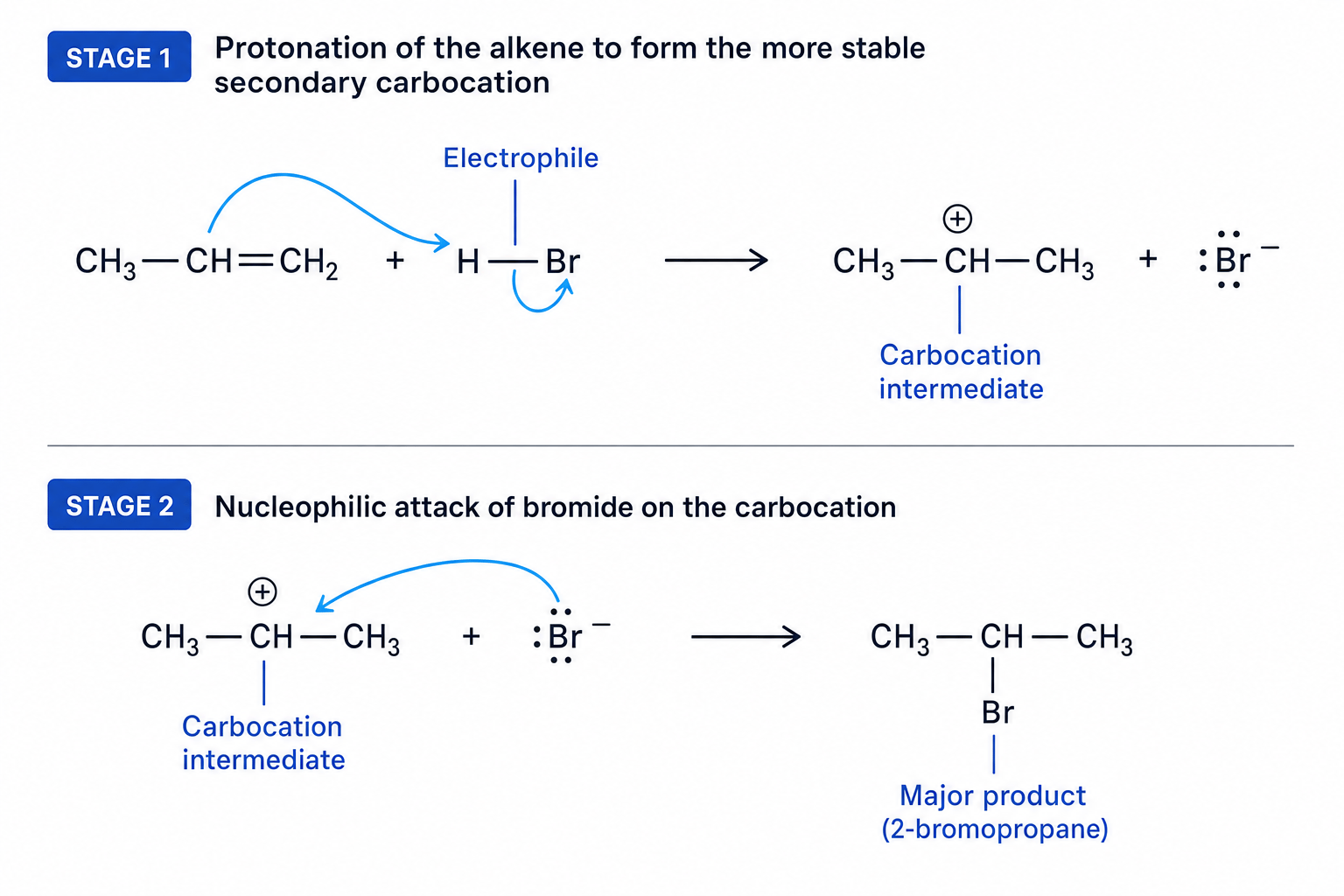
The pi bond donates a pair of electrons to the electrophile. This forms a new bond and usually creates a positively charged intermediate called a carbocation.
Carbocation
A carbocation is an organic ion containing a positively charged carbon atom.
Carbocations are more stable when the positive carbon is bonded to more alkyl groups. For A-Level, the stability order is:
tertiary > secondary > primary
This matters when an unsymmetrical alkene reacts, because the major product forms via the more stable carbocation.
Predicting the major product with HBr
Predict the major product when propene reacts with hydrogen bromide.
-
Identify the two possible ways HBr could add across the double bond. H and Br must add to the two carbons that were originally in the C=C bond.
-
Compare the carbocations that could form after H⁺ adds. If H⁺ adds to the end carbon, the positive charge is on the middle carbon, giving a secondary carbocation. If H⁺ adds to the middle carbon, the positive charge is on the end carbon, giving a primary carbocation.
-
The secondary carbocation is more stable, so it forms more readily. Br⁻ then attacks this carbocation, producing 2-bromopropane as the major product.
Major products
For unsymmetrical alkenes, the major product usually comes from the pathway that forms the more stable carbocation intermediate.
Reaction with bromine water
Alkenes decolourise bromine water. This is the standard chemical test for a C=C bond.
Observation:
- bromine water changes from orange/brown to colourless
For ethene:
CH2=CH2+Br2→CH2BrCH2Br\text{CH}_2=\text{CH}_2 + \text{Br}_2 \to \text{CH}_2\text{BrCH}_2\text{Br}CH2=CH2+Br2→CH2BrCH2BrThe product is 1,2-dibromoethane.
Test for unsaturation
Bromine water is decolourised by alkenes because Br₂ adds across the C=C bond. Alkanes do not decolourise bromine water under normal conditions.
Saying bromine water turns clear
In exam answers, say orange/brown to colourless. “Clear” is ambiguous because orange bromine water is also transparent.
Reaction with hydrogen halides
Hydrogen halides such as HCl, HBr and HI add across the C=C bond to form halogenoalkanes.
Example:
CH2=CH2+HBr→CH3CH2Br\text{CH}_2=\text{CH}_2 + \text{HBr} \to \text{CH}_3\text{CH}_2\text{Br}CH2=CH2+HBr→CH3CH2BrThis is electrophilic addition. The hydrogen halide is polar, so the H atom acts as the electrophilic part.
Hydrogenation: making alkanes
Alkenes react with hydrogen to form alkanes. This is called hydrogenation.
Typical conditions:
- H₂ gas
- nickel catalyst
- heated, often about 150 °C
Example:
CH2=CH2+H2→CH3CH3\text{CH}_2=\text{CH}_2 + \text{H}_2 \to \text{CH}_3\text{CH}_3CH2=CH2+H2→CH3CH3Hydrogenation is used industrially, for example in converting unsaturated vegetable oils into more saturated fats.
Hydration: making alcohols
Alkenes react with steam to form alcohols. This is called hydration.
Typical industrial conditions:
- steam
- phosphoric acid catalyst, H₃PO₄
- high temperature, about 300 °C
- high pressure, about 60 atm or 6000 kPa
Example:
CH2=CH2+H2O⇌CH3CH2OH\text{CH}_2=\text{CH}_2 + \text{H}_2\text{O} \rightleftharpoons \text{CH}_3\text{CH}_2\text{OH}CH2=CH2+H2O⇌CH3CH2OHThis reaction is reversible, so the conditions are chosen to balance rate, yield and cost.
Hydration is reversible
Do not write hydration of alkenes as if it always goes to completion. In industrial ethanol production, the reaction is an equilibrium.
Writing products of alkene addition
Write the product when but-2-ene reacts with steam in the presence of H₃PO₄.
-
Identify the two carbons in the C=C bond: in but-2-ene, the double bond is between carbon 2 and carbon 3.
-
Add H and OH across the double bond. Because but-2-ene is symmetrical, both directions give the same product.
-
Replace the C=C with a C–C single bond and place OH on carbon 2 or carbon 3; these are equivalent here. The product is butan-2-ol.
Addition polymerisation
Alkenes can also undergo addition polymerisation, where many alkene monomers join to form a polymer.
Monomer and polymer
A monomer is a small molecule that can join repeatedly to form a long-chain molecule called a polymer.
For ethene:
nCH2=CH2→[−CH2−CH2−]nn\text{CH}_2=\text{CH}_2 \to \left[-\text{CH}_2-\text{CH}_2-\right]_nnCH2=CH2→[−CH2−CH2−]nThe pi bond opens up, and the carbon atoms link together into a long chain. No small molecule is lost, so this is addition polymerisation.
Drawing repeat units
For addition polymers, keep the same two carbon atoms from the C=C bond in the repeat unit, change C=C to C–C, and put brackets around the repeat unit with an nnn outside.
In the exam
-
For naming, make sure the parent chain includes the C=C bond and give the double bond the lowest possible number.
-
For mechanisms, draw curly arrows from electron pairs: from the C=C pi bond to the electrophile, and from the bond in H–Br to Br.
-
For product prediction, check whether the alkene is symmetrical. If not, compare carbocation stability to predict the major product.
Check yourself
- Why are alkenes more reactive than alkanes?
- What observation would show that an unknown hydrocarbon contains a C=C bond?
- When propene reacts with HCl, why is 2-chloropropane the major product?