

What you'll learn
- What alkanes are, including their bonding, formulae and physical trends.
- How to name branched alkanes and recognise structural isomers.
- How alkanes burn and why incomplete combustion matters.
- How free-radical substitution with halogens works under UV light.
1. What is an alkane?
Carbon forms four covalent bonds. In alkanes, every carbon atom is bonded using single covalent bonds only: C–C and C–H.
Alkane
An alkane is a saturated hydrocarbon containing only single covalent bonds. A hydrocarbon contains carbon and hydrogen only; saturated means it has no carbon–carbon double bonds, so it contains the maximum number of hydrogen atoms for that carbon skeleton.
Open-chain alkanes have the general formula:
CnH2n+2C_nH_{2n+2}CnH2n+2where nnn is the number of carbon atoms. For example, methane is CH₄, ethane is C₂H₆, propane is C₃H₈ and butane is C₄H₁₀.
Alkanes are also tetrahedral around each carbon atom, with bond angles close to 109.5°. The single bonds are σ bonds, and rotation around C–C single bonds is usually possible.
The alkane formula is for open chains
The formula CnH2n+2C_nH_{2n+2}CnH2n+2 applies to non-cyclic alkanes. Cycloalkanes contain a ring and have a different general formula, CnH2nC_nH_{2n}CnH2n.
2. Alkanes as a homologous series
A homologous series is a family of organic compounds with similar chemical reactions, a general formula, and neighbouring members that differ by CH₂.
Alkanes form a homologous series because each successive alkane adds one carbon and two hydrogens. Their chemical reactions are similar because they all contain the same types of bonds: C–C and C–H single bonds.
Physical trends
As alkane chain length increases:
- boiling point increases
- volatility, meaning ease of evaporation, decreases
- viscosity, meaning resistance to flow, increases
- flammability generally decreases because longer chains are harder to vaporise
These trends are mainly due to stronger London forces, which are weak intermolecular attractions caused by temporary dipoles. Larger molecules have more electrons and greater surface contact, so their London forces are stronger.
Physical properties depend on intermolecular forces
Alkanes have similar chemical reactions, but their physical properties change gradually as chain length and branching change because London forces change.
Comparing boiling points
Hexane and 2,2-dimethylbutane both have molecular formula C₆H₁₄. Which has the higher boiling point?
-
Both molecules have the same molecular formula, so the key difference is shape, not molar mass.
-
Hexane is less branched, so its molecules can make more surface contact with each other. This gives stronger London forces.
-
2,2-dimethylbutane is more compact and more branched, so it has weaker London forces. Therefore, hexane has the higher boiling point.
3. Structural isomerism
Structural isomers
Structural isomers are compounds with the same molecular formula but different structural formulae, meaning their atoms are connected in different ways.
For example, C₅H₁₂ has three structural isomers. They contain the same numbers of carbon and hydrogen atoms, but the carbon skeleton is arranged differently.
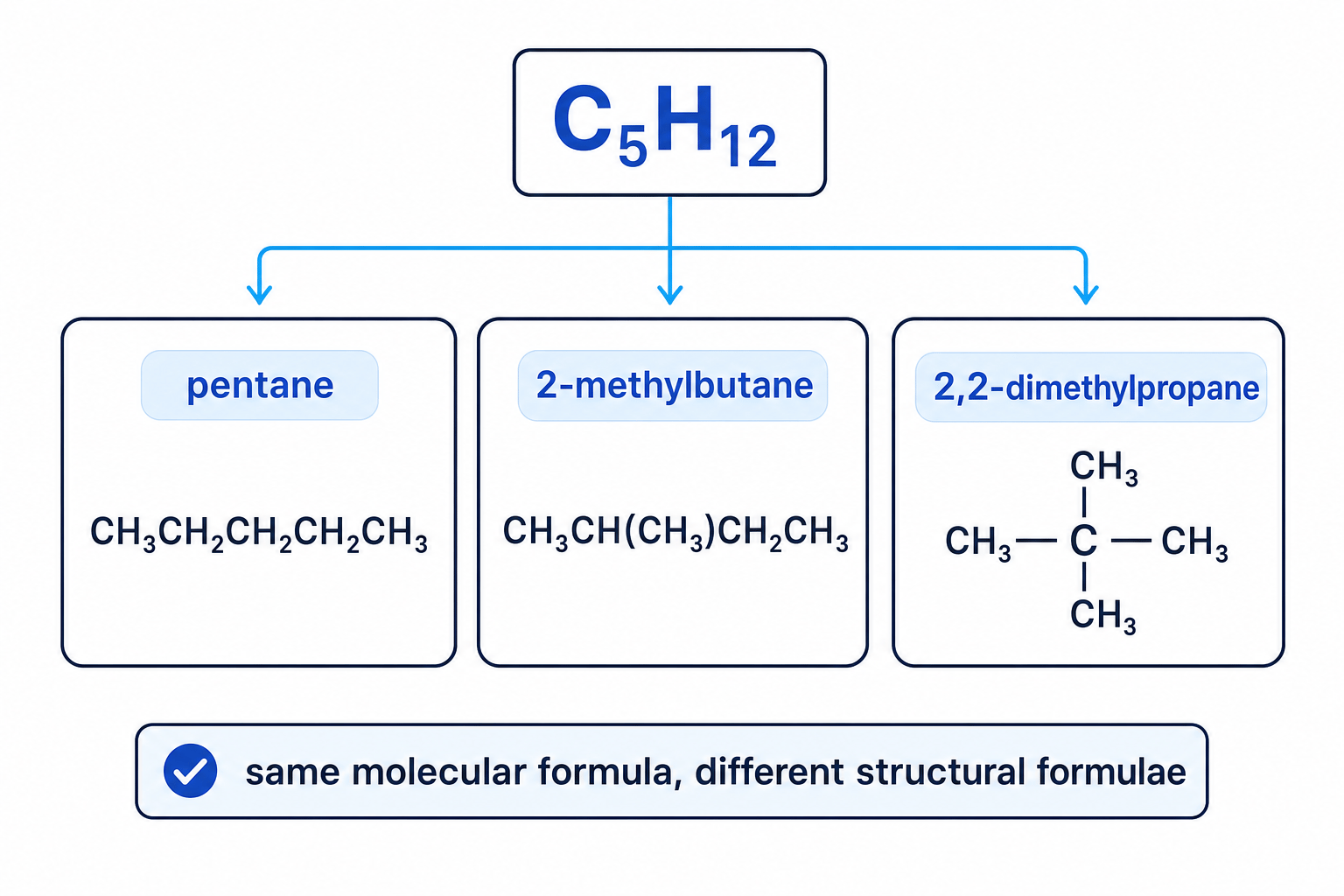
Branching matters because branched isomers have different boiling points from straight-chain isomers. Structural isomerism becomes more important as the number of carbon atoms increases.
4. Naming branched alkanes
A substituent is an atom or group attached to the main carbon chain. In alkanes, common substituents are alkyl groups, such as methyl, CH₃–, and ethyl, C₂H₅–.
To name a branched alkane:
- Find the longest continuous carbon chain.
- Use this chain as the parent name: methane, ethane, propane, butane, pentane, hexane, heptane, octane.
- Number the chain to give the substituents the lowest possible numbers.
- Name and locate each substituent.
- Use prefixes such as di-, tri- and tetra- if the same substituent appears more than once.
Punctuation in organic names
Use commas between numbers and hyphens between numbers and words: for example, 2,3-dimethylpentane. Do not leave spaces in the name.
Naming a branched alkane
Name CH₃CH₂CH(CH₃)CH(CH₃)CH₃.
-
The longest continuous chain has five carbon atoms, so the parent alkane is pentane.
-
Numbering from the right gives methyl groups on carbon 2 and carbon 3. Numbering from the left gives carbon 3 and carbon 4. The lower set of numbers is 2,3.
-
There are two methyl substituents, so use dimethyl. The name is 2,3-dimethylpentane.
5. Sources of alkanes: crude oil and cracking
Crude oil is a mixture of hydrocarbons, including many alkanes. It is separated by fractional distillation, where compounds are separated because they have different boiling points.
Shorter-chain alkanes have lower boiling points and are collected nearer the top of the fractionating column. Longer-chain alkanes have higher boiling points and are collected lower down.
Long-chain hydrocarbons can be broken into shorter, more useful molecules by cracking. Cracking often produces a shorter alkane and an alkene. An alkene is a hydrocarbon containing a C=C double bond.
For example:
C₁₂H₂₆ → C₈H₁₈ + 2C₂H₄
Cracking is useful because shorter alkanes are in high demand as fuels, while alkenes are valuable starting materials for polymers and other chemicals.
6. Combustion of alkanes
Alkanes are widely used as fuels. In complete combustion, there is a plentiful supply of oxygen, producing carbon dioxide and water.
For an open-chain alkane:
CnH2n+2+3n+12O2→nCO2+(n+1)H2O\text{C}_n\text{H}_{2n+2} + \frac{3n+1}{2}\text{O}_2 \to n\text{CO}_2 + (n+1)\text{H}_2\text{O}CnH2n+2+23n+1O2→nCO2+(n+1)H2OCombustion is exothermic because more energy is released when strong C=O and O–H bonds form than is needed to break the original bonds.
Calculating carbon dioxide from complete combustion
10.0 g of octane, C₈H₁₈, is burned completely. Calculate the mass of CO₂ formed.
-
Balance the equation and identify the mole ratio:
2C8H18+25O2→16CO2+18H2O2\text{C}_8\text{H}_{18} + 25\text{O}_2 \to 16\text{CO}_2 + 18\text{H}_2\text{O}2C8H18+25O2→16CO2+18H2O
So 1 mol of octane forms 8 mol of CO₂.
-
Calculate the amount of octane:
n(C8H18)=10.0 g114.0 g mol−1=0.0877 moln(\text{C}_8\text{H}_{18}) = \frac{10.0\ \text{g}}{114.0\ \text{g mol}^{-1}} = 0.0877\ \text{mol}n(C8H18)=114.0 g mol−110.0 g=0.0877 mol
-
Use the mole ratio and molar mass of CO₂:
n(CO2)=8×0.0877=0.702 moln(\text{CO}_2)=8 \times 0.0877=0.702\ \text{mol}n(CO2)=8×0.0877=0.702 mol
m(CO2)=0.702 mol×44.0 g mol−1=30.9 gm(\text{CO}_2)=0.702\ \text{mol} \times 44.0\ \text{g mol}^{-1}=30.9\ \text{g}m(CO2)=0.702 mol×44.0 g mol−1=30.9 g
Incomplete combustion and pollutants
In a limited oxygen supply, incomplete combustion can produce carbon monoxide, CO, or carbon particulates, C, instead of only CO₂.
Carbon monoxide is dangerous because it binds strongly to haemoglobin, reducing the blood’s ability to transport oxygen. Carbon particulates can cause respiratory problems and contribute to global dimming.
Combustion in engines can also produce nitrogen oxides, NOₓ, because nitrogen and oxygen from the air react at high temperatures. Sulfur dioxide, SO₂, can form if sulfur-containing impurities are present in the fuel.
7. Why alkanes are relatively unreactive
Alkanes do not react readily with many common reagents. Their C–C and C–H bonds are strong, and the bonds are effectively non-polar, so alkanes are not easily attacked by nucleophiles or electrophiles.
However, alkanes are not completely unreactive. Their two key reactions at this level are:
- combustion with oxygen
- substitution with halogens under UV light
8. Free-radical substitution
Free radical and homolytic fission
A free radical is a species with an unpaired electron, shown by a dot, such as Cl•. Homolytic fission is bond breaking where each atom takes one electron from the shared pair, forming radicals.
Alkanes react with chlorine or bromine in the presence of UV light. This is a substitution reaction, because one hydrogen atom in the alkane is replaced by a halogen atom.
For methane and chlorine:
CH₄ + Cl₂ → CH₃Cl + HCl
This reaction happens by a free-radical chain mechanism.
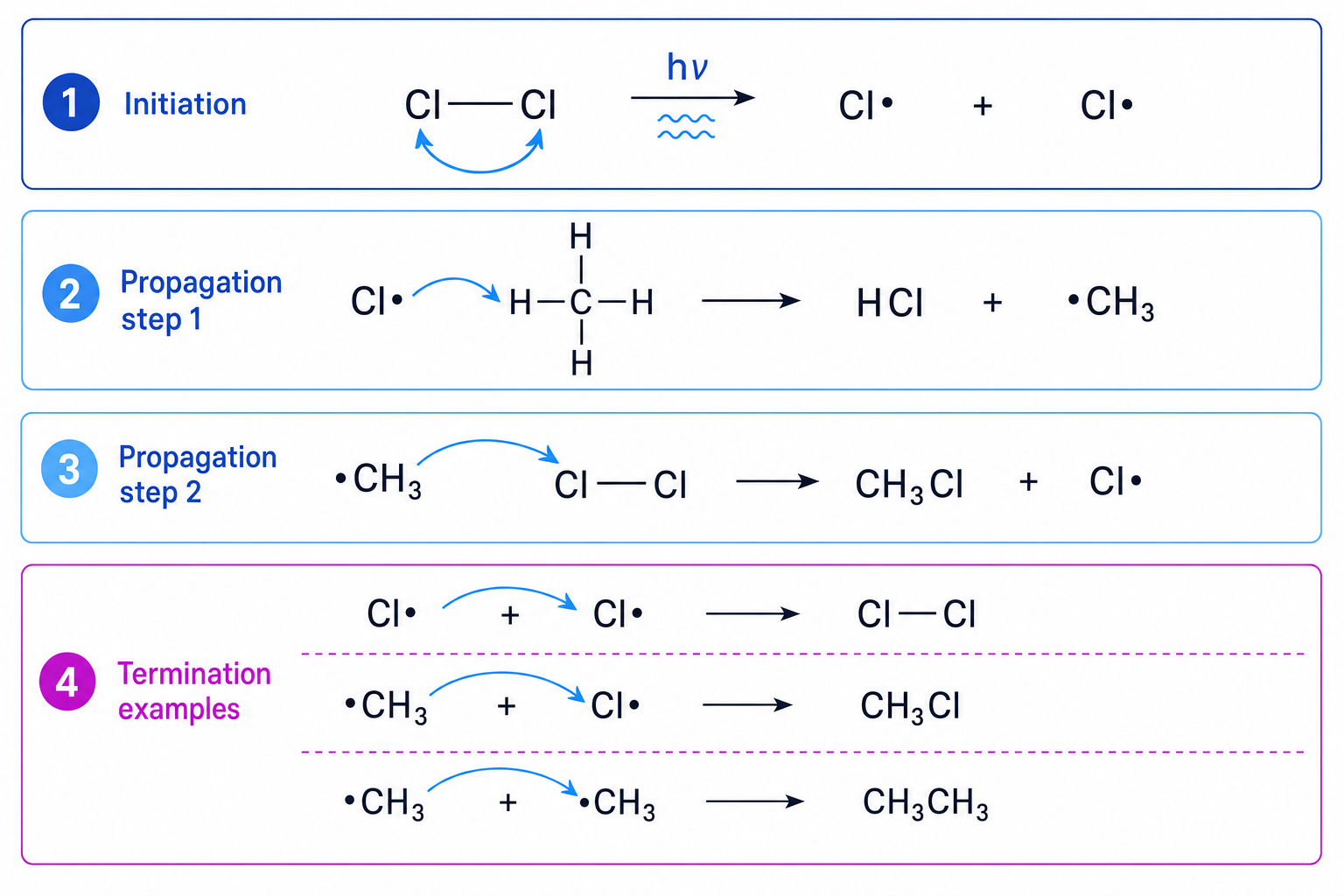
The three stages
Initiation starts the reaction. UV light breaks the Cl–Cl bond by homolytic fission:
Cl2→2Cl∙\text{Cl}_2 \to 2\text{Cl}^{\bullet}Cl2→2Cl∙Propagation keeps the chain going. A radical is used in one step and regenerated in another:
Cl∙+CH4→HCl+CH3∙\text{Cl}^{\bullet} + \text{CH}_4 \to \text{HCl} + \text{CH}_3^{\bullet}Cl∙+CH4→HCl+CH3∙ CH3∙+Cl2→CH3Cl+Cl∙\text{CH}_3^{\bullet} + \text{Cl}_2 \to \text{CH}_3\text{Cl} + \text{Cl}^{\bullet}CH3∙+Cl2→CH3Cl+Cl∙Termination removes radicals when two radicals combine:
Cl∙+Cl∙→Cl2\text{Cl}^{\bullet} + \text{Cl}^{\bullet} \to \text{Cl}_2Cl∙+Cl∙→Cl2 CH3∙+Cl∙→CH3Cl\text{CH}_3^{\bullet} + \text{Cl}^{\bullet} \to \text{CH}_3\text{Cl}CH3∙+Cl∙→CH3Cl CH3∙+CH3∙→C2H6\text{CH}_3^{\bullet} + \text{CH}_3^{\bullet} \to \text{C}_2\text{H}_6CH3∙+CH3∙→C2H6Writing the chlorination mechanism for ethane
Write the key radical steps for forming chloroethane from ethane.
-
Initiation produces chlorine radicals under UV light:
Cl2→2Cl∙\text{Cl}_2 \to 2\text{Cl}^{\bullet}Cl2→2Cl∙
-
In the first propagation step, a chlorine radical removes H from ethane:
Cl∙+C2H6→HCl+C2H5∙\text{Cl}^{\bullet} + \text{C}_2\text{H}_6 \to \text{HCl} + \text{C}_2\text{H}_5^{\bullet}Cl∙+C2H6→HCl+C2H5∙
-
In the second propagation step, the ethyl radical reacts with chlorine:
C2H5∙+Cl2→C2H5Cl+Cl∙\text{C}_2\text{H}_5^{\bullet} + \text{Cl}_2 \to \text{C}_2\text{H}_5\text{Cl} + \text{Cl}^{\bullet}C2H5∙+Cl2→C2H5Cl+Cl∙
-
Adding the two propagation equations cancels the radicals, giving the overall substitution:
C2H6+Cl2→C2H5Cl+HCl\text{C}_2\text{H}_6 + \text{Cl}_2 \to \text{C}_2\text{H}_5\text{Cl} + \text{HCl}C2H6+Cl2→C2H5Cl+HCl
Confusing alkane and alkene reactions
Alkanes do not rapidly decolourise bromine water in the dark. Halogenation of alkanes needs UV light and is substitution; alkenes decolourise bromine water by addition without UV.
Further substitution can happen
Chloromethane can react again to form dichloromethane, trichloromethane and tetrachloromethane. Radical substitution often gives a mixture of products unless conditions are carefully controlled.
In the exam
-
For naming, always choose the longest continuous carbon chain, then number it to give the lowest set of locants.
-
For combustion, balance carbon first, hydrogen second, then oxygen; decide whether the question describes complete or incomplete combustion.
-
For radical substitution, include UV light, use radical dots, and separate the mechanism into initiation, propagation and termination.
Check yourself
- Why does hexane have a higher boiling point than 2,2-dimethylbutane?
- Name the compound CH₃CH₂CH(CH₃)CH₃.
- Write the two propagation steps for the bromination of methane under UV light.
