

What you'll learn
- How natural and artificial cloning produce genetically identical plants and animals.
- How microorganisms are cultured safely and used in biotechnology.
- How batch and continuous fermentation affect product yield.
- How immobilised enzymes are used in industrial processes.
The big picture: cloning and biotechnology
Clone
A clone is an organism, cell, or DNA molecule that is genetically identical to another, produced by asexual reproduction or by an artificial cloning technique.
Biotechnology
Biotechnology is the industrial use of living organisms, or parts of living organisms, to make useful products such as foods, medicines, fuels, enzymes or other chemicals.
Cloning is useful because it preserves a desirable genotype. Biotechnology is useful because living systems carry out chemical reactions under relatively mild conditions, often with high specificity.
Genetically identical is not always visibly identical
Clones have the same genetic information, but their phenotype can still differ if they grow in different environments or if mutations occur.
Natural clones in plants
Plants often reproduce asexually by vegetative propagation, where new individuals grow from non-reproductive organs such as stems, roots or leaves. These new plants are clones of the parent plant.
Examples include:
- Runners, also called stolons, in strawberries: horizontal stems grow across the soil and form new plants at nodes.
- Tubers in potatoes: swollen underground stems store food and can sprout into new plants.
- Bulbs in onions and daffodils: underground storage organs produce new shoots.
- Rhizomes in plants such as ginger: horizontal underground stems produce shoots and roots.
- Suckers in some shrubs and trees: shoots arise from roots.
Why growers like vegetative propagation
Vegetative propagation lets farmers and horticulturalists produce many plants with the same desirable features, such as high yield, attractive flowers, disease resistance or uniform ripening time.
Taking plant cuttings
A cutting is a piece of plant tissue removed from a parent plant and encouraged to grow into a new cloned plant. Stem cuttings are common.
A typical method is:
- Choose a healthy parent plant with the desired characteristics.
- Use a sterile scalpel to cut a young stem section, often just below a node.
- Remove some lower leaves to reduce water loss by transpiration.
- Dip the cut end in rooting powder containing auxin, a plant growth regulator.
- Place the cutting in moist compost or growth medium.
- Keep it warm and humid until adventitious roots develop.
This is a simple cloning technique because the cutting develops into a new plant by mitosis, without fertilisation.
Artificial plant cloning: micropropagation and tissue culture
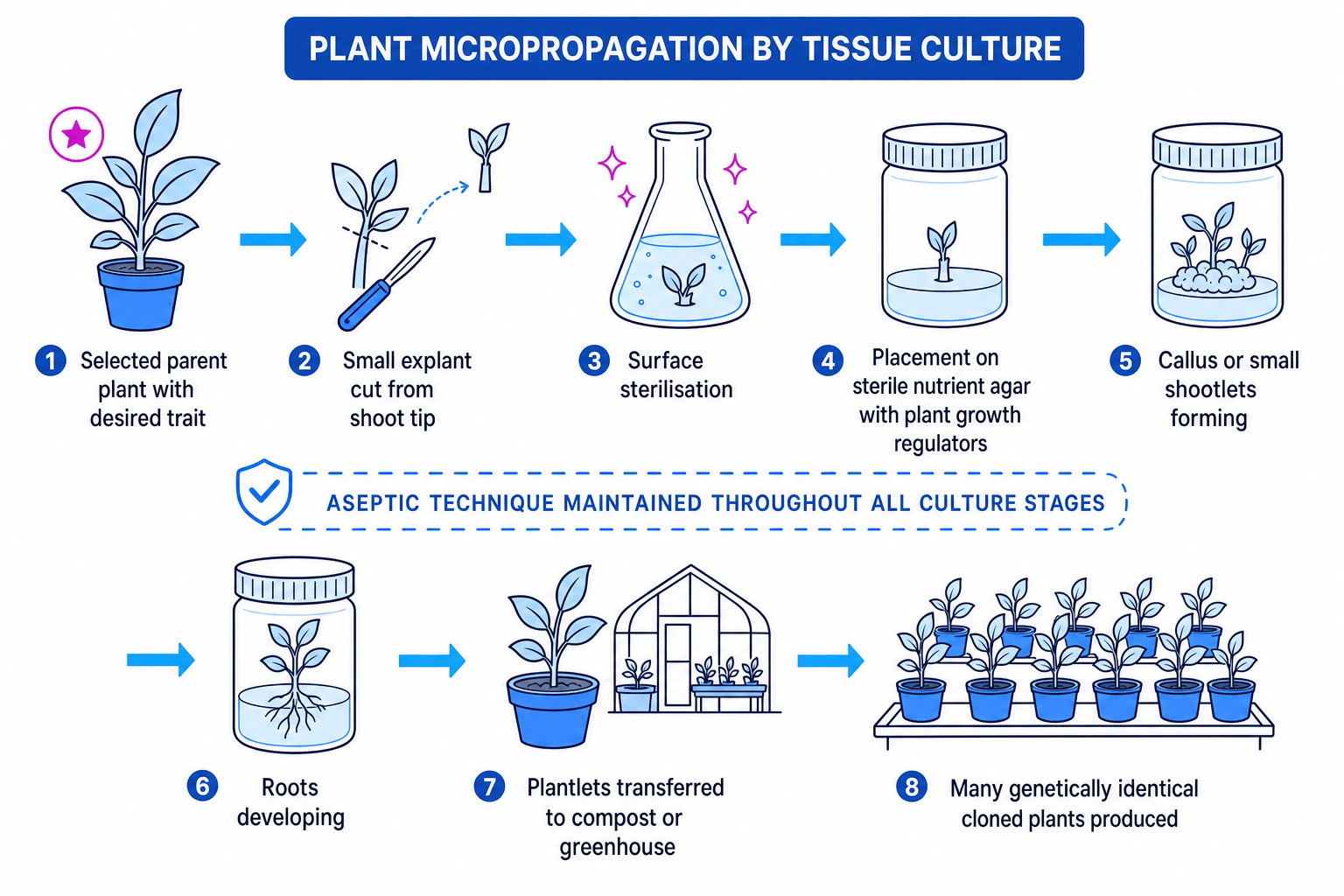
Micropropagation is the production of many cloned plants from small pieces of plant tissue. Tissue culture means growing living tissue on a sterile nutrient medium.
The starting tissue is an explant, usually taken from a shoot tip or meristem. Meristem tissue is often used because it is actively dividing and may be virus-free.
Plant cells are often totipotent, meaning a single plant cell can divide and develop into a whole plant if given the right conditions.
The general process is:
- Select a parent plant with desirable characteristics.
- Remove a small explant using aseptic technique.
- Sterilise the explant surface to remove microorganisms.
- Place it on sterile nutrient agar containing sugars, minerals and plant growth regulators.
- Cells divide by mitosis to form a mass of undifferentiated cells called a callus.
- Different ratios of auxins and cytokinins encourage shoots and roots to form.
- Plantlets are transferred to soil or compost and grown on.
Evaluating plant cloning
Plant cloning is useful in horticulture and agriculture because it can rapidly produce large numbers of uniform plants. This is valuable for crops, ornamental plants and conservation of rare species.
Advantages include:
- Rapid production of many plants from one parent.
- Desirable features are preserved.
- Disease-free stock can be produced from meristems.
- Plants can be produced all year round in controlled conditions.
- Rare or endangered plants can be multiplied without collecting many wild specimens.
Disadvantages include:
- Low genetic diversity, so a disease or environmental change may affect all plants.
- Tissue culture is expensive and requires skilled technicians.
- Cultures are easily contaminated by microorganisms.
- Cloned crops can encourage monoculture, reducing biodiversity.
- Mutations during tissue culture can occasionally cause variation, called somaclonal variation.
Choosing a plant cloning method
A grower wants to produce 20 000 identical orchid plants from one high-value parent plant.
- Cuttings would be simple, but each cutting needs enough plant material, so producing 20 000 plants from one parent would be slow and may damage the parent.
- Micropropagation starts with very small explants, so many cultures can be produced from little parent tissue.
- Because orchids are high-value plants, the higher cost of sterile tissue culture is justified by the rapid production of many identical plants.
Natural clones in animals
Natural animal clones can form when an early embryo splits into two or more separate embryos. This produces monozygotic twins, often called identical twins.
They are genetically identical to each other because they came from the same zygote, but they are not genetically identical to either parent. They contain a combination of genetic material from the egg and sperm.
Artificial animal cloning
There are two main methods you need to know.
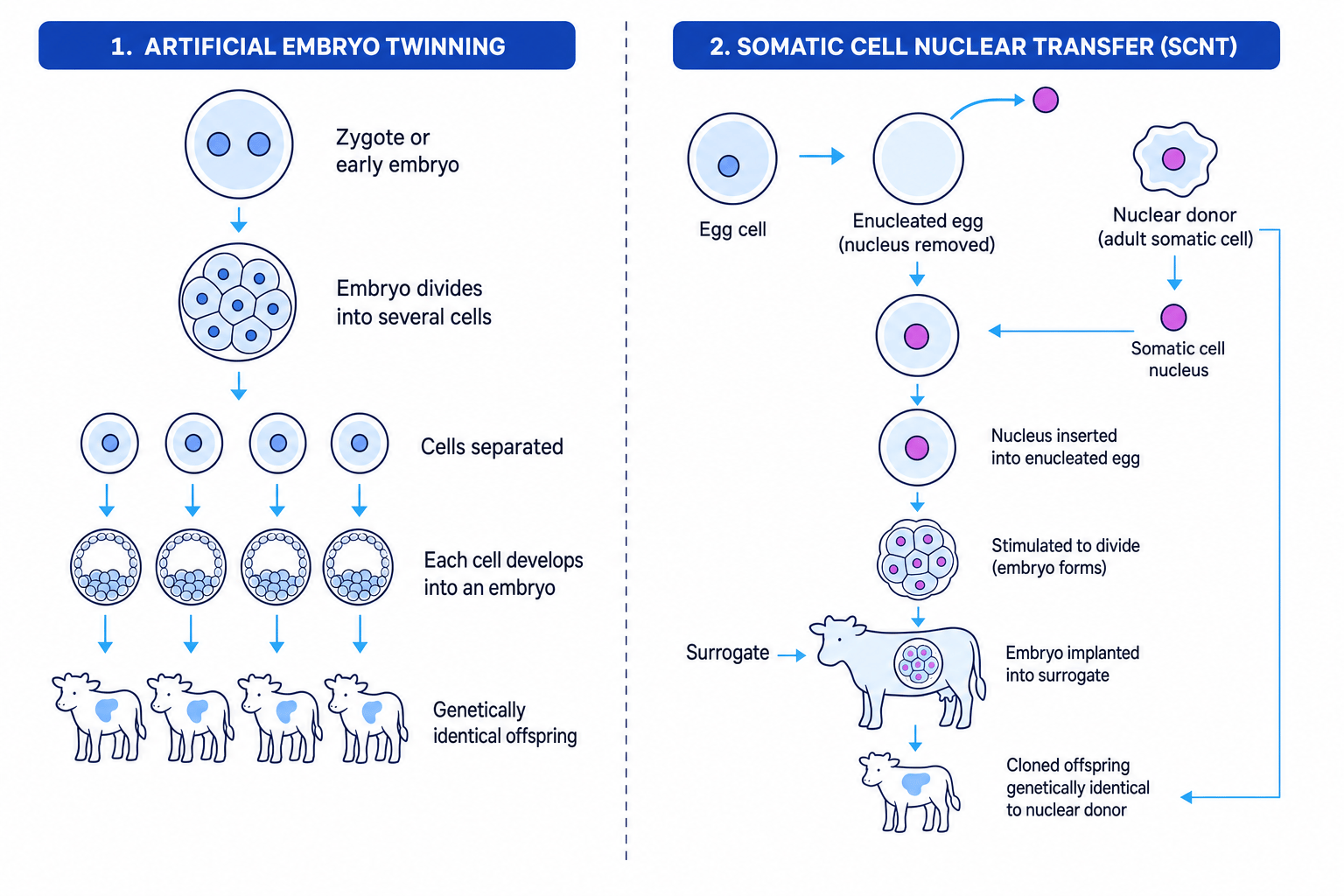
Artificial embryo twinning
In artificial embryo twinning, an early embryo is split into separate cells. Each cell can develop into an embryo. The resulting offspring are genetically identical to each other.
This is similar to natural identical twinning, but done artificially.
Somatic cell nuclear transfer
A somatic cell is a body cell that is not a gamete. Somatic cell nuclear transfer, or SCNT, produces a clone with the same nuclear DNA as the animal that donated the somatic cell nucleus.
The process is:
- Remove the nucleus from an egg cell. This is enucleation.
- Take a nucleus from a somatic cell of the animal to be cloned.
- Insert the somatic cell nucleus into the enucleated egg.
- Stimulate the cell to divide by mitosis.
- Implant the embryo into a surrogate mother.
- The offspring is genetically identical in nuclear DNA to the nuclear donor.
Embryo twinning versus SCNT
Artificial embryo twinning makes clones of an embryo. SCNT makes a clone of the animal that donated the somatic cell nucleus.
Evaluating animal cloning
Potential uses include:
- Producing animals with high milk yield, fast growth or desirable meat quality.
- Multiplying genetically modified animals that produce human proteins in milk or eggs.
- Creating genetically identical animals for medical research.
- Conserving valuable or endangered genotypes.
Arguments against include:
- Low success rates and many embryos may fail to develop.
- Increased risk of miscarriage, developmental abnormalities or poor health.
- Animal welfare concerns for egg donors, surrogates and offspring.
- Reduced genetic diversity in livestock.
- Ethical concerns about treating animals as products.
- Cloned animals may have issues with longevity, although lifespan varies and is affected by many factors.
Microorganisms in biotechnology
Microorganisms include bacteria, fungi and some unicellular eukaryotes. They are widely used in biotechnology because they are small, grow quickly and can be cultured in large numbers.
They are useful because:
- They have short life cycles, so products can be made quickly.
- They reproduce rapidly by binary fission or budding.
- They often grow on cheap nutrient sources.
- They need relatively small spaces compared with plants or animals.
- Conditions such as pH, temperature and oxygen concentration can be controlled.
- Some can be genetically modified to make useful products.
- They can produce extracellular enzymes or secrete products into the medium.
Microorganisms as factories
Microorganisms are useful industrial “factories” because they convert cheap raw materials into valuable products quickly and under controlled conditions.
Microorganisms as food
Bacterial sources include lactic acid bacteria used in yoghurt and cheese production. Fungal sources include yeast used in bread and alcoholic drinks, and fungi such as Fusarium used to produce mycoprotein.
Advantages of using microorganisms for human food include:
- Rapid production of protein-rich food.
- Less land may be needed than for animal farming.
- Microorganisms can use waste materials as substrates.
- Production can be controlled and independent of seasons.
- Mycoprotein can be low in fat and suitable for vegetarian diets.
Disadvantages include:
- Fermenters must be kept sterile to prevent contamination.
- Some microorganisms may produce toxins if conditions are not controlled.
- The product may need downstream processing and purification.
- Some people may be allergic or unwilling to eat microbial products.
- Large-scale fermenters are expensive to build and run.
Culturing microorganisms safely and effectively
Aseptic technique means using methods that prevent unwanted microorganisms entering a culture.
Good aseptic technique includes sterilising equipment and media, disinfecting benches, using sterile pipettes, flaming inoculating loops, keeping container lids open for the shortest possible time, and sealing agar plates with tape.
Safe incubation
In school practical work, agar plates are usually incubated at lower temperatures such as 25 °C, rather than human body temperature, to reduce the chance of growing human pathogens.
Microorganisms can be grown on solid agar plates or in liquid nutrient broth. Agar plates are useful for counting colonies. Broth is useful when investigating growth rate because samples can be taken over time and turbidity or viable cell count measured.
Batch and continuous fermentation
Fermentation is the large-scale culture of microorganisms in a fermenter to produce a useful product.
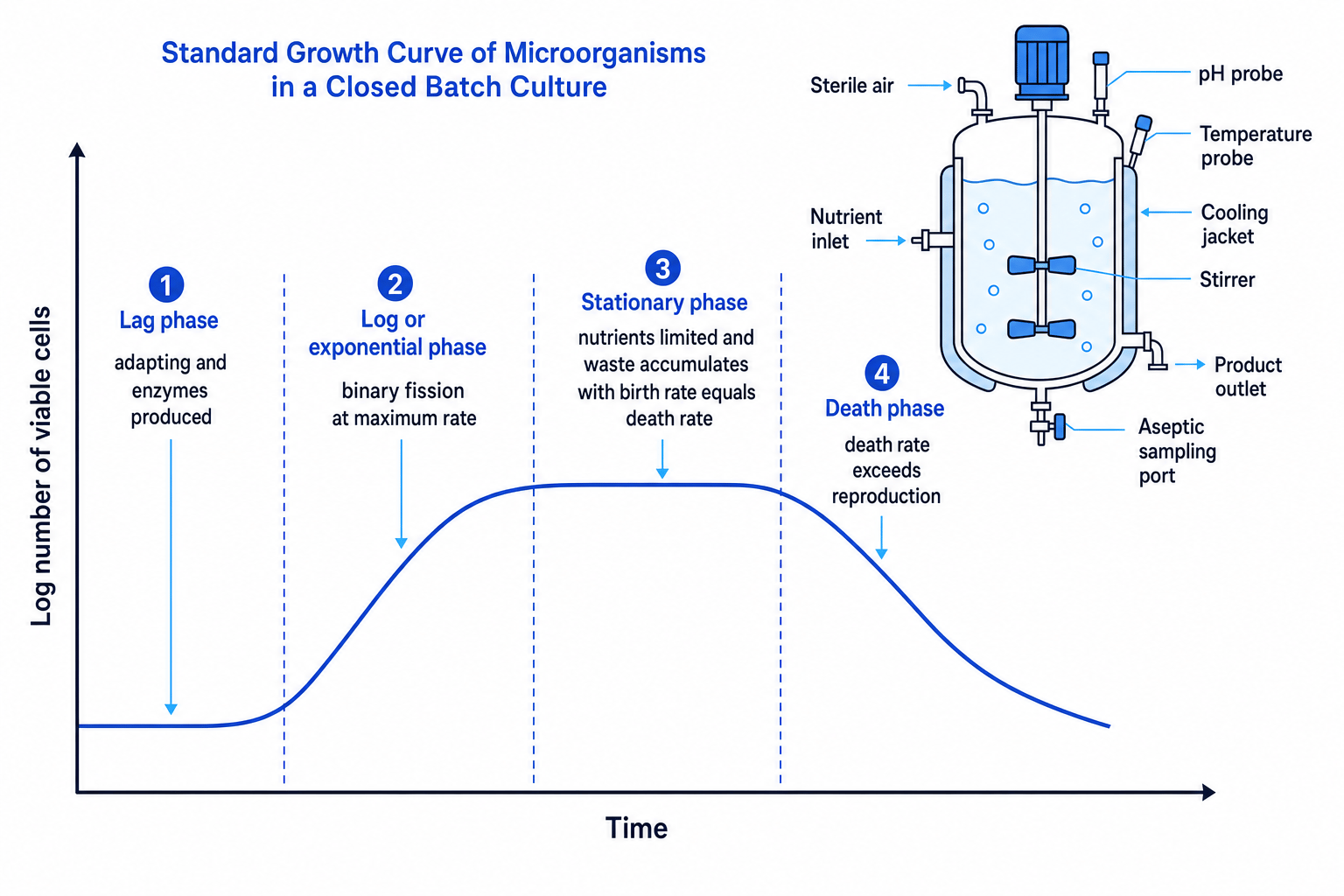
In batch fermentation, the fermenter is filled with sterile nutrients, inoculated, and then left for a fixed time. Products are harvested at the end. This is useful when the desired product is made during the stationary phase, such as many secondary metabolites.
In continuous fermentation, sterile nutrients are added continuously and culture fluid is removed continuously. Conditions can be maintained so microorganisms remain in the exponential phase for a long time. This can give a high yield of biomass or primary metabolites.
To maximise yield, conditions are manipulated:
- Temperature is controlled using cooling jackets.
- pH is monitored and adjusted.
- Sterile air may be supplied for aerobic respiration.
- Stirring keeps cells suspended and distributes nutrients.
- Nutrient concentration and dilution rate are controlled.
- Aseptic sampling checks growth and contamination.
Growth of microorganisms in closed culture
A closed culture is one where no new nutrients are added and no waste products are removed after inoculation. A batch culture is a closed culture.
The standard growth curve has four phases:
- Lag phase: cells adapt, take up water, synthesise enzymes and begin metabolism.
- Log phase, also called exponential phase: cells divide at their maximum rate.
- Stationary phase: nutrients become limiting and waste accumulates; birth rate equals death rate.
- Death phase: death rate exceeds reproduction, so viable cell number falls.
During binary fission, the number of organisms can be calculated using:
N=N0×2nN = N_0 \times 2^nN=N0×2nwhere NNN is the final number of organisms, N0N_0N0 is the starting number, and nnn is the number of divisions.
Calculating population size after binary fission
A bacterial culture starts with 2.0×1032.0 \times 10^32.0×10³ cells. Each cell divides 8 times. Calculate the final number of cells.
- Identify the values: N0=2.0×10³N_0 = 2.0 \times 10^3N0=2.0×10³ cells and n=8n = 8n=8 divisions.
- Substitute into the formula: N=2.0×103×28N = 2.0 \times 10^3 \times 2^8N=2.0×103×28.
- Calculate 28=2562^8 = 25628=256, so N=2.0×103×256=5.12×10⁵N = 2.0 \times 10^3 \times 256 = 5.12 \times 10^5N=2.0×103×256=5.12×10⁵ cells.
Serial dilution and viable counts
A serial dilution is a stepwise dilution of a sample, often by factors of 10. It is used to produce agar plates with countable numbers of colonies.
A colony-forming unit, or CFU, is one living cell or group of cells that gives rise to one visible colony.
CFU cm−3=number of coloniesvolume plated in cm3×dilution\text{CFU cm}^{-3} = \frac{\text{number of colonies}}{\text{volume plated in cm}^3 \times \text{dilution}}CFU cm−3=volume plated in cm3×dilutionnumber of coloniesEstimating viable cell concentration
A 0.10 cm³ sample from a 10−510^{-5}10−5 dilution produces 86 colonies.
- Use the dilution that gives a countable plate, so the colony count is 86 and the dilution is 10−510^{-5}10−5.
- Substitute into the formula: CFU cm−3=860.10×10⁻⁵\text{CFU cm}^{-3} = \frac{86}{0.10 \times 10^{-5}}CFU cm−3=0.10×10−586.
- Calculate the original concentration: CFU cm−3=8.6×10⁷\text{CFU cm}^{-3} = 8.6 \times 10^7CFU cm−3=8.6×10⁷ CFU cm⁻³.
Immobilised enzymes in biotechnology
An immobilised enzyme is an enzyme that is fixed, trapped or attached so it does not freely mix with the product.
Methods include:
- Adsorption: enzymes stick to a surface by weak bonds.
- Covalent bonding: enzymes are chemically bonded to a support.
- Entrapment: enzymes are trapped inside gel beads, such as calcium alginate.
- Membrane separation: enzymes are held behind a partially permeable membrane.
Immobilised enzymes are used in processes such as converting glucose to fructose, hydrolysing lactose to glucose and galactose, and producing semi-synthetic penicillins. You do not need to memorise these examples, but you should be able to apply the principles to unfamiliar contexts.
Advantages include:
- Enzymes can be reused, reducing long-term cost.
- Product is easier to separate from the enzyme.
- Product is less likely to be contaminated with enzyme protein.
- Enzymes may be more stable over changes in temperature or pH.
- Continuous production is possible.
Disadvantages include:
- Immobilisation can be expensive.
- Enzyme activity may decrease if the active site is altered.
- Substrate and product must diffuse into and out of the support, which can slow the reaction.
- Immobilised enzymes may still be inhibited or denatured under unsuitable conditions.
Why immobilise enzymes?
Immobilisation is most useful when the enzyme is expensive and the process can be run repeatedly or continuously, so reusing the enzyme outweighs the set-up cost.
In the exam
- When describing cloning methods, state what is genetically identical to what: embryo twins match each other; SCNT offspring match the nuclear donor.
- In fermentation questions, link the condition to the reason: temperature affects enzyme activity, pH affects enzyme shape, oxygen affects aerobic respiration, and asepsis prevents contamination.
- For microbial calculations, write the formula, substitute values with units where relevant, and give answers in standard form for large cell concentrations.
Check yourself
- Why does micropropagation usually require aseptic technique?
- How does continuous fermentation differ from batch fermentation?
- What is one advantage and one disadvantage of immobilising an enzyme?
